Shakespeare has the phrase hoist with his own petard, blown up by the bomb he meant for someone else. Chinese has a whole dinner party built on the same joke, and the dish served was a jar of fire.
The Chinese idiom is 请君入瓮, in pinyin *qing jun ru weng*. Word for word: please step into the jar. It means to turn a person’s own cruel method back on him.
This Chinese fable comes from the Comprehensive Mirror, a vast history of China compiled in the eleventh century. It is set during the reign of Empress Wu Zetian, the only woman to rule China as emperor in her own name. Its two characters were both torturers. One of them invented the method. The other aimed it at him.
In the years when Wu Zetian held power, the air at court was very tight.
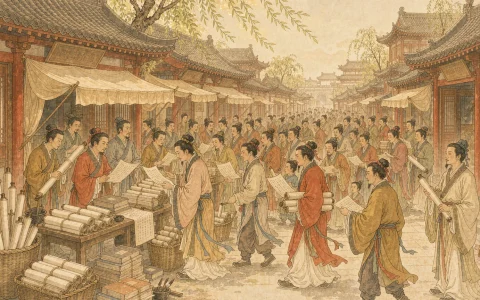
She had climbed to the throne step by step from the position of empress, and there were many in the empire who would not accept it. To crush them, she opened the door wide to informers. High or low, anyone could accuse anyone of treason. Once accused, the court sent an investigator. The investigators, to make the accused speak, thought of every method there was.
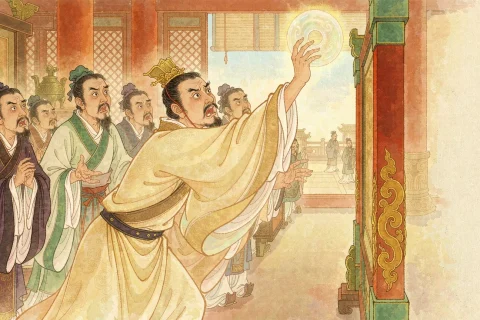
In those years, a bronze chest stood at the gate of the court, with slots on each side, for dropping in secret letters. An unsigned accusation dropped into it could turn a whole family upside down. No one had to sign a name. Whether the court believed it depended entirely on the men who handled the case.
The men who handled the cases were the most feared people of the age.
The two most famous investigators were Lai Junchen and Zhou Xing.
Lai Junchen was brutal. How many instruments of torture, how many methods, passed through his hands, no one could count. He even wrote a book, the Classic of Weaving, that taught men how to weave a charge around a person and how to squeeze a confession out of him inch by inch.
Zhou Xing was brutal too, and cunning. He could take a man’s own words and, step by step, coil them around him. Few who fell into his hands lasted to the end.
The two were the same kind, and they were colleagues. When the court took up its treason cases, the two often worked side by side.
In those years, hundreds and thousands of officials fell into their hands. A man could be hated for a single sentence, woven into a crime, and dragged down together with his whole household. Some could not bear the pain and confessed to anything, and afterwards could not say what they had confessed to. Officials at court kept their greetings very short. Whoever talked too much might be written down and sent into those files.
One year, Wu Zetian received a letter of accusation. The man accused in the letter was Zhou Xing.
The charge was treason.
The empress handed the case to Lai Junchen.
In another man’s hands, that order would have been a hard duty. In Lai Junchen’s hands, it became a piece of sport. The man he was ordered to handle was the one who, like himself, knew the arts of breaking people better than anyone alive.
Lai Junchen did not move at once.
Another man would have taken soldiers and arrested Zhou Xing on the spot. Lai Junchen did not take that road. He knew what Zhou Xing was. In torture and forced confession, Zhou Xing was the master. Tie him up and beat him, and he might not confess at all, and meanwhile you would have warned him. What Lai Junchen wanted was for Zhou Xing to walk into the method himself.
So he set out a table of wine.
He sent a man to invite Zhou Xing, saying there was a case he wanted to consult his old brother about.
The invitation raised no suspicion at all. Colleagues asking each other for advice on a case was an ordinary thing. Zhou Xing changed his clothes, in good spirits, and came.
The two drank and ate and talked. Zhou Xing did not know that this table had been laid for him.
Halfway through the wine, Lai Junchen put on a worried face.
He said to Zhou Xing: Old brother, the case in my hands is a little difficult. The accused is stubborn. The evidence is complete, and he still will not confess. What method is there, do you think, to make him talk?
Zhou Xing perked up.
This was his specialty. He set down his cup and said, with some pride: That is easy.
He gave Lai Junchen a method.
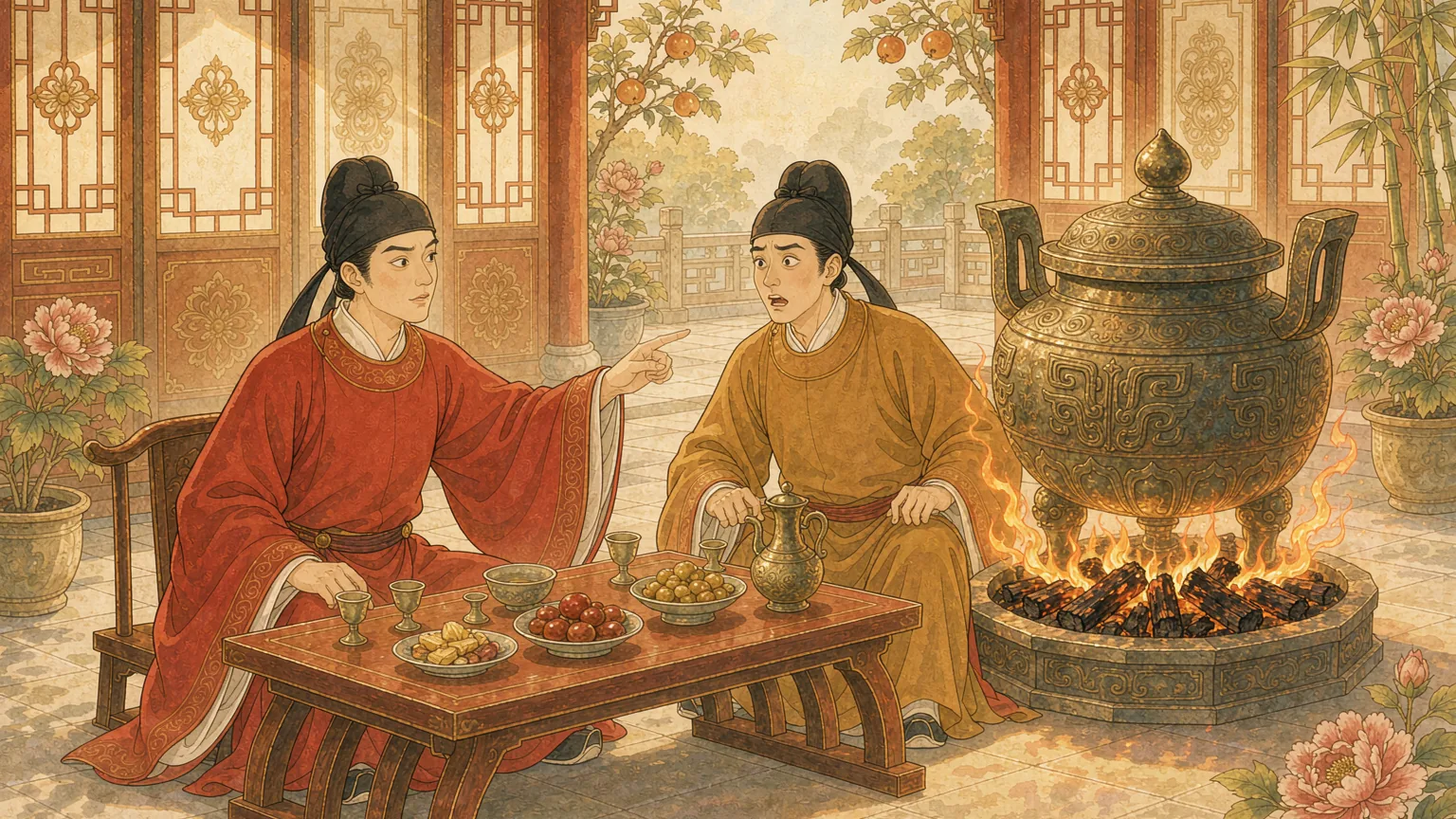
He said: Take a large jar. Put the accused inside it. Then set charcoal around the jar, all the way around, and roast it slowly. Roast it long enough, and the inside is close and scalding, and no man can bear it. What crime will he not confess to then?
Zhou Xing was pleased with himself. He had given, he felt, a fine answer.
He spoke with relish, like a man teaching a newcomer to the trade. He did not notice the small light that came into Lai Junchen’s eyes.
Lai Junchen heard him out and nodded.
Then he stood up.
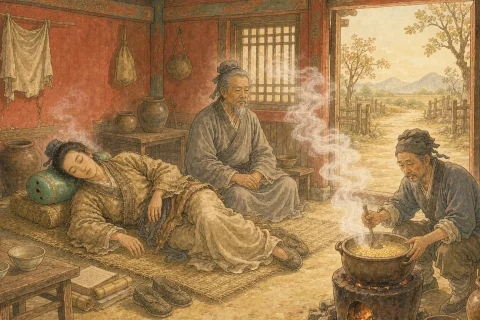
He called his men, and, exactly as Zhou Xing had described, they brought in a large jar. Around its base they stacked charcoal in a ring, and lit it.
The flames leapt up and licked along the jar’s sides. The jar began to hum with the heat. Even the air around it grew scalding.
Lai Junchen turned to Zhou Xing, let his face go cold, and said the sentence that has been repeated for more than a thousand years:
Someone has filed a complaint against you, brother. The one to be investigated is you. Please, brother, step into this jar.
Zhou Xing’s face went white.
He knew better than anyone what it would be like to have that jar come down over him. The method was his own invention, and he had used it on others, again and again. The more ruthless his advice had been, the worse it was for him now. Now it was his turn.
He dropped to his knees and knocked his head on the ground and confessed. Every plea came out one after another, and he admitted it all.
The moment before, he had been the expert handing out a method. The moment after, he was a prisoner begging beside the jar. The turn was so fast that the wine had not yet gone cold.
The case was finished, and by law the penalty was death. Wu Zetian spared him, remembering that he had handled many cases for her, and sent him into exile in the south.
But he had too many enemies on the road. Zhou Xing was killed partway there.
People use the Chinese proverb qing jun ru weng for a man destroyed by his own method, for the stone he lifted landing on his own foot.
The four characters read satisfyingly, like the end of a play. But under the stage there is nothing empty.
Lai Junchen won that round, and did not end well either. A few years later he too fell. The men he had woven charges against, the families he had destroyed, all turned and wove a charge around him. Wu Zetian ordered him executed, and the people of Luoyang fought to watch, fought to trample his corpse. Using the same method on everyone had not saved him from the same method.
The jar is still in the story, still roasting. It has never brought down only one man.
What is truly frightening is not the jar. It is the calculation in the jar-maker’s mind, the certainty that because the method was his own invention, it could never fall back on him. But methods are common property. Anyone can pick one up, and at any time someone will pick it up and point it at him.
People take these four characters as a word about retribution. Retribution does not have to wait for heaven. People are the scale. However you measured others, sooner or later others will measure you the same way. That account turns over faster than the charcoal.