There is an English proverb about the early bird catching the worm. Chinese has one too, except in the Chinese version the bird is a rooster crowing in the middle of the night, and the person getting up is a young official reaching for his sword.
The idiom is 闻鸡起舞, in pinyin *wén jī qǐ wǔ*. Word for word: “hearing the rooster, rise and dance” — where *dance* here means to practise swordplay.
Today a Chinese speaker uses it to describe someone with ambition and discipline, who does not wait for the right moment but gets up and trains while everyone else is asleep.
The story is set at the end of the Western Jin dynasty, and it is recorded in the *Book of Jin*, the official history of that era. Its two heroes were real men. One of them never stopped fighting. The other never came home.
At the time this story begins, China looked peaceful.
The capital, Luoyang, was busy and rich. Wealthy families competed to show off — one banquet could cost more than a farmer earned in years, one fur coat could be traded for a house. The city was lit every night, and there was music everywhere.
Nobody saw the crack in the wall.
Out on the northern grasslands, the tribes were gathering more riders every year. And inside the court, several princes held their own armies and had their eyes on the throne. The peace was a thin sheet of ice. It looked solid. You only found out what was underneath by standing on it.
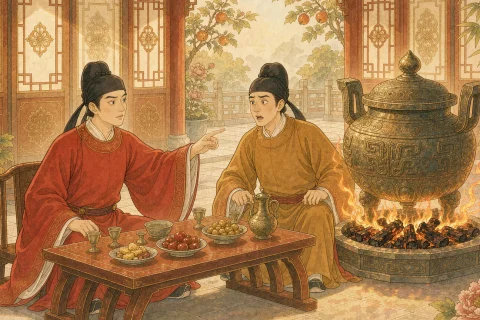
Two young men met in that city — or rather, in Sizhou, where both held the same small post: clerk.
One was named Zu Ti. The other was named Liu Kun.
They were both young, and their jobs were dull: copying out documents, filing records. It was the kind of post where a man could easily coast, doing the minimum, drinking with friends after work.
These two did not coast. When they were together, they talked about the frontier, about armies, about the state of the empire.
They became so close that they shared everything. Same carriage when they travelled. Same bed at night. Same blanket.
Sizhou was a quiet little place. After the day’s paperwork, while the other clerks went off to drink and gamble, the two of them would sit and talk about the border wars until dark. And when the conversation turned to men who had wanted to serve their country and never got the chance, both of them would fall silent.
Neither of them knew it yet, but the road ahead of them would be worse than any story they told each other in that room.
Then came the night.
Everything was quiet. The only sound was the slow drip of the water clock.
And then, from somewhere outside the wall:
*Cock-a-doodle-doo.*
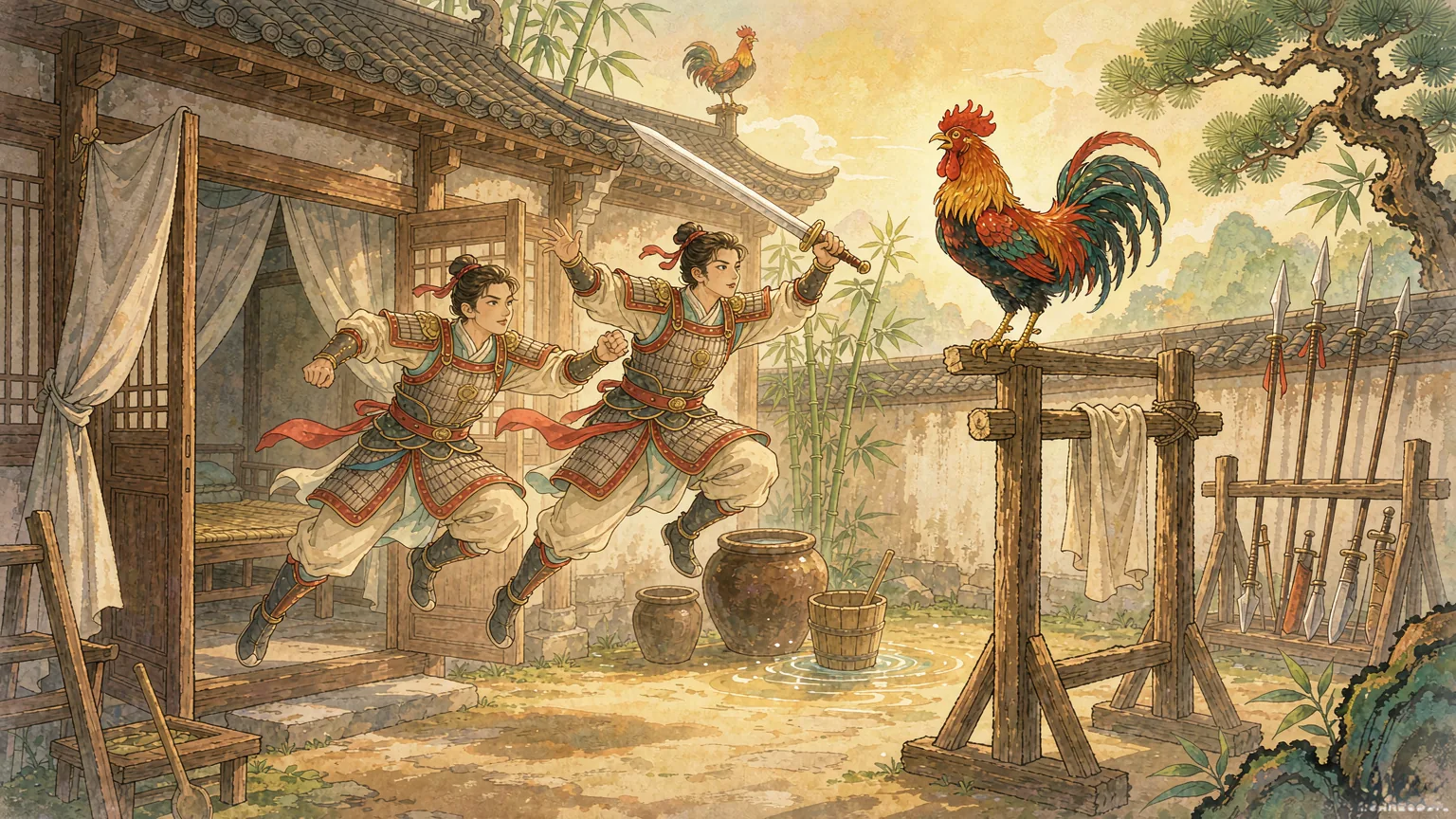
A rooster, crowing at the third watch — hours before dawn. In those days, a rooster crowing in the middle of the night was considered an evil omen. People heard it and felt a chill.
Liu Kun sat bolt upright. He shook the man beside him.
Listen, he whispered. Why is that rooster crowing now?
Zu Ti was already awake.
He was not frightened. He sat up and gave Liu Kun a light kick through the blanket.
That is not a bad sound, he said. Quiet, and hard.
Liu Kun stared at him.
Heaven thinks we are sleeping too deeply, Zu Ti said. It sent the rooster to wake us. Other people hear an omen. We hear an order.
He threw off the blanket and got out of bed.
The room was dark. He felt along the wall, found his sword, picked it up, and pushed open the door.
Liu Kun watched his back for a few seconds. Then he threw off his own blanket, took his own sword, and followed him out.
In the courtyard, the moon was still up. There was a thin frost on the ground.
The two of them stood in the cold, took their stances, and began to practise. The blades flickered in the moonlight. Their feet cracked the frost. They trained until the sky in the east began to turn pale.
From that night on, it became their habit. The rooster crowed, and they got up. They got up, and they practised. One night. Two nights. A year. Two years.
Winter came, and frost settled on the blades, so cold it stung the hands. Summer came, and they were sweating before the sun rose. Sometimes the rooster would crow a second time while they trained, and the real dawn would come, and only then would they stop and go back inside. Their feet wore a pale track into the mud of the courtyard.
This was not play.
Zu Ti trained for real. How to charge on horseback. How to hold a line on foot. How to break out when surrounded. He knew, in a way most people around him did not, that these skills would be needed.
And he was right.
Before many years had passed, the empire came apart.
The horsemen came south. The great city of Luoyang fell. Chang’an fell after it. Palaces burned. Whole towns emptied as people fled south. The Western Jin dynasty was over.
Liu Kun stayed in the north. He held a single city in Bingzhou, surrounded on every side, fighting the riders by day and, on some nights, playing his nomad flute from the walls until the enemy soldiers wept and went home. He held out for years.
Zu Ti took his family, his clansmen, and several hundred neighbours and fled south, across the Yangtze River. More people joined them along the road, until the column stretched far behind them.
When the boat reached the middle of the great river, Zu Ti stood at the bow and looked at the mountains on the northern shore.
Then he picked up an oar and struck it against the side of the boat.
*Thump. Thump.* He struck it again, harder.
And in front of everyone on board, he swore an oath:
If I, Zu Ti, do not clear the north and cross back over this river, may I be like this river — and never return!
Everyone on the boat went red-eyed. That oath was remembered. People gave it a name of its own: “striking the oar in midstream.”
Zu Ti did not just make speeches.
On the northern bank he raised his own soldiers, forged his own weapons, and drilled them himself. Battle by battle, he took back the lands south of the Yellow River. Villagers in the north rose up to join him when they heard he was coming. Enemy commanders learned to be careful of him. For a while, he was the best hope the south had.
Those were the brightest years of his life.
They did not last.
Back in the southern court, the powerful men began to get nervous. Zu Ti had won too much, and won it too well. His reputation was becoming a threat. So they sent a man with no military skill to be his superior, and gave that man the power to hold him back. When Zu Ti asked to push north one more time, the order sat unsigned.
He waited. He grew frantic.
Then word came from the north: his old friend Liu Kun was dead — killed not by the enemy, but by his own allies.
Something in Zu Ti, stretched tight for so many years, finally snapped.
He fell ill. Even sick, he kept planning campaigns and drawing defence maps, holding every pass in his mind. When the people around him told him to rest, he only shook his head.
Not long after, the man who had spent his whole life wanting to cross the river and march north died in his post in the south, worn down and bitter. He was only in his fifties.
He never got back across the river.
But that is not what people remember.
What they remember is a bed, a rooster’s crow in the dark, and two young men running out into the moonlight with swords in their hands.
And that is where the idiom 闻鸡起舞 comes from.
It is not about becoming a general.
It is about this: whether the rooster crows is not up to you. Whether you get up is. Whether the empire falls or holds is not up to you. What is up to you is whether the sword in your hand is sharp when you need it.
Most people spend their lives waiting for a chance. Zu Ti and Liu Kun did not wait. They spent the years before the chance arrived making themselves into men who could catch it.
That rooster has been crowing for two thousand years.