There is an old English song that ends with a line about life being but a dream. Chinese took the same thought and made it smaller, and sharper, and put it in a kitchen.
The Chinese idiom is 黄粱一梦, in pinyin *huáng liáng yī mèng*. It means, word for word, a yellow-millet dream. *Huang liang* is not just any grain. It is millet, the cheapest and plainest food a poor traveler would eat, and it cooks fast — the kind of meal you put on the stove in the evening. The four characters together describe a whole lifetime of glory that fits inside the time it takes to cook one pot of porridge.
This one comes from a Tang dynasty tale called *The Record Inside a Pillow*, written by Shen Jiji more than twelve hundred years ago. Like a great many Chinese fables, it begins with a tired man complaining, and a stranger with something in his bag.
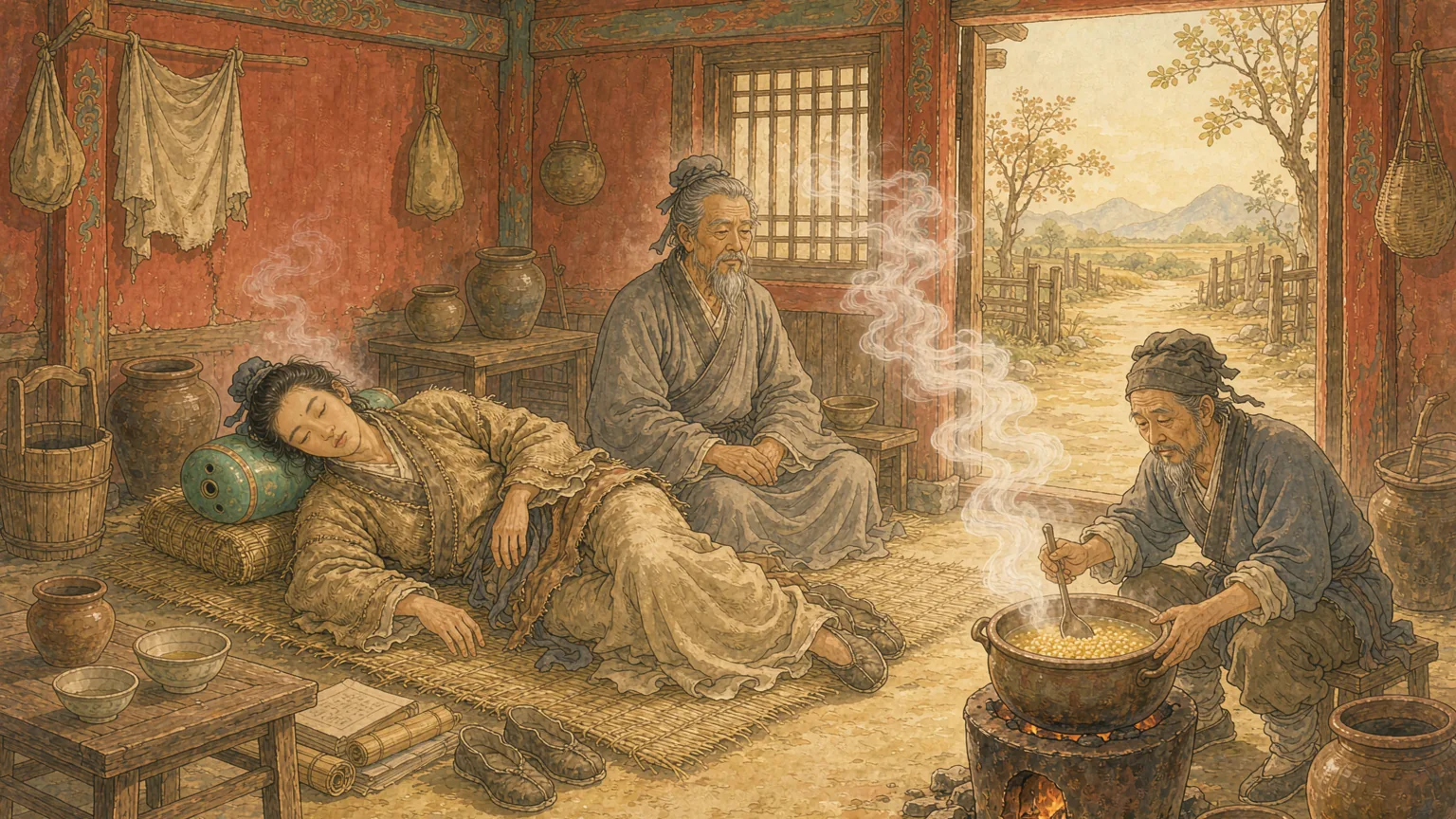
It happened in the years of the High Tang.
In the town of Handan, on the busy road that ran north and south, there stood a small inn. The traffic never stopped — carts, traders, people going to visit relatives. Water on the stove never had time to go cold.
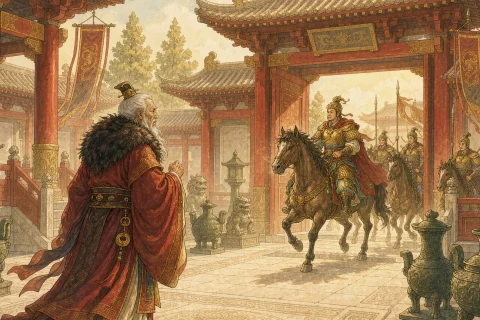
One evening an old man stopped to rest there. He was a Daoist priest, not young, his hands clasped behind his back. He looked like any elderly gentleman who had walked a long way.
The door opened, and a young man came in.
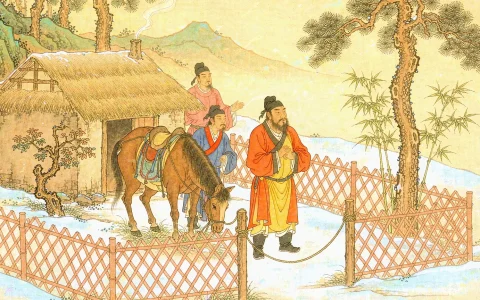
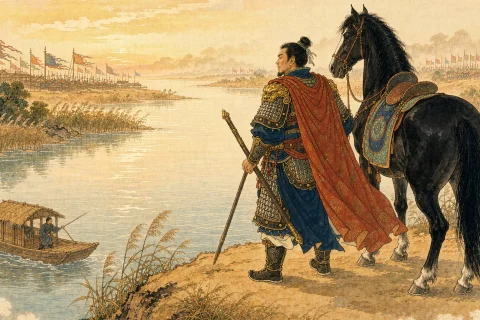
His name was Lu. He wore a short jacket of coarse hemp, and he had a little dark horse outside that he was about to take into the fields to work. He sat down in the inn, on the same mat as the priest, and the two of them fell into easy talk.
After a while, Lu looked down at his own clothes.
The cuffs of his jacket were worn and frayed. His shoes were old.
He sighed.
A man should not live out his whole life like this, he said. How have I ended up so stuck?
The priest sat beside him and listened. He did not answer.
After a moment, he reached into his cloth bag and brought out a pillow. He held it out to Lu.
Sleep on my pillow, he said, and you will have all the honor and wealth that should have been yours. Not one thing will be missing.
The pillow was made of blue-green porcelain, with a small hole at each end, and it was cool to the touch.
Lu took it and put it under his head. The moment he rested on it, his thoughts began to blur.
Outside, the innkeeper was crouched by the stove, steaming a pot of millet. The fire crackled. Steam began to rise.
Then Lu opened his eyes and found that he was no longer in the little inn.
He had married a daughter of the Cui family, one of the great old clans. The dowry was huge — good fields, a courtyard house, horses and carriages, all laid out for him. He never wore that rough hemp jacket again.
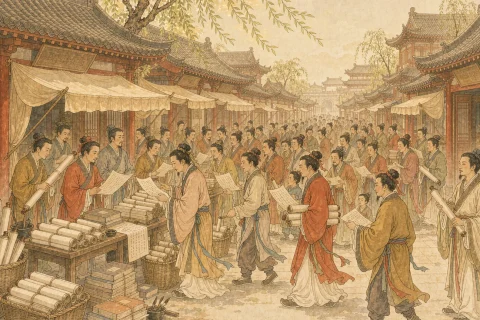
The next year he went to the capital for the imperial examinations, and he passed.
His career opened up and stayed open. He served as a book corrector, then as a county officer, and rose step by step. In Shanzhou, he cut a canal and turned dry fields into rice paddies. Then he was sent to Bianzhou, where he governed so well that people left their doors unlocked at night.
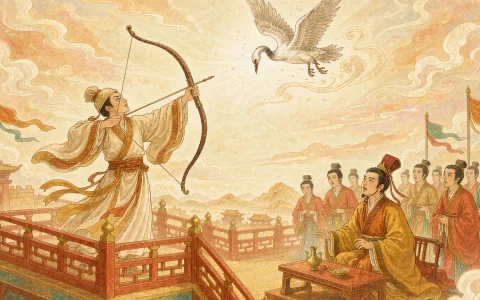
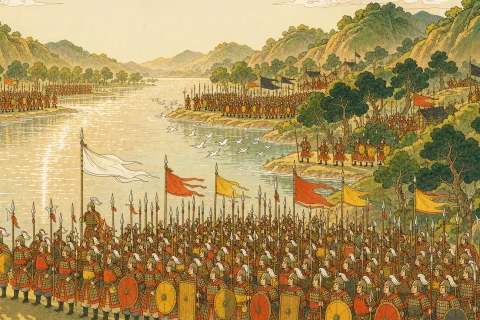
War broke out on the frontier. He was sent west to Hexi, won a battle, and took back nine hundred *li* of land. The people along the border carved a stone to record what he had done.
Back at court, he rose all the way to prime minister.
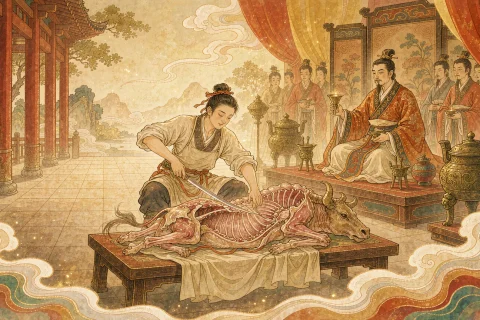
He held the post for more than ten years. Gold thread was stitched into his court robes, and riders cleared the road ahead of him. Singers and musicians were kept in his hall, and banquets filled his tables. At the New Year, the line of visitors stretched to the mouth of the lane. When he rode out of the city, dozens of attendants followed him, and ordinary people stepped aside to let him pass. By then he had long forgotten the rough hemp jacket he used to wear.
And then his colleagues grew jealous.
Together they drew up a charge: that he had conspired with frontier generals and was plotting rebellion.
An imperial order arrived, and Lu was thrown into prison.
He was held there for days he could not count. By day he heard the chains. By night he heard the rats. He could not understand it — yesterday the hall was full of guests, and today there was nothing but a wall.
He drew a knife to end his own life.
His wife held his arm and would not let go, and the knife did not fall.
The death sentence was lifted, and he was sent into exile in the fever-ridden south. Illness came and went the whole way, and more than once he was sure he would not survive the road.
Years later, the false charge was cleared. The emperor called him back and made him Duke of Yan.
His five sons all studied and became officials, and all married into great houses. Grandchildren crowded around his knees. In that house there was no honor that had not been given to him.
He lived past eighty. Then he fell ill and took to his bed. The emperor sent a royal son-in-law to check on him, and famous doctors arrived with good medicine, wave after wave.
None of it saved him.
In his last days he went over his own life again and again. Everything he wanted, he had gotten. Everything he had fought for, he had won. And now, at the end, he could carry none of it with him.
As he breathed his last, he was still thinking about a few matters of state.
And then Lu woke up.
He was lying on the mat in the little inn at Handan. The porcelain pillow was still under his head.
The priest sat beside him, exactly as before.
At the stove, the innkeeper’s pot of millet was not yet done. The steam had only just begun to rise.
Lu sat up and stared around the room.
Could all of that have been a dream?
The priest looked at him and spoke slowly.
The good things of a life, he said, turn out to be no more than this.
The words were light, but they landed on Lu harder than anything else.
He sat on the mat and said nothing for a long while.
A whole life — marriage, examinations, office, the rank of prime minister, the false charge, the prison, the exile, the return, a dukedom, sons and daughters and grandchildren, old age, death — every piece of it had been walked through in the span of a nap.
And the pot of millet had not even begun to smell good yet.
The innkeeper straightened up from the stove, lifted the lid, and put it back down. The grain was still hard. The fire would have to burn a while longer. That pot of porridge was slower than Lu’s whole lifetime.
Lu stood up and bowed deeply to the priest.
You meant to block up my greed with a dream, he said. I have understood.
He felt the porcelain pillow with his hand. It was still cool. Outside, a donkey brayed, and someone in the next room snored. Everything in the world was exactly as it had been.
Later, the tale was copied and passed around, and the four characters stayed behind.
This Chinese proverb is not saying that wealth is evil. It is saying that wealth comes too fast and weighs too little.
A poor scholar wants nothing more than rank and fame. But in the dream he gained all of it and lost all of it, and he found out that the prizes and punishments that kept him awake at night could be lived through once, and then again, in the time it takes to cook a meal.
Everyone who reads the story laughs at Lu for being greedy. But put yourself in his place, and who is not greedy? A person’s one life is usually spent chasing the exact things that filled his dream — to rise above his station, to have a full house of children and grandchildren, to leave a name that does not fade. What the old priest handed him was not a trick.
It was a mirror.
Lu left the inn before dark. He led his little dark horse down the road into Handan. Behind him, the fire in the stove still moved, and the millet in the pot was going soft, one grain at a time.