Military planners talk about the home front. The idea is simple. An army can hold a line as long as the place it is fighting for still lives in the minds of the men. Take that away, and the line stops mattering.
The Chinese idiom is 四面楚歌, in pinyin *si mian chu ge*. It means songs of Chu on all four sides. It is used for the moment when a person realizes that everyone around him has already changed sides, and that there is no longer anywhere to go back to.
The Chinese proverb behind it is not about a battle. It is about a song. It comes from the *Records of the Grand Historian*, written by Sima Qian, and from the last night of a man who had never lost a battle until the night he heard his own village singing from the enemy camp.
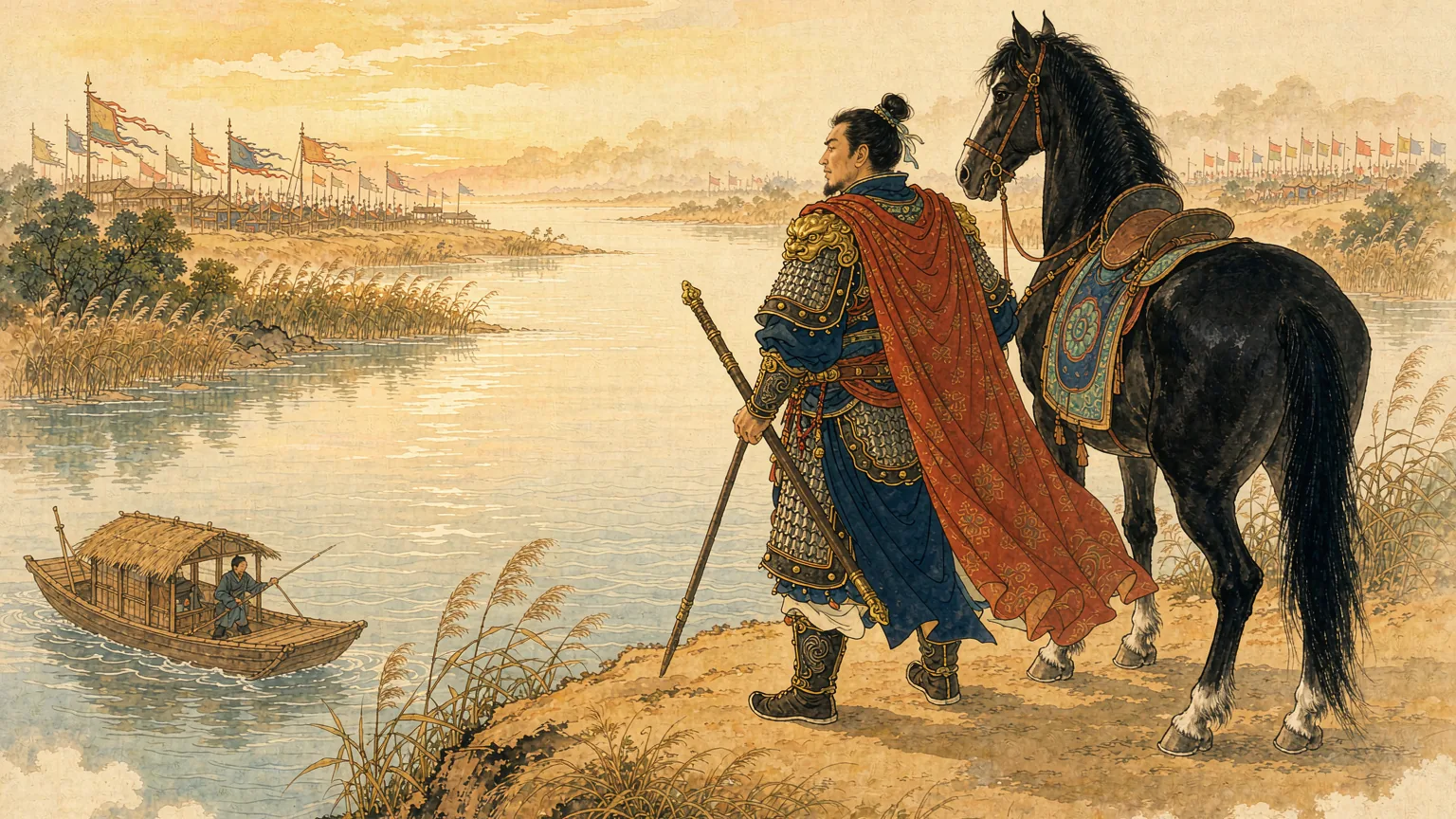
The war between Chu and Han lasted more than four years.
Xiang Yu was a man of Chu. He was strong enough to lift a bronze cauldron, the huge pot an army cooked in. He was only twenty-four when he raised his troops. He fought fast and hard, and in a head-on clash nobody could stand against him. After the Qin dynasty fell, he named himself the Hegemon King of Western Chu, divided the empire among the lords, and ruled from the city of Pengcheng.
Liu Bang was given the remote region of Hanzhong. He did not look like a serious rival.
Only a few years earlier, Xiang Yu had been the man everyone feared. At Julu, he smashed his own cooking pots, sank his boats, and led the Chu army across the river, destroying the main force of Qin. In those days, the generals of the other lords crawled into his camp on their knees when they came to see him.
But as the years went on, the picture turned. Liu Bang knew how to use people, and he knew how to wait. He could lose ten times and come back for the eleventh. Xiang Yu could win battles, but he could not hold men. One capable officer after another left him for Liu Bang.
In the end, Xiang Yu’s territory kept shrinking and his food kept running out. He agreed to a truce with Liu Bang, splitting the empire along a line called the Hong Canal, each side to keep its own half.
Liu Bang did not keep it.
In his view, the empire was not settled yet, and keeping promises was a business for later. The urgent thing was to give Xiang Yu no time to breathe.
He tore up the agreement and came after him. He chased him all the way to Gaixia, gathering the armies of Han Xin, Peng Yue, and Ying Bu as he came, and closed a ring around him.
It was the winter of 202 BC.
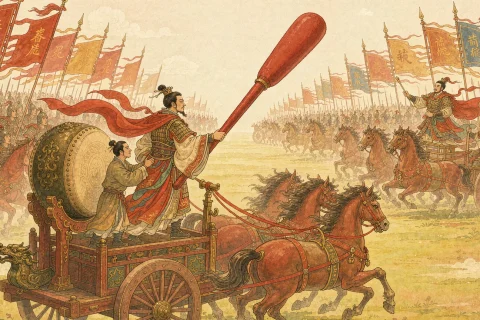
In the north wind, the tents of Chu stretched out of sight, and so did the banners of Han. On both sides, the soldiers waited for daylight, and waited for the other side to break first.
Xiang Yu pulled back to Gaixia with little food and not many men. The camps of the Han army, and of all the lords who had joined it, were layered around him, drawing tighter.
He fought all day. When he came back to his tent, it was fully dark.
That night, he heard singing.
Not from one place. From four sides. East, west, south, north, camp after camp, all singing. They were singing the tunes of Chu. The words were the words of Chu.
Those were the songs he had grown up with.
He sat up straight. He asked the men around him, has Han already taken all of Chu? Otherwise, where did so many men of Chu come from?
Nobody could answer.
Some accounts say the songs were arranged by Liu Bang on purpose. Others say the Han army and its allies simply contained thousands of men from Chu, away from home for years, and once a few began to sing, the sound spread until it came from every side. Whoever started it, the meaning reached Xiang Yu as the same thing. Even his own accent had turned against him.
He rose and had wine brought into the tent. Outside were the campfires of the enemy, stretching away without end. Inside there were only a few lamps. With him were Lady Yu, who had followed him since he was young, and Wuzhui, the black horse he had ridden for years.
He lifted the cup and could not drink.
He began to sing. He had written the words himself. My strength could uproot mountains, and my spirit covered the age. But the times are against me, and my horse will not run. When the horse will not run, what can I do? Lady Yu, Lady Yu, what am I to do with you?
He sang it once. He sang it again.
Lady Yu stood and answered him, following his tune. Everyone in the tent turned their faces away and wept.
What happened after that, the *Records* does not say in detail. It leaves one line only. The beauty joined him. She answered his song. Then the tent was quiet.
Xiang Yu mounted his horse.
That night he took eight hundred riders and broke out through a gap in the Han lines. At dawn the Han army found out, and sent the cavalry commander Guan Ying after him with five thousand horsemen.
Xiang Yu rode south.
By the time he crossed the Huai River, eight hundred riders had become a little over a hundred.
At Yinling he came to a fork in the road and lost his way. He saw a farmer in the fields and asked him for directions. The farmer looked at him, then pointed to the left.
Xiang Yu took the left road.
It led into reeds and mud. Horse after horse sank into the marsh and struggled deeper. By the time they had scrambled out, the pursuers were on their heels.
At Dongcheng he turned in the saddle and counted. Twenty-eight riders were left.
The Han army behind them numbered in the thousands.
Xiang Yu reined in and looked at his men. Then he spoke.
I raised my troops eight years ago, he said. I have fought more than seventy battles. Whoever stood in my way, I broke. Whoever attacked me, I defeated. I have never lost, and that is how I became Hegemon. Now I am trapped here and it is heaven that means to destroy me. It is not that I cannot fight.
I do not accept it, he said. Today I will fight you one good fight. Break the ring, cut down a general, take down their banner. Three things, and I will do them in front of you.
He split the twenty-eight into four troops and charged out on all four sides.
Xiang Yu went first, straight into the Han lines. He cut down a Han general, then killed dozens of their soldiers. When he gathered his men again, he had lost only two. The twenty-eight knelt and gave him their hearts.
At the Wu River.
The local ferry officer was waiting with a small boat. He said to Xiang Yu, the region east of the river is small, but it is a thousand li across and it holds hundreds of thousands of people. If you cross, great king, you can rise again.
Xiang Yu laughed.
Heaven means to destroy me, he said. What would I do with a crossing? I led eight thousand men of the eastern shore across this river, and not one of them is going back. Even if the elders of the east took pity on me and made me their king again, with what face would I stand in front of them?
He gave his black horse to the ferry officer.
Then he told his remaining men to dismount and fight on foot, with short weapons, hand to hand. Xiang Yu alone killed several hundred of the Han soldiers, and took more than ten wounds himself.
He turned his head and saw a man in the Han ranks he knew, named Lü Matong.
I hear the King of Han has set a price on my head, he said, a thousand pieces of gold and a fief of ten thousand households. Let me do you that favor.
Then he cut his own throat.
The Han soldiers rushed in to seize the body. In the trampling and the fighting over it, five men each came away with a piece. All five were made marquises.
Xiang Yu was not beaten by the Han army at Gaixia.
On that night, when he heard the songs of Chu from four sides, he already understood one thing. The home he meant to return to was gone. Eight thousand men of the east had followed him out. The fields of the east were still there. The men were not coming back.
The battle had not been fought, and the road was already cut inside him.
Chinese proverbs like this one do not describe a siege. They describe the feeling of a siege. It is not that nobody would come to help you. It is that every place that used to answer you in your own voice has stopped doing so.
Xiang Yu did not hear the enemy win that night. He heard that he had already lost his home. Few Chinese fables end this quietly, and none of them end this completely.