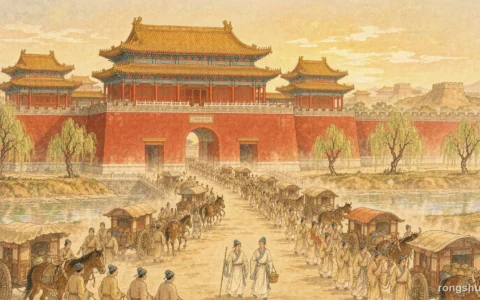
In the ninth month of 260 BC, the mornings in the Taihang mountains were already cold. The mist had not lifted.
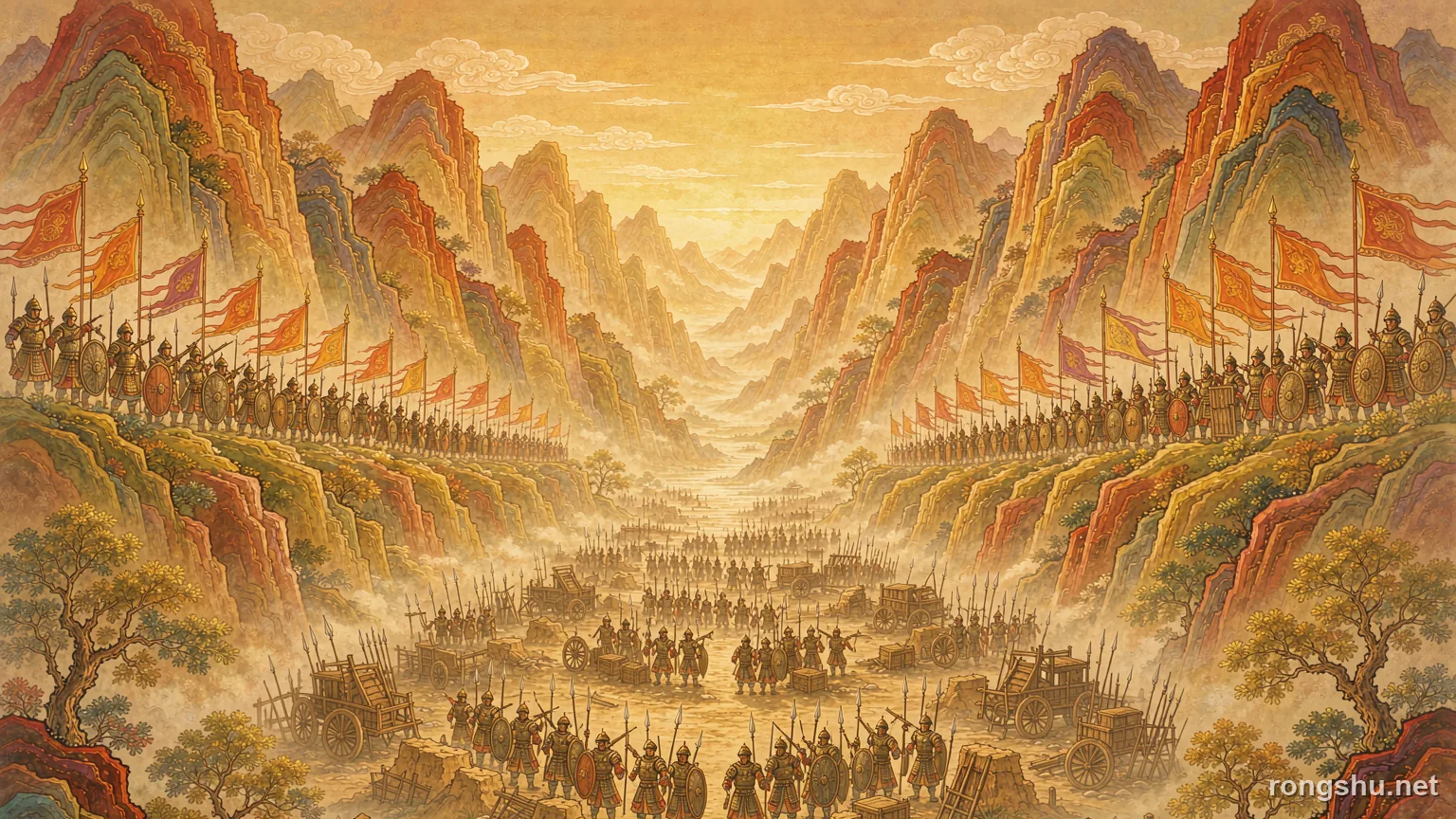
Along the slopes on both sides of the valley stood rank after rank of Qin crossbowmen.
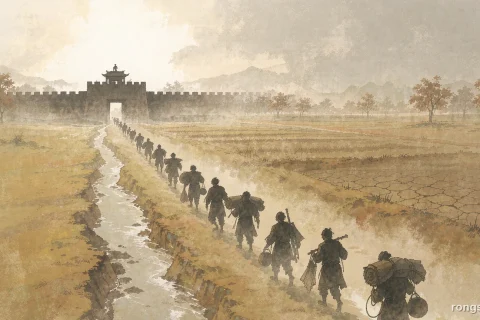
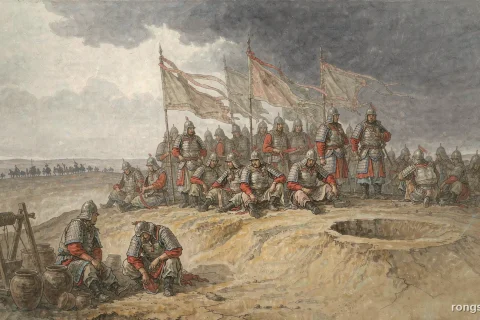
At the bottom of the valley was an army that had gone forty six days without grain.
They were soldiers of Zhao. They had been trapped there for six weeks.
Their commander was Zhao Kuo. On that day he made his last decision. No more waiting. Break out.
He had no other choice.
The grass roots and the tree bark had long since been eaten. Most of the horses had been killed. If they waited any longer, the army would come apart on its own, with the Qin never raising a hand.
The crossbows on the slopes were the best of their day. A strong mechanism could send a bolt a long way. Every time the men of Zhao tried to break out, the first thing they met was a wall of arrows.
This was the Warring States period, when China was still seven states and not one.
The strongest of the seven was Qin, in the west. The only one that could match it was Zhao, in the north.
And this battle had nothing to do with Changping when it began.
In Chinese history it stands as the largest single battle of the age. Counting both sides, the numbers ran into the hundreds of thousands. After it was over, the question of who would rule China was all but settled.
A Gift of Land
The road to Changping started with a piece of ground.
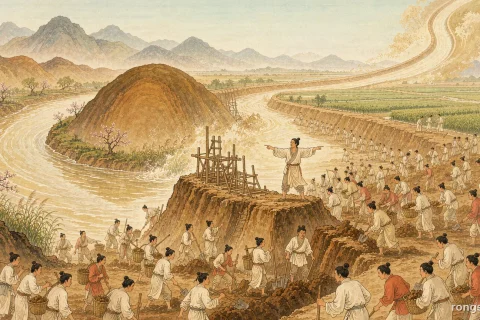
In 262 BC, Qin attacked the state of Han and took Yewang. That one stroke cut the Han province of Shangdang off from the rest of Han, with a wall of mountains in between.
Han had no way to hold it. The court decided to offer Shangdang to Qin and buy a truce.
The governor of Shangdang, a man named Feng Ting, refused.
He would not hand the province to Qin. Instead he did something else. He offered its seventeen towns to Zhao.
He had a calculation of his own. Shangdang was a place that mattered. Whoever held it stood at the other man’s door. Give it to Zhao, and Qin and Zhao would have to fight.
Zhao received the gift, and the court fell into an argument.
A lord named Zhao Bao put it plainly. Good things do not fall out of an empty sky. To gain a piece of land for no reason is not luck but trouble.
Another lord, Zhao Sheng, argued the other way. Land like Shangdang, offered for nothing, is not to be refused.
The young king of Zhao, Xiaocheng, took the second view.
Once he did, there was only one way left to go.
The Wall of Lian Po
In 260 BC the Qin army came, led by Wang He.
Zhao sent against it an old general named Lian Po.
Lian Po tested the Qin line in a few small fights. He gained nothing and lost men.
One of his commanders fell in one of those skirmishes.
Those fights taught him one thing. This war could not be fought that way.
The Qin had come a long way in high spirits. To trade blows head on was not worth it.
So he stopped fighting.
He ordered his men to build walls and stand behind them. Deep trenches, high ramparts. Let the Qin shout at them from outside. He would not come out. He meant to turn the battle into a war of waiting. The Qin supply line was long. Wait long enough and the Qin would be the first to break.
His arithmetic was not bad.
Qin was much farther from Changping than Zhao was. Grain came up from the Guanzhong plain and over the mountains. For every measure of grain that reached the front, several were eaten along the way.
It worked.
The Qin attacked several times and could not break in. The two armies stood there from summer into autumn and winter, and neither side gained an advantage.
Back at the Zhao capital, the court began to lose patience.
The king sent one messenger after another to hurry Lian Po, to complain that he was losing men and would not fight. What he wanted was a quick and clean victory, not a standoff that never ended.
Fan Ju, the chancellor of Qin, was counting on exactly that impatience.
A Younger Man
Fan Ju sent men to Handan with heavy gifts and loose talk.
The talk was this. Of all the Zhao commanders, the Qin feared only one, the son of the Lord of Mafu, Zhao Kuo. As for Lian Po, he was easy. He was about to surrender.
The Lord of Mafu was the title of Zhao Kuo’s father, Zhao She, a famous general of Zhao who had won a brilliant fight years earlier at Yuyu. The father’s name was loud, and the son had read the military books since boyhood. On the subject of war he could out-argue anyone, including his own father.
The king of Zhao listened to the talk.
He replaced Lian Po with Zhao Kuo.
Not everyone agreed. The mother of Zhao Kuo wrote to the king herself to say that her son was not fit for the command. Lin Xiangru, the chancellor, advised against it as well, saying that the young man knew only his father’s books and could not adapt to what he found.
The king did not listen.
Qin, meanwhile, was also changing commanders.
King Zhaoxiang of Qin quietly sent Bai Qi to Changping to take over from Wang He. It was a secret move. Bai Qi was the best commander Qin had, and the whole army was told that anyone who leaked his arrival would be put to death.
Zhao Kuo did not know that the man waiting for him was no longer Wang He.
Forty Six Days
Zhao Kuo took over and changed Lian Po’s way of fighting.
He replaced a set of old officers, reorganized the units, and ordered the whole army to attack.
What he met was an army that pretended to give way.
The men of Zhao chased it as far as the Qin ramparts, and there found walls too high and too thick to break. And in the moment when the Zhao main force was fully committed, Bai Qi moved two detachments.
One, of twenty five thousand men, swung around behind the Zhao army and cut its line of retreat.
The other, five thousand horsemen, drove like a knife between the Zhao camp and the troops in front, cutting the whole army in two.
Bai Qi knew this way of fighting well. He did not meet the Zhao head on. He let them come in, and then closed from both sides. It was the most ruthless method of the age. Not a battle in line, but a whole army put into a pocket.
At the same time the Zhao supply road was sealed.
The army of Zhao was surrounded, and not in one piece.
The front part and the rear part could not see each other and could not help each other.
When word reached Xianyang, King Zhaoxiang of Qin came north in person to Henei. He ordered every man over fifteen in the region called up and sent to Changping, to close off any relief force or grain convoy that Zhao might send.
The ring drew tighter.
Zhao waited for relief. No relief came. Zhao waited for grain. No grain came.
The days without food were counted one by one.
The grain was gone.
The spirit went soon after.
By the forty sixth day the state of the camp hardly needs describing. The histories leave one phrase for it. The men ate one another.
The army was divided into four groups and sent out to break the ring, one after another. They tried several times and could not tear an opening. At last Zhao Kuo led the best of his remaining troops himself. He was hit by a Qin arrow and died on the road out.
With their commander dead, the rest of the army laid down its weapons.
The long wait was over.
What the Word Came to Mean
What happened next is the heaviest stroke in the whole story.
The Records of the Grand Historian says that Bai Qi judged the surrendered men of Zhao to be unreliable, and feared that they would rise if left alive. He had them killed almost to the last man, and released only two hundred and forty of the youngest.
The number the histories give for the dead is four hundred and fifty thousand, counting all the killed and taken in the campaign.
How large that number really was has been argued ever since. Some modern scholars have done the arithmetic. Zhao at that time held perhaps two million people in all, of whom the adult men were only a few hundred thousand. To put nearly every able bodied man into one battle would mean leaving every other front empty. So many now believe that the army Zhao actually fielded was closer to two hundred thousand, and that the figure of four hundred thousand was the boast of the day, written down as if it were fact.
One more thing in the old accounts has been rewritten by archaeology.
The word used for the killing, keng, was long read as burial alive. In 1995, however, a pit was excavated at Yonglu village in Gaoping, Shanxi. It held the bones of more than a hundred people, laid one upon another. Almost all of them had been killed first and dumped afterward. No sign was found that great numbers had been buried alive. What was done there was probably more complicated than later readers imagined.
Whether the number was two hundred thousand or four hundred thousand, one thing is not in doubt. The best of a Zhao generation was left in the ground at Changping.
That year the earth at Changping was newly turned.
The state of Zhao never recovered its strength.
Qin did not come out of it whole either. Bai Qi said so himself afterward. After Changping, he remarked, half of our soldiers are dead, and the country is empty.
For Qin, though, the price had been worth paying.
The one power that stood in the way of its march east had had its back broken. Thirty odd years later, in 221 BC, Qin destroyed the six states and made China one. Changping was the decisive step on that road.
Yet Zhao did not fall at once.
The next year the Qin army laid siege to Handan, the Zhao capital. That time Zhao held. Lord Pingyuan went to Chu for help, and Lord Xinling seized a general’s tally and brought an army to break the siege. The Qin pulled back.
A state with a broken back still stood for more than thirty years.
Bai Qi did not come to a good end either.
After Changping he fell out with Fan Ju and lost the trust of King Zhaoxiang. In 257 BC the king sent him a sword and told him to end his own life.
Before he died, Bai Qi said one thing.
He said that he deserved to die. At Changping, when the men of Zhao surrendered by the hundred thousand, he had tricked them and killed them all. That alone, he said, was enough.
To a reader in the West, the shape of this battle may look familiar. At Cannae in 216 BC, Hannibal let the Roman legions push into his centre, then closed his horsemen on both wings and destroyed an army far larger than his own. What Bai Qi did at Changping was the same idea, carried out on a plain in Shanxi a generation before Cannae and on a larger scale. A commander who can close a ring around a whole army wins more than a battle.
Two thousand years later, people remember the name of Zhao Kuo mostly because of one phrase.
The phrase is talking war on paper. It means a man who can explain everything from a book and do nothing in the field.
But the phrase did not exist in the Warring States period. It came later, and it spread. Zhao Kuo himself was not without ability. He came from a family of commanders, he knew the books, and as a young man he had given good advice. His real opponent was the strongest army of the age, led by a commander who had almost never lost.
To reduce a war between two states to the joke of a young man who could talk but not do is to make it too easy.
The fault was not his alone. The greed of taking Shangdang in the first place, the haste of changing commanders on the eve of battle, the promise made to the people of Shangdang and the slowness of the relief, none of these were decided by Zhao Kuo.
When Lian Po was still at Changping, he said something plainer. He built his wall and stayed behind it.
That was not cowardice. It was the only victory he could count on.
Two thousand years have passed. The valley at Changping is covered in crops.
When the pit was found in 1995, a villager struck human bone with a hoe while leveling the ground for planting.
The field went back to corn.