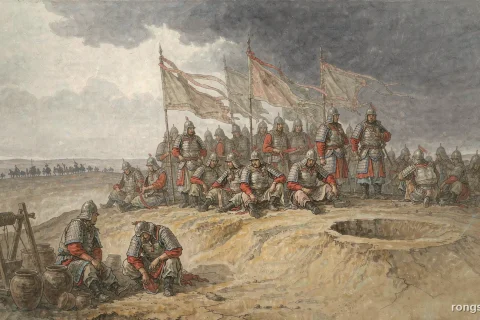
The wind was still cold when the sky began to pale. A man climbed the earthen platform and stood at the top, looking north.
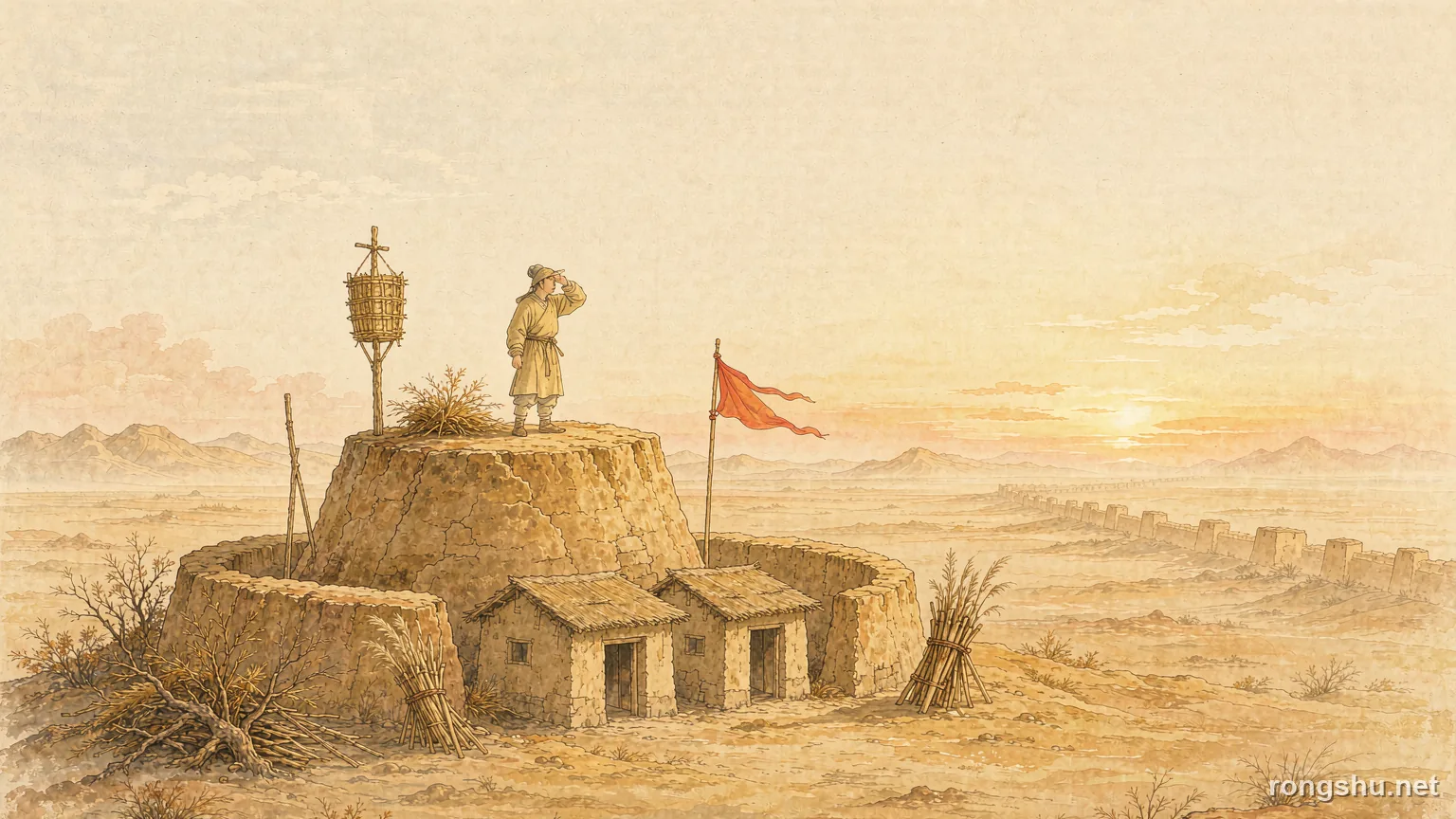
He was about thirty. His skin had gone dark from the sun.
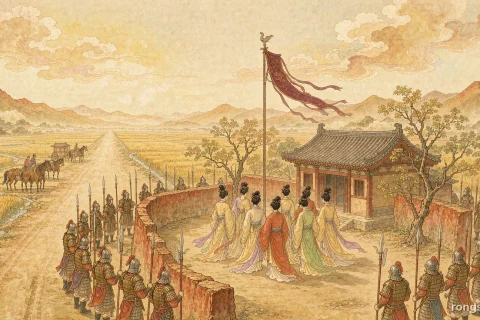
The platform was not high. It had been built up in layers of tamped earth, and the weather had worn its corners round. Below it ran a low ring of mud wall, and inside that wall stood three small rooms. He lived in one of them, with two other men.
He stood at the top and looked north.
In two thousand years, people would come to dig this place. The wooden slips they pulled out would go into glass cases in a museum, numbered, photographed, transcribed. But in the years he lived here, this was just another morning on the edge of the desert.
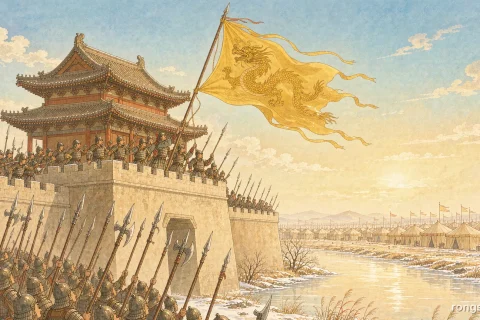
The platform he stood on was called a sui. It was the eye of the Great Wall.
A Wall of Tamped Earth
First, where this wall came from.
The Great Wall people remember best is the one of the First Emperor of Qin.
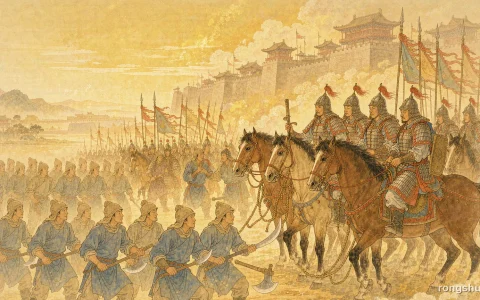
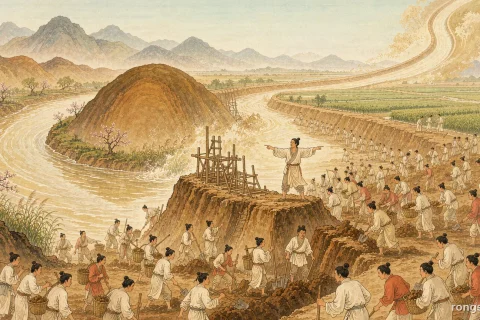
Around 215 BC he sent his general Meng Tian north with three hundred thousand men to drive back the Xiongnu. They cleared the raiders out of the bend of the Yellow River. Then the emperor set his workers to joining up three older walls, which had been built separately by the states of Yan, Zhao, and Qin. The new line ran from Lintao in the west to Liaodong in the east, and the histories call it ten thousand li long. The people who built it were conscripted laborers, soldiers, and convicts. The old records say close to a million were used.
The cost was heavy.
A much later tale tells of a woman named Meng Jiang, whose husband was taken away to build the wall and died on the works. She wept at the foot of the wall until it fell down.
That story was invented long afterward and appears in no Qin record. But it has lasted two thousand years, which says something about what the wall meant to ordinary people.
One thing should be made clear. The First Emperor did not begin the Great Wall.
Before him, the states of Qin, Zhao, and Yan had each built walls along their northern borders to stop cavalry. What the Qin did was join the separate walls into one line, strengthen them, and close the gaps.
Under the Han, the whole system took a long step forward.
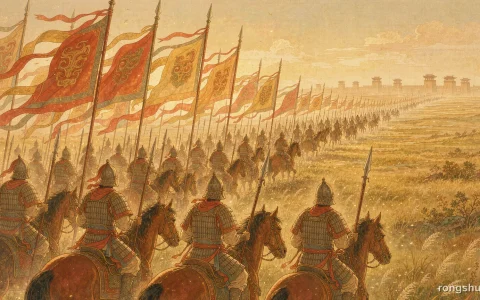
In the early years of the Han, the empire was weak. It bought peace from the Xiongnu with tribute and marriage, and few soldiers stood on the wall. Under Emperor Wu the situation turned around. His generals drove the Xiongnu far to the north and opened the Hexi Corridor, the long strip of land that led west.
Now that strip had to be held, because beyond it lay the trade road to the western regions.
Emperor Wu built a new wall along the corridor. It began at Lingju, in what is now Gansu, ran west past Jiuquan to the Jade Gate, and reached still farther west to a salt marsh that is now the Lop Desert. People later called this stretch the Hexi frontier.
Note the word.
For their own frontier works, the Han used the term sai, not the term for the Great Wall. They kept that name for what the Qin had left behind.
Much of the Han frontier was not a high wall at all. Where there was drifting sand, with no earth to tamp and no stone to lay, the builders dug ditches instead. Where there was neither wall nor ditch, they drove wooden posts into the ground and strung ropes between them as a line for patrols to follow. The wooden slips call these ropes hanging cords.
Readers in the West may find this system familiar. The Romans built Hadrian’s Wall across the whole width of Britain, with forts and watchtowers and ditches along it, and a longer frontier of their own along the upper Rhine and the Danube. At the time of the Eastern Han, the Romans were building walls too. The thinking behind the two kinds of wall, though, was very different.
Names on Wood
What brings this system alive is the wooden slips.
Beginning in 1930, archaeologists working in the Han frontier towers along the Ejin River have pulled more than thirty five thousand of them out of the ground.
They are not scripture, and they are not imperial edicts.
Most of them are the ordinary paperwork of a frontier garrison: records of grain issued, records of roll call, records of patrols, notes asking for leave, and letters from home.
In other words, the slips are the office files of a defense system.
From those files we learned how the frontier was organized. At the top stood the commandant, who held a large district. Below him came the office of the houguan, whose head was called the hou, and the place where he was stationed was the fort. Below that came the section, led by a section chief. At the bottom was the tower, the sui, the earthen platform of the opening scene. The man in charge of it was the tower chief.
How many men held one tower?
Some had three or four. Some had as many as thirty. Along one frontier command, a tower usually held two or three conscripts and a tower chief.
Where did the men come from?
They were drafted from counties far to the east.
Under the Han system of service, every adult man owed the state a stretch of garrison duty on the frontier. They walked west for months, from Shandong or Henan or Hebei, and came to live on an earthen platform at the edge of the desert for two or three years, before they were replaced.
What did they do all day?
They watched, patrolled, passed on fire signals, repaired walls, hauled grain, and cut grass. The slips have a word for the grass cutting. Fodder for the horses had to be cut far from the tower and carried back on a man’s back.
What did they eat?
Each man drew a monthly ration of grain, a little over three measures. That sounds like a lot, but it was unmilled grain, and a man had to pound and grind it himself. Vegetables and salt usually had to come from home.
From the slips it is clear that many of these men could read and write. They kept registers, wrote reports, and did sums. One fragment that came out of the sand is part of a multiplication table. A soldier on the frontier had to be able to count.
There is also a letter home, written by a man on the frontier. It asks after the old people and the children. At the end it says that if the family is short of money, they should sell the things he has sent back.
Many of these letters never went out.
Not everything in the slips is paperwork.
One man fell ill, and the report says: sick, headache, unable to eat. When a man died, a slip carried his name and a single word, deceased.
Reading them two thousand years later, you feel that these were people who lived.
Two Bundles, One Fire
The eyes of the wall had to be able to send word. That brings us to a set of rules written down in exact detail: the frontier signal code.
In 1974, in a room less than six square meters wide at one fort, archaeologists found a group of seventeen wooden slips. The group is known as the Frontier Fire Signal Code. It is a set of regulations for what signal to raise in what situation.
How exact were the rules?
Here is one line. If the Xiongnu attack the northern tower in daylight, raise two signal bundles, light one stack of brushwood, and set torches burning on top of the surrounding wall, and keep them burning until dawn.
The words need some explaining.
The frontier used five kinds of signal. A signal bundle was a cage of woven grass or a wooden frame covered with cloth, raised in daylight so that its shape could be seen far off. A banner was a long strip of cloth. Smoke came from a chimney. A torch was a bundle of reeds, lit at night and held up. A stack was a pile of brushwood, which gave smoke by day and a great fire by night.
How many of each, and at what hour, was laid down in the code and could not be varied.
A larger raiding party, a different direction, a change in the weather, and the answer changed with it. When a tower saw its neighbor’s signal, it had to answer in kind, so that the message passed from one tower to the next.
How fast did it travel?
One estimate from the slips puts the speed of a fire message at about five hundred and seventy kilometers in a day and a night. At that rate, an alarm sent up from Dunhuang would reach the capital in three days and two nights.
Two thousand years ago there was no telegraph and no telephone. With a wall, a few piles of brushwood, and some flags, a message could cross half of China.
Footprints in the Sand
Besides the fire signals, the conscripts had a more tedious duty: reading footprints.
The ground outside the frontier line was prepared on purpose. The grass and trees were cut away, the surface was leveled, and a layer of sand was spread and smoothed. The slips call this a sky field.
The sand was soft. When a man or an animal crossed it, it left a mark.
Every morning one conscript walked the length of the sky field, looking for prints that should not be there. When he found some, he wrote them down: which way they went, how many hooves, how far he followed them, and where he lost the trail. These records are known as daily trail slips.
At one gate on the frontier, a single slip was found, written in a careful hand, with a line that says: daily trail record of the soldier of the northern post.
The method looks almost silly. But in an age without radar, it was the sharpest line of defense there was.
Sometimes it failed. One trail slip records prints crossing the sky field; the man followed them for two li, and then the ground turned hard and the prints stopped, and no one knew where the intruder had gone.
Life on the frontier was not all rules. Inspectors came around, and a man who had not done his checking properly could be punished.
A slip found in 1974 records the case of a section clerk named Guangde. He had failed to tour the towers under his charge, failed to keep them plastered, and failed to have the required equipment ready. His sentence was fifty strokes.
Buried for Two Thousand Years
Among the famous documents in the Juyan slips is a debt case.
In the third year of the Jianwu era, about AD 27, an officer named Su brought a complaint against a commoner named Kou En for failing to repay a debt. He said he had supplied an ox and grain to hire Kou En to carry five thousand fish to market, and that Kou En had agreed to bring back four hundred thousand coins. Instead he brought back only a little over three hundred thousand. He also said Kou En had sold one of his oxen and settled the account with it.
The case went first to the county, where the local official questioned Kou En.
Kou En told a different story entirely. The ox had been part of his pay, he said, not a loan. The fish had not sold for the promised price, and he had handed over both the money from the fish and the money from the ox. On the way to market he had driven the officer’s wife for more than twenty days, and had bought meat and barley out of his own pocket, none of which had been counted. His son had also fished for the officer for more than three months without being paid.
By his reckoning, he owed nothing. The officer owed him.
The county ruled that Kou En was not in debt.
The officer refused to accept it and took the case higher.
A debt dispute two thousand years old, with an official as the plaintiff and a commoner as the defendant, and the commoner won the first round.
How did these slips survive at all?
In 1930 a joint Chinese and Swedish expedition reached the Ejin River.
On the twenty seventh of April, the Swedish archaeologist Folke Bergman was measuring a wall at a frontier tower when his pen fell to the ground. Bending to pick it up, he saw a Han coin lying beside it. He dug a little, and found wooden slips.
The next day the team began to dig in earnest, and the slips came out of the sand in batches. Over the months that followed they dug at about thirty sites and recovered more than ten thousand. From 1972 to 1986, Chinese teams worked the same ground and recovered more than twenty thousand more.
Why did they last? Because the place is so dry.
Wood buried in sand that sees almost no rain for centuries does not rot.
The Juyan slips are counted with the oracle bones of Yinxu, the Dunhuang manuscripts, and the old archives of the imperial palace as the four great finds of Chinese documents in the twentieth century.
Before them, almost everything we knew about this frontier system came from a few general sentences in the standard histories.
Ban Gu never told us how many men held one tower, or how much grain a man drew in a month, or how the fire signals were lit.
The slips told us instead.
Today, dozens of ruined platforms still stand near Ejin, some of them half sunk in the dunes. Most of the men who stood on them and looked north left no names. What they left were the ledgers, the roll calls, and the letters.
One letter in the slips was written by a man named Xuan to two people he calls Young Grandson and Young Wife. It is full of ordinary family talk.
When he wrote it, he did not know whether it would arrive.
Two thousand years later we know that it did.
It arrived in our hands.