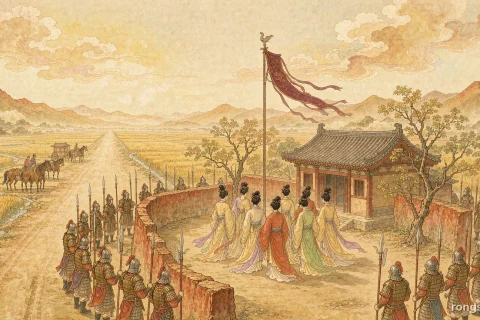
In 237 BCE a man of about fifty was brought before the court at Xianyang with his arms bound.
His name was Zheng Guo, a water engineer and a subject of the state of Han.
The men who denounced him were Qin’s own nobles. This man, they said, had not come to build a canal but to exhaust them. Ten years of labour and a hundred thousand workers on earthworks, and Qin would have nothing left to march east with. He was a spy, sent by Han.
Under Qin law a spy was put to death.
No one in the hall spoke for him. The granaries had been emptying for years while the canal was being dug, and families all over the country had sent men to the works. Now that it had come out, the talk at court was blunt. Han had meant to tie Qin’s manpower and grain to a ditch, and it had very nearly worked.
Zheng Guo did not deny that he was a spy.
The hall went quiet.
He lifted his head and said one thing.
The words were written down in the Records of the Grand Historian, and they are still quoted two thousand three hundred years later. “I did begin as a spy,” he said, “but when the canal is finished it will also be to the advantage of Qin. I gave Han a few more years of life, and I am building Qin a work of ten thousand generations.”
King Zheng heard him out. Then he told him to go back and finish the canal.
To understand what was at stake in that sentence, it helps to know the position Qin had reached.
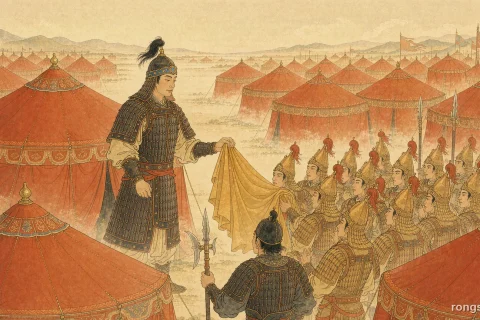
Qin had been remade a century earlier. Under Duke Xiao, who ruled from 361 to 338 BCE, the state took on Shang Yang’s reforms and turned from a frontier power in the west into the hardest fighting state of the seven that remained.
Shang Yang’s measures cut deep. He abolished the old communal fields and allowed land to be bought and sold. He organised households into groups of five and ten and made neighbours answerable for one another’s offences. He created ranks of merit: every enemy head taken in battle raised a man one grade, and a noble with no battlefield record lost his standing. He moved the capital to Xianyang.
That machine ran for more than a hundred years. Qin’s granaries were fuller than anyone else’s, and Qin’s soldiers were less afraid to die.
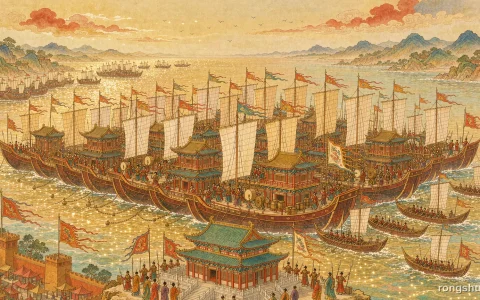
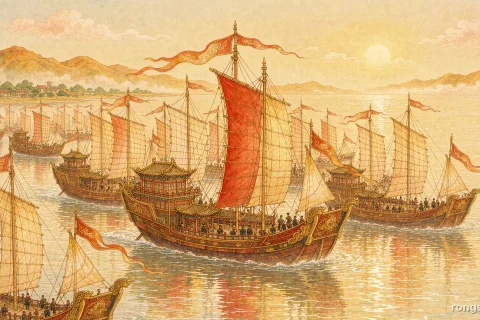
By the time King Zheng came to the throne, Qin’s armies had come through the Hangu Pass many times, and piece after piece of the other six states had been pared away.
The first to feel the cold was Han, the neighbour at Qin’s door.
Han was the smallest and weakest of the seven. Its territory lay directly across Qin’s eastern route, and any Qin army moving east stepped on Han first. Han could not win a war and could not hide from one.
The two had fought more than once. In 293 BCE the Qin general Bai Qi broke a Han and Wei army at Yique and took two hundred and forty thousand heads. After that Han’s best troops were essentially gone. What the state had left was a strip of ground squeezed between Qin, Wei and Chu, and a supply of years that could be bought only by submission.
Han’s ruler worked out a plan. He did not send troops. He did not send an envoy to beg for peace.
He sent a water engineer.
The scheme has a name in the histories. It is called the plan to exhaust Qin: to sink Qin’s men, materials and years into one enormous public work, until the state had nothing left over for anything eastward.
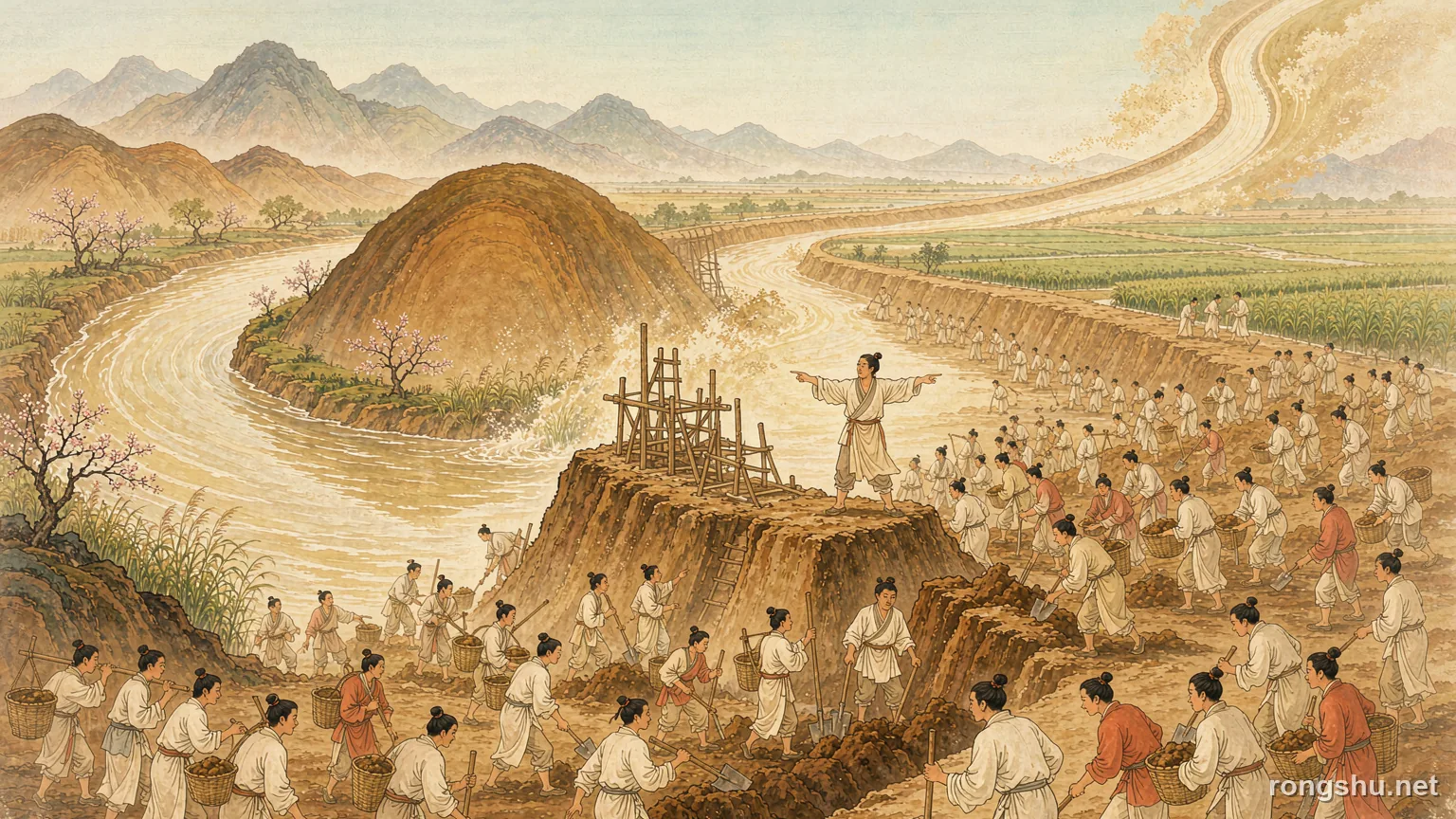
The Engineer With a Map
Zheng Guo did not arrive in Qin empty handed.
He walked the whole way from the Jing to the Luo, several hundred li, measuring levels and gradients, and then brought Qin a proposal.
Cut a canal from the place where the Jing comes out of the hills, and lead its water east until it reaches the Luo.
The intake was put where the Jing bursts through the Zhongshan hills. The river bends here; the current is quick, the level steady, and the silt at its heaviest. Later generations called this stretch the Gourd Mouth, and also the Dragon Gate of the Jing. The line of the canal does not follow the land downhill to the south east, but runs east along the northern rim of the Weibei plateau, so that as much irrigable ground as possible is enclosed.
This canal is counted, with the Dujiangyan that Li Bing built in Sichuan and the Lingqu that Shi Lu cut in Guangxi, as one of the three great water works of Qin. It is the northernmost and the earliest, and the earliest large diversion scheme in China to use no dam at all: nothing was built across the river, only a single opening cut upstream, borrowing the water.
Why was it worth building? Because the ground in between was salt.
The Guanzhong plain is good land, but north of the Wei, between the Jing and the Luo, there was a broad stretch of marsh and salt flat. It lay low and drained badly, and once water soaked into it the salt came up to the surface. It stared back white. Nothing planted there would grow.
Zheng Guo’s answer was to bring in the muddy water of the Jing.
The Jing carries more silt than almost any other tributary of the Yellow River. A later folk saying described it: in one stone of Jing water there are several pecks of mud.
Mud looks like a nuisance to a canal. On salt land it is medicine.
Anybody who knows the older history of irrigation will see how narrow the margin was. In southern Mesopotamia the land between the Tigris and the Euphrates was irrigated for a thousand years and more, and the same water that fed it ruined it. The plain is almost level, the water table is high, and the water drawn up through the soil evaporates and leaves its salt behind. Wheat gave way to hardier barley, and then much of the land went out of cultivation, and the cities of Sumer lost the fields that had made them. The mud of the Jing did the opposite work, because this ground was not level. It rose away from the river, the channel drained, and the silt arriving every year buried the salt under fresh soil.
Let the muddy water onto the fields and the silt settles, pressing the salt down and renewing the topsoil year after year. This is what later writers meant by irrigating salt marsh with silt heavy water.
Work began in the first year of King Zheng, which is 246 BCE.
That was 246 BCE.
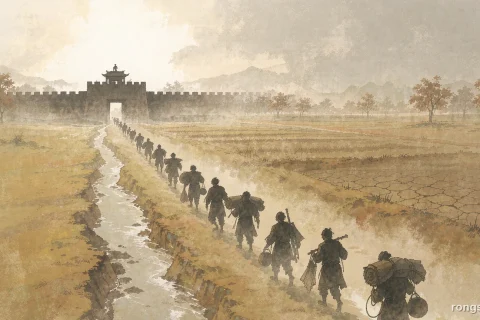
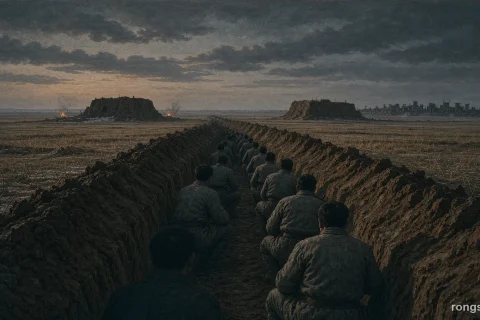
A hundred thousand soldiers and labourers went onto the works.
The canal ran more than three hundred li.
It was not a straight line. It had to cross several small rivers and gullies, and in places the channel cut across a stream and let it pass underneath, a technique water engineers later gave a name of its own.
There was no cement. The walls were pounded earth, layer on layer. Levels were set with wooden channels and rules, and the fall checked by men standing in the water. Three hundred li, ten years, and that was the whole of the method.
It took nearly ten years.
A generation of labour went into that gap.
A Canal Half Dug
It was when the end was almost in sight that the plan came apart.
The histories give it four characters: discovered while the work was still going on.
Someone revealed what Han had intended. The reaction of Qin’s nobles went beyond wanting Zheng Guo killed. They used the affair to argue something much larger. These men who come from outside, they said, cannot be trusted with anything.
The Order of Expulsion
That same year, something more famous happened.
King Zheng issued an order of expulsion. Every man in Qin’s service who had not been born in Qin was to be driven out of the state.
One name on the list was Li Si. He was from Chu, and he held office in Qin.
As a young man Li Si had been a minor clerk in a Chu district. He had seen the rats in the latrine, filthy and frightened of every passer-by, and then the rats in the granary, fat and settled. What a man amounts to, he concluded, depends on where he stands. He resigned, studied statecraft under Xunzi, concluded that the world would be unified by Qin, and travelled west. He began as a retainer of Lu Buwei and rose to serve the king himself.
On the road out of Xianyang, Li Si wrote a memorial and sent it back.
It is known as the Memorial on the Expulsion of Guests, one of the most widely read pieces of political writing in Chinese.
Its argument is plain. Qin is strong because of men who came from outside. Duke Mu had Baili Xi; Duke Xiao had Shang Yang; King Hui had Zhang Yi; King Zhao had Fan Ju. Not one of them was born in Qin. Judged by birthplace alone, Qin would never have reached the position it now held. Mount Tai does not reject any soil, and so it becomes high. Rivers and seas do not turn away any stream, and so they become deep.
The memorial then goes through the contents of the Qin palace, item by item. Jade from Mount Kun. Pearls from the Marquis of Sui. The sword Tai’e. The music of Zheng and Wei. Not one of these was produced in Qin. Why, Li Si asked the king, do you accept all of them, and then insist on birthplace when it comes to men?
King Zheng read it and withdrew the order.
Zheng Guo stayed, and went back to his canal.
From the day he stood bound in the hall to the day the water ran through, a single year passed. From the first spadeful of earth to the last, ten.
The Fields That Fed Qin
The canal was finished in about 236 BCE, ten years after the work began.
The Records of the Grand Historian give the outcome in a few dozen words. The canal was completed. Silt heavy water was used to irrigate more than forty thousand qing of salt marsh, and the yield came to a full zhong per mu. Guanzhong became rich farmland, with no bad years. The canal was named after Zheng Guo.
Forty thousand qing took in the whole of that stretch between the Jing and the Luo, the ground nobody had wanted.
Put plainly: the canal was built, the salt flat was watered, the yield was a full measure per mu, and the bad years stopped. Then came the line that matters. Qin grew wealthy and strong, and in the end swallowed the other states.
What this canal added to Qin was not only grain.
Wars in the ancient world were fought with grain. Every measure delivered to the front cost several more on the road. Somebody in the Han period worked out that in moving grain from Guanzhong to the northern frontier the ratio of what arrived to what was eaten on the way could fall as low as one to ten. If Guanzhong could feed itself, Qin no longer had to draw on anywhere else, and the range, the frequency and the size of its campaigns all moved up a level.
Two things mattered above all to Qin: the system of military ranks Shang Yang had given it, and the million and more acres of dependable cropland Zheng Guo had given it.
With those two in place, the next ten years were easy to write.
Han was destroyed in 230 BCE. Zhao in 228. Wei in 225. Chu in 223. Yan in 222. Qi in 221.
Count back from the completion of the canal, and Han had meant to hold Qin up for ten years.
What it held up was itself.
After it was finished the canal kept its name and gathered others.
The Han dug the White Canal alongside it; later dynasties followed with the Zheng-Bai, the Fengli, the Censor Wang, the Guanghui and the Longdong canals, and in 1932 came the Jinghui.
The White Canal dates from the reign of Emperor Wu of Han, and the official who ran it was a man called Bai. He saw that the water in Zheng Guo’s district was not enough, took a second channel off further upstream, and ran the two side by side.
Over two thousand years the headworks moved upstream again and again, because the Jing has been dropping: the surface of the river today lies about twenty metres below the bed of the old canal. Water will not flow uphill, so the people moved uphill instead.
In Jingyang in Shaanxi, going north from Wangqiao town to the foot of the Zhongshan hills, there is still a field of old headworks. More than forty intake sites, from the Warring States down to the Qing, are packed into a triangle of less than ten square kilometres, the Warring States channel, the Han and the Tang lying one on top of another.
In November 2016 the Zheng Guo Canal was added to the World Heritage Irrigation Structures list.
When the men of the Han compiled the History of the Former Han they set down a folk song from the district:
Where do we farm? At Chiyang, at Gukou. Zheng Guo went first, the White Canal came after. Our spades rise like cloud, we open the canal and it comes down like rain. One stone of Jing water, several pecks of mud. We water and we manure at once, and our millet grows. We clothe and feed the capital, hundreds of millions of mouths.
The last lines are the heart of it. The water is thick with mud, and the mud is fertiliser. The same flood that carries the silt is the flood that feeds the crop, and the crop feeds the capital.
The Qin lasted fifteen years. The canal outlived it. When the Han writers set down the Records, the canal was still watering fields, and when they compiled the History it still was.
What became of Zheng Guo is not recorded. The year the canal was finished it took a name, and the surname of a spy became the name of the largest canal in Guanzhong.
It is still watering fields today. It has been renamed many times over the centuries. The names have changed. The river and the hills and the ground have not.