On the morning of 1 September 1449, two hundred thousand men were dying of thirst on a bare hill in northern China.
The place was called Tumu, a staging post on the road between the capital and the frontier, and it had one fatal feature. There was no water. The river lay a short ride to the south, and the night before, horsemen had taken it.
The soldiers dug where they stood. A foot down, two feet, a yard. They brought up dry earth. A horse screamed, and then the whole hillside.
Nobody moved. In a square of two hundred thousand men, not one man moved, because to break the line was to break the army, and to break the army was to die. Half of them would be dead by nightfall. The young man under the yellow canopy in the middle of them, the Emperor of China, twenty-two years old, would be a prisoner by evening.
To see how the Ming dynasty brought its own emperor to that hill, you have to start with a eunuch named Wang Zhen.
He had been a schoolmaster in Shanxi before he entered the palace, and he could read. Inside, he taught the young eunuchs their letters, and was given to the household of the heir to the throne.
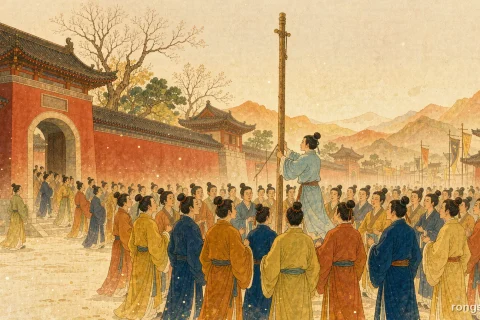
That boy, Zhu Qizhen, came to the throne at nine years old. Picture a child on the dragon throne with a row of white-bearded ministers in front of him. Who was he going to trust? Not the men who lectured him and kept their distance. He trusted the man he saw every day.
So as the boy grew, Wang Zhen grew. When the old ministers died or retired, he took charge of the red brush, the pen that wrote the emperor’s decisions on memorials. By the end, senior officials were calling him Grandfather.
In the summer of 1449 the Mongols came south.
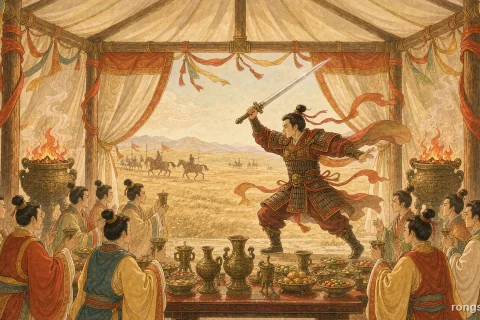
The western group, the Oirats, had grown strong under a leader named Esen. In July he sent his riders across the frontier in four columns, the main force straight at Datong, a garrison town near the border. The Ming troops there rode out, were beaten, and lost several commanders.
The reports reached Beijing. Wang Zhen went to the young emperor with an idea. Go north yourself, he said. Ride out with the army. The moment the enemy sees the Son of Heaven coming, they will scatter.
Almost every senior minister objected. Yu Qian, the vice minister of war, put it bluntly. We do not know the enemy’s strength, he said. We are not prepared. And the emperor leaving the capital is a matter of the survival of the state.
Zhu Qizhen would not listen. On the sixteenth day of the seventh month, the army marched out of Beijing. Two hundred thousand men, announced as five hundred thousand. Two days had passed between the first defeat report and the order to move.
In Europe, a king taken alive on a battlefield is rare enough that people remember it for centuries. John of France, pulled off his horse at Poitiers. Richard of England, shipwrecked on his way home and handed to a rival for a ransom. In China it happened too, but only a handful of times in two thousand years.
It was the rainy season.
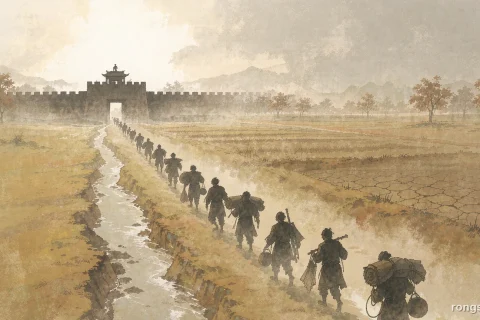
The army marched north through the worst mud of the year. Carts sank, men sank, horses sank. Soldiers began to die in the ditches of cold and hunger before they ever saw an enemy.
The minister of revenue petitioned several times to turn back. Wang Zhen did not merely refuse. He made the old man kneel on the wet grass until dark.
The army reached Datong on the first day of the eighth month, and saw what was left of the last force that had tried to fight the Oirats. Nobody had collected the dead. They lay in the open fields outside the walls, and two hundred thousand men walked past them in silence.
Only then did Wang Zhen agree to turn around.
A retreat should be fast. Wang Zhen had another idea.
His family came from a district called Yuzhou, which lay roughly on the road home. He wanted to take the emperor past his own ancestral house. He wanted his neighbors to see it.
So the army turned toward Yuzhou and marched forty li that way. Then Wang Zhen thought about his crops. If two hundred thousand men crossed his family estates, the harvest would be trampled to nothing.
So he turned the army around and sent it back the way it had come. Forty li out, forty li back, two days lost, in the one situation where two days were the difference between getting home and not getting home.
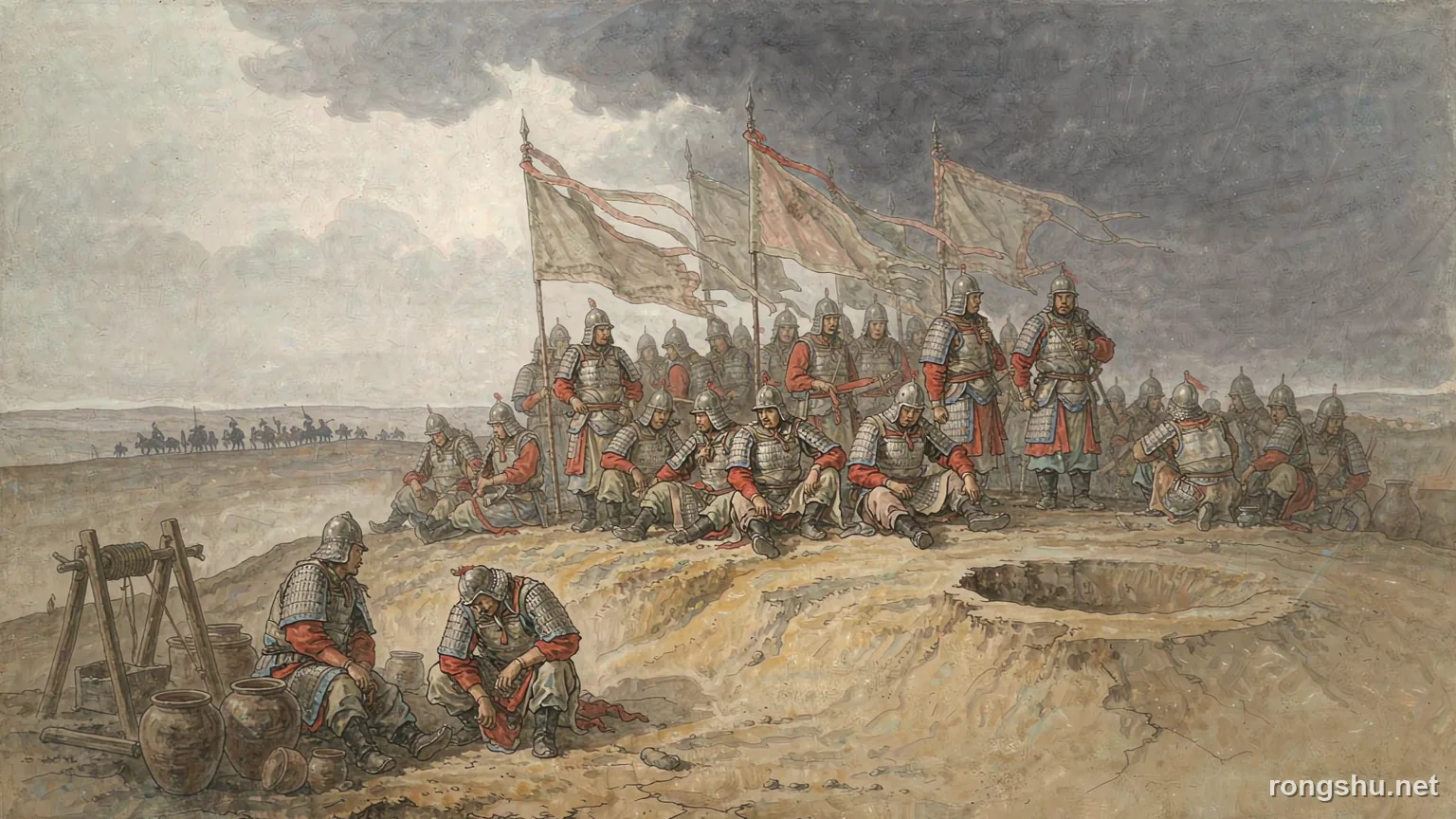
On the thirteenth day of the eighth month the army reached Tumu.
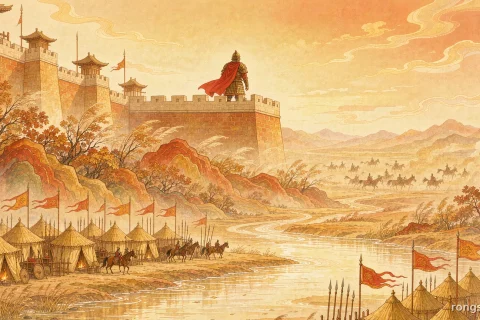
Tumu was a poor place to stand and fight. It sat on high ground with no water. Twenty li to the south stood the town of Huailai, with intact walls and full granaries, and the ministers begged the emperor to move into it.
Wang Zhen refused. A thousand and more wagons of his own property were still strung out behind the army, and he was not going to abandon them. He would wait at Tumu for his wagons.
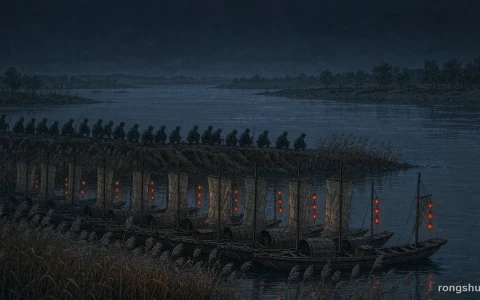
So two hundred thousand men camped on a dry hill, and waited.
By the next morning, they were surrounded. The Oirats had taken the river first, and the army was sealed inside a pocket of dry ground with no way to reach water.
One day. Two days. Men began to drink the urine of their horses, and then there was not even that.
On the fifteenth day, Esen sent a messenger under a flag of truce. He was willing to talk. Wang Zhen let out his breath and gave the order. Break camp. Move the whole army down to the river.
Two hundred thousand men began to move at once. That was the moment the horsemen came.
An army standing still can hold a line. An army walking cannot. The Ming formation came apart in a few minutes, and the Oirat cavalry rode into the gaps. Men ran for the water, ran into each other, were trampled by their own side. The riders galloped back and forth through the crowd, shouting that any man who laid down his weapons and took off his armor would not be killed.
Many of them did. They were shot where they stood.
When it was over, more than half the army was dead or scattered, and fifty senior officials had been killed in the rout, including the duke Zhang Fu and both the minister of war and the minister of revenue.
Wang Zhen died in the same crowd. One story says a guard of his own crushed his skull with a hammer in the chaos. Whether the man existed is hard to prove. That a great many people wanted him dead is not.
Zhu Qizhen did not get away. He came down off his horse, sat on a rock, and waited for the Oirats to reach him.
An emperor of China, sitting on a rock, waiting to be taken.
The news reached Beijing a few days later.
The court went quiet first, then wild. The ministers wept, then argued, and the argument turned into a brawl. Several of Wang Zhen’s men were beaten to death in the audience hall by officials who had spent years bowing to them.
Then they got to the real question. What do we do now?
A lecturer from the Hanlin Academy stood up. He had sent his family south weeks before, as soon as the emperor marched out. The capital, he said, holds nothing but tired soldiers and thin horses. If Esen comes on with the force he has, how do we stop him? I have studied the heavens and the calendar. Our mandate is finished. Move the capital to Nanjing.
A great many voices agreed with him.
Then Yu Qian, standing in the hall, spoke.
Anyone who speaks of moving south, he said, should be executed. The capital is the root of the empire. Move the root, and the whole thing comes down. Have we already forgotten what happened to the Song?
The hall went silent.
Everyone there knew what he meant. Three hundred years earlier, the Song dynasty had lost the north and retreated south of the great river. It never went back. It lasted another century and a half, then ended in the sea, with the last child emperor in the arms of a drowning minister.
Yu Qian was not a general. He was fifty-one, a civil servant out of Hangzhou who had spent his career fixing river dikes and grain stores, and had never commanded a single soldier. He said the capital would not be abandoned. If it fell once, it would never be recovered.
The empress dowager backed him. So did the emperor’s half-brother. On the twenty-first day of the eighth month, Yu Qian was promoted to minister of war.
The first thing he did was to put someone else on the throne.
An empire cannot go a day without a ruler, and Esen was holding a live emperor, which is the most dangerous card in politics. He could ride up to any gate in China with Zhu Qizhen beside him and demand that it open. The commander inside could obey and be called a traitor, or refuse and be called the murderer of his own sovereign.
On the sixth day of the ninth month, Zhu Qizhen’s half-brother took the throne, and the captured emperor was given the title of retired emperor. The card was dead in Esen’s hand.
The second thing Yu Qian did was find an army.
Tumu had eaten the empire’s trained soldiers. What was left in Beijing was under a hundred thousand men, and most were old, sick, or untrained. Yu Qian sent orders to every garrison in the east that could march. Bring your men to the capital, now. Anyone who delays will be executed.
In about a month he assembled two hundred and twenty thousand men.
The grain was the harder problem. The great stores sat at Tongzhou, a day’s march away, and if Esen arrived first he would simply eat them. So every unit marching to the capital was ordered to pass through Tongzhou and carry its own grain in on its back.
Then he took the army out of the city.
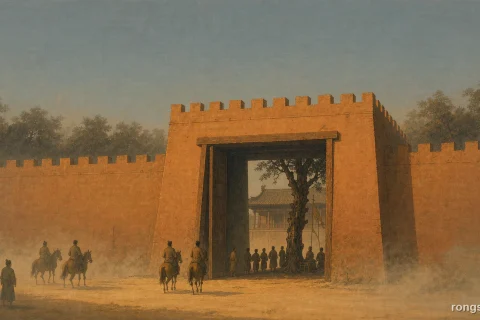
Two hundred and twenty thousand men were divided among the nine gates of Beijing and told to form up outside the walls. Then the gates were closed behind them.
Officers objected. The safe thing, they said, was to stay inside and let the enemy break his teeth on the stone.
Yu Qian would not have it. If we sit behind the walls, he said, the enemy will burn and loot everything outside at his leisure, and starve the city from a distance.
He put on armor and went out to the Desheng Gate, and there he gave his orders. Any officer who abandons his men and runs will be killed by his own men. Any soldier who abandons his officer and runs will be killed by the man behind him.
In one line: nobody goes back.
In the tenth month, Esen came, and he brought his prize with him. Outside the Desheng Gate there was an earthen platform, and there he set up the retired emperor so that the defenders on the wall could see him brought out like a piece of luggage.
Yu Qian did not send anyone out to receive him.
On the thirteenth day of the tenth month, the main Oirat force attacked. Yu Qian had put his gunpowder troops, the men who handled the cannons and the hand-cannons, inside the empty houses outside the gate. Then he sent a small group of cavalry out to fight, and then to run away.
The Oirat horsemen came after them, straight into the empty street.
The houses opened. The guns fired. The cavalry came out of the side lanes, and the Oirats were caught in between. Desheng Gate held.
Over the next few days Esen tried two more gates. Each time, soldiers on the wall and civilians in the streets fought him together, and each time he was thrown back. After five days the relief armies from the provinces began to arrive, and Esen, who could see his road home closing behind him, broke camp in the night and rode north.
Yu Qian took cavalry out and chased him as far as the Juyong Pass before turning around.
The capital of the Ming dynasty was still standing.
A civil servant who had never led an army, commanding men gathered in a month, had held a city that everyone had already given up for lost.
Esen now had a retired emperor on his hands, and a retired emperor is worth nothing if the men on the throne do not want him back. The next year he handed Zhu Qizhen over without conditions.
Zhu Qizhen came home to a very cold welcome. His half-brother had grown used to being emperor, and put him in a walled house in the southern part of the palace for seven years. Then, in 1457, the emperor fell ill. A group of generals brought the retired emperor out of that house in the night and put him back on the throne. One of the first things the restored emperor did was arrest Yu Qian.
The charge was treason.
The men who tried the case knew the charge was false. Nobody dared to overturn it. Eight years earlier, Yu Qian had stood in a hall full of frightened officials and refused to let their empire run away. Eight years earlier, he had insisted on putting another man on the throne, which had stopped Esen and saved the country, and which had also cost the restored emperor seven years in a locked house.
On the twenty-second day of the first month, Yu Qian was executed outside the Chongwen Gate.
When the imperial guard came to seize his property, they expected a fortune. His house was three rooms around a small courtyard, so shabby that the officers went in carefully for fear of knocking it down. They found a few chests of books and some worn-out clothes. One room was locked. Inside were the ceremonial robes and the sword the emperor had given him, put away untouched, never once worn.
The official history of the Ming dynasty, written long afterward, said that his loyalty and his integrity contend with the brightness of the sun and the moon.
He had written a poem when he was young.
Thousands of blows hack it out of the deep mountain. Fire burns it as if it were nothing at all. Broken to pieces, it does not care. It only wants to keep its whiteness in this world.
The poem is about lime, the white powder that is burned out of mountain stone. Rock is dug from the hill, fired, drowned, and crushed, and what is left is white.
It is not clear that he was thinking about his own life when he wrote it. It turned out to describe it exactly.
In the eighth month of 1449, two hundred thousand men died of thirst on a dry hill, and a dynasty came within a few weeks of ending. One man pulled it back. Eight years later, that dynasty gave him back what he had earned.