Before dawn the wind off the Yellow River cut through every coat.
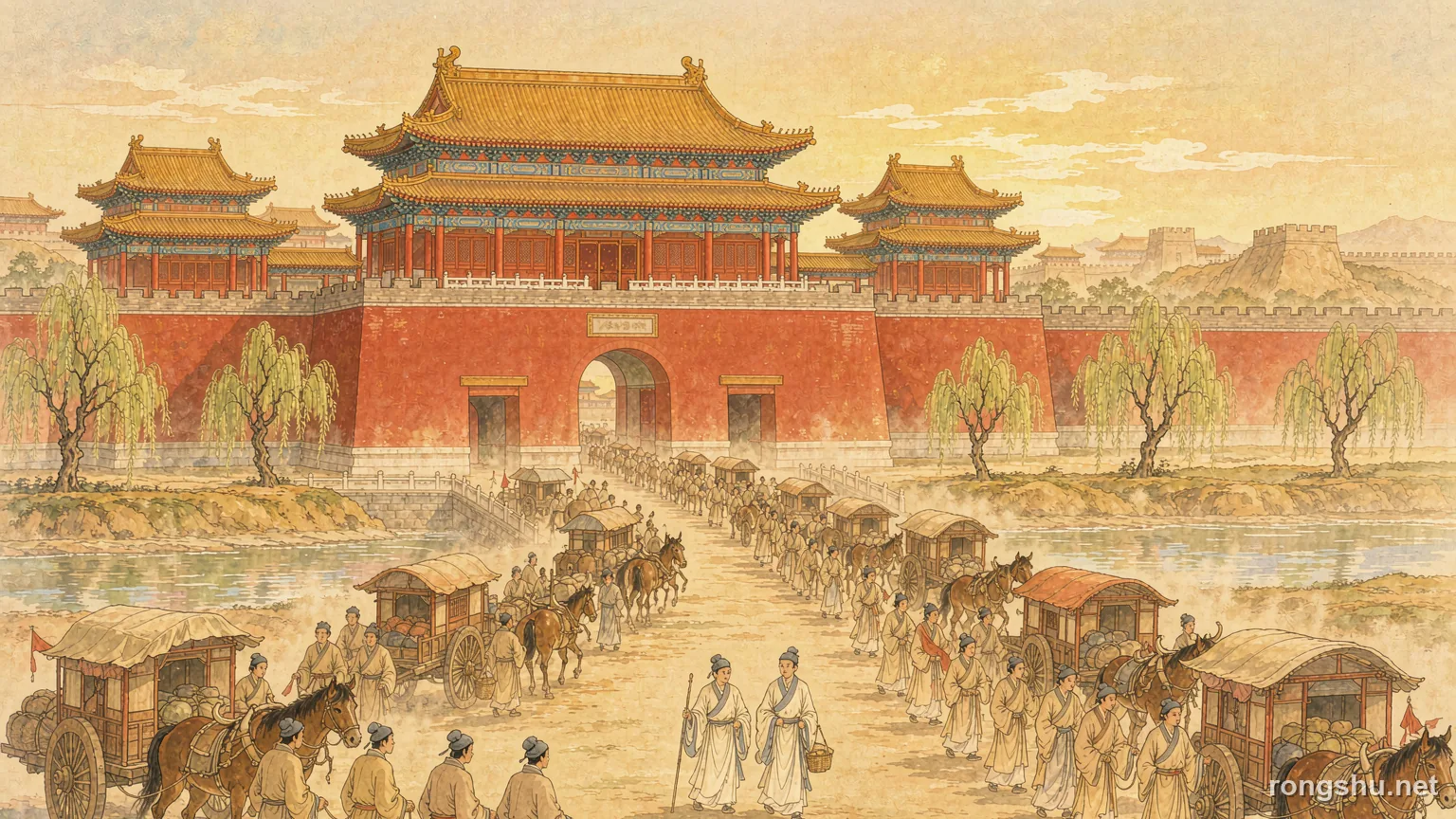
The column was already forming outside the walls of Kaifeng. Carts, mules, and long lines of people tied together at the wrists. In the middle of it walked two men in plain clothes.
They were father and son. Both of them had been emperor.
A month earlier they had sat in the great halls of the city and received the bowing of a hundred officials. Now horsemen of the Jin were marching them north, toward a place whose name they could not have pointed to on any map.
How many people were in the column, how many days the road would take, when it would end, neither man knew.
They knew only one thing. North.
When the column left the gate, people stood along the street. No one dared to make a sound.
The Jin rode in front and behind. In between walked the long file. Some rode in carts, some rode animals, and more went on their own two feet. Rope ran from one wrist to the next.
It was the last time that year that Kaifeng sent anyone out of the city.
In Chinese history this year has a name of its own. People call it the Jingkang disaster.
A Bargain With the Jin
To see how the road led there, we have to step back a few years.
The emperor then was Zhao Ji, remembered as Huizong. He wrote a beautiful hand and painted beautifully, and he invented a slender, sharp style of calligraphy that people still copy today. Put him in a modern city and he would be a celebrated artist.
But he was an emperor.
His most trusted officials were men like Cai Jing and Tong Guan. Later Chinese writers grouped this whole set of favorites under one name. They called them the six villains.
What Huizong loved was not only paintings. He loved strange stones and rare trees, and he loved moving the finest things in the empire to his capital. To carry a single lake stone to Kaifeng took a thousand men, hundreds of miles of water, and the tearing down of bridges and locks along the way. The whole business had a name of its own: the flower and stone convoys.
In the southeast the farmers could not bear it any longer. In 1120 a man named Fang La rose in rebellion and within half a year gathered hundreds of thousands of followers. Putting the rising down drained the treasury and the army. By the time the Jin came south, the Northern Song had very little strength left to spare.
The northern border, meanwhile, was growing looser every year.
North of the Song there was an old rival called the Liao. The Liao held a belt of land known as the Sixteen Prefectures, which covers roughly the region of modern Beijing and the north of Hebei and Shanxi. The Song had lost that land long before, and for almost a hundred and seventy years they had wanted it back.
In 1115, northeast of the Liao, a new power rose. The Jurchen had founded a state they called the Jin.
The Song saw an opening.
Around 1118 the court sent envoys by sea to make contact with the Jin. The two sides struck a bargain. They would attack the Liao together. When the Liao were gone, the Sixteen Prefectures would return to the Song, and the Song would pay the Jin the yearly tribute it had once paid to the Liao.
In the Chinese histories this bargain is called the Alliance of the Sea.
It sounded like a good deal.
The trouble is that a bargain has to be paid for with results.
The plan was to attack together. On the Jin side the armies swept through the Liao quickly and hard. On the Song side the army marched twice against the Liao capital at Yanjing and twice was beaten back by what was left of the Liao. In the end it was the Jin who took Yanjing.
With nothing to show for the campaign, the Song paid in silver instead. They bought back Yanjing and a few other towns from the Jin, and what they received were empty cities stripped bare.
That one campaign told the Jin everything they needed to know.
What they saw was a state with money, a weak army, and a court that could not keep its own house in order.
And a pretext was not hard to find.
In 1123 a Liao commander named Zhang Jue surrendered the Pingzhou region to the Song. The Jin demanded that he be handed over. The Song could not hold its ground, so they killed the man and sent his head north.
That single act chilled people on both sides.
The Liao officers who had come over understood that the Song could not protect its own. The Jin understood that the Song could be pushed around at will.
The Sorcerer on the Wall
In the first month of 1126 the Jin army appeared before Kaifeng for the first time.
Inside the city there was a minister named Li Gang. He organized soldiers and civilians onto the walls and held off the assault. An old general named Chong Shidao brought his troops in, and relief armies began to gather from other provinces.
Chong Shidao saw that the Jin had come a long way and were deep in enemy land. He proposed a plan. Do not fight them now, he said. Wait until they cross the river to go home, then strike them halfway across. The court did not take it. A young officer named Yao Pingzhong went out on his own to raid the Jin camp, found it empty, and came back beaten.
Unable to break the city, the Jin agreed to talk. Their terms were heavy. The Song were to cede three garrison towns, Taiyuan, Zhongshan, and Hejian, and pay a large sum in silver and gold.
The court paid. The Jin withdrew.
The city had held.
And that very success told the Jin how weak the Song really were. They had learned that Kaifeng could not be taken by storm, and also that this court did not dare to fight in earnest.
Once the Jin had gone, the city breathed out.
Some officials argued that the defenses should be cut back. Others argued that the relief armies should be sent home. The reasoning sounded sensible. The war was over, and all those soldiers were eating for nothing.
Li Gang was pushed out of the government. As for the three towns the court had promised, it changed its mind, and even encouraged the people there to resist on their own.
That winter the Jin came again.
This time there was no bargaining and no detour. Two armies marched straight for Kaifeng.
By then the Song position was far worse than the year before. Chong Shidao had fallen ill and died. Taiyuan had fallen in the autumn. North of the Yellow River there was almost nothing left to hold. Most of the relief armies had already been sent home.
The city was short of soldiers, and its people were divided.
That was when a man named Guo Jing stepped forward.
He said he knew magic.
He said that if he were given seven thousand seven hundred and seventy nine spirit soldiers, he could seize the Jin commanders alive and drive the army away. He added that these soldiers would have to be chosen by their birth dates, with the signs matching.
The court believed him.
They really did gather such a company and let him lead it onto the walls.
The result is not hard to guess. At the first clash the spirit soldiers broke and ran for the city. The Jin came in behind them, over the walls.
On the twenty fifth day of the intercalary eleventh month, Kaifeng fell.
The last hope of an empire had been placed in the hands of a man who was good at boasting.
After the Walls Fell
The city had fallen, but the court was still there.
It chose to negotiate.
The Jin terms grew harsher with every round. First the Song were made to disarm their own people and hand over horses and weapons. Then they were made to collect silver and gold on the Jin’s behalf, from offices, from rich households, from ordinary families, layer by layer. When the sum fell short, people were taken instead.
How urgent was that demand? The court eventually stripped the bronze vessels from the palace, the ritual vessels from the ancestral temple, even the gold inlay from court robes, and melted them down. When the palace was bare, officials were sent house to house.
Then the Jin began calling names.
Members of the imperial clan. Palace women. Craftsmen. Musicians. Cooks. Servants of every kind. They went through the clan registers page by page, and whoever was named had to go.
Kaifeng was turned inside out.
In the first month of 1127 the Jin summoned Emperor Qinzong to their camp outside the walls. He went in and did not come out.
He carried something in with him: a written surrender. It had been drawn up by the chancellor of the day, and its wording was as humble as language allowed.
Then the Jin sent for the retired emperor, Huizong.
Father and son were both held in the Jin camp. In the second month the Jin ruler issued an edict stripping both of them of their rank. Qinzong had his dragon robe pulled off his back while he stood there.
The Jin did not yet take the throne of the Central Plains for themselves. They had no wish to govern so much land just then. Instead they set up a puppet, a former chancellor named Zhang Bangchang, and gave him the title of Chu.
He lasted thirty two days, and then the whole arrangement was taken apart.
What the Jin carried away was not only people and money.
The ritual bronzes of the court, the books of the imperial library, the paintings from the palace, the instruments from the astronomical tower, all were loaded onto carts. Huizong’s own collection was the finest in the empire, and it was picked over piece by piece: paintings, ancient bronzes, rare books.
Much of it was scattered across the north afterward, and much of it was never seen again.
Among the things taken were unique copies handed down for centuries, and old paintings that Huizong himself had copied by hand. They went onto the carts and crossed the Yellow River with the column.
When the Southern Song court settled, one of the first things it did was gather books again. Where a text could not be found, it was pieced together from memory and from broken copies.
What came back that way was never quite the same as what had been lost.
A dynasty can rebuild palaces, rewrite its rules of office, and raise new armies, all within a few decades.
Some books, once gone, are simply gone.
The Long Road North
On the first day of the fourth month of 1127, the column started north.
The histories do not agree on how it is counted. Some say more than three thousand members of the imperial clan and officials were taken. Some say six thousand. Some records run to over a hundred thousand, counting not only the clan and the officials but craftsmen, musicians, cooks, and every kind of servant.
The numbers differ so widely because the writers were counting different things.
What is certain is that these people were marched north under guard.
The road went first to Yanjing, then northeast, into the heart of Jin territory. Huizong was moved from one place to another several times, ending in a small town in the far north. Qinzong traveled much the same road.
That road could not be walked in a single winter.
In that column, some people carried a lute, some carried books, some carried nothing at all. Along the way some froze to death, some died of sickness, and some simply vanish from the later lists.
What became of most of them the histories record very briefly, in a single line.
In 1127 the Northern Song ended. Counting from the founding by Zhao Kuangyin, it had lasted a hundred and sixty seven years.
The North They Lost
When the Jin pulled back north, one man had been missed.
The ninth son of Huizong, the Prince of Kang, named Zhao Gou.
During the siege he had been sent away on business and was not in the city when it fell. Of all the sons of Huizong, he was the only one who got away.
A country cannot go long without an emperor.
Zhang Bangchang held on for about a month, then could not manage it. He brought out the Dowager Empress Meng and issued an edict in her name, naming Zhao Gou as emperor.
In the fifth month of 1127 Zhao Gou took the throne, and called his reign Jianyan. This was the beginning of the Southern Song.
And so a dynasty carried its household south of the Yangtze.
From then on that part of the country around Kaifeng was known as the old capital. The north was a home that could not be returned to, and the south was a place to stay for the time being.
The name given to the new capital, Linan, means exactly that: a place to settle for now. A court that meant to stay a while stayed more than a hundred years.
Zhao Gou did one thing afterward that has been remembered for a thousand years. He had a general killed.
The general was Yue Fei.
Among the terms the Jin set for peace, one line read that Yue Fei must be killed before there could be an agreement.
For a reader in the West, the sight of a ruler carried off by an enemy is not unfamiliar. At Poitiers in 1356 the king of France was pulled off his horse and taken prisoner by the English. Two emperors taken at once, as happened in China in 1127, is rarer still.
Huizong never came home. He lived eight more years in the north and died in a small town at the far edge of the world.
Qinzong lived longer. He endured about twenty more years and did not come home either.
Father and son both died in the north.
And in the south, their descendants held on for another hundred and fifty years.
Today Kaifeng still stands beside the Yellow River.
Beneath the modern city, layer on layer, lie the palaces, streets, and walls of the Northern Song. The river has flooded again and again, burying the old city in silt and leaving a new one to grow on top. Dig a well deep enough and you strike Song brick.
Through all those hundred and fifty years of the Southern Song, the court was at Linan, beside a lake, among green hills.
Yet every winter, people looked north.
The place they looked toward was named Kaifeng.