In the fourth month of 1584, soldiers sealed the gates of a large house in Jiangling, in the province of Huguang.
They pasted the seal across the doors. Nobody inside was allowed out. Nobody outside was allowed in.
It stayed shut for more than ten days.
When the doors were opened again, more than a dozen people in the household had starved to death. There were old servants among them, and children, and women of the family.
The master of that house was Zhang Juzheng. Two years earlier he had been the most powerful man in the empire.
He had been dead for a little over a year.
To understand how that happened, you have to start at the beginning.
Zhang Juzheng was born in 1525. He was quick as a boy: first degree at fifteen, provincial examination at sixteen, the highest degree at twenty-three, and then a place in the Hanlin Academy, where the empire trained the men it intended to govern with.
The year he arrived, the man running the government was the great corrupt minister Yan Song.
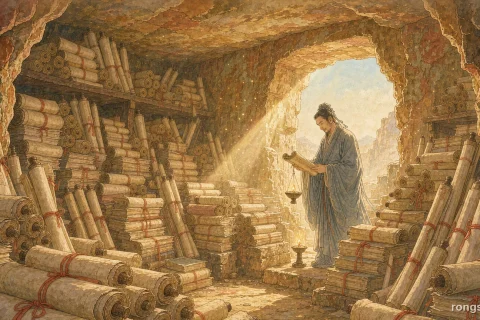
For the next twenty years Zhang Juzheng did small jobs in the academy and in the state college, most of them involving paper. He spent those years collecting every file, memorial and account book he could get his hands on and going through them, sorting them, and thinking about them.
In 1549 he sent up a memorial listing what he considered the five diseases of the state. The imperial clan was out of control. Officials neglected their posts. The bureaucracy ran on habit. The frontier was not maintained. And the treasury was empty.
The memorial was read, filed, and never acted on.
Two men who shared that academy with him went on to run the government themselves, one after the other. Xu Jie was the subtle one. Gao Gong was the hard one. In the 1560s the two of them fought each other to a standstill, and Zhang Juzheng, in between, managed to stay on good terms with both.
He waited another twenty years.
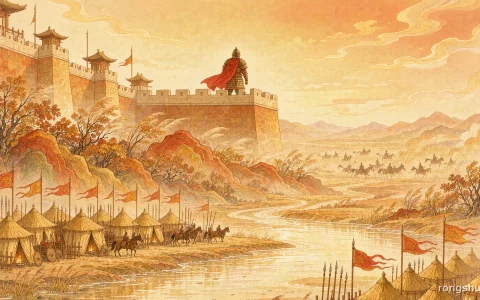
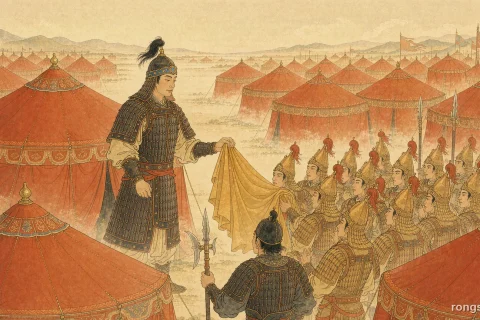
In 1567 the emperor died and the man who had been waiting behind him took the throne. Zhang Juzheng had been that man’s tutor, and he moved straight into the inner cabinet. Over the next six years he did two things: he rebuilt the northern defences, and he made peace with the Mongol leader Altan Khan. In 1571 the Ming court gave Altan Khan a title, opened border markets, and ended decades of raiding.
In 1572 the emperor died again. His heir was a boy of ten, Zhu Yijun.
Zhang Juzheng, working with the chief eunuch of the palace, pushed the sitting chief minister out of office and took his place.
The person in charge of the empire was ten years old. The boy’s mother trusted Zhang Juzheng. The most powerful eunuch in the palace backed him. That was all he needed.
He ran the government for ten years.
Three Ledgers
The first thing he did was not a reform. It was an audit.
In the winter of 1573 he put a system called the examination of results into force.
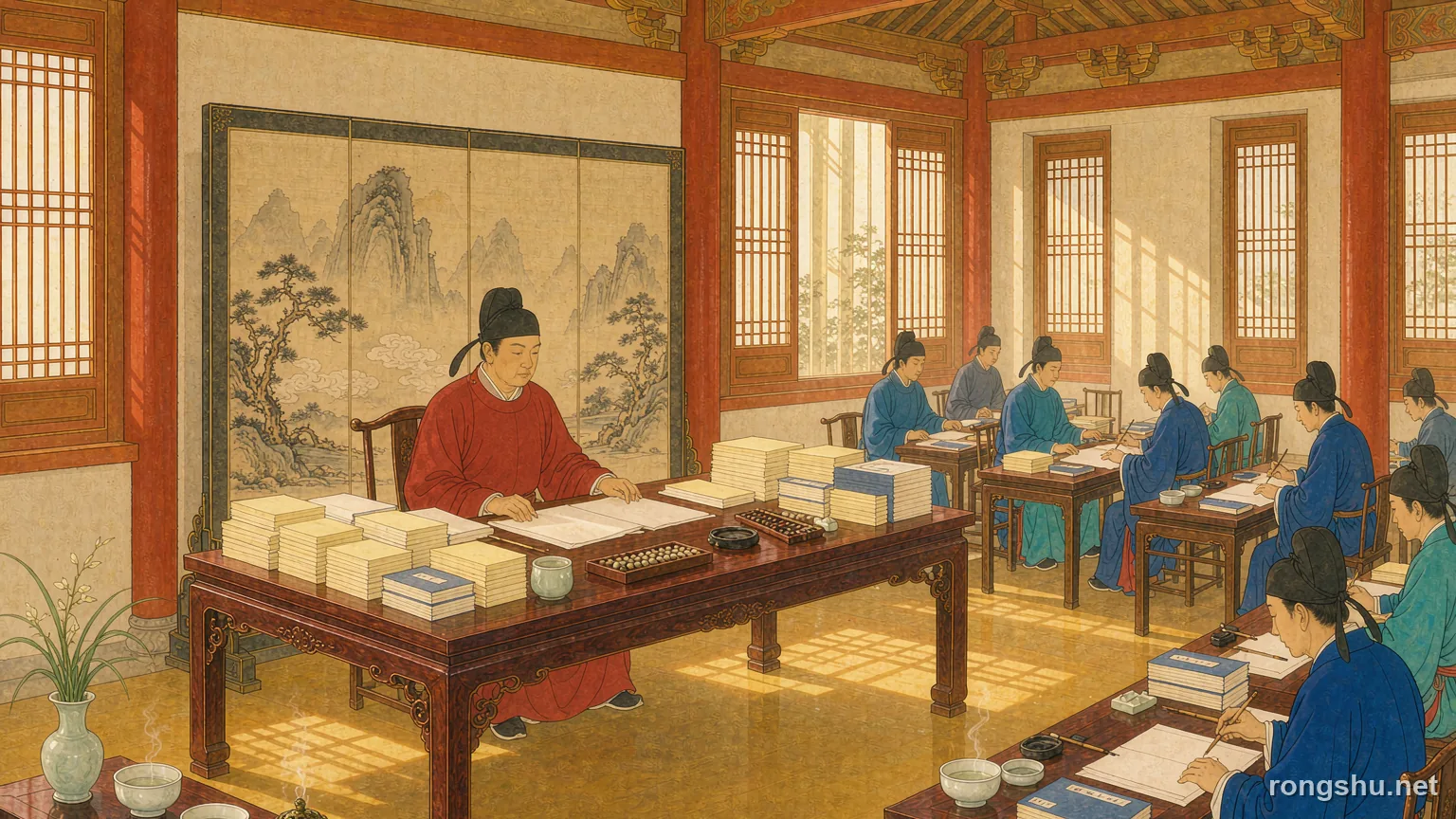
The idea was simple to describe. Every time the throne approved a piece of business, the ministry concerned had to set a deadline for it, then enter it in three ledgers. One copy stayed in the ministry as a running list, with items crossed off as they were finished. One copy went to the six offices of scrutiny, so that the censors could check against it. One copy went to the inner cabinet, so that the cabinet could check against the censors.
Monthly review, annual reckoning.
Under the old rules, a document was finished the moment it left the desk. Whether anything happened afterwards, and when, and how well, was nobody in particular’s business. A provincial official could sit on an order for a year, then send back a vague reply, and that was the end of it.
The three ledgers closed that road.
What made them bite was that they turned whether the work was done into a line that could be checked. An official could no longer write back that the matter had been referred onward, or that his subordinates had been instructed to look into it. He had to report an outcome, and the censors tallied it every month. If the tally did not match, the deadline was enforced, and the penalties were written down: demotion, a year of salary, removal from office.
The history gives the result in eight characters. Even ten thousand miles away, orders were carried out the day they arrived.
That is an exaggeration. But some of it was real. In the first year, a group of officials in Shandong and Henan who had failed to collect their assigned taxes were demoted and fined. Within months, men governing whole provinces and one minister in the southern capital were removed because their figures did not balance.
He also used the system to cut people. In the eight months from the winter of 1578 to the summer of 1579, five hundred and ninety-five redundant posts were abolished.
He used it to pick people too. Qi Jiguang on the northern frontier and Li Chengliang in the northeast were his appointments. So was Pan Jixun, whom he put in charge of the Yellow River. Zhang Juzheng gave Pan Jixun two things: all the money he asked for, and a deadline. If the dikes were not finished on time, he would go to prison.
The three ledgers were less a law than a whip. Their power did not live in the text. It lived in one man, because the last link in the chain, the cabinet, was Zhang Juzheng.
The Single Whip
The second thing he touched was money.
Ming taxation came in several pieces. Land tax was paid in grain. Labour service was paid in bodies, by men who had to turn up and work. On top of that came a long list of local levies with local names. All of it passed through the hands of village collectors, and by the time the grain and the silver reached the state, the difference between what the farmers paid and what the treasury received was enormous.
Before he could change the tax, he had to know how much land there was.
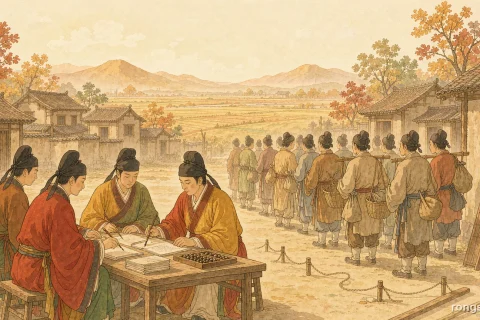
In 1580 a trial survey in Fujian was finished, and he ordered the measuring of farmland across the empire, with three years to complete it. That winter a set of eight regulations went out. Three years later the survey was essentially done, and the registers showed more than a million and eight hundred thousand additional acres that had never been declared.
Only then could the tax be rebuilt.
In 1581 he ordered the single whip method to be applied everywhere.
In one sentence: land tax, labour service and all the local levies were merged into a single payment, assessed on land, converted into silver, and collected and transported by the government directly.
Behind that sentence sat a much larger change. Silver had been pouring into China from Japan and from South America for half a century, and by then ordinary buying and selling was already done in silver. What Zhang Juzheng did was make the state follow the market. No more grain. No more bodies. Silver.
That sounds like an accounting change. It was not. Labour service used to mean a man leaving his fields to work for the state. Now it meant silver, and a man could pay someone else to go in his place. And because the government collected directly, the middlemen who had lived off the old system were simply cut out of it.
When Zhang Juzheng died in 1582, the state granaries held ten years of grain, and the horse administration alone was sitting on four million taels of silver.
The Year He Would Not Go Home
In 1577 his father died, in Jiangling.
The rule was absolute. An official whose parent died had to resign and go home for twenty-seven months of mourning. There were no exceptions. An exception was a confession that a man did not know how to be a son.
Zhang Juzheng could not go. If he went, the three ledgers, which rested on him alone, would fall apart in a week.
The emperor issued an order that he was to stay at his post. His rank and his office were untouched. He was to wear plain mourning cloth, keep his mourning in his office, and carry on.
He petitioned to be allowed home anyway, more than once. The emperor refused every time, in his own hand. You are the arm and the rib of my body, the reply ran. How could you go. Behind the answer stood the boys mother and the chief eunuch, both of whom needed Zhang Juzheng exactly where he was.
The court exploded.
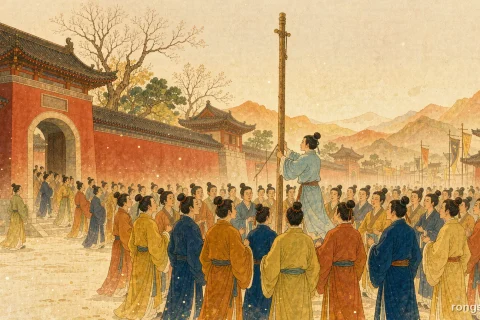
It was not one or two men. The junior scholars of the Hanlin Academy signed a joint protest. Officials used the word unfilial in memorials addressed to the throne. People gathered outside his house to shout at it.
His answer was the rod. The men who sent up protests were beaten in the courtyard of the palace, and some were sent into exile, and a few were stripped of office and made commoners. One of them, a young official named Zou Yuanbiao, was beaten so badly that his leg was broken, and he walked with a ruined leg for the rest of his life.
After that, the man changed.
He stopped bothering with appearances. Before, he had been willing to give people room. After, anyone who stood in the way was flattened. And this is roughly where the histories begin to split on him: on one side the phrase used is the minister who saved the age, and on the other it is the overmighty servant.
The Day They Sealed the House
In the sixth month of 1582 Zhang Juzheng died in office. He was fifty-eight.
The emperor gave him a great funeral. A posthumous title, an honorific name, days of court mourning, an escort home to Jiangling with officials lining the road.
Six months later an investigating censor sent up a memorial listing fourteen crimes.
In 1583 his ranks and his honours were stripped from him.
In the fourth month of 1584 the emperor ordered the confiscation of the family property in Jiangling. The men sent to carry it out were a palace eunuch and a vice minister of justice.
What they found was a little over ten thousand taels of gold and something over a hundred thousand taels of silver.
That is a large sum. It was also less than a twentieth of what had been taken from the last great corrupt minister to fall. The investigators concluded that the rest must be hidden, and set about finding it.
What followed is recorded plainly.
The vice minister in charge, Qiu Chun, had a name in the capital for harshness. Members of the family were taken away one by one and questioned about where the rest of the silver was. The eldest son, Zhang Jingxiu, signed a statement admitting to tens of thousands of taels, and then, while his guards were looking the other way, hanged himself in his room. His note is preserved, and it is not addressed to his family. It is addressed to the men running the case.
The third son jumped into a well, then refused food, and failed to die. He was sent into exile.
Brothers, sons and nephews were stripped of office or sent away. And before any of that, more than a dozen people had already starved to death inside a sealed house.
A man who had once made the whole empire work to his calendar could not, two years after his death, keep his own front gate shut.
The reforms he left behind split into two fates.
The first to go was the examination of results. Zhang Siwei and Shen Shixing took over after him, and the system loosened within a year, and then existed only on paper. The reason is not hard to see. It had never been written into the law. It was a working habit by which the chief minister overshadowed the six offices of scrutiny, and when the chief minister fell, the censors took their authority back on the first day.
The other half lasted. The single whip method was never abolished. It ran to the end of the Ming, and when the Qing took power they merged the land tax and the head tax into one, a reform whose ancestry runs straight back to the order of 1581. And the land figures from the survey became the tax base for the next two centuries. On the day Qing troops entered China, the new emperor’s first proclamation said so outright: the land and the grain taxes are to be levied exactly according to the registers of the previous dynasty.
In 1622 the court restored Zhang Juzheng to his offices and his name.
By then the emperor had changed. Once he was governing for himself, he stopped wanting to see people and stopped wanting to read papers, and for decades he barely appeared at court. The boy who had been made to sit and study under Zhang Juzheng grew up and threw out his rules one by one.
One detail is worth keeping. Among the men who argued for that restoration was Zou Yuanbiao, the young official whose leg had been broken on his orders, forty-five years earlier.
He was an old man by then, and he stood up in the court and spoke for him.
Zhang Juzheng is buried in what is now the city of Jingzhou, and the grave is still there. The house was not so lucky.
England had a man like this too, in the same century.
Thomas Cromwell rebuilt the machinery of the English state for Henry VIII. Records, accounts, the whole paper flow of government: the English state ran as smoothly as it did in the 1530s in large part because he had built it that way.
In 1540 the king turned on him, and he was executed on Tower Hill.
A man who puts a country in order, and is then put in order by it, is a pattern that both places produced.
The difference is that when Cromwell lost his head, Zhang Juzheng was fifteen years old and still at his books in Huguang.