It was night.
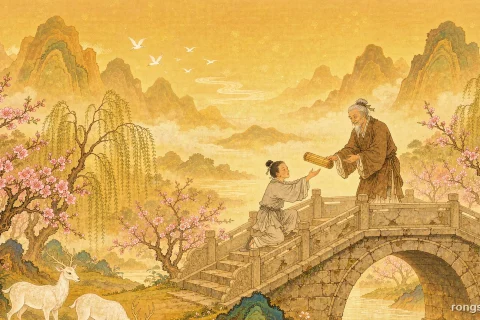
The door of a shed full of firewood was locked from the outside. Inside was a girl of twelve or thirteen.
She had not had a proper meal in days. That afternoon she had woven cloth a little too slowly, and for that she had been beaten and shut in, with no food and no sleep.
She worked a hole in the roof of the shed and climbed out.
She ran all the way to the bank of the river, slipped down into the hold of a boat, and lay there without a sound.
The boat left.
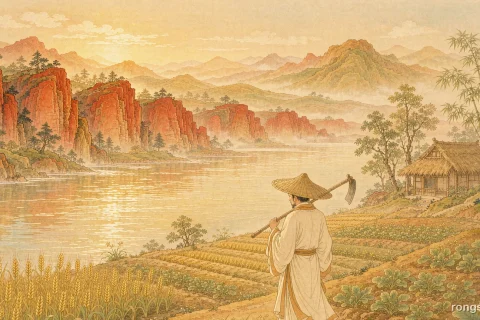
Where it was going was the far south of Hainan, the island at the southern edge of the country, to a place called Yazhou.
(This part of the story is first set down by a writer of the Yuan dynasty, in a collection of his prose. How a runaway girl got onto that boat, and how she reached Hainan, is a tale handed down rather than recorded. But the tale has been told for seven hundred years, and people have kept it.)
Her name was Huang Daopo.
In fact her real name did not survive. Daopo is what later generations called her, and in the language of the time it meant an old woman of great skill and virtue.
So the name we use for her is a title of respect, not a name.
The Night She Ran Away
Huang Daopo came from a town called Wunijing, in the prefecture of Songjiang. The place is now part of the city of Shanghai.
She was born about the year 1245.
Wunijing was a small river town with too many people and too little farmland, and almost every household wove cloth to make ends meet.
The last decades of the Song dynasty were hard. War came from the north, and taxes rose year after year. Poor families could not raise many children, and sending a daughter away as a child bride, to be raised in the household of her future husband, was one of the few ways out.
She went into that house and became a pair of hands that cost nothing.
Up before light, carrying water, cooking, minding children, sitting at the loom until midnight. The mother in law was cruel and the husband was rough. There were beatings and there was shouting, and there was never a day of rest.
The night she ran was the real beginning of her life.
She was thirteen or fourteen when the boat reached Yazhou.
A girl from somewhere else, with no money and no one who knew her.
The people there took her in. She settled in Yazhou, and she stayed more than thirty years.
Thirty Years in Yazhou
Cotton was not native to China.
It came in from the west and from the south, reaching the frontier regions first and the heartland later. In the Tang and Song dynasties cotton was grown only in the far south and the far west, and only toward the end of the Song did farmers in the Yangtze delta begin to try it.
But growing cotton and making good cloth out of it are two different things. Planting it is easy. Turning the fibre into a piece of cloth takes an entire set of tools and skills.
Hainan was then one of the great cotton regions of the country.
The Li women of the island had been growing cotton on a large scale since the eleventh century. They had a full set of tools and methods: iron rods to crush the seeds out of the fibre, small bows to fluff the cotton, then spinning, then the loom.
What they made had many names. There was plain cotton cloth. There was a fine dense weave. There were brocades with patterns, and heavy quilt covers, and patterned blankets and saddle cloths.
The island brocades carried frogs and birds and dragons, the creatures people saw every day. Their loom was unlike the looms of the mainland: one end tied to the weaver’s waist, the other held by the feet. The cloth came out narrow, but the patterns could be wonderfully fine.
In those years these goods were sent to the capital as tribute.
This is what the girl from the south learned.
She lived among those women. She went to the fields with them, spun with them, sat at the loom with them. When one of them wove to show her how it was done, she tried it again and again.
What she learned was not only the handwork. It was how the tools were made: which piece of wood served as an axle, what the bowstring was made of, what angle the treadle should sit at.
She kept her own home in her mind the whole time.
As she learned, she compared: this way of spinning is faster, why. This way of fluffing cotton makes it softer, why.
Between learning and comparing, thirty years went by.
Some of the cloth she made in those years was surely sold to buy a day of food. What is certain is that her hands grew quicker with every year.
A runaway girl had become a craftswoman with real skill in her hands.
Coming Home to Wunijing
In the last years of the thirteenth century, she took a boat back to Songjiang.
She had left as a child. She came back as an older woman.
What she carried home were her tools, a treadle wheel, a heavy bow, and a pair of very practised hands.
She had also come at the right moment. Early in the Yuan dynasty the government set up an office in the south to collect cotton as tax, and the growing and weaving of cotton was being pushed as serious business.
Her skills met a market that was just beginning to grow.
What she found at home made her heart sink.
Songjiang was already growing cotton. But its tools and methods were still at a clumsy stage.
Seeds were picked out of the fibre by hand, one by one, and a woman could get through very little of it in a day.
Cotton was fluffed with a small bow barely a foot long, and the fibre came out lumpy and uneven.
Spinning was done on a hand turned wheel with a single spindle: one hand turned while the other drew the thread, slowly, and the thread broke easily.
A loom produced a few feet of cloth a day. Slow cloth sold cheap, and a farming family could work the whole year through and still make almost nothing.
She took out what she had learned, one piece at a time.
The village women did not believe her at first. Someone asked how one spinning wheel could turn three spindles at once.
She set the machine up and spun for them where they stood. The women who watched went home, and came back the next day with their daughters.
She began to teach.
What She Brought Back
The first thing she changed was the machine that takes the seeds out of the cotton.
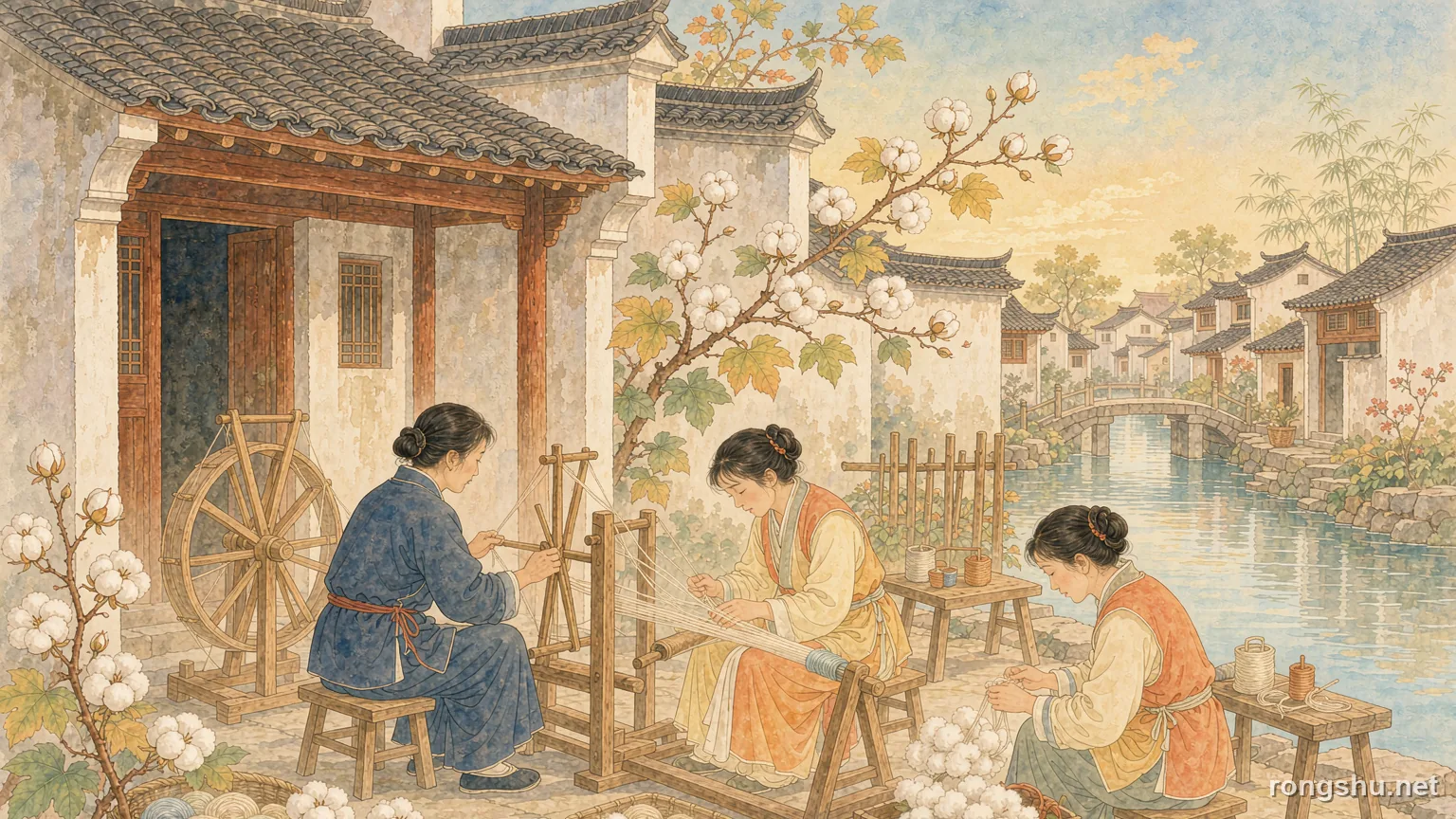
In Yazhou they used a treadle, and from that she and the local carpenters built a gin: two rollers turning against each other, so that the seeds were squeezed out between them and the cotton came away on the other side. One of the two rollers was made of iron, to press harder.
The gin took two people to work, one turning at the top and one catching below. What had been done by hand, one seed at a time, was now done by a machine that in a single day could do the work of dozens of people.
The machine was later used all across the lower Yangtze.
The second thing she changed was the bow used to fluff the cotton.
The old bow was too small. She had a bow four feet long made, with a cord of twisted rope, and instead of plucking the string with the fingers the worker struck it with a mallet.
A long bow, struck evenly, opened the cotton into a soft clean mass, and a day of work did what several days had done before.
The third thing she changed was the spinning wheel.
The wheels in use around Songjiang had one spindle and were turned by hand. She changed them into a wheel worked by a treadle, with three spindles, so that both hands were free and three threads could be drawn at once.
This was an extraordinary thing at the time.
In Europe, the wheels of that period spun one thread at a time. Hers was more than a century ahead.
The fourth thing she changed was the weaving itself.
A good machine is not enough; how a cloth looks depends on how it is woven.
Out of her decades of experience she worked up a method that she passed on in four steps: staggering the warp, matching the colours, drawing the heddles, and lifting the pattern threads.
Where the warp threads went, how the colours were set against each other, where the pattern began: all of it had rules. Bed covers, head cloths and ribbons woven this way carried patterns of flowers on branching stems, of paired phoenixes, of chequered fields. The lines were as clear as if they had been painted.
She kept nothing back. She taught the whole of it to the women of Wunijing.
She gave away everything she had.
Taken together, these changes took weaving in the district from a few feet a day for one person to dozens of feet. More cloth meant cheaper cloth.
A Rhyme the Children Sang
The cloth of Wunijing soon had a name.
Other towns learned from it, and the cotton industry grew in the counties along the coast as well.
The most famous product was a quilt called the Wunijing quilt, which sold all over the country. A book of the period describes the cloth made there as bright and clear, as though it had been drawn on.
Within a few decades the cotton cloth of Songjiang was among the finest in China. Merchants came for it from the north and from the south. It went north to the capital and south to the coast, and later it was carried overseas.
The industry gave ordinary farm households a second income. Much of the weaving was done by women, and money in their hands changed their standing in the family.
For several hundred years the region around Suzhou and Songjiang was the richest part of China, and cotton and cloth were what made it rich.
By the end of the Yuan dynasty more than a thousand households in the district lived by cotton.
And the cloth of Songjiang acquired a phrase that is still quoted: the cloth of Songjiang clothes the world.
It is not an empty boast. It means that people across the country wore clothes and slept under quilts made there.
In and around Shanghai, children sang a rhyme:
Grandmother Huang, Grandmother Huang, teach me to spin, teach me to weave, two bobbins, two bolts of cloth.
The rhyme was still being sung well into living memory. Children clapped it out on the doorstep without knowing who Grandmother Huang was, and the name stayed alive that way, generation after generation.
The Grandmother Huang of the song is Huang Daopo.
After her death the people of the district took her as a goddess of weaving.
In 1336 a shrine to her was built, and it was maintained with offerings at the proper seasons. War destroyed it, and it was rebuilt. All told there were more than ten temples, shrines and halls to her in the Shanghai region, and they carried other names as well, among them the Shrine of the Mother of Cotton.
In one of the old gardens in the city a small pavilion built by the cloth merchants guild still stands, and inside it she is honoured as the founder of their trade.
People called her the First Cotton.
When she died is not certain. One account gives 1306; another puts it about 1330.
Before her, what most Chinese people wore was silk and hemp. Silk was expensive. Hemp was coarse.
Cotton cloth was, for a very long time, a rare thing.
What she did was make cotton cloth cheap, strong and handsome, and within reach of ordinary people.
For centuries the official histories gave her no biography. Her story survived in the shrines, in the children’s song, and in a handful of scattered lines by writers. Only in modern times did historians of science go back through the old books and piece her together out of those fragments.
In the Qing dynasty a poet wrote a verse about her.
At the Wunijing shrine they make offerings to old Mother Huang; most of the good sturdy cloth of the district comes from her ground.
She fed us and she clothed us; she was our true mother; year after year the music and the thanks go up to her.
More than seven hundred years after her time, the English historian of science Joseph Needham wrote about her in his great study of Chinese science and technology.
He called her an outstanding innovator in cotton textile technology in the thirteenth century.
Today there is a grave for Huang Daopo in Huajing, outside Shanghai, and a small museum beside it. In 1957 the grave was repaired and a stone tablet was set up.
In 1980 China issued a postage stamp with her image on it.
The woman on the stamp never left a portrait behind.
What she left behind was a rhyme, and many millions of cotton garments worn by ordinary people.