In 218 BC a convoy of carriages rolled east out of the Qin capital.
One carriage in the middle was larger than the rest, with curtains hanging on all four sides.
Inside sat a man who had conquered the six warring states a few years earlier and had taken a new title for himself: the First Emperor.
At a place called Bolangsha, in what is now Henan, someone was waiting by the road.
The waiting man was young, and beside him lay a great iron hammer. It weighed one hundred and twenty jin, which in that period came to about thirty kilograms.
The convoy arrived.
A strongman swung the hammer.
It did not hit the big carriage. It smashed into one of the escort carriages and killed everyone inside.
The First Emperor was riding in a different one. He knew how many enemies he had made, and he travelled with several identical carriages so that nobody could tell which one carried him.
The young man fled in the confusion.
The emperor was furious and ordered a nationwide search. It went on for ten days.
They never found him.
The young man was Zhang Liang.
The story is set down in the Records of the Grand Historian, written by Sima Qian. A nobleman of a destroyed kingdom spent his whole fortune to hire a strongman, and tried to cut a new dynasty short with one blow of a hammer.
He failed.
But what he did afterwards mattered far more than that carriage.
Zhang Liang came from the state of Han, one of the seven warring states that the First Emperor had swallowed up. This Han is not the later Han dynasty, and it has nothing to do with Korea. It was a small kingdom in the middle of China, and it was the home of Zhang Liang and his family.
His grandfather had been chancellor of Han, and so had his father. Between them they served five kings, and the family was one of the great ones of the state.
In 230 BC, Qin destroyed Han.
Zhang Liang was still a young man then. He had money, three hundred servants, and a younger brother who had died and had not yet been buried.
He did not bury him.
He took everything the family owned and used it to find a man who could kill the First Emperor.
The Records put it in eight characters: his brother died unburied, and he spent the whole family fortune to hire an assassin.
A man who would not even bury his own brother, because he had one thing left to do.
So there was Bolangsha.
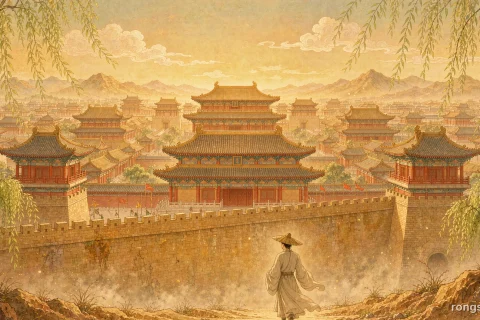
Afterwards he changed his name and fled to a town called Xiapi.
A wanted man does not walk in the open. By any ordinary reckoning, the story should end here.
But in Xiapi he met someone else.
The Old Man on the Bridge
Outside Xiapi there was a bridge.
One day Zhang Liang was walking across it when an old man in coarse cloth came the other way.
The old man stopped in front of him, took off his shoe, and threw it down from the bridge.
Then he said: Boy. Go down and fetch my shoe.
Zhang Liang was startled. He wanted to hit the man, but the man was old, so he held back, went down, and brought the shoe up.
The old man put out his foot. Put it on me.
Zhang Liang knelt down and put the shoe on his foot.
The old man smiled and said: This one can be taught.
He told Zhang Liang to come back at dawn five days later.
Five days later Zhang Liang went before daylight. The old man was already on the bridge, and he was angry. How do you make an appointment with an old man and then arrive late? Go away. Come back in five days.
The second time Zhang Liang went at the first crow of the rooster. The old man was there before him again.
The third time Zhang Liang went at midnight and waited on the bridge.
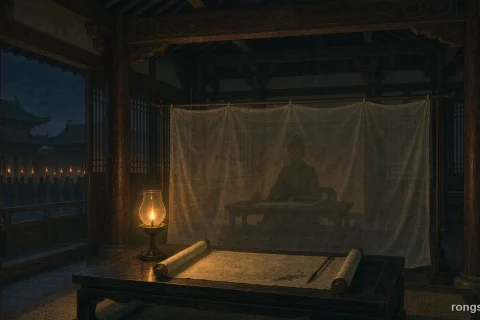
After a while the old man came, pleased this time, and took a scroll from inside his robe.
Read this, he said, and you can be a teacher of kings. In ten years you will rise. Thirteen years from now you will see me again in the north, and the yellow stone at the foot of Mount Gucheng will be me.
Then he left, and was never seen again.
The scroll was a book of military strategy, the Art of War of the Grand Duke.
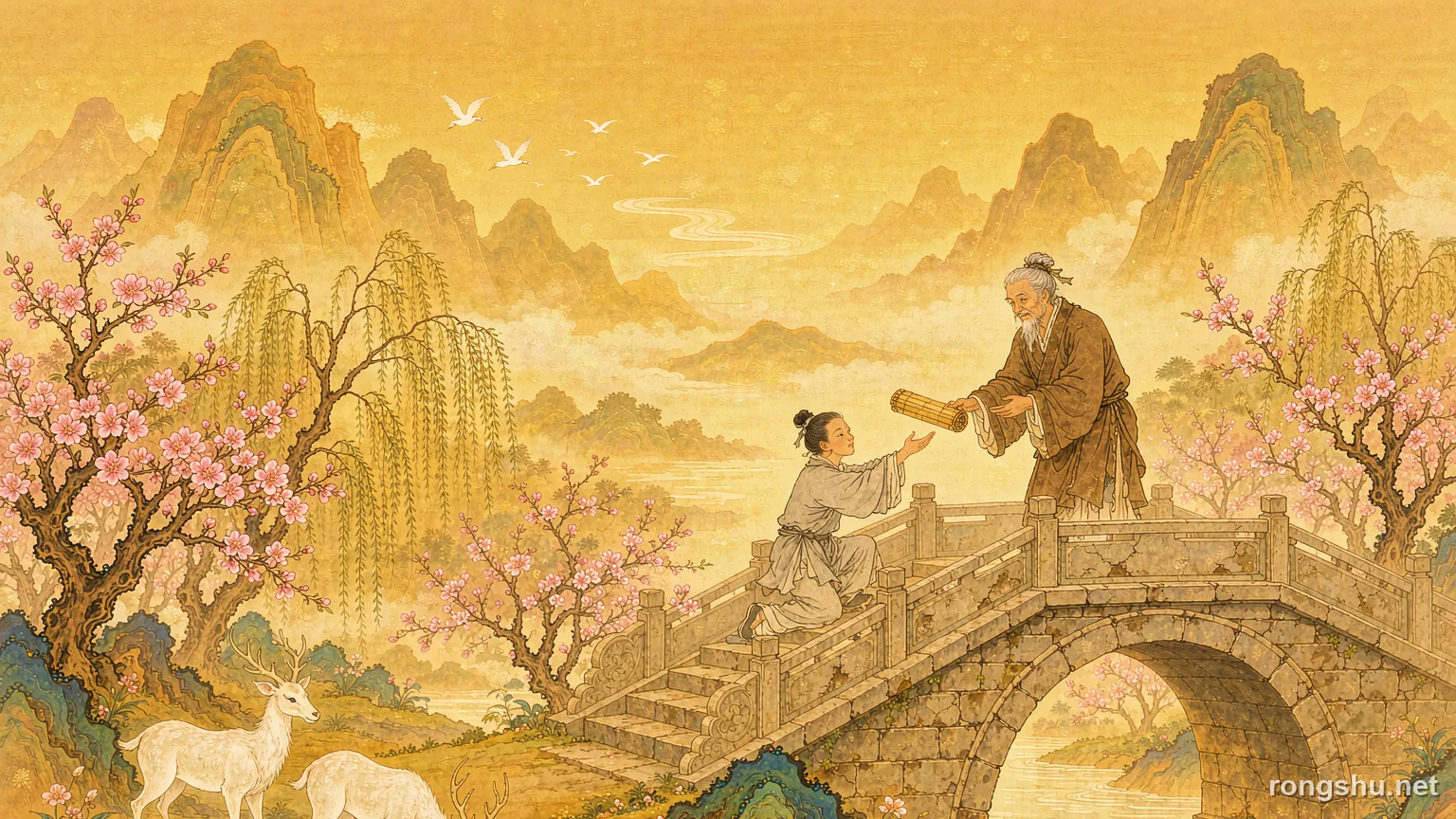
All of this is in the Records of the Grand Historian, written out in detail, down to the dialogue.
Who the old man actually was has been argued over for two thousand years. Some say a recluse. Some say a spirit of that yellow stone. Some say Zhang Liang invented him, because a hired killer who wants to become an adviser needs a story about where his knowledge came from.
True or not, from that day on Zhang Liang was no longer a man with a hammer.
The Meeting at Liu
Ten more years passed, and the empire did fall apart.
In 209 BC a group of conscripts delayed by rain decided that they would be executed for being late anyway, and rebelled. Their names were Chen Sheng and Wu Guang, and the whole country answered.
Zhang Liang raised a band of a hundred young men and set out to join a leader who called himself the King of Chu.
On the way he met Liu Bang.
Liu Bang had a few thousand men and was moving through the same country. The two men took to each other at once. Zhang Liang explained the military book he had been given, and Liu Bang understood it. Better than that, he used it.
Zhang Liang had told the same things to other men, and they had not understood.
Liu Bang understood.
Zhang Liang said one sentence about him: this man is a gift from heaven.
From that day on Zhang Liang stayed with him and never left. He was later made Marquis of Liu, and the title came from the town where their roads crossed.
A Borrowed Chopstick
Liu Bang won the empire with three men.
For fighting he had Han Xin. For the supply lines and the home base he had Xiao He. For counsel he had Zhang Liang.
Liu Bang said so himself, in a sentence every Chinese schoolchild learns. In a tent, sitting and working out a plan, a man can decide how a battle a thousand miles away will go. That, he said, I cannot do as well as Zhang Liang.
Zhang Liang never held a battlefield command and never ran a province, and was still counted among the three.
In 206 BC Liu Bang was the first rebel leader to enter the heartland, and the Qin dynasty ended. Then Xiang Yu arrived with far the larger army, pushed Liu Bang out to a remote region in the southwest, and made himself Hegemon of Western Chu.
Between those two events lay a banquet, at which Xiang Yu fully intended to kill him. Zhang Liang had learned in advance that Xiang Yu’s own uncle was friendly to Liu Bang, and he used the man as a shield. Liu Bang walked out alive.
For the next four years the two men fought for the empire, and Zhang Liang supplied several of the decisions that shaped it.
The first was a refusal.
At one point Liu Bang was losing badly, and an adviser proposed a clever solution. Find the descendants of the kings of the six destroyed states, restore their kingdoms, and every one of them will be grateful and fight for you.
It sounded reasonable, and Liu Bang was about to agree.
Zhang Liang came in, borrowed the chopsticks lying in front of Liu Bang, and used them to lay out his argument on the table, one point at a time. Do this, he said, and we are finished.
His first reason was the strongest. The men who have left their homes and families to follow you are not doing it for your sake. They expect land. Give the land to the old royal families instead, and every one of them will go home to serve his own lord. Who will be left to fight your war?
Liu Bang stopped eating, spat out the food in his mouth, and cursed the adviser. This fool nearly ruined everything.
The second decision was about pursuit.
In 202 BC the two men agreed to divide the empire along a canal and end the war. Xiang Yu turned east, and Liu Bang was ready to do the same.
Zhang Liang and another adviser stopped him. We already hold most of the empire, they said. Their army is exhausted and their food is gone. This is the moment heaven is handing us Chu. Let a tiger go back into the mountains and you will have to deal with him again.
Liu Bang turned around and followed, caught Xiang Yu at a place called Gaixia, and surrounded him.
That night the besieging army began to sing the songs of Chu from all four sides. Xiang Yu heard them and believed that all of Chu had already fallen. His men began to slip away in the dark.
He broke out with a few hundred horsemen and killed himself on the bank of a river.
The third decision was about the capital.
With the empire won, Liu Bang wanted to sit at Luoyang. A conscript soldier named Lou Jing got himself an audience and argued for the region around Chang’an instead. Unable to decide, Liu Bang asked Zhang Liang.
Luoyang is open on all sides, Zhang Liang answered, and can be attacked from any of them. Chang’an sits behind mountain passes, with rich farmland and the grain of Sichuan at its back. Three directions can be held, and only one has to be watched.
Liu Bang moved west and made Chang’an his seat that same day.
The word of a common soldier became the foundation of four hundred years of empire, because one man nodded at it.
The Four Old Men of Mount Shang
In his last years Liu Bang had one problem he could not solve: his heir.
He was fond of a son by his favourite concubine and wanted to set aside the empress and put that boy on the throne instead. The ministers were against it, almost all of them, and none of them could move him.
The empress panicked and sent for Zhang Liang.
At first he excused himself. This is a family matter, he said. An outsider will not be listened to. She kept sending people to ask, and in the end he gave her a plan.
There are four men, he said, whom the emperor has wanted for years and has never been able to get. They are very old. They ran off into the mountains because the emperor insults scholars, and they have refused every invitation.
Have the crown prince write to them himself, in the humblest terms he can manage, and send a courteous messenger with generous gifts.
The four men came.
Some time later, at a banquet, Liu Bang saw four white-browed old men standing behind his son and asked who they were.
They gave their names.
Liu Bang was astonished. I have been trying to find you for years and you would not come to me. How is it that you now follow my son?
Because you despise scholars and curse them to their faces, they said. We were not going to be treated that way. Your son is different. Men are willing to die for him, so we came.
They drank a toast and went out.
Liu Bang watched them leave, then called the concubine over and pointed after them. I wanted to change the heir, he said, but those four men are with him now. His wings have grown.
She wept.
He told her to dance a dance of her home region for him, and he would sing. He sang a short poem about a great swan whose wings are already full.
Nothing more was said about changing the heir, and the boy became emperor after him.
The Yellow Stone at Gucheng
After the empire was settled, Zhang Liang did less and less.
When Liu Bang handed out titles he told Zhang Liang to choose for himself any thirty thousand households he liked in the rich east.
Zhang Liang refused.
I met Your Majesty at Liu, he said, and heaven gave me to you. You acted on my plans, and by luck they worked. A small place like Liu is enough for me.
That became his title: Marquis of Liu.
He said afterwards that he had done quite enough, using nothing but his tongue to become a teacher of emperors, and that he wanted now to put human affairs aside and go wandering with an immortal of the mountains.
He began to practice an old Daoist discipline of not eating grain, living on a little medicine instead.
The empress told him to stop making himself suffer. A life is short, she said, like a white horse passing a crack in a wall.
He ate a little, for her sake.
In 186 BC Zhang Liang died and was given the posthumous title Marquis Wen Cheng. In Chinese custom a great man receives, after death, a name that sums up his life, and the word chosen for him means cultured and accomplished.
Of his death the Records say almost nothing.
But one thing the old man on the bridge had said did come true.
Thirteen years from now, the old man had told him, you will see me again in the north, and the yellow stone at the foot of Mount Gucheng will be me.
Thirteen years later Zhang Liang was passing through that country with the emperor, and at the foot of Mount Gucheng he found a yellow stone.
He took it home and kept it like a treasure.
When he died, his family buried the stone with him. And when they came to tend the grave, they made offerings to the stone as well.
That hammer at Bolangsha had broken an escort carriage and killed the wrong men. The man who swung it had wanted the whole thing to end there, with the First Emperor dead and the young nobleman either dead or famous.
It did not.
Because it missed, there was Xiapi, and Liu Bang, and the banquet, and the singing from four sides at Gaixia. Because it missed, there was a dynasty that lasted four hundred years, and a yellow stone buried beside a man at the foot of a mountain.