In the summer of 91 BC, two armies fought in the streets of the capital.
One belonged to the emperor.
One belonged to the crown prince.
The fighting lasted five days.
When the histories came to set it down, they used four words: tens of thousands dead.
The prince who lost was Liu Ju. He was the eldest son of the emperor, and he had been the heir for more than thirty years.
The order to put down the rising came from the emperor himself.
His name was Liu Che. History remembers him as Han Wudi, the Martial Emperor of Han.
That year he was sixty-six years old.
A Sixteen Year Old Emperor
Liu Che was born in 156 BC, the tenth son of Emperor Jing.
At four he was given a small kingdom of his own.
At seven, the existing heir was set aside and he took that place.
In 141 BC his father died.
Liu Che was sixteen. He put on the robes of an emperor.
Real power, though, was still six years away.
The person who mattered at court was his grandmother, the Grand Empress Dowager Dou. She held to the old teaching of quiet rule, and she had no patience for Confucian scholars.
Her grandson wanted the scholars.
Barely on the throne, he raised two of them to high office and set them to redesigning the court ritual, the calendar, the colours of the banners, the whole show of a new reign.
The old woman did not argue. She acted.
Both men were thrown into prison and died there. Two of the great offices were handed to other men.
The boy emperor had reached for power and had his hand pushed back.
He waited six years.
In 135 BC the Grand Empress Dowager died.
Liu Che was twenty-one. Now the word was his.
One of his first acts was to change empresses. She was a cousin of his, married to him for years without a child. In 130 BC she was accused of calling in women to curse a favourite of the emperor. She was set aside and sent to a distant palace. It was the first witchcraft case of his reign. Nobody imagined then that forty years later the same charge would fall on his own heir.
Below him lay a very rich country.
His grandfather and his father had spent decades keeping taxes light and wars few. The histories describe the storehouses of those years: strings of coins in the capital piled so high that the cords rotted through, grain in the great granaries heaped in layer after layer until it spilled outdoors.
The money was there. The grain was there. The soldiers were there.
The question was what this young emperor would do with them.
He had one answer, and it fit in a single line: he would spend everything that two generations had saved.
The Wars That Made an Empire
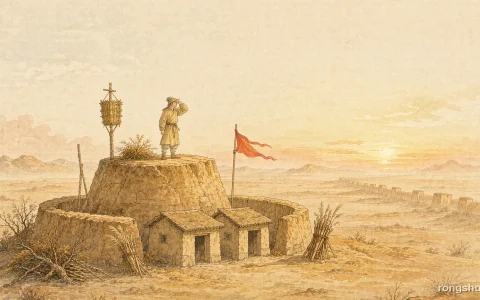
To the north lived a people called the Xiongnu, riders of the grassland.
Han had never beaten them. The founder of the dynasty had been surrounded by them for seven days, and for the next sixty years the court had bought peace with marriages and gifts.
Liu Che did not want to keep buying.
In 133 BC he set a trap at a frontier market town, hoping to draw the Xiongnu into an ambush. The plan leaked. Nothing came of it.
But the fighting began with his reign.
He had two men.
The first was Wei Qing. Wei Qing came from nothing. He had been a groom in the household of a marquis, and only the rise of his sister at court gave him his chance.
The second was Huo Qubing, Wei Qing nephew, who went to war at eighteen.
In 129 BC Wei Qing led his first raid beyond the frontier and struck the holy place where the Xiongnu made their sacrifices. It was the first real victory Han had won against them.
In 127 BC he took back the great bend of the Yellow River and pushed the frontier north of the capital.
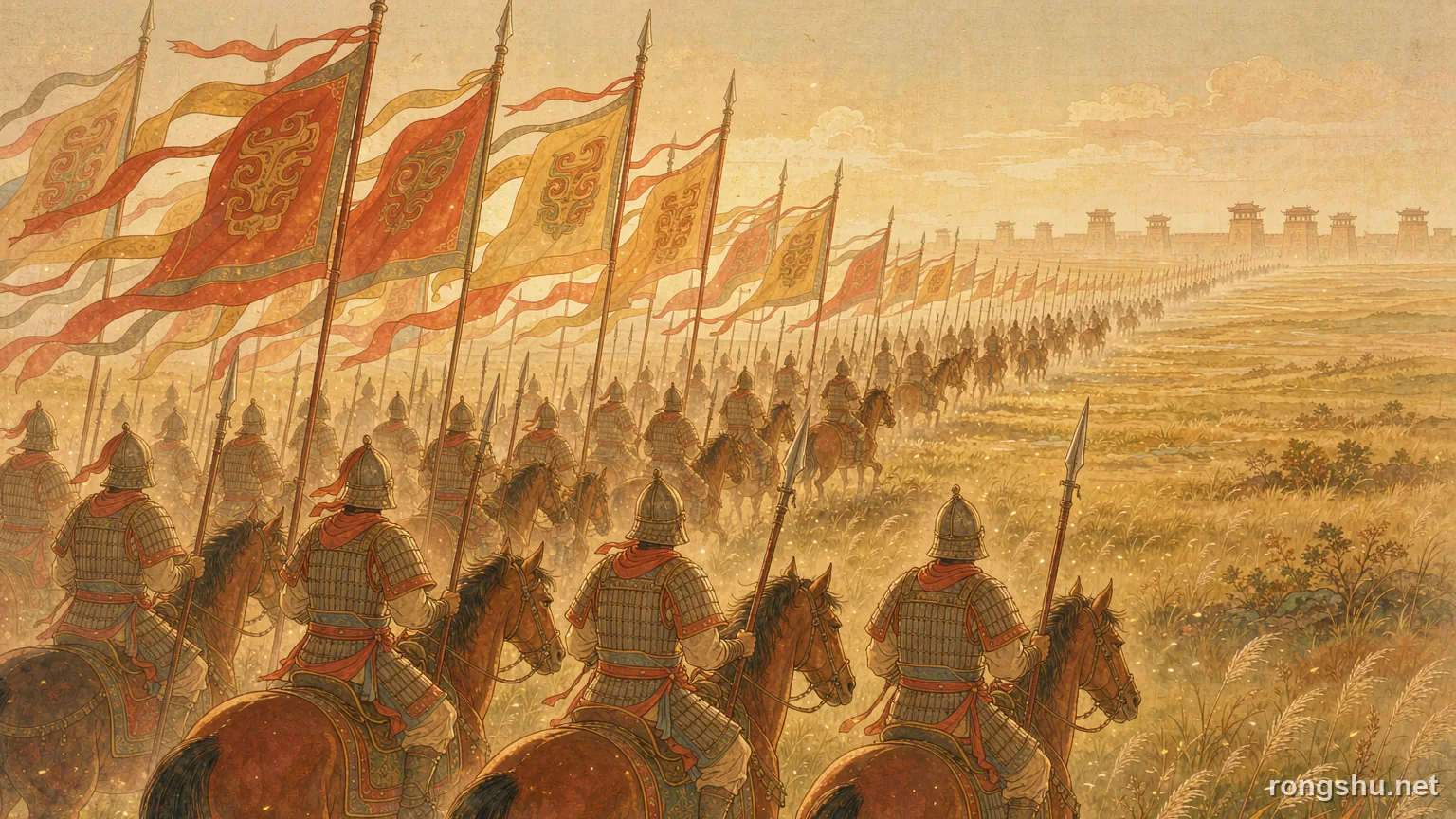
In 121 BC Huo Qubing rode out to the west twice. On the first raid he took ten thousand men and covered a thousand miles in six days, and came back with a golden idol from a Xiongnu shrine. On the second he opened the long corridor that runs west toward the deserts.
With that corridor open, Han planted four new commanderies along it: Wuwei, Zhangye, Jiuquan and Dunhuang.
Only then could a road to the far west really begin.
In 119 BC the uncle and the nephew went out together.
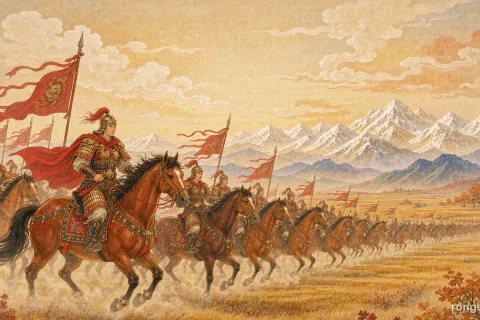
Each took fifty thousand horsemen through the Great Wall and hunted the Xiongnu into the northern desert. After that campaign the Xiongnu pulled away, and for a time there was no royal camp south of the sand.
Huo Qubing rode as far as a mountain called Langjuxu and built an altar on top to report the victory to heaven.
He was twenty-one years old.
The armies went to other places as well.
In the south they took the kingdom of Nanyue and turned it into nine new commanderies.
In the east they crossed into the Korean peninsula and set up four more.
In the southwest they reached the hill peoples and brought them under registered counties.
And one man was sent out on a road that was not a road at all.
His name was Zhang Qian.
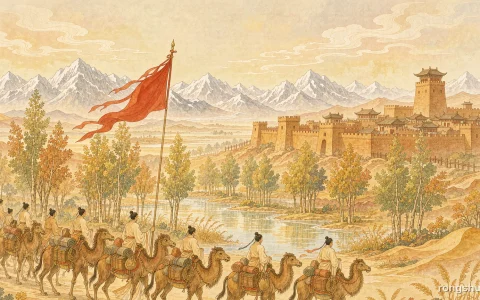
In 138 BC Zhang Qian left with more than a hundred men. His errand was to find a people far to the west and persuade them to attack the Xiongnu from behind.
He was gone thirteen years. The Xiongnu held him for part of that time. His party scattered. Two men came back.
What they carried home was a pile of information about the lands beyond the mountains.
In 119 BC Zhang Qian went out a second time. Now he brought silk and gold, and he came back with envoys from the western kingdoms.
The trade route that later ages would call the Silk Road was first walked out by men such as these.
In 110 BC he rode out beyond the Great Wall with a hundred and eighty thousand horsemen and went on to Mount Tai, where he made the great sacrifice to heaven.
Not everyone who served him ended well. In 99 BC a general named Li Ling marched out with five thousand foot soldiers, was surrounded by eighty thousand Xiongnu riders, and surrendered. One official, the historian Sima Qian, said that Li Ling was no coward and had surely meant to live and repay the court. Those few sentences angered the emperor. Sima Qian was imprisoned and sentenced to castration. He did not die, because he had to finish the book his father left unfinished, the Records of the Grand Historian.
Inside the empire he was busy as well.
The great lords had been a danger since the founding of the dynasty. A minister named Zhufu Yan offered him a device that is usually translated as the extension of grace.
Under the old rule a title passed to one eldest son. Under the new rule every son received a share.
A kingdom, within a few generations, became a scatter of small parcels.
No sword was drawn. The problem solved itself.
He set thirteen inspectors over the provinces to keep watch on the officials.
He took the minting of coins into the hands of the state and made one coin for the whole realm. Salt and iron became government business. New offices bought goods where they were cheap and sold them where they were dear.
Piece by piece, the machinery of Han grew harder.
And the bill came due.
Decades of war ate through everything the earlier reigns had saved. Taxes and labour service grew heavier year by year. In his later reign, two million people were recorded as wandering homeless in the east of the empire.
He had not yet stopped to count the cost.
Wooden Men in the Earth
What a man fears changes as he grows old.
In his youth Liu Che had not been afraid of dying. He ruled for more than fifty years and named one era after another, each a fresh start for the calendar. Only now was he living in a period he called Conquest and Harmony.
He had begun to listen to men who promised that he need not die at all.
Believe in magic, and suspicion follows. He came to think that someone, somewhere, was cursing him and keeping his illness alive.
In the palace there was a practice known as the witchcraft of the wooden figures. A little human shape cut from wood, buried underground, with a charm spoken over it, was said to be able to kill.
Women who had lost his attention brought in others who claimed to know the craft. The business spread, and the accusations spread with it.
In 91 BC he fell ill and went to a distant palace to rest.
A courtier named Jiang Chong came forward. Jiang Chong ran the imperial parks and gardens, and he was one of the harshest officials around the throne. He also had an old grudge: years before, he had prosecuted a servant of the crown prince.
He told the emperor that the air of the palace was thick with curses.
The emperor told him to search.
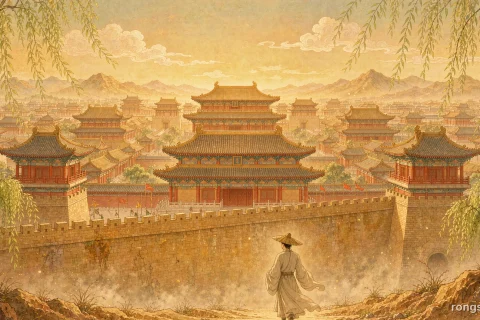
Jiang Chong had the palace dug up. He began among the women of the inner rooms and worked his way inward, and at last he reached the residence of the crown prince.
What they dug out were wooden men.
Prince Liu Ju wanted to go and explain himself to his father, face to face. He was not allowed in.
Between the distant palace and the capital, the messages were carried by men such as Jiang Chong and the eunuch Su Wen, and they passed on what suited them.
The prince could not defend himself with words, so he acted. He seized Jiang Chong and killed him with his own hands.
Once blood was shed, there was no going back.
He called out soldiers and took control of part of the capital, saying that he was clearing away the wicked men around the throne.
In the distant palace, what reached the emperor was a single report: the crown prince has risen in rebellion.
He ordered his chancellor to march on the city.
So father and son fought in the streets of the capital.
Five days. Tens of thousands dead.
The prince lost. He fled the city with two of his sons.
His mother, the empress Wei Zifu, took her own life in the palace.
The prince reached a county to the east and hid in a poor household. When the searchers closed in, he hanged himself.
He was thirty-eight years old.
A year later the emperor learned the truth.
The whole clan of Jiang Chong was put to death. Su Wen, who had kept the messages from getting through, was burned alive on a bridge.
He built a palace and called it the Palace of Longing for the Son.
He built a terrace near the place where the prince had died, and called it the Terrace of Looking Back.
From the terrace you could look out along the road that the prince had taken, away from the capital.
The man was gone.
An Emperor Apologizes
In 90 BC there was one more blow.
A general of the empress family led an army north against the Xiongnu, lost his battle, and went over to the enemy. He had been caught up in the witchcraft cases before he marched.
The emperor had his whole clan put to death.
By then there was little money and little manpower left for war.
The next year, in 89 BC, the minister who managed the treasury proposed a new scheme. Soldiers would be sent to farm fertile land at a place called Luntai, and from there the armies would press step by step into the west.
The emperor said no.
He issued an edict, and in it he admitted his mistakes.
He wrote that the plan to farm at Luntai would burden the people beyond bearing, and would not be carried out.
He wrote that sending the general out on that last campaign had been his own failure of judgement. From then on, he said, the business of the court should be to end harsh rule, to stop extraordinary taxes, and to let the farmers work their land.
Men came to call it the Luntai Edict. Later ages remembered it as an emperor apologizing in public.
He appointed a new chancellor and gave the man a title: Marquis of Enriching the People.
An emperor who had fought for more than forty years ended by naming his chief minister after the wealth of ordinary farmers.
In 87 BC he came to the last stretch of the road.
In the first month he named his youngest son, Liu Fuling, as his heir.
The boy was eight years old.
The Mother of the Young Heir
Right after the investiture, he did one more thing.
He called in the young mother of the new heir, a consort known as Lady Gouyi, found a reason to punish her severely, and had her taken to prison.
She turned to look at him as she was led away.
He waved his hand and said: go. You will not live.
A few days later she was dead.
Someone asked him why, having made her son the heir, he had also put the mother to death.
He gave an answer that is set down in the old records. In the past, he said, when states have fallen into chaos, it has always been because the heir was young and the mother was strong.
He had watched one young family of in-laws tear at the court. He did not intend to see it again.
He entrusted the eight year old heir to four men: Huo Guang, Jin Midi, Shangguan Jie and Sang Hongyang.
In the second month of 87 BC, at a palace called Wuzha, he died.
He was seventy years old.
Today, if you drive through Xingping in Shaanxi, you will see a hill.
It is square and flat topped, and it has stood there for more than two thousand years. It is called Maoling. The man inside it is Han Wudi.
Beyond the same field is another grave.
That one belongs to Huo Qubing, who died at twenty-four, before his own uncle did.
A stone stands in front of it. Carved into the stone is a horse, and under the hooves of the horse lies a Xiongnu warrior.
The emperor inside the great hill spent a lifetime pushing the borders of the world outward, and the last words he left behind were an apology.
The two graves have looked at each other across that field, in the sun, for two thousand years.