In the prison at Xunyang, a man in his late fifties sat waiting to learn whether he would live or die.
It was the year 757. A few months earlier he had been one of the writers attached to the staff of a prince, riding east at the head of an army. Now the prince was dead, and the prisoner was accused of joining a rebellion.
The law said the sentence was death.
He wrote poems in his cell and sent them out to anyone who might help him. His wife went from door to door on his behalf. Two officials got him out of the prison, and one of them gave him a place on his own staff.
It was not over.
In the end a famous general offered to buy the poet’s life with his own rank and salary. The sentence was changed to exile.
Yelang. A place in the far southwest, more than six hundred miles away, as far as a Chinese of that age could imagine being sent.
To understand how a poet came to be waiting in that cell, you have to go back more than fifty years, to a mountain town in Sichuan.
Leaving Home With a Sword
Li Bai was born in 701. Chinese histories count a person as one year old at birth, so the ages given in this account run a year ahead of Western counting.
Where he was born is still argued over. One tradition puts it at Suyeb, a town in what is now Kyrgyzstan. Another puts it in Jiangyou, in Sichuan. He himself mentioned only an ancestral home in the far west, and left the rest vague.
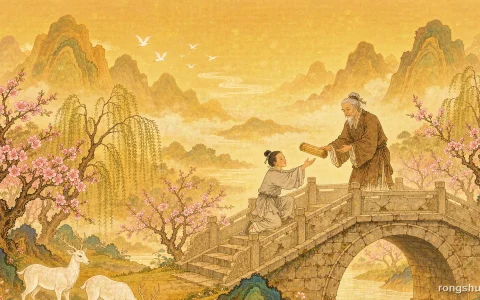
What is clear is that he read books from the age of five, the philosophers at ten, and took up the sword at fifteen.
Later, in a letter asking a senior official for help, he summed up his own youth in two lines. At fifteen, he said, he loved swordplay and went to every lord he could reach. By thirty he had a finished style and had knocked on the doors of ministers. It was an honest description of how he spent his twenties. He was not studying for examinations. He was travelling, meeting people, and asking to be noticed.
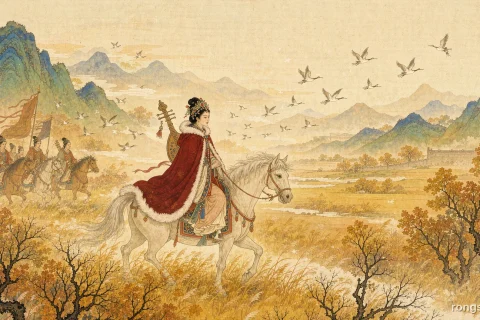
At twenty-four or twenty-five he did something decisive. He left Sichuan and went down the river.
Years later he described it in eight characters. He took his sword, left his country, said goodbye to his parents, and travelled far.
A young man with a sword and some money went out through the passes and did not come back.
He drifted down the Yangtze, past Dongting Lake, Mount Lu, Nanjing, Yangzhou. One autumn he fell ill in Yangzhou with few friends around him, and wrote a desolate poem about being homesick.
One tradition says that the poem he wrote in Yangzhou was the one Chinese children learn before any other. It is four lines long. Bright moonlight in front of his bed, he says, so bright that he mistakes it for frost on the ground. He lifts his head and looks at the moon. He lowers his head and thinks of home. Twenty characters, and a stranger awake at night in a city that belongs to other people.
At twenty-seven he married. His wife was a granddaughter of a former chancellor.
He stayed in that region for ten years.
He spent the decade on one thing: finding a way in. A scholar in Tang China could enter government by examination or by recommendation. Li Bai did not sit the examinations. He wrote poems and letters and sent them to anyone who might pass his name up to the emperor.
He wrote to a local official asking to be recommended. The man refused.
At thirty he went to the capital, Chang’an.
He stayed in the Zhongnan mountains, where young men hoping for office gathered. He called on princes and ministers. He sent poems to the emperor’s own sister.
A year of it produced nothing.
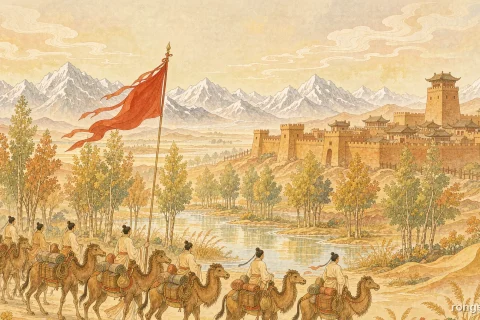
He left the capital and kept moving. In those years he wrote a great deal, including a poem about the impossible roads into Sichuan, which eventually reached Chang’an.
Its opening line became one of the most quoted in the language. The road to Shu, it says, is harder than climbing to the sky. Seven characters that turn a mountain track into a matter of life and death.
Two Years in the Palace
In 742, at the age of forty-two, Li Bai was summoned to the capital by the emperor himself.
The accounts differ on who recommended him. What is agreed is that the emperor had read his poems.
On the day he was received, the emperor came down from his carriage to meet him, seated him at a jewelled table, and stirred a bowl of soup for him with his own hand.
That was about as high as a writer could rise in Tang China.
The post he was given was Hanlin attendant. It was not a ministry and not a chancellorship. His work was to write poems for the emperor, and to sit with him at banquets and on outings.
When the emperor admired peonies by a palace pool, Li Bai wrote three famous songs about them.
The first line compares a woman to a flower and her clothes to clouds. The emperor was pleased. So was the lady in the poem.
At one palace banquet, drunk, ordered to draft a document, he stretched out his foot and told the most powerful eunuch in the empire to pull off his boot.
That story comes from Tang dynasty notebooks, not from the official record. It may not be true.
But look at the picture. A writer newly arrived at court, ordering the emperor’s own attendant to take off his shoes.
The arrogance of it was repeated all over Chang’an, and it earned him enemies.
Everyone at court knew what that eunuch was. He did not need to argue with an enemy face to face. He only needed to say a word in the emperor’s ear, and then another, on a day when the emperor was listening.
He had not yet entered the palace when an older poet named He Zhizhang read his work. He Zhizhang was a tutor to the crown prince, a man of great standing, and he called Li Bai a banished immortal, a spirit from heaven sent down to earth by mistake.
That day the two men went drinking. He Zhizhang had no money with him, so he took the gold turtle that hung from his belt, the badge of his rank, and handed it over to pay for the wine.
Li Bai liked the name of banished immortal and used it about himself for the rest of his life.
But it was never what he wanted.
When he left home in his twenties, he wanted to be a chancellor. He wanted to do something large, and then, when it was done, retire to the mountains.
Hanlin attendant was a long way from chancellor.
After two years he was bored. He drank. When the emperor sent for him, he did not come. The people around the emperor began to speak against him.
Du Fu, writing years later, left a picture of him from these years. Li Bai, he said, drank a gallon and wrote a hundred poems, and slept it off in the wine shops of the capital. When the emperor called, he did not get into the boat. He called himself a god of wine.
Sent Away With Gold
In 744, at forty-four, Li Bai was sent away with gold.
The phrase in the histories is polite. It sounds like a reward. It meant he was to leave the capital.
He wrote later that slander had poisoned the emperor’s mind against him.
That summer, in Luoyang, he met Du Fu.
The two greatest poets in Chinese literature met for the first time. Li Bai was already famous across the empire. Du Fu was in his early thirties and going nowhere.
They spent a long time together and agreed to meet again in the autumn.
They did meet. A third poet came with them. The three of them climbed mountains, drank, and talked about the state of the country.
Afterward Li Bai took a Daoist ordination and became, formally, a Daoist priest.
The next ten years were the freest of his life.
He wrote about a waterfall that seems to fall from the stars, three thousand feet of water he calls the Milky Way. He wrote about a mountain that he looks at and that looks back at him, and the two of them never tire of each other. He wrote about a pool so deep that even a thousand feet of water cannot measure what a friend meant to him when he said goodbye.
He wrote a great drinking poem that opens by telling the reader to look: the water of the Yellow River comes down from heaven and runs to the sea and never comes back. It ends by telling him to bring out his finest horse and his thousand-ounce fur coat, to sell them for more wine, and to drown every sorrow that has ever existed in one cup.
He wrote about how hard the roads of the world are, and ended by saying that a time will come to ride the wind and break the waves.
He was also still looking for a way in. He travelled north to the frontier, as far as the region where the rebel general kept his army, to see whether there was a war in which he could win something.
What he found there chilled him. He came back saying that something enormous was going to happen in the north.
A few years later it did.
By his fifties he had still never held a real office.
The Prince of Yong Goes East
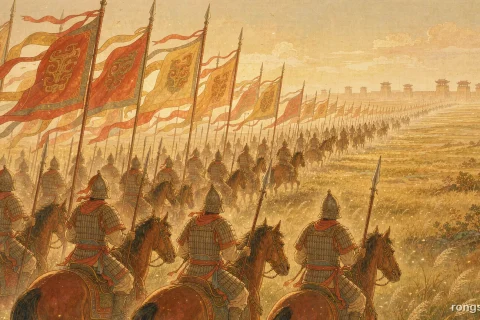
In the winter of 755 a general named An Lushan rose in rebellion in the north.
The revolt, remembered as the An Lushan rebellion, knocked the Tang dynasty off the height it had stood on.
The next year the emperor fled west. The two capitals fell. The north descended into chaos.
In the south, the emperor gave one of his sons a command over the Yangtze region.
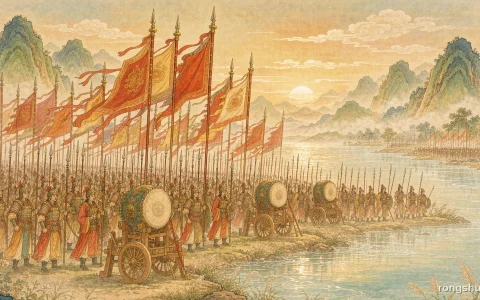
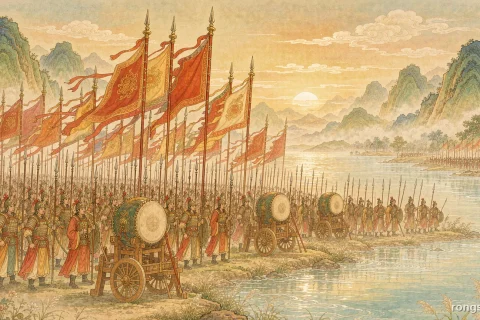
The prince was called Li Lin. He took an army east down the river, gathering talented men as he went.
Li Bai was living in retreat on Mount Lu.
The prince’s messengers came up the mountain again and again. Li Bai hesitated a long time, then came down and joined the prince’s staff.
He was fifty-six.
He wrote eleven poems in praise of the prince’s eastern progress. One line names a statesman of the Eastern Jin, who won a famous battle while sitting at a chessboard miles behind the front, and asks to be that man, to sweep the dust of the invaders away while he talks and laughs.
He believed that the chance he had waited thirty years for had finally come.
The problem was that the emperor’s own son, now on the throne, did not want a brother holding an army in the south.
In the eyes of the court, this was not an army for putting down a rebellion. It was a second rebellion.
The brothers fought.
In 757 the prince’s forces were defeated, and the prince was killed.
Li Bai fled south, was caught at Xunyang, and put in prison.
The Pardon on the Road
In 758 he left Xunyang under guard, bound for Yelang, in what is now Guizhou.
In Tang poetry, being sent to Yelang was a way of saying that a man had been sent to the end of the world.
The journey took more than a year.
In 759 a drought struck the capital region, and the court proclaimed a general amnesty. By custom, death sentences were reduced and everything below them was pardoned.
The pardon reached Li Bai on the road.
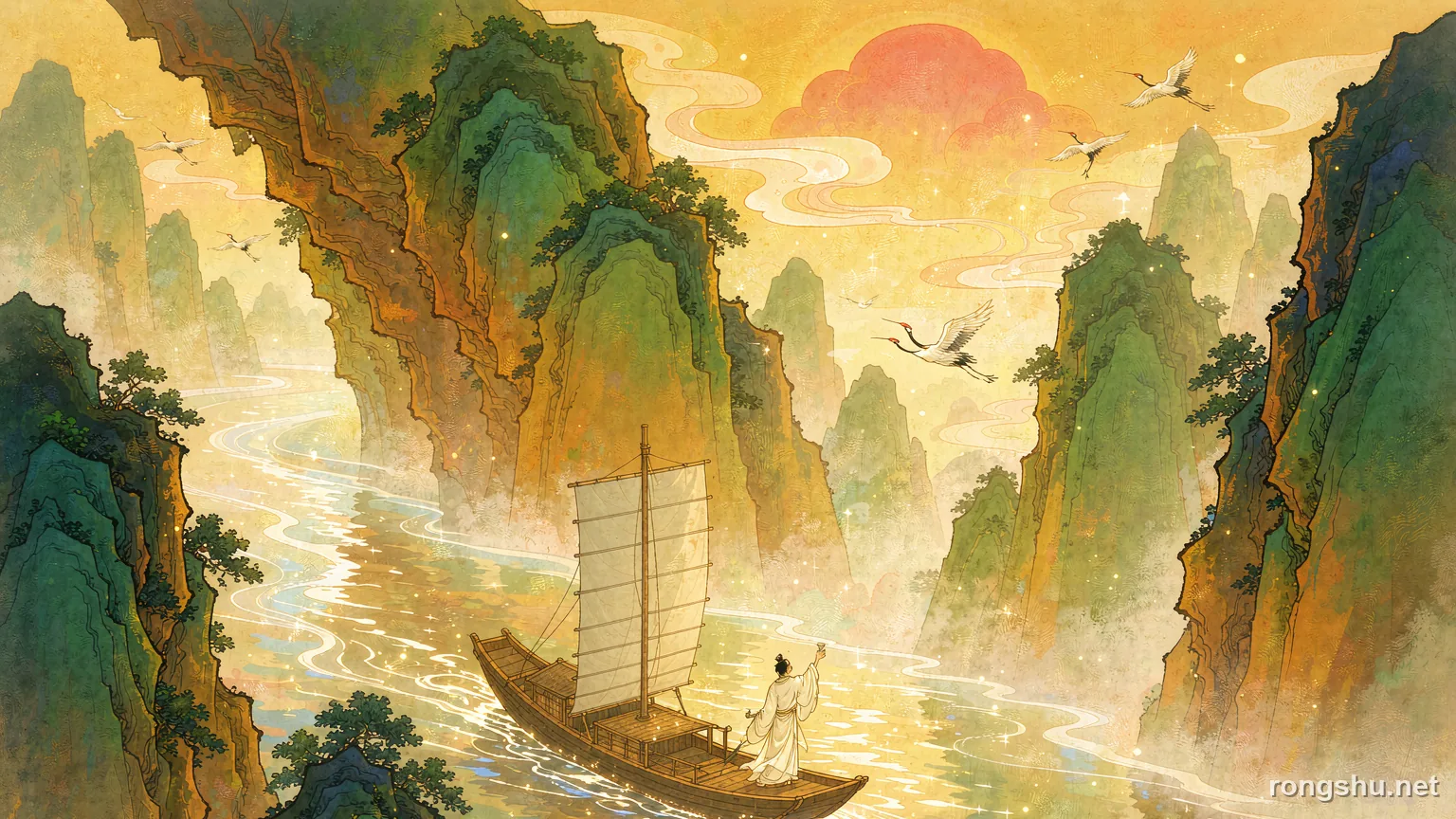
He turned around and went back down the Yangtze, and wrote the poem that Chinese children still learn first. He leaves White Emperor City in the morning among coloured clouds, he says, and a thousand miles of river lie behind him by evening. The monkeys cry along both banks without stopping, and his light boat has already passed ten thousand mountains.
Four lines, all of them moving fast.
He was fifty-nine.
After that he drifted. He stayed a while at Jiangxia, then went back to old haunts in Hunan, Xuancheng, and Nanjing. His health was failing and his money was running out.
He lived two more years in that country, depending on friends. The men he had once drunk with were dead or scattered.
In 761 he went to live with a relative who was magistrate of a small town called Dangtu.
The next year he fell seriously ill. He gave his manuscripts to that relative and asked him to make a collection. He wrote a poem about dying.
He was sixty-two.
How he died is not settled.
The Old Book of Tang says he drank too much and died of it.
Other accounts say he died of illness at Dangtu.
The version most people know is that he was drinking on a boat, saw the reflection of the moon, reached for it, and drowned.
There is no evidence for that one. It is a folk story.
But it has lasted more than a thousand years, because people felt that a man who wrote about the moon should die that way.
Du Fu, far away in Sichuan, heard that Li Bai had been exiled and dreamed of him night after night. He wrote two poems about the dreams. The first line says that parting by death swallows a man’s voice, and parting in life leaves him always aching.
Li Bai was still alive when Du Fu wrote that. His friend had already wept for him in verse.
He is buried at the foot of a green hill at Dangtu.
His relative collected the poems and wrote a preface. In it he said that of everything Li Bai had written in those years, nine parts in ten had been lost, and what remained had been recovered from other hands.
A man who spent his life trying to become a chancellor left no office behind. He left poems, most of them lost. The ones that survived are still memorised by every schoolchild in China.