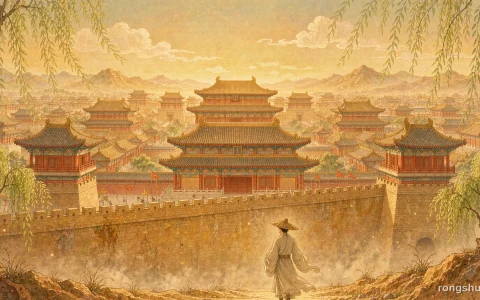
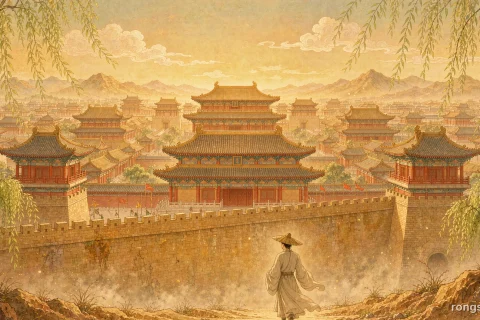
On a cold morning in the first month of 1457, outside one of the southern gates of Beijing, an old man with greying hair was brought out to be killed.
The sky was heavy and the wind was cold. The street on both sides was packed with people, and no one made a sound.
He was bound, and he stood there, looking back toward the city.
Eight years earlier, just outside that wall, he had taken a broken army and stopped a host that had marched to the gates of the capital.
The order to kill him had been given by the man he himself had brought back from the north eight years before.
That man was the emperor.
The old man was Yu Qian.
Before they took him out, he recited a poem. He had written it as a boy.
Through ten thousand blows, out of the deep hills; through fire, as if it were nothing at all.
Smashed to pieces, it does not care; what it wants is to keep its whiteness in the world.
Then he died.
The Boy at the Lime Kiln
Yu Qian, whose courtesy name was Tingyi, was born in 1398 in Qiantang, which is now the city of Hangzhou.
His family were scholars. He worked hard as a boy, and he was blunt by nature, with a stubborn streak that never went away.
One day in his youth he stopped in front of a lime kiln.
The kiln was burning rock. Grey black stone went into the fire, and what came out was lime, white as snow.
He stood and watched for a long time, and afterwards he wrote the poem they call Lime.
(The poem is said to have been written at twelve, or at fifteen, or at seventeen. Each claim has a source.)
The poem is the life story of a lump of lime: cut out of the mountain, struck with hammers and chisels, burned in the fire, and finally ground to powder, and not minding any of it.
What it wants to keep is one thing: whiteness.
In 1421 he sat the imperial examination and passed.
He was twenty-three.
He had in fact taken first place in the earlier round. Because he would not go and pay his respects to the chief examiner, he made an enemy, and was pushed down to ninety-second place.
He did not care.
In the first years of the next reign the court posted him as an investigating censor, an official whose whole job was to find faults.
He found them thoroughly.
In one year he was sent to inspect the garrison troops in the south. He arrived, changed into plain clothes, and went around quietly on his own.
What he found was officers killing ordinary people and cutting off their heads to claim rewards for enemies killed in battle.
He dug out case after case and sent them up to the capital.
From that time on he had enemies of his own.
Two Empty Sleeves
In 1430 the court created the post of provincial inspector, and the emperor picked Yu Qian by name to be the military vice minister for Henan and Shanxi.
He was thirty-two.
He stayed there nineteen years.
Henan flooded in those years, and Shanxi went dry. He spent half of each year in the north and half in the south of his two provinces, working on the Yellow River, opening granaries, clearing miscarried cases and settling people who had run off their land.
It was quiet work, and it made little noise.
The people of the region called him Yu the Clear Sky.
The work made him enemies, too. Once he wrote a corrupt official name down inside his sleeve, and reported him as soon as he got back to his office. Colleagues told him he was harsh. He said that if he loosened his grip for a moment, the people of that county would suffer for another year.
In those days there was a custom at court. An official coming up to the capital from the provinces was expected to bring local goods with him, to spread around as gifts.
Yu Qian brought nothing. He came to the capital with two empty sleeves.
Someone told him that even if he would not hand out silver, he could at least bring a few fans, or mushrooms, or incense.
He answered with a poem.
Silk fans, mushrooms, and incense sticks; made for the people use, and turned into a curse.
Two clean sleeves, walking up to the court, so that no one in the streets has anything to say.
In 1448 he was called back to the capital as military vice minister.
Let No One Speak of Flight
The next year, something enormous happened.
In the seventh month of 1449, the Oirat Mongols came south in force. The emperor, Zhu Qizhen, listened to his favourite eunuch and led an army out in person.
Half a million men marched out of Beijing.
On the fifteenth day of the eighth month, at the harvest festival, that army was destroyed about two hundred li short of the capital. The emperor himself was taken.
It was a bad defeat. The army had been boxed in with no water for two days, and men and horses could barely stand. The Mongol commander offered a truce, and the moment the Chinese line moved, the cavalry came down on it from all sides. The eunuch was killed in the rout, along with dozens of senior commanders.
Yu Qian was fifty-one that year.
The day the news reached Beijing, the court fell into chaos. Some men wept, some cursed, and one of them beat a member of the eunuch faction to death in the audience hall.
It was in that room that an official rose and said the stars were against them, that the capital could not be held, and that the court should move south.
For a moment nobody answered.
Yu Qian was then the vice minister of war. He stood up and shouted one sentence.
Anyone who speaks of moving south will be executed.
The hall went still.
He went on: the capital is the root of the realm. Move it, and everything is lost. Have we forgotten how the Song dynasty lost the north?
Those words were written into the official history of the dynasty.
So the court changed its mind. It would hold the city, and not move.
Fighting a war needs someone to run the army. Yu Qian was raised to minister of war.
And there was one question that could not be dodged: the emperor was in enemy hands.
The Mongols carried him with them and used him as a lever. What was the court to do.
Their answer was to make another emperor.
On the first day of the ninth month, Yu Qian and the senior officials asked the empress dowager to place the captured emperor younger brother on the throne. He took the reign name Jingtai.
With that one stroke, the captive emperor stopped being the soft spot of the government.
The Day at Desheng Gate
From the decision to hold the city to the arrival of the enemy at the walls, he had fifty days.
In those fifty days he did a few things.
First, he gathered troops.
The capital had fewer than a hundred thousand, and they were the wreckage of the army lost in the field. He called in more from everywhere: the anti pirate garrisons, the reserve units of Henan and Shandong, the labourers who hauled grain. In the end he had some two hundred and twenty thousand.
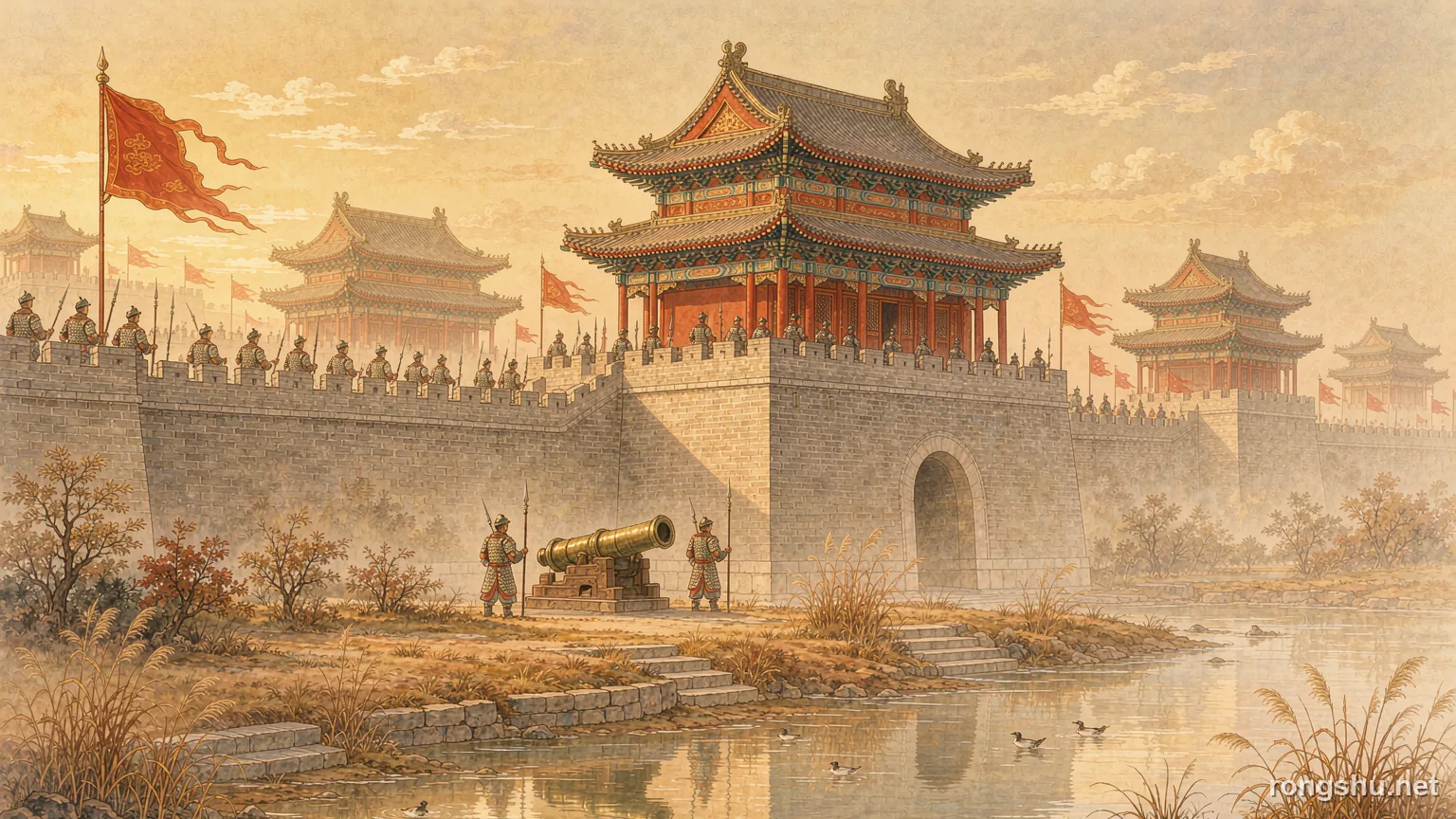
He split them into nine camps outside nine gates of the city, and took the most important gate himself, the Gate of Virtuous Victory, which faces the road that comes down from the north.
Second, he brought in the grain.
There was a granary downriver at Tongzhou holding several million bushels. Some men wanted to burn it so that the enemy could not use it. Yu Qian refused. That grain, he said, was the lifeblood of the capital. He had it carried inside the walls inside a fortnight.
Third, he laid down the law.
He took the names of the commanders at all nine gates, and then he issued his order: if a general abandons his men and runs, kill the general. If the men abandon their general and run, the ranks behind will kill the ranks in front.
The gates closed behind them.
That battle would be won, or everyone in the city would die.
On the eleventh day of the tenth month, the Mongol cavalry appeared at the walls.
The enemy commander still held his card. He brought the captive emperor up to the Gate of Virtuous Victory and put him in front, hoping the defenders would not dare to shoot.
The answer from inside the wall was six characters: the state comes first, the ruler second.
The fighting at the gate began on the thirteenth.
Yu Qian had set an ambush. He sent a small party out to draw the enemy in. The riders came after them, ran into the trap, and the cannon and hand guns opened together. In the narrow ground the cavalry could not turn.
It was a hard fight. The brother of the Mongol commander was killed there.
The two armies faced each other for five days.
The city held. The enemy rode around it and found a wall everywhere he went. Relief columns were on the road toward Beijing from the provinces.
Afraid of being closed in, he took his army away.
Beijing had been saved.
Getting the captured emperor back took a long negotiation. The Mongols wanted something for him, and the court would not trade the state for a man. In the end, a year later, the enemy decided the prisoner was no longer worth keeping and simply sent him home.
That was the autumn festival of 1450. The emperor was home.
By then his brother had settled firmly on the throne.
Two tigers cannot share one mountain.
The returning emperor was taken to a palace in the inner city the same day. It was called a residence. It was a confinement.
It lasted nearly seven years.
One Room, Locked and Sealed
After the siege, the court met to reward the men who had held the city. Yu Qian was given a high title, and his son was offered a post.
He refused. He said that fighting was still going on on every side, and that a minister had no face to take rewards.
He was the man the emperor relied on most. Gifts came to him; he would not take them, and when they could not be returned, he locked them away, untouched.
He lived in an old house that kept out the rain and little else. The emperor thought it was not fitting and gave him a fine residence. He said that the country was in trouble and a minister had no business being comfortable. When he could not refuse it, he took it, sealed the emperor gifts inside it, and went on living in the old house.
In the first month of 1457, the emperor on the throne fell gravely ill.
A group of men around the court, led by a general and an official, took a thousand soldiers in the night, broke open a palace gate, and brought the man from the inner palace out and put him back on the throne.
It was over before dawn.
When the coup was launched, Yu Qian was at court. He did not stop it.
Some said afterwards that with his position, and the troops in his hand, he could have stopped it if he had chosen to.
He did not move.
When daylight came, the old emperor sat on the throne once more.
The first business was to settle accounts.
He hesitated over whether Yu Qian should die.
One official said a single sentence: if Yu Qian lives, then what we have done has no name.
The general who led the coup had been promoted by Yu Qian after the siege. He had been in prison for a lost battle, and Yu Qian had spoken for him and gotten him command again.
The first thing this man did was to kill the man who had saved him.
The charge was treason.
On the twenty-second day of the first month, Yu Qian was executed.
He was sixty. That day the sky went black with cloud, and the histories record it plainly: on the day he died, all was dark, and the whole realm knew it was wrong.
The same day, officers came to search his house.
They searched for a long time and found very little. The household of a first rank minister held no surplus money. It was bare, and full of books.
There was one room with a heavy lock on the door.
Inside it, everything the emperor had ever given him was laid out: sealed documents, robes, vessels. The seals were still in place, nothing had been used.
The men who opened that room, it is said, could not lift their heads.
After his death his family were exiled, his son sent far off to the west.
In Beijing, ordinary people quietly set up tablets for him in their own homes.
In 1475 the next reign cleared his name and restored his offices. In 1489 he was given a posthumous title, and a shrine was built beside his grave.
The official history of the Ming gave him a line of praise that is still quoted: loyal and righteous, in glory with the sun and the moon.
Today in Hangzhou, beside the West Lake, there is a grave.
It is Yu Qian, buried at the foot of a low hill near the water.
Across the lake from him lies Yue Fei, the general of the Song.
Later ages grouped the two of them, with one more loyal official of the end of the Ming, as the Three Heroes of the West Lake.
What the three have in common is simple. Each of them stood between the country and a disaster. None of them came to a good end.
At his grave is carved the poem he wrote as a boy.
Lime is cut out of the mountain, struck, burned, and ground down.
It takes nothing with it.
It leaves only the colour white.