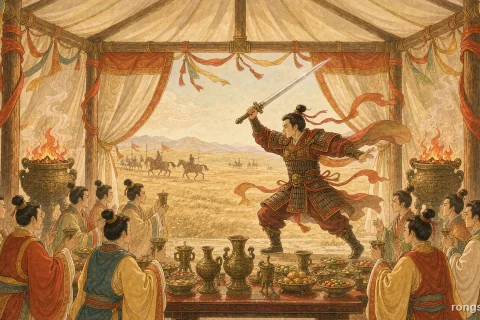
By the time the wind came up, the ships could no longer move.
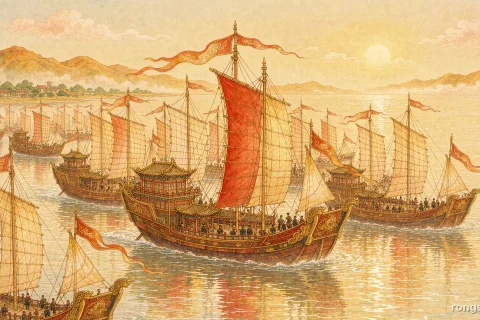
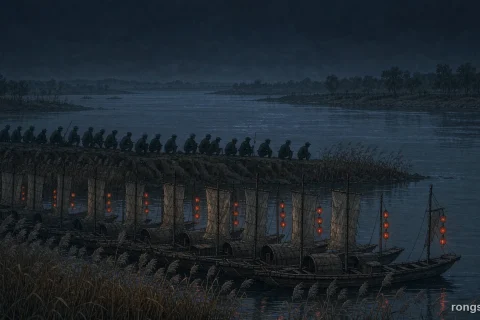
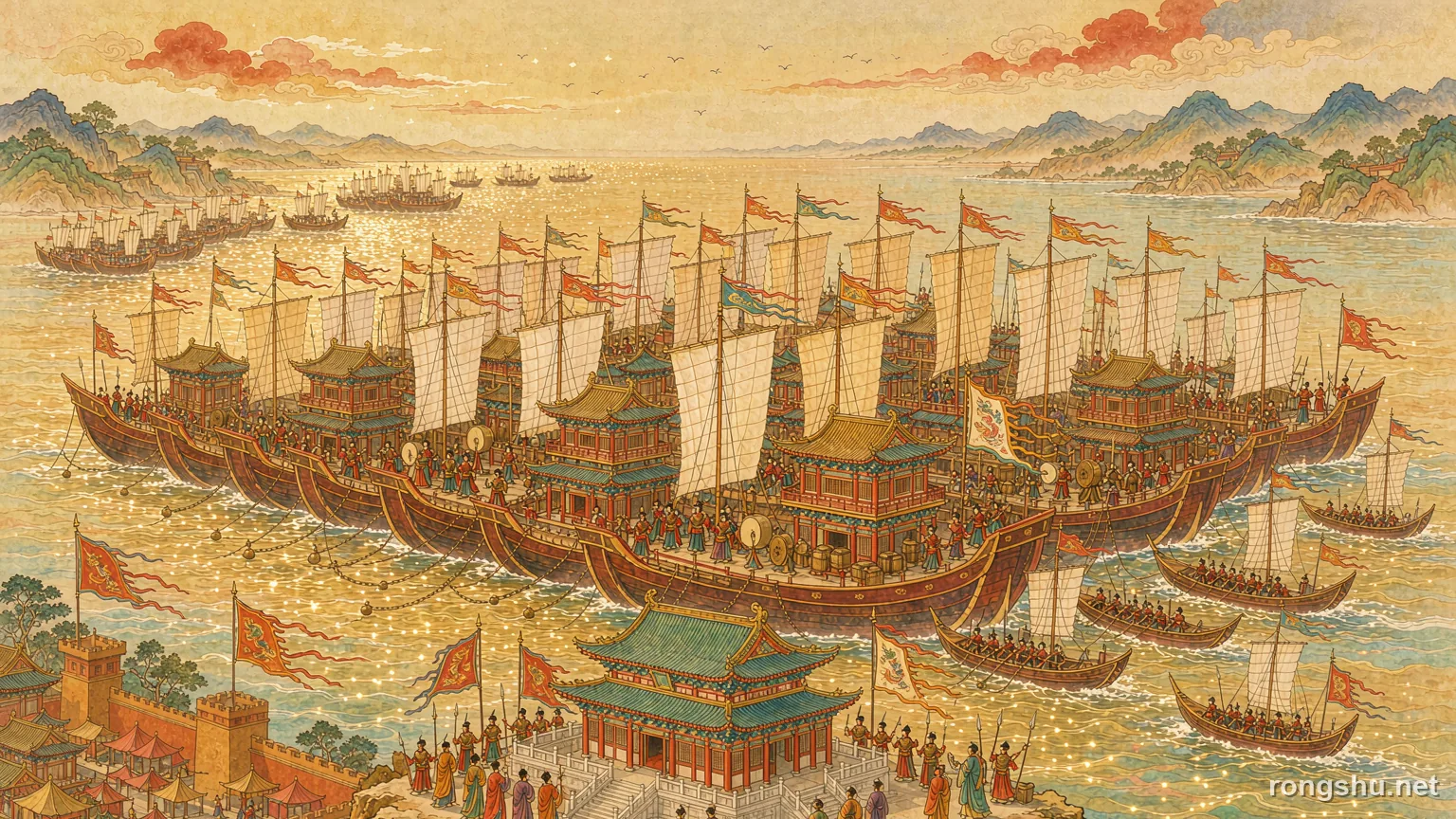
More than a thousand of them had been chained and planked together into a floating city on the water. The young emperor was at the centre of it, in a palace built on a deck, and around him the warships stood facing outward like the walls of a town.
This was February 1279, off the coast of what is now Xinhui in Guangdong, at a place called Yashan.
Since the first month of that year the Yuan fleet had sealed the mouth of the bay. Fresh water could not get in.
Too many ships, too many people, all of them packed into one channel. Men advised the Song commander, Zhang Shijie, to take the mouth of the bay first. He refused. His answer was tired. They had been on the water for years, and there was no end in sight. If there was to be a battle, he said, let it settle things.
The people on the ships drank seawater. It made them vomit and swell.
On the day of the final attack the Yuan boats came in with the tide, running along the planks that joined one vessel to the next, straight at the middle. The great ropes were cut one after another. The fleet came apart and every ship fought for itself.
On the third day the chancellor, Lu Xiufu, saw that it was over. He made his own wife go into the sea. Then he put on his court robes, and he took the eight-year-old emperor onto his back.
What he said to the boy was this. The affairs of the state have come to this. Your Majesty must die for the state.
And he jumped.
The ministers on the deck followed him. So did the soldiers, the maids, the craftsmen. The Song history records one line for what the water gave back a week later: more than a hundred thousand bodies.
To understand that day, you have to go back a hundred and fifty-two years.
In 1127 the northern Song state ended. An army from the Jin empire took the capital, and carried away two emperors as prisoners, along with most of the imperial family.
The one branch that got away went south of the Yangtze and set up a new court at Linan, which is the modern city of Hangzhou.
Everyone treated it as temporary. The north would be taken back.
It never was. Year by year the northern campaigns got smaller and the southern capital got more comfortable. Palaces were built along the lake. The markets got rich. Living below the river stopped being an emergency and became a way of life.
That way of life lasted more than a century.
Some people did try to go back. Yue Fei carried the war to the edge of the old northern capital, was recalled by twelve messages from the throne, and died in prison in 1142. After him came one treaty, and then another, and each moved the border further south. In the end nobody brought it up.
Then the north changed hands again. The Mongols destroyed the Jin, and then came south themselves. In 1267 they began the siege of Xiangyang.
Xiangyang held out for six years. It fell in 1273.
The commander who held it surrendered, and took service with the Mongols. A few years later he was standing on the deck of a Yuan ship, coming down the river toward the Song capital.
With Xiangyang gone the whole upper Yangtze was open, and the Yuan river fleet came down it. Two years later the army was outside Linan.
The man running the court was a minister named Jia Sidao. He kept sending envoys to negotiate, and he kept the truth from the throne. In 1275 the army he led, a hundred and thirty thousand men, was destroyed in the field. There was nothing left to defend the capital with.
He was stripped of office and died on the road into exile.
In the first month of 1276 the empress dowager brought the five-year-old emperor out of the city, and handed over the seals and a written surrender.
That is where the Song dynasty stops existing in the ordinary sense of the word.
Some people declined to accept it.
Taken at Wupo Ridge
Wen Tianxiang was born in 1236, in Jiangxi.
At twenty-one he sat the highest examination in the capital, wrote an answer of nearly ten thousand characters without a draft, and the emperor made him first in the whole country. The examiner in charge wrote that his principles were a mirror and his heart was iron.
For the first twenty years of his official life he had nothing to do with soldiers. He sent up memorials attacking a court eunuch, and he made enemies of powerful ministers, and he was sent down more than once.
In 1259, when the Mongol army reached the Yangtze, that same eunuch proposed moving the capital, and nobody dared say he was wrong. Wen Tianxiang sent up a memorial asking for his head. It was read and filed.
In 1275, when the court issued a general call for anyone who could raise troops, he was a prefect in Jiangxi. He read it, wept, sold everything his family owned, and began recruiting. Inside three months he had brought together the better part of ten thousand men and marched them to the capital.
Someone told him it was futile. The Yuan armies were enormous. He was feeding sheep to a tiger.
Wen Tianxiang said he knew that. But the dynasty had fed its officials for more than three hundred years, and when the emergency came not one man in the whole country had stood up. That was the shame. He was raising a banner so that others would see one and follow.
On the day the capital surrendered he was made chancellor and sent to the Yuan camp to negotiate. He would not bow to the Yuan commander. They kept him. On the road north he escaped.
For three more years he raised and led troops in Fujian and Guangdong. He won engagements and lost them. In 1277 his wife and two sons were taken by the Yuan army.
In the twelfth month of 1278 he was captured at a place called Wupo Ridge in Guangdong. He swallowed the poison he was carrying. There was not enough of it.
A Wall of Ships
They brought him into the Yuan fleet.
By then the last shreds of the Song court, under Lu Xiufu and the general Zhang Shijie, had withdrawn to Yashan. Two hundred thousand people were living on the water. They cut timber, built houses, and put up a palace for the child emperor. Three thousand buildings went up on the shore.
The Yuan commander was a man named Zhang Hongfan. He kept Wen Tianxiang with him and took him to Yashan, and he asked him to write a letter ordering Zhang Shijie to surrender.
Wen Tianxiang did not write it.
He wrote a poem instead.
Its last two lines are among the most quoted in Chinese history. Since the beginning of time, who has not died. Let my loyal heart stay bright in the records.
Zhang Hongfan read it. He did not press him again.
One detail is worth having. Zhang Hongfan was Chinese, and his father had been a general who changed sides. The Yuan court did not talk about it. The Ming court never stopped.
At Yashan the Song fleet chained itself into one body a thousand ships thick, which looked like a wall and had one fatal property. It could not move.
Zhang Hongfan sealed the bay. He cut off the water and the firewood. Then he sent small boats in loaded with straw and oil, and set them alight, and let the wind do the rest. The Song decks had been plastered with mud, and the fire did not take.
In the end it was the water that did it. The fleet was pinned where it was. The people on it could not drink.
On the last day the Yuan boats came in from all sides and cut the ropes apart. Chained together, the ships had no way out.
The people on them ate dry grain and drank the sea. It made them vomit and swell, and then there was nothing left to drink. They lasted a little over ten days.
Lu Xiufu went into the sea with the boy on his back. Zhang Shijie broke out with a dozen ships, and a few days later a typhoon took him off the coast near Yangjiang and he drowned. The empress mother, when she was told what had happened to the child, walked into the water as well.
Wen Tianxiang watched it from a Yuan ship a short distance away.
He wrote about it afterwards in plain words. He had seen it with his own eyes, and no punishment ever given him came close to the pain of it.
He tried to jump in too. The guards stopped him.
Three Years in the Capital
After Yashan he was taken to the Yuan capital, which is the modern city of Beijing.
The Mongol emperor, Kublai Khan, said something that got written down. Which family has no loyal man in it. He gave orders that this one was to be treated well.
On the road north Wen Tianxiang refused food for eight days. He had planned to die of it exactly when the convoy passed his home district, so that he could be buried there. Eight days was not enough, and his district went by. He gave up the idea and ate.
From the tenth month of 1279 to the twelfth month of 1282 he was held in the capital. Three years and two months.
The visitors did not stop coming.
The first was a man who had been, like him, a first-place scholar and a chancellor, and who had run away when the Yuan army came and then taken service with them. Wen Tianxiang received him with a poem, and the poem was not kind.
The second was the last Song emperor, the boy who had been carried out of the capital in 1276 at the age of five. He was nine now. He came into the cell, and before he could say anything Wen Tianxiang was on the floor, weeping and calling him Your Majesty. There was nothing for the child to do but leave.
The third was the Yuan chief minister, who demanded that he kneel. Wen Tianxiang said that a chancellor of the southern court does not kneel to a chancellor of the northern one. The minister asked him why he was where he was. Wen Tianxiang said: if the south had used me as its chancellor earlier, northerners would never have reached the south, and southerners would never have come north.
The cell was a bad place. It was in that cell that he wrote the poem every Chinese schoolchild still learns, the Song of Righteous Spirit.
The cell was low and wet, with earth walls. In the preface he lists the seven airs of the place one by one. Standing water, mud, sun, fire, rotting rice, crowded men, filth. He says he has one thing that answers all seven, the great flowing spirit Mencius described.
In the spring of 1280 a letter came from his daughter. His wife and his children, lost for three years, were in the capital, in service. The message could not have been plainer. Surrender, and the family is together again. He did not write back. Later he wrote to his sister that a man is not made of stone, and that the thing had come to the point where honour required him to die.
In the twelfth month of 1282 Kublai Khan had him brought in and made one last attempt. If you will turn the loyalty you gave the Song toward me, he said, the chancellorship of my empire is yours.
Wen Tianxiang answered that he had received the Song’s kindness and held its highest office, and that when it was destroyed there was only one thing left for him to do.
Kublai Khan asked him what he wanted.
He said: one death is enough.
The Market Square
The next day, in the first month of 1283, he was taken to the execution ground in the southern part of the capital.
Word had gone round that he was to be killed. Ten thousand people came, against imperial orders, and the streets were blocked with them.
The official in charge of the execution asked whether he had anything to say, and told him that a report back to the throne could still save his life.
Wen Tianxiang said that if he was to die he would die, and that he had nothing to say.
He asked which way was south. Someone pointed. He knelt and bowed toward it and said that his business was finished, and that he was not ashamed.
Then he put his head down.
He was forty-seven.
The person who claimed the body and buried it was his wife, Ouyang.
Afterwards they found a note sewn into the lining of his belt, written in his own hand. It says that Confucius taught men how to be complete, and Mencius taught them how to be right, and that if a man has done what is right he has done what is complete. It asks what a man studies the sages for, if not for a day like this one. And it ends by saying that from now on he has nothing left to be ashamed of.
Zhang Hongfan put up a stone at Yashan. The inscription said that the general Zhang Hongfan had destroyed the Song there.
Someone chiselled it out, later.
The dynasty was gone, and the writing about it only grew. Men who had served the Song wrote poems and collected documents and set down what they remembered. One of them painted orchids with no roots and said the ground had been taken away. In Zhejiang, scholars who would not serve the new dynasty set up a poetry society and set a subject for competition, a spring scene in garden and field. More than two thousand sets of poems came back. Everyone who read them understood what they were about.
A hundred years later the Ming replaced the Yuan, and the Ming built a shrine at Yashan and put three men in it: Wen Tianxiang, Lu Xiufu, and the general Zhang Shijie.
What is interesting is who has praised them since. Ministers of fallen dynasties and emperors of new ones, the Qing emperor Qianlong among them. They were all praising the same thing, and it was not a military victory.
They were praising a man who had said what he intended to do, and then done it.
The place is called Yamen now, in Jiangmen in Guangdong. The sea is still there, and at high tide the waves come up against the rocks.
Seven hundred and more years later, the spot where the boy and the chancellor went into the water is a small museum.