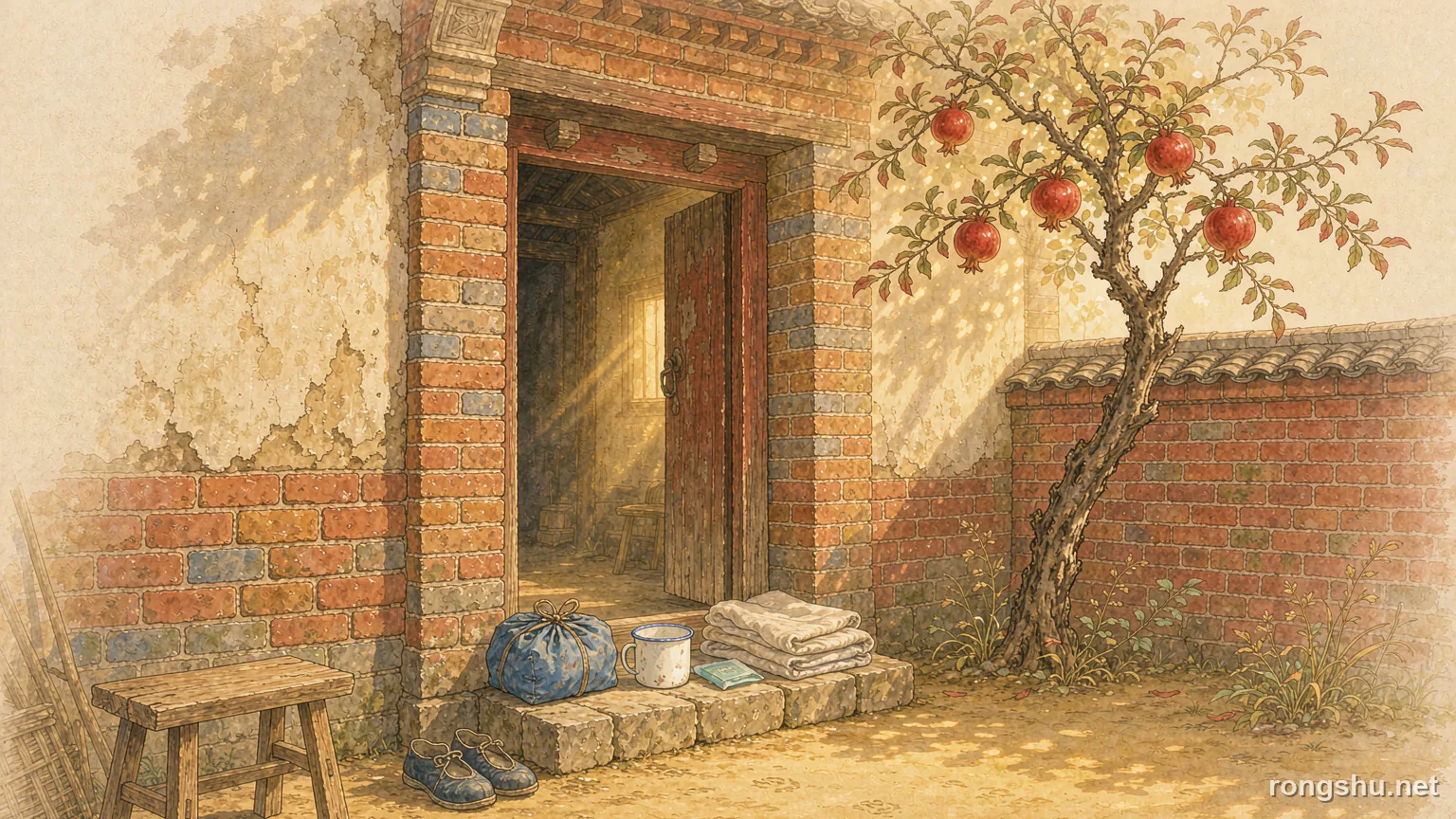
On the first morning of the month, Zhou Deshan set his blue cloth bundle down on the stone step outside the door.
It was not a big bundle. Six or seven shirts, an enamel mug, two bottles of medicine, and that was all.
He sat on the doorsill and waited for the van to come round the corner of the lane.
The sun was just up and warm on the courtyard wall. A hen scratched at the dust by his feet.
The pomegranate tree in the yard was planted by his wife. The tree is still there. She has been gone eleven years.
Just after eight the van came. He stood, brushed the dust off his trousers, and picked up the bundle.
The strap was worn to fuzz.
One Month at a Time
Zhou Deshan is seventy-eight. In the village they call him Deshan the elder.
His wife died young and left him three sons. The eldest, Zhou Jianguo, keeps a hardware shop in the town. The second, Zhou Jianjun, drives a box truck on long hauls. The third, Zhou Jianping, teaches physics at a middle school in the county town.
He still lives in the old house at the east end of the village. Three tiled rooms, a walled yard, a well.
The sons made a rule among themselves. Each household takes him for one month. Thirty days, and then he moves on.
This arrangement needs one word of explanation. For forty years the cities have pulled the young out of the Chinese countryside and left the villages to the old. A man like Zhou Deshan will not follow his sons to town. He built his house with his own hands, and it is where he expects to die. So the sons take turns, and the father carries his whole life in one cloth bundle.
The old house stays locked. He carries the key on his belt.
His days are slow. He wakes at five and gets up at six. He keeps the rooms clean. There is rice porridge on the stove and a dish of salted vegetables.
The porridge has to be thick, he says. Thick porridge fills you up.
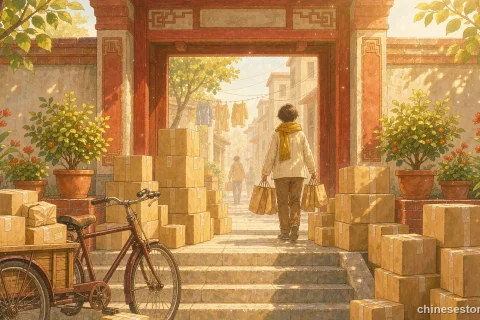
At his eldest son’s place he helps in the shop, carrying boxes in from the street until his hands are black. At noon he and Jianguo squat by the back door with lunch boxes, and he puts his meat into his grandson’s bowl.
At his second son’s place he is mostly alone. Jianjun is on the road three or four days at a stretch, and Guiying works at a supermarket and leaves before light. At noon he heats up last night’s food and eats by the south window.
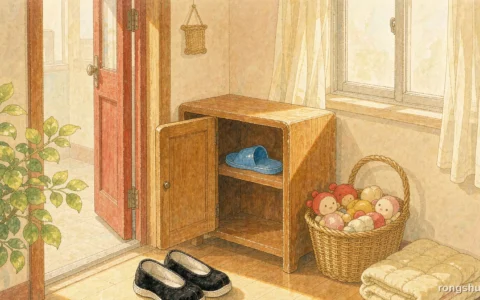
At his third son’s place there are only two rooms. He sleeps on the sofa in the living room. When the boy does his homework he turns the television off and sits on the balcony, watching the traffic below.
The three households are forty kilometres apart at their furthest. A bus runs between the village and the town twice a day. He used to cycle. He cannot manage the bicycle now, so a son drives over to fetch him.
His life is counted in turns. When the end of a month comes, he knows. It is time to pack the bundle.
The bundle was sewn by his wife when she was young. Blue cloth, coarse stitches, the corners mended twice with thread of the same colour.
The day before every move he washes what he has worn, hangs it on the wire in the yard, folds it flat in the afternoon, and only then packs.
When it is done he sits on the edge of the bed and looks at it for a while.
He keeps a pencil stub too short to grip, wrapped in paper. It goes wherever he goes.
There are not many old friends left in the village. By the entrance there is a locust tree with stone benches under it, and he used to go twice a day to play chess and hear the newspaper read out loud. Since he began moving between his sons, it is not easy to get there.
The Calendar on the Wall
A calendar hung by the door of the eldest son’s house.
It came in with the hardware stock, one yuan a copy, printed in red. One line of characters at the top, one date below, one page torn off a day.
The month he moved in with the eldest, Zhou Deshan tore off a page every morning.
Halfway through the month, Jianguo’s wife Yulan noticed.
Father, she said, do not tear that, you will make a mess of it.
I am afraid of forgetting the date, he said.
Forgetting what date, she said.
He did not answer.
After that Yulan left it alone and let him tear. The calendar grew thinner by a day.
That month was busy. New stock came in, and Yulan did the accounts until her voice went, then cooked for everyone.
At the table he always sat at the inner end, and his bowl of rice was cooked separately, softer, on purpose.
The second son’s house was different. Guiying came from the north, and she cooked with soy sauce. The dishes ran salty.
The old man’s teeth are bad. He said nothing and drank plain hot water between mouthfuls.
Once Guiying asked him, father, is it too salty.
Not salty, he said.
That night he finished the whole bowl, and wiped up the last of the soup with a piece of steamed bread.
At the third son’s house the food was soft again. Xiaomin grew up in the county town and cooks light, dishes steamed rather than fried.
He ate two bowls and said, good.
Xiaomin laughed. Father, she said, you did not eat well at the second brother’s, did you.
All of them are good, he said.
He cannot remember the dates of his grandchildren’s birthdays, but he remembers the months. When the month comes he takes money out of the cloth pouch he wears against his body and gives each child one note. The same number every time. Not a cent less.
In a Chinese village a family is judged by whether it is in order, and the cash given at birthdays and New Year is a ledger as much as a gift. Give one grandchild more than another and the whole lane will hear of it.
The boy at the third son’s house asked him once, great-grandfather, why do you not just stay at our house.
He said, I have to go back and keep an eye on the house.
The grandson at the eldest son’s house asked him the same thing. He gave the same answer.
In autumn he dug the turnips in the old yard, cut them into strips, and dried them on a reed mat for three days. Then he packed them in a jar with salt and a stone on top. When the pickles were ready he gave one jar to each of the three households.
Yulan kept hers on the kitchen windowsill and ate it with porridge, and it went quickly. Guiying tasted hers, said it was too salty, and carried it over to her own mother’s house. Xiaomin put hers at the back of the fridge and forgot it, and when she found it again there was a white bloom on the lid.
He asked none of them about it.
The calendar was the one from the eldest son’s house. He tore through the month and half of it was left. When he left, he rolled it up and put it in the bundle.
What Was Sewn in the Lining
The third son found out in August.
He went straight from work to the eldest brother’s house to collect his father. It was almost dark when he arrived, and the old man was sitting on a low stool in the yard with the pencil stub in his fingers.
He parked the car, went in, and saw an old calendar spread open on the table in the main room.
His father had taken it out of the bundle.
On the back of the calendar were lines of writing, in pencil.
The characters were small. They were crooked. But every stroke was careful.
The first of the month, Jianguo’s house, rice soft, ate two bowls.
The fifth, Jianguo’s shop, carried three boxes of stock for him, back a bit sore. Put on a plaster at night, did not tell them.
The twelfth, Jianjun’s house, he was on the road, Guiying on shift. Ate alone. Did not finish the dishes.
The eighteenth, Jianjun’s house, mopped the floor and aired the quilts. He can sleep in a clean bed.
The twenty-second, Jianping’s house, the little boy talked to me. He asked, great-grandfather, can you play chess.
Under all of it, written smaller still:
Any of the houses will do. Do not argue over me.
The third son stood at the table and read the calendar from the first page to the last. On the back of the final page three characters were written. He did his part.
Then he reached into the bundle and found the lining.
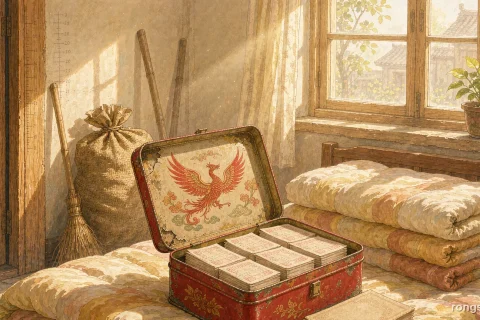
His mother had sewn it, two layers of cloth with a channel left between them. Rolled up inside was money, held with a rubber band, and a sheet of paper folded in half.
The paper was a receipt from the pharmacy, written on the back.
It said: If one night I do not get up, do not call a doctor and do not spend the money. Under the bed in the house there is a tin box. In it are the deed to the old house and the money I have saved. It is already divided. One share each, three of you. Nobody more and nobody less.
Below that was one more line. When the money is divided, do not fight.
He folded the paper, put it back in the lining, pulled the zip closed, and laid the bundle at the bottom of the bag.
When he went out, his father was still on the low stool. There is food in the pot, the old man said.
I am not hungry, father, he said.
Then I Will Go Home
That evening the three brothers sat down together, and nobody ate.
The eldest came back from the shop with engine oil on his hands. The second drove in from out of town and left the van outside the gate. The third laid the pharmacy receipt on the table.
The eldest read it twice, lit a cigarette, and stubbed it out halfway.
The second said nothing at all. His hand kept rubbing against his trouser leg.
Father is seventy-eight, the third son said. There are three of us. One month each, turn by turn.
What is wrong with taking turns, the eldest said. Every household has its troubles.
It is my house that is wrong, the second said. I am on the road. He sits there alone.
That is still the rule we agreed, the eldest said.
What does the rule matter, the third said.
The room went quiet. Nobody touched the packet of cigarettes again.
Yulan had been standing in the doorway. She came in and said, it is not that we are unwilling, and went back into the other room, closing the door softly.
Zhou Deshan came in from outside. He was leaning on a wooden stick and he walked slowly.
The calendar on the table was his own. He had only meant to tear off a page.
He stood at the table and looked at the roll of money, and then at his eldest son.
If you are going to talk it over, he said, let me say one thing.
All three looked at him.
I am going home, he said.
Father, you cannot manage on your own, the eldest said.
I can, he said. I can split firewood. There is water in the well. The vegetable plot is still there. And the pomegranate tree needs cutting back.
He said, any of you, whenever you have a free evening, come and sit with me a while. That is enough.
What about the daytime, the second son said.
I will get through the daytime myself, he said.
The eldest began to speak again, and the old man raised a hand.
There are three of you, he said. I know how many times a year you can come back. I do not blame anyone. I just want to live in my own house.
That night the eldest drove him back to the village.
When the door of the old house opened there was a layer of dust in the yard, and two sparrows flew off the well head.
Zhou Deshan set the blue bundle down at the head of the bed and did not open it.
He took the calendar off the wall and hung it back on the same nail.
The eldest did not leave that night.
The two of them sat by the stove and boiled a pot of water. When it came to the boil it rattled and bubbled, and it filled the quiet of the room.
The Light in the House
The days after that went like this.
Every Wednesday evening the eldest drove over with vegetables and rice, and filled the water tank in the yard while he was there. When the second son drove past the village he stopped the van at the entrance, came in for half an hour, smoked one cigarette, and left. On weekends the third son came with his boy, and the boy chased the hens around the yard and kicked up the earth under the pomegranate tree.
There is rice kept warm on the stove. The well water is cold, and he draws it up and leaves it standing in the tank.
The old friends are back under the locust tree. He goes once a day and plays chess until the sun slants. The board is painted on the stone table, and half the grid has worn away.
In autumn he dried another mat of turnip strips and gave one jar to each of the three households.
Zhou Deshan still tears off a page of the calendar every morning. By the end of the year there is one page left.
He turns it over and writes two characters on the back.
The two characters say: all is well.
Then he hangs the calendar back on the wall.
The stone step outside the door has been empty since that day.
The blue bundle is folded at the very bottom of the cupboard, under two old quilts.
This is a work of narrative writing based on real situations in Chinese family life. All names have been changed.