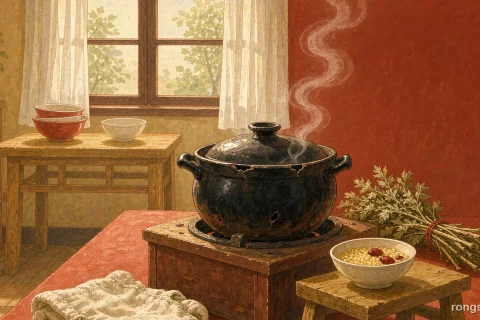
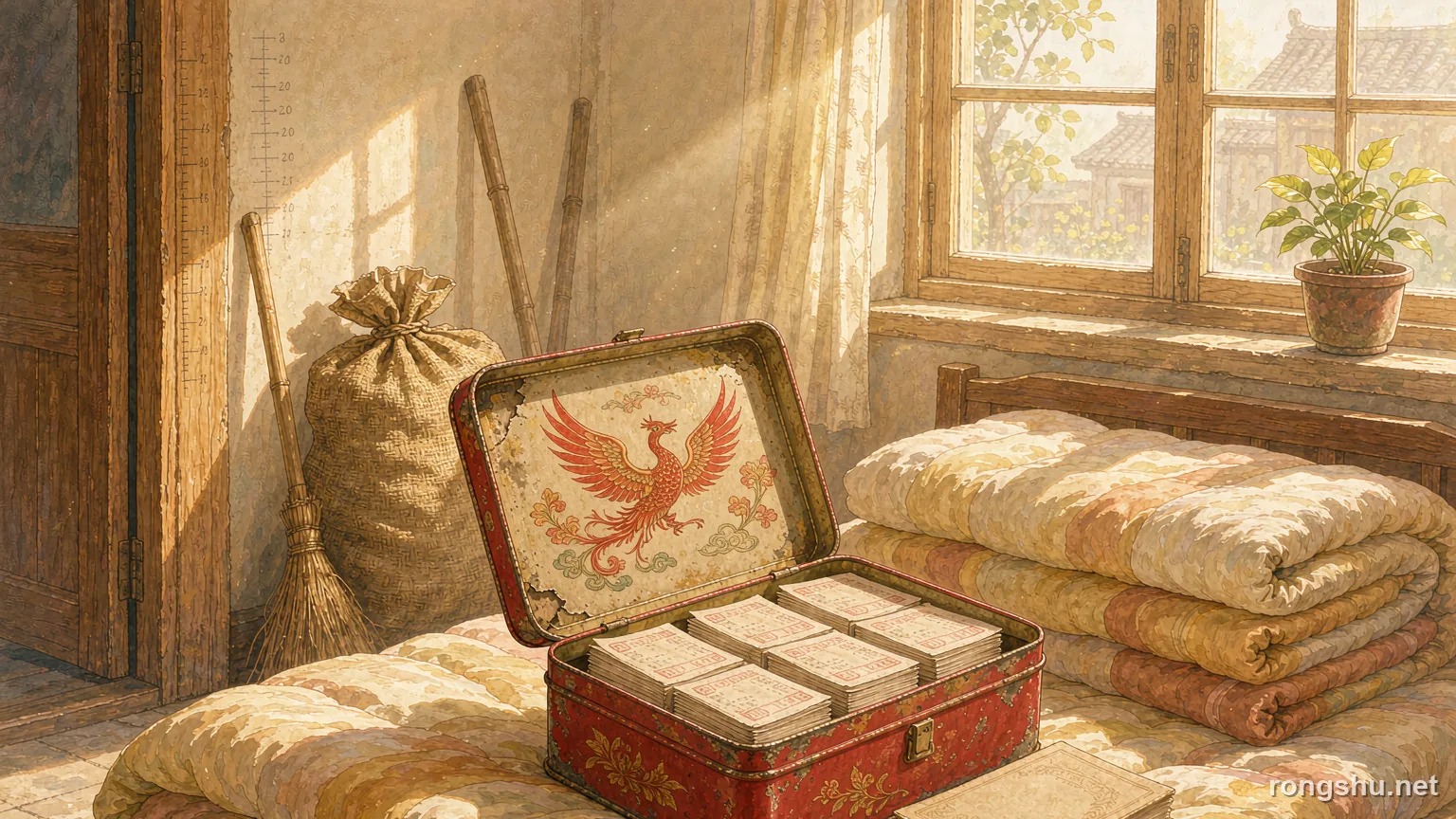
He Xiaoyan has counted the tickets in the tin box. Twelve of them.
For the first four years he came home twice a year. For the four years after that, once. She has counted them one by one, and she knows every line printed on them by heart.
Last year return ticket is still in the box, dated the seventh day of the first month.
That one he could not bring himself to throw away.
She thought about taking it out and putting it in the photo album. In the end she left it where it was.
She Stays, He Goes
He Xiaoyan is thirty-four and works at a kindergarten in a county town.
She arrives at half past seven and leaves at five. She has a middle class of thirty-two children, and by the end of the day her voice is gone.
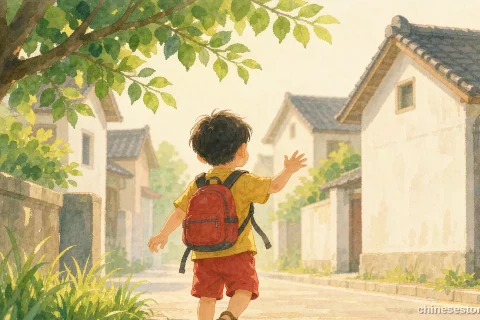
Her son, Yangyang, is eight and in second grade. His grandparents collect him from school.
Her husband, Luo Zhiqiang, is thirty-six. He drives a forklift at a logistics park in the provincial capital. Seven or eight thousand a month, and more in the busy season.
They have been married eight years. The flat is two rooms in an old compound in the county town. His father paid half the deposit; the two of them are paying off the rest.
The doorframe at home is scored with one horizontal line after another, closer together as they go up. The boy height, year by year. The topmost line was drawn last summer, when his father was home, with the date written beside it.
Her days are full. Up at half past six to make breakfast, Yangyang at the school gate by twenty past seven, at the kindergarten by half past. She collects the boy in the afternoon, cooks, sits with him over his homework, washes up, and it is nine o clock. At half past nine she and her husband have a ten-minute video call.
The work at the kindergarten looks light and is not. With a middle class you watch them eat, you coax them to nap, you change them when they wet themselves. In September, when the new ones cry, she can go through three sets of clothes in a morning.
Everyone on the street knows her husband is away. At the vegetable stall, at the school gate, they ask when Zhiqiang is coming back.
At the new year, she says.
The background in those calls keeps changing. Sometimes a white wall in a work shed, sometimes an iron bunk, sometimes a street lamp. It is good here, he always says. Do not worry about me.
She has never been to the place where he lives.
His parents live with her. His mother has an old trouble in her legs that aches when the weather turns, and she holds the rail to go upstairs. His father says little and likes to squat by the door with a cigarette.
Everyone in this family, the old people, the child, herself, lives on this one street. Only he is more than a thousand kilometers away.
One More Year
After the new year, on his last night at home, he sat on the sofa peeling an apple.
One more year and I am done with it, he said.
You said that the year before last, she said.
He handed her the apple and smiled. This time it is true.
She took the apple and let that one go.
The next morning she packed for him. A grain sack with a change of clothes, two cartons of cigarettes, a bag of chili sauce she had fried herself. At the door she tucked in a pair of insoles she had stitched.
The bag gets heavier every year, he said.
Good, she said. Then you will not have to buy things out there.
A few days after he left, his mother found her by the washing machine. Xiaoyan, she said. Why do you not go out there too.
Who would take Yangyang to school, she said.
Then never mind, his mother said.
The sentence broke off halfway between them. The washing machine hummed on.
His mother leg trouble goes back to her younger years. After walking a while she has to sit down, and damp weather makes it worse. She has never been off her medicine. Two years ago He Xiaoyan offered to take her to the city to have it looked at, and she refused and asked what the money would be for.
What this family is short of is people, and the one missing is him.
In March, Yangyang language teacher sent her a photograph. It was a composition from class, titled My Father.
What Yangyang had written was: My father is inside the phone.
And then, after it: He is very busy. He delivers parcels to a lot of people.
He Xiaoyan looked at those first five words for a long time. She saved the photograph and did not delete it.
She signed the composition and Yangyang handed it in.
In May, his mother leg hurt badly enough that she went into hospital for two days.
Those two days He Xiaoyan worked by day, ran to the hospital at noon, came home at night to cook for Yangyang, and went back to sit by the bed in the small hours. On the third morning she called Luo Zhiqiang from the hospital corridor.
Everything is fine here, she said. Do not worry.
That is good, he said.
After the call she sat on a chair in the corridor for a while before she got up and went to work.
That night on the video call she said nothing about it. Are you busy over there, she asked. Not busy, he said. The signal came and went, and the words between them stopped on the screen and started again.
The Tin Box Under the Bed
In the summer holidays Yangyang made a fuss about going to see his father in the provincial capital.
He Xiaoyan thought about it and agreed. She took five days off from the kindergarten and bought two train tickets. She did not tell Luo Zhiqiang in advance. She wanted to surprise him.
They arrived at noon. He came to the station on his electric scooter. The helmet was old, and his face was browner than it looked on the screen.
He took them to eat and ordered a table of dishes: braised fish, sweet and sour ribs, a soup. Yangyang ate fast and happily. He hardly touched his own chopsticks and just watched the boy eat.
In the afternoon he took them to where he lives.
Beside the logistics park is a building whose basement is divided into rooms. His room holds eight men and four double bunks. The smell at the door is diesel mixed with damp.
Everyone else was out at work. Work uniforms in the same shade of blue hung over the iron frames. A small rice cooker stood in the corner with a crack across its lid. A towel hung at the head of the bed, stiff as a board.
He was a little awkward about it. Just for now, he said. I am moving next month.
He Xiaoyan said nothing. She put the luggage down and straightened the bedding for him.
He slept in the afternoon. Yangyang did his homework beside him, keeping very quiet.
He Xiaoyan was sorting things under the bed when her hand met a square, cool corner.
She pulled it out.
A tin box. The one that had held moon cakes at home, a phoenix painted in red on the lid, a chip out of one edge.
She knew this box. Before the new year, tidying the flat, she had put it back on the top shelf of the cupboard. She had thought it was still at home.
She opened it.
Inside, the tickets were stacked neatly, one pressing on the next. She counted them. Twelve.
She picked them up one at a time. When she turned the first one over, her hand stopped.
On the back of every ticket was a line in ballpoint pen. Sometimes a date. Sometimes a number: one metre thirteen, one metre twenty-one, one metre twenty-eight.
Then she remembered. The doorframe at home is scored with one horizontal line after another. Every time he came back he stood Yangyang against the frame and drew the line in pencil.
So he had been keeping his own record, on his tickets.
She spread the twelve tickets on the bed and laid them out by year. Row after row of numbers, like the lines on the doorframe at home, only standing somewhere else.
Under the tickets lay a bank passbook.
She opened it. The numbers grew larger year by year. The last entry was from the month before.
Below the passbook was a printed sheet of paper. On it he had copied out a passage about what a family needs in order to settle in the provincial capital and get a child into school there. The copying was crooked, and several places had been crossed out and written again.
The last line on the sheet was in his own hand: sort it out before Yangyang starts third grade.
He Xiaoyan sat on the edge of the bunk in the basement. Outside it was summer. Inside, the room was a little cold.
She looked up at the boards of the upper bunk, and then at Yangyang, sound asleep.
She did not cry. She put everything back the way it had been, closed the box, and pushed it under the bed again.
Two Numbers on a Sheet of Paper
Luo Zhiqiang slept until evening. By the time he woke, He Xiaoyan had the meal ready.
The three of them ate around the small square table. Yangyang talked about riding the lift in the tall building and said he wanted to come again.
When the boy was asleep she took him out to the stairwell.
There was one lamp in the stairwell, a yellow one. They sat down on the steps.
I saw the box, she said.
He paused, and rubbed his palms on his trousers.
I was going to tell you once it worked out, he said.
And if it does not work out, she said.
Then it is as if I never said it.
Until when were you planning to hide it, she said.
Until Yangyang starts third grade, he said.
You have one year until then, she said.
She took a sheet of paper and a pen out of her pocket and wrote on the step.
She wrote two numbers. One was the money he could bring home in a month as things stood. The other was what she had found out he could probably earn at jobs back in the county town.
Under those she wrote three more lines: the mortgage, Yangyang school fees, his mother medicine.
She pushed the paper across to him. Work it out yourself, she said.
He held the paper a long time. The lamp in the stairwell flickered.
Xiaoyan, he said. Out here I can put away half again as much in a year.
I know, she said.
But last time Yangyang was doing his homework, she said, he stopped halfway and asked me whether Papa does not like us any more.
He lowered his head.
Someone came up the stairs, footsteps near and then far.
After a while he said, Xiaoyan, it is not that I do not want to come back.
It is that you do not dare come back and say it, she said.
He did not argue.
They sat on the steps until late. In the end they settled on one number: one more year.
She wrote the number in the corner of the sheet and folded it.
Before she left the next morning she pushed the sheet into the tin box, under the tickets.
It stays here, she said. So you can sleep at night.
A Ticket for the Sixteenth
Autumn went by, and then winter.
On the twenty-eighth day of the last month, Luo Zhiqiang came home. He set the grain sack inside the door and went to look at Yangyang, asleep.
He Xiaoyan poured him hot water and told him to soak his feet first.
Yangyang woke and came running out barefoot with the tin box in his arms. Papa, he said, I counted them. Twelve.
Luo Zhiqiang laughed and crouched down and showed him how to count in fives, stacking them one bundle at a time.
From the outer room came the two voices, old and young, counting, line after line.
He Xiaoyan was chopping vegetables in the kitchen. She had bought fish that day, and ribs, which Yangyang loved, and a bunch of garlic shoots, which he loved. Soup simmered on the stove and steam curled along the rim of the lid.
The knife struck the board, once, once, once.
Then the knife stopped.
Beside the board lay a train ticket.
For the sixteenth day of the first month. Two days earlier she had walked past the station and bought it without thinking much about it.
She had told no one. She turned the ticket over, face down, and left it there.
Outside, the sky was beginning to darken. In the stairwell someone called a child in for dinner.
She finished the last spring onion, set the pan on the heat, and the oil hissed.
In the outer room Yangyang finished counting the twelfth ticket and lifted his head. Mama, he called, is that enough.
Enough, she said.
This is a work of narrative writing based on real situations in Chinese family life. All names have been changed.