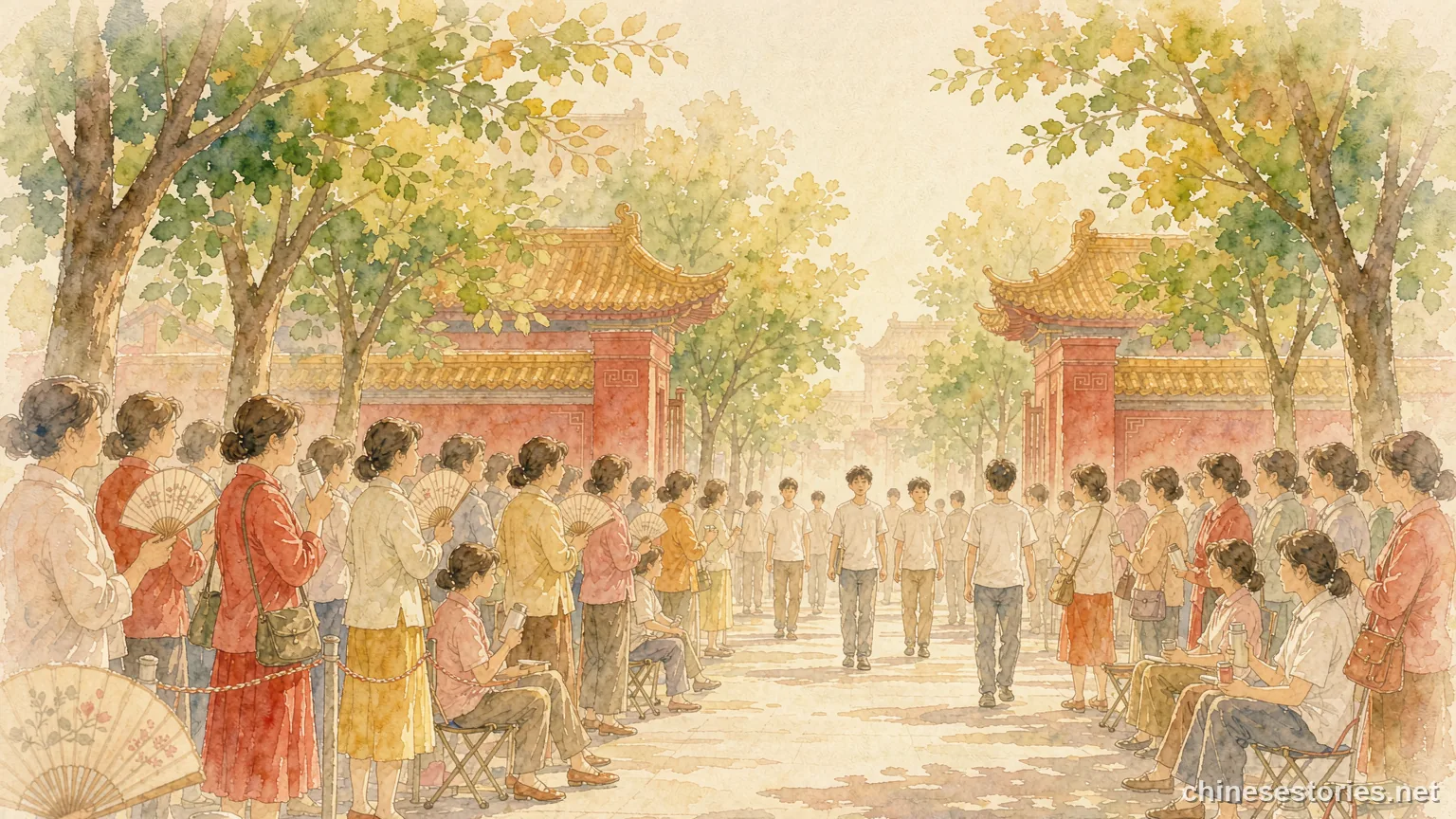
On the first morning of June, a mother in a red dress stands outside a high school gate in Beijing, holding a thermos flask and a paper fan.
Her daughter is inside, at a desk the length of an arm, about to begin the exam that will do more than any other single thing to shape the next ten years of her life.
The same scene repeats across the country. Traffic is redirected near exam halls. Building sites go quiet. Some taxi drivers offer free rides to students. Police stand at the gates, and in a few cities small drones are grounded for a few hours so nothing can carry a signal to a candidate.
Families plan their whole year around this week. Parents book hotel rooms near the test centre. Grandmothers cook. Teachers wear red and line up at the gate to wave students through. On the evening before the first paper, some students are told to go to bed early and not to think about anything at all.
Then, for two or three days, an entire country seems to hold its breath around a set of sealed papers.
What the Gaokao Actually Is
The exam is called the gaokao, which simply means the high exam. It is the national college entrance examination, and it is the main door into university in China.
It happens once a year, in early June. The first day is almost always June 7. Most students sit the core papers that morning and afternoon. Depending on the province, the whole exam runs for two, three, or four days.
There is no second sitting that year. If a student is ill, or panics, or simply has a bad morning, there is no retake until the following June.
In most provinces the total is 750 points. Every subject folds into that one number. Students answer national questions, or province-set papers built on the same syllabus, and then wait several weeks for the result.
In 2025, about 13.35 million students registered for the exam. That was slightly down from the record of 13.42 million the year before, and it was still more people than the entire population of many countries. They sat in more than 7,800 test centres, spread from the biggest cities to remote counties.
The exam has not always existed in this form. It was abolished during the Cultural Revolution and restored in 1977, when millions of people who had been working in fields and factories suddenly got a chance to sit for university. Many of today’s grandparents took that exam. They still talk about it as the day their lives turned.
Because so many students sit the same papers, the exam itself becomes a national event. Within an hour of the Chinese essay prompt being released, it is being read and argued over on every screen in the country. The topic of that essay is often the small talk of the day, even among people who finished school long ago.
The exam is often described abroad as China’s SAT or A-levels, but that comparison only goes so far. The SAT can be taken several times, and it is one input among many. The gaokao is closer to a single, national, once-a-year sorting of an entire generation.
The Morning of the Test
The core subjects are Chinese, mathematics, and a foreign language, usually English. Under a set of reforms that have rolled out province by province, students then choose three more subjects from a list that includes physics, chemistry, biology, history, geography, and politics. By 2025, twenty-nine provinces had moved to this model.
The questions reward speed and accuracy as much as deep thought. A mathematics paper can run to more than twenty problems in two hours. A Chinese essay question gives a short prompt and asks for eight hundred characters in about an hour. There is little room for a slow, careful reader.
The security around the exam is tight. Papers travel in sealed vans under guard. Phones are collected at the gate. In recent years, some centres have installed scanners that detect smart glasses and smart watches, and cameras watch the rooms for any unusual movement.
The mornings themselves are choreographed. Parents are kept outside a marked line. Volunteers hand out water. A teacher from each school stands at the entrance with a printed list, checking names one by one as students file past.
For most families, the rhythm of the day is simple and fixed. The student sits two papers, one in the morning and one in the afternoon. Between them there is a long, quiet lunch, usually eaten quickly and followed by a short rest. Parents say little, because there is nothing left to say. The work was done over the past three years.
Scores are not compared across the country as one pool. Admission is decided province by province, and the cut-off line for a given university differs from place to place. A student in one province may need a far higher score for the same course than a student in another.
The competition at the very top is severe. To reach Tsinghua or Peking University, the two most famous universities, a candidate in most provinces needs roughly 680 to 700 points out of 750. In some places that means finishing in the top fraction of one percent of everyone who sat the exam.
That is why the exam is not really about passing. It is about ranking. Everyone is measured against everyone else in the same province, and a few points can move a student across a line that decides which city, which university, and which field they enter.
The Single-Log Bridge
There is a phrase Chinese families use for this exam. They call it the single-log bridge, the one narrow crossing that a crowd of thousands must squeeze across at once.
The image is not new. It comes from the old imperial exams, which for more than a thousand years selected officials by written test. A farmer’s son who passed could enter the ranks of scholars and officials. The idea that a written exam can lift a family out of its station is very old in China, and the gaokao inherited it.
For decades, this was the most reliable ladder of social mobility in the country. It is the one route that a family without money or connections can still climb. A student from a small town who scores well can move to a major city, enter a good university, and change the arc of a whole household.
Parents who never finished school will tell you that everything they did was to give their child this chance. Many of them moved to the cities for work and left their children behind with grandparents, precisely so the next generation could sit a better exam in a better school.
Even so, the starting line is not the same for everyone. A child in a large city studies in a well-funded school with experienced teachers and rows of laboratories. A child in a distant county may study in a smaller school, with fewer books and a longer walk to class. The exam is designed to be the same for both. Families know that the years before it are not.
That promise is why the exam carries so much weight. It is also why so many families accept the pressure as the price of fairness. In a country of this size, the exam is seen as impersonal, and being impersonal is part of what makes it feel honest.
The stakes have grown as the number of graduates has risen. A university degree no longer guarantees a good job the way it once did. So competition has moved down the chain, into which university a student attends, and then into which graduate programme, and then into which employer.
Families in Exam Season
In the weeks before the exam, family life reorganises around the candidate.
Mothers are said to wear a qipao on the first day, a fitted dress whose name sounds like the phrase for a smooth success. Fathers wear red. Some families hang a pair of chopsticks and a rice dumpling over the door, because the shapes and the words suggest passing and rising. A bowl of noodles may be served for the same reason: long noodles, long luck.
Hotels near major test centres sell out months ahead, so a student can sleep ten minutes from the gate. Grandparents take over the cooking and try to keep the flat quiet. In some neighbourhoods, a notice goes up asking residents to keep the volume down, and a group of volunteers stands at the crossroads to wave cars away from the school.
The pressure is not only on the child. Parents often describe the exam as the return on eighteen years of investment. That language can be heavy, and many students say they feel they are carrying the hopes of an entire family into the room.
Not everyone welcomes the intensity. Some families now question whether this much pressure is healthy. Others accept it as the way things work, and do their best to make sure their child is not the one who cracks.
A quiet industry has grown up around all of this. Tutoring centres, mock exams, and study camps fill the final year. Some families spend a large part of their income on extra classes. The trade has been reshaped in recent years by new rules, and many sessions moved to quieter, smaller forms, but the demand that created it has not gone away.
The final year has its own calendar. There are three rounds of revision, each followed by a large practice exam. Classrooms carry a countdown on the wall, and the number falls a little every morning. By spring, the students have stopped counting and the teachers have started.
In many homes, one parent quietly takes on a second shift of worry. They read about universities, compare cities, and keep a notebook of possible choices. None of it will matter until the score is known, but it gives the waiting a shape.
Gaokao Versus the SAT
To an English-speaking reader, the closest familiar thing is the American college admission test, but the fit is loose.
The SAT is offered several times a year and can be retaken. It is combined with grades, essays, and activities. A weak score can be offset. The gaokao is offered once. It is scored by subject, added into a single provincial ranking, and then matched to universities through a system of choices that students submit after seeing their result. One number does almost all the work.
The British A-level system is closer in seriousness but different in shape. Students sit exams in three or four subjects, and universities make conditional offers in advance. In China, the student does not know the destination until the number is public.
There is one more difference that surprises outsiders. In many Western systems, a student applies to several universities and waits for offers. In China, the student submits a ranked list of choices after seeing the score, and a central system places them according to their rank. It is less like applying and more like being assigned.
There is also a difference in what the result is used for. In the West, a test score is often one line in a story a student tells about themselves. In China, the score is the story’s spine. It sets the university, the city, the first job, and often the first serious relationship, because so much of adult life in a big city begins with where a person studied.
Each system reflects a different idea of fairness. The Western model trusts a spread of signals, gathered over years. The gaokao trusts one clean, comparable measurement, taken on the same day by everyone.
Neither is obviously kinder to a nervous teenager. Both simply place the moment of judgement in a different place. What the gaokao does is make that moment impossible to miss, for the student or for the family standing outside the gate.
After the Last Bell
When the final paper ends, students walk out into a strange quiet.
Some cry. Some run to their parents and say nothing at all. Outside the gate, the red dresses and the red shirts mix into a crowd, and someone always brings a camera.
Two weeks later, the scores appear online late at night. Families crowd around a laptop. The number appears, and a summer of decisions begins: which universities to list, which city to accept, whether to try again next year.
For the students who do well, the next weeks are a blur of celebrations and forms. For those who do not, there is a harder silence. Some take a year to study and sit the exam again. Some choose a different road altogether, into vocational training, into work, or into study abroad.
Whatever the outcome, one thing is shared. For three days in June, these students were the most important people in the country, and the whole of it moved a little out of their way. There is no other exam in the world quite like that.
By late August, the exam is already turning into someone else’s story. The next class has started its final year. The same classrooms, the same desks, the same countdown on the wall, one more time.
This story is based on publicly documented practices and on reporting in the Chinese and international press. The families described are illustrative, and no individual is identified.