Su Wan gets home at half past six. She has the key in the lock when she hears the child laughing inside.
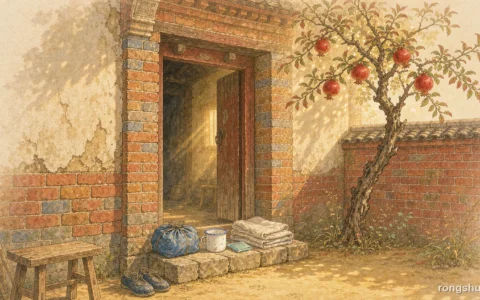
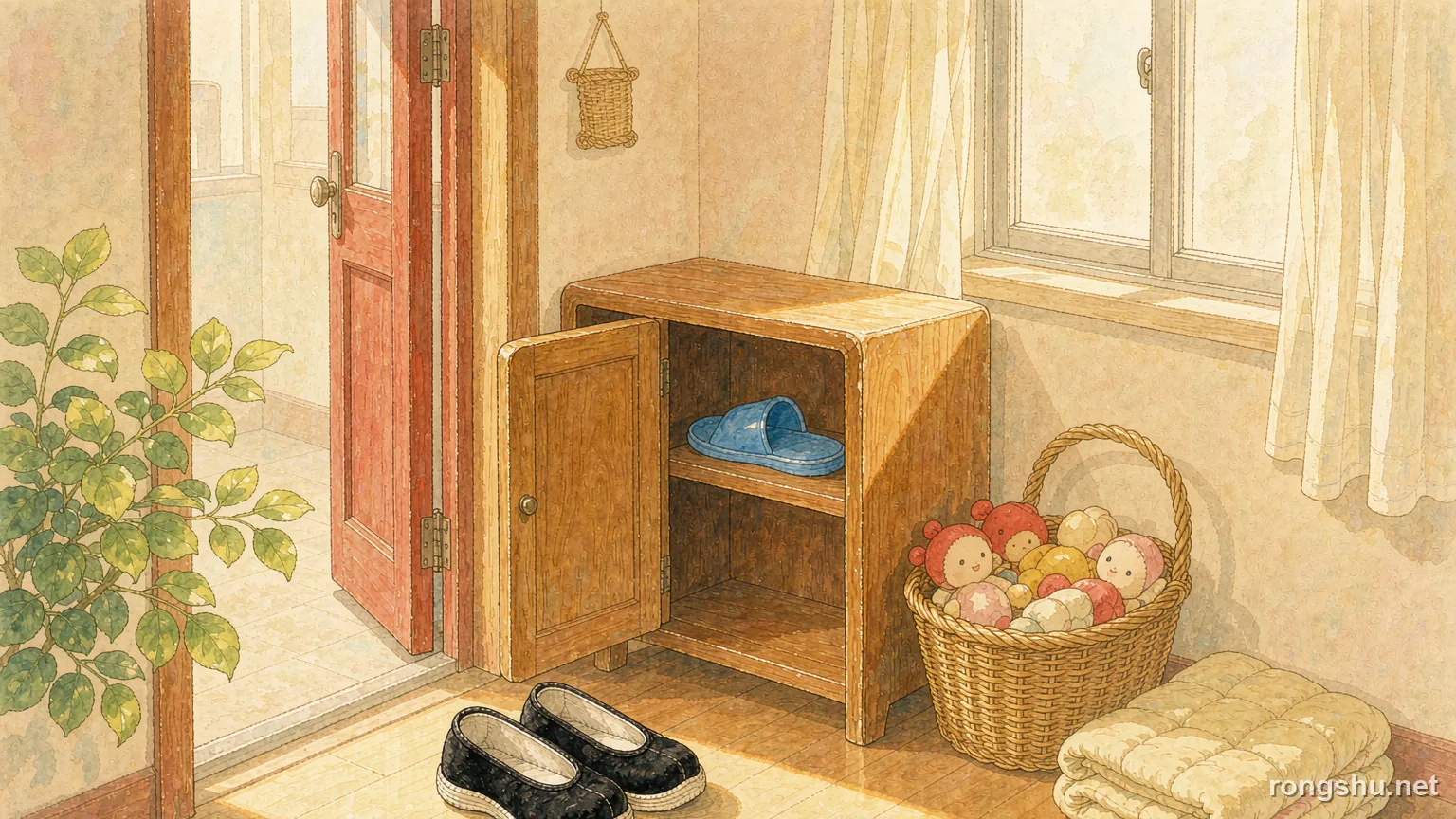
The door opens, and the first thing she sees is a pair of shoes by the threshold.
Black cloth uppers, white cloth soles, stitched in rings, the toes turned up a little.
The flat has wooden floors, and everyone changes shoes at the door.
The cloth shoes have been sitting there for three days, ever since her mother-in-law arrived, and nobody moves them.
What Came Out of the Two Sacks
Li Xiuying came in early April.
Her son Chen Zhigang drove out to fetch her. When she climbed out of the car she lifted two woven sacks from the boot.
One held eggs, packed in wheat straw, each one set in its place. The other held dried vegetables, bean thread, and pickles she had made herself in glass jars with the mouths tied off in plastic.
She had also brought an enamel basin, for washing the baby.
Su Wan laughed. Mother, she said, we have a baby bath.
This one is better, Li Xiuying said. It does not slip.
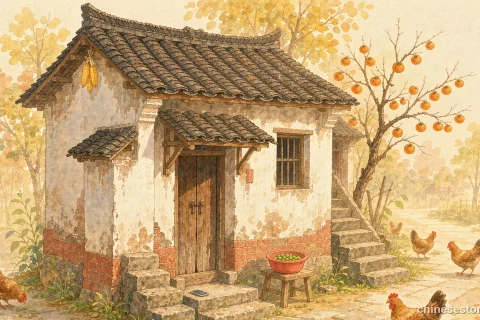
She is sixty-three, small, and speaks quietly. The village is more than three hundred kilometres away, and her husband is still there, working the fields and keeping two pigs.
She arrived wearing the cloth shoes. She had stitched them herself, and after the whole journey the soles were still clean.
Look at those two sacks again. Eggs, dried vegetables, pickles, two jars that took a month to fill. It is not shopping. In a Chinese village, food you have put up with your own hands is how a woman arrives at her son’s door without empty hands.
The flat has two bedrooms and a living room, on the seventeenth floor. The bedroom belongs to the young couple and the baby. She sleeps on the sofa bed in the living room.
The first evening she could not light the gas stove. The knob has to be pressed down before it turns, and she pressed and pressed and nothing happened, and she thought it was broken.
The next morning Su Wan got up and smelled gas in the flat.
Li Xiuying was standing at the stove with both hands rubbing on her apron.
I cannot work this one, she said. Ours at home burns wood.
Su Wan showed her once, and Li Xiuying nodded and said she had it. When Su Wan came home that evening there was a pot of water heating. I can do it now, Li Xiuying said.
Then there was the lift. She would not ride it alone.
She said she had seen on television that a lift can shut a person inside.
That almost never happens, Su Wan said. You just press the number for your floor.
Oh, Li Xiuying said.
In the daytime both of them work, and the flat is left to her and the baby. Xiaoman is eighteen months old and has just learned to walk. She does not dare take him downstairs, because of the lift.
So the whole day she walks a circle through seventy square metres with a small child, living room to bedroom, bedroom to balcony.
From the balcony she can see a small paved area below. She stands there every day for a while and watches people walking their dogs and people airing quilts.
She keeps a ring of keys on her belt. They are the keys to the village house. In the evening, when there is nothing to do, she takes the ring off her belt and touches the keys one by one.
At noon she telephones her husband. He is hard of hearing and she has to shout. It is the same few things every time: the price of grain, whether the pigs have been fed, whose son is getting married. When she hangs up she puts the phone on the arm of the sofa and sits there for a while.
She does not put the baby’s clothes in the washing machine. She says the drum turns too hard and ruins them. When the child is asleep she carries a basin into the bathroom and scrubs them by hand, one at a time, wrings them out, and hangs them on the inner line on the balcony.
She brought an apron too, blue cloth, worn pale at the front, with a patch over the pocket. She tied it on the day she arrived and wore it for cooking and mopping and changing nappies from morning to night. She untied it only to sleep, folding it and laying it at the head of the sofa bed.
The Paper on the Fridge
Xiaoman is Su Wan’s first child.
When he was six months old Su Wan taped a sheet of paper to the fridge. It laid out the day: up at seven, breakfast at eight, a short nap at ten, rice porridge at noon, fruit at three, bath at half past seven, asleep at half past eight.
The paper was printed and taped across the middle of the fridge, where you cannot miss it.
Li Xiuying knows a few characters, not many. On that sheet she could make out two words only. Eat. Sleep.
So she did things her own way.
Food. She was afraid the child would go hungry, so she followed him with the bowl. The boy ran around the living room and she went after him, a spoonful at a time. When he would not eat she coaxed him. Last mouthful, last mouthful.
Su Wan spoke to her about it twice. Mother, she said, let him eat by himself. If he does not eat, he goes hungry.
He is so small, Li Xiuying said. What if he starves.
When it turned warm she still put socks on the boy and a thin jacket over his shirt. Su Wan put a hand on his back and it was soaked.
Mother, she said. Too many clothes.
A small child must not take a chill, Li Xiuying said. Cold feet and he catches a cold.
Su Wan took the jacket off. The next time they went out, Li Xiuying had put it back on.
Another time Su Wan came to the kitchen door and saw her mother-in-law put the baby’s spoon in her own mouth to test the heat, and then hand it back to him.
She stopped for a moment and said nothing.
That evening she talked to Zhigang in the bedroom. He was lying on the bed looking at his phone. My mother means well, he said.
I know she means well, Su Wan said.
Then that is that, he said.
Su Wan said nothing more.
She had thought about doing it herself. But she works, and someone has to watch the child, and a paid helper costs several thousand a month and still has to be trusted.
This is what it looks like when two parents both work in a Chinese city. Her own mother is in poor health, back in her home town. On this side of the family there is only Li Xiuying.
She had done those sums, more than once.
Of the eggs Li Xiuying brought from the village, she ate none herself. She steamed them for the baby and fried the rest for Su Wan and Zhigang. In the morning she ate pickles with her porridge. Eat some yourself, mother, Su Wan said once. There is plenty at home, Li Xiuying said. I do not care for them.
She also kept the flat. The floors shone and the toys were stacked in the basket by size. One day Su Wan went looking for a small sock and turned out every drawer, and found it at last in her mother-in-law’s sewing kit. The cuff had split, and Li Xiuying had patched it with a square of cloth.
The paper on the fridge she never moved. When she wiped the fridge down she wiped carefully around the edges of it, that strip as well.
A Tune on the Balcony at Night
Things changed on a night.
Xiaoman started to burn at about ten, over thirty-eight degrees. Su Wan put a cooling patch on him and gave him water. Zhigang was away on a work trip and would not be back until the next day.
She walked the room with him in her arms, and the more she walked the more frightened she became.
Li Xiuying got up from the sofa. You sleep, she said. I will hold him.
Mother, you sleep too, Su Wan said.
I am not sleepy, Li Xiuying said.
She took the child and held him against her chest. He cried and she walked the living room, out to the balcony and back.
She walked for a long time, and the flat went quiet.
Su Wan lay in bed, not asleep, and heard a very soft sound from outside.
A tune. Slow, one note at a time, with no words.
She got up and stood in the doorway.
The balcony door was open a hand’s width and the night air came through it. Her mother-in-law stood with her back to the room, the child against her shoulder, moving up and down on her heels.
Su Wan had never heard the tune before.
After a while the child slept. Li Xiuying laid him on the bed and turned, saw her, and stopped. Again her hands went to her apron.
Mother, Su Wan said. What is that song.
I do not know what it is called, Li Xiuying said. Where we are from, everyone hums it.
Did you always know it, Su Wan said.
I used it for Zhigang too, Li Xiuying said. He had a fever one night like this, and his father was out hauling bricks and not home. I held him by myself until it got light.
She said, I held him and held him, and the tune came.
Su Wan stood there and said nothing.
After a moment she said, mother, go and sleep. I will watch him.
The next morning Su Wan got up and found the porridge already on. It bubbled in the pot.
She walked to the fridge and pulled the printed schedule off the door, crumpled it, and threw it away.
Li Xiuying watched her and did not dare ask.
Mother, Su Wan said. From now on we do it your way. If anything happens with him, you call me.
No, Li Xiuying said. I am only doing it by guesswork.
You are not guessing, Su Wan said.
The child had come off the fever that day. He sweated in his sleep and the pillow towel was damp through. Li Xiuying felt it with her hand and went for a dry towel to put underneath.
That morning she said to Su Wan, when Xiaoman starts kindergarten, I will go home.
That is two years away, Su Wan said.
Two years goes quickly, Li Xiuying said.
Su Wan said nothing. She dropped the paper ball into the bin.
A Pair of Slippers in the Shoe Cabinet
After that the two of them found other ways.
Su Wan worked out that her mother-in-law was not refusing to listen.
She simply did not trust that sheet of paper. Paper is for the eyes. Li Xiuying trusts her hands.
So Su Wan tried something else. On the gas stove she taped a drawing beside the knob. An arrow pointing down, a circle for the direction, four characters. Press down, turn.
Li Xiuying followed it. The first day it took her three tries to light; the second day it caught the first time. After that she rolled her sleeves up the moment she went into the kitchen and said she knew how to work city fire now.
The lift took five rides, with Su Wan beside her, down seventeen floors and back up. Li Xiuying gripped the rail and watched the numbers.
On the fifth ride she said, this thing does not bite.
It does not bite, Su Wan said.
The market was the same. Su Wan took her twice. The third time Li Xiuying went on her own with the cloth bag over her shoulder.
The market sits behind the housing compound, ten minutes on foot. The first time she went alone she stopped at the entrance for a while and watched how people went in and came out. She likes to bargain. Four yuan, the seller said, and she offered three and a half. The seller did not move, so she took two steps away, and the seller called her back. She walked home slowly with the vegetables, looking into the shops on both sides.
That day she came in with a bag of greens, two fish, and a small sack of rice.
She came in and stopped at the door to change her shoes.
Su Wan had bought her a pair of slippers, plastic, blue, and put them in the shoe cabinet.
Li Xiuying would not wear them. It is a waste of money, she said. Mine are good. Cloth soles, and my feet do not sweat.
It is a wooden floor, mother, Su Wan said. You will slip.
Li Xiuying tried them. They are soft, she said.
Then wear them, Su Wan said.
Li Xiuying put the slippers back in the cabinet and went on wearing the cloth shoes. Two days of that. On the third day she changed.
The cloth shoes went to the sink, where she scrubbed them with a brush and hung them on the balcony.
She Went Down to Buy Vegetables Herself
Later, when Su Wan was about to do something, she began to ask first.
What do you think, mother, she would say. Is this all right.
Li Xiuying learned to ask too. Whether the boy could eat a thing. Whether he had enough on.
They still disagreed sometimes. Once Li Xiuying chased the boy around with the bowl again, and Su Wan stood by and let it happen. When the bowl was empty Li Xiuying put it down herself and said, next time he eats on his own.
She stopped mentioning going home as well.
At the end of May the wheat needed bringing in. Her husband telephoned to say it was done, and asked when she was coming back.
She took the call on the balcony. Su Wan, in the room, heard her say quietly, a little longer.
She came back in and said, the old man brought it in on his own.
Mother, Su Wan said, if you want to go and look, we will drive you.
No hurry, Li Xiuying said.
Then let father come and stay a few days, Su Wan said.
Li Xiuying stopped for a moment. He cannot ride a lift, she said.
I will teach him, Su Wan said.
Li Xiuying laughed. You teach him, she said.
That night Su Wan watered the plants on the balcony and looked along the rail.
The scrubbed cloth shoes hung at the far end, soles facing out. Beside them stood a pair of blue slippers.
Air came in through the window and made one loose thread on the cloth shoes swing.
This is a work of narrative writing based on real situations in Chinese family life. All names have been changed.