At half past five in the morning, the departures hall of a provincial railway station is already full. Men carry cardboard boxes on their shoulders, families sit on their luggage against the wall, and a student in a puffer jacket sleeps with her head on a backpack. Outside on the platform, the board shows trains to Chengdu, Xian and Changsha, all of them sold out.
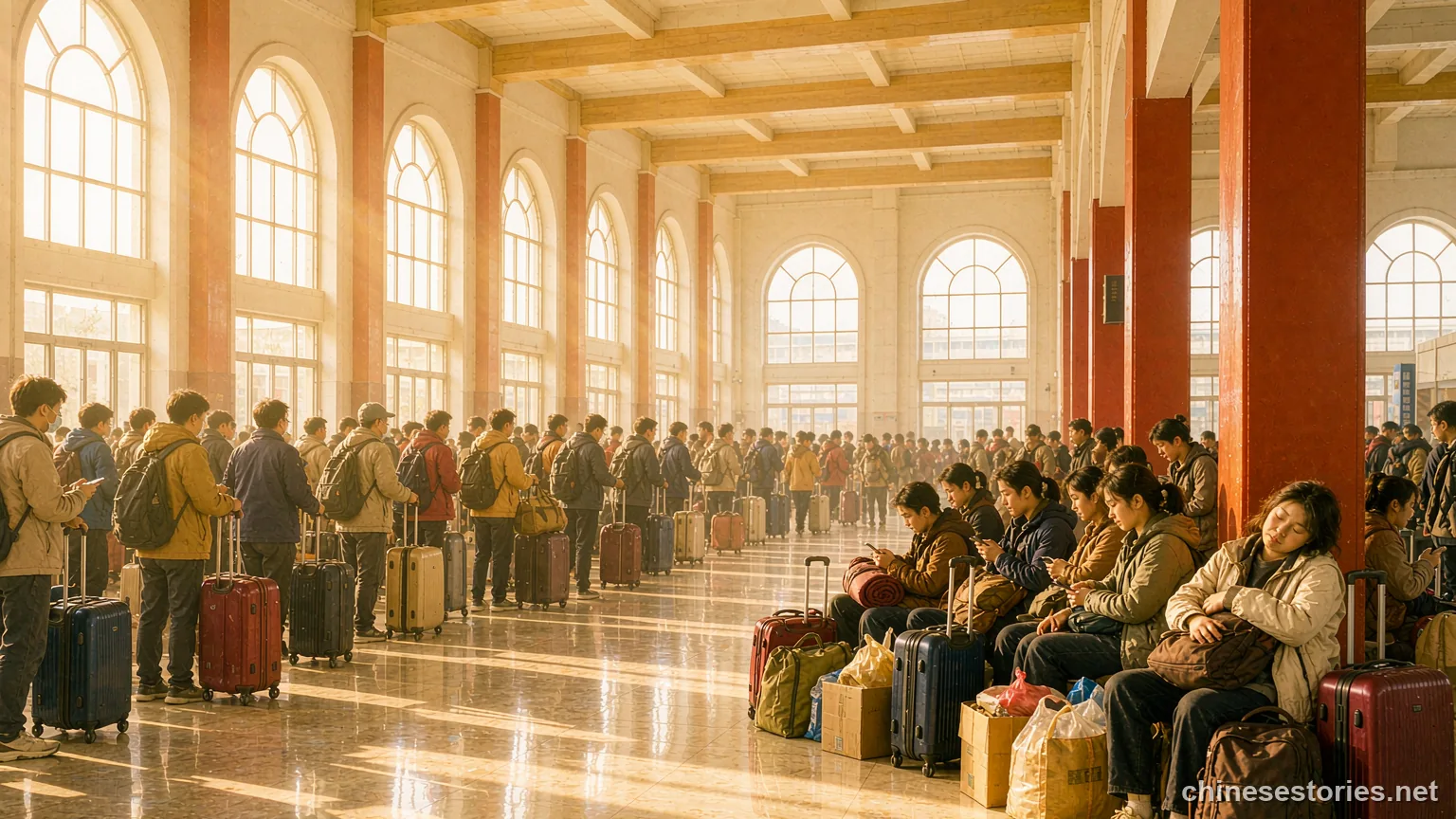
This is the first morning of October, and it looks the same in hundreds of stations across the country. For seven days, work stops almost everywhere at once. Offices close, factories pause, and a country of more than a billion people decides to move.
The result is the largest regular movement of human beings on the planet. Every autumn it happens quietly, on schedule, and then it is over. For anyone outside China who has ever wondered why their Chinese colleagues vanish for a week, or why hotel prices in a small city suddenly triple, this week is the answer.
What Golden Week Is
Golden Week is not one holiday but two, built around the national day on the first of October and around the lunar new year in winter.
The system began in 1999. To encourage spending and give people a real break, the government stitched public holidays together with weekends into long blocks of consecutive days. The October version runs for seven days and has become the busiest travel period of the year after the spring festival.
Because the dates are fixed, everyone knows them years in advance. Schools plan around them. Shops restock for them. Airlines and railways add capacity months before. A worker in a factory in the south and a teacher in the north-east are looking at exactly the same seven days on the same calendar.
That single shared date is the whole point, and it is also the whole problem. A holiday that everyone takes at the same time produces a country that moves at the same time.
What the Crowds Look Like
By the second day of October, the movement is visible everywhere.
The railway network, the largest in the world, runs at maximum capacity, and hundreds of millions of tickets are sold in the days before. Motorways turn into long ribbons of parked cars, and a journey that takes four hours on an ordinary Tuesday can take twelve. At famous sites, the queue outside a mountain gate in the morning can stretch for a kilometre.
The numbers match what the eye sees. Tourism authorities measured about 826 million domestic trips during the seven days of the October holiday in 2026, with total spending of roughly 738 billion yuan. In a country of about 1.4 billion people, that is close to six journeys for every ten residents, in one week.
Inside the cities, the pattern repeats in miniature. Restaurant tables are booked out, cinemas sell every seat, and museums that are free and quiet in March need timed-entry tickets in October. Parks fill with families who have driven two hours to sit on the grass.
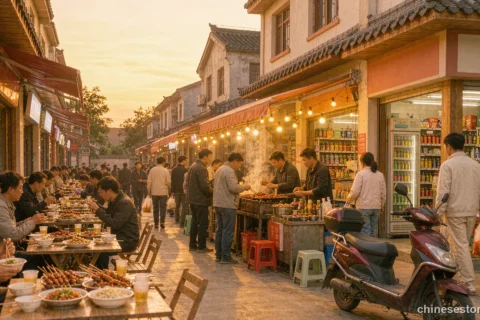
Not every destination is a mountain or a beach. Some of the fastest growth is in places built for a single evening rather than a whole week. A city that opens a night market, a light show and a row of small stages can draw visitors who sleep at home and spend three hours on a street. Officials in many places now talk about the night economy as a holiday asset of its own, and the busiest hours of the holiday are often after dark.
The season matters too. October is the mildest month in much of the country, between the heat of summer and the cold of the north wind, and the trees are turning. For a family choosing one week in the year to be outdoors, the first days of October are the obvious choice, and that preference is now so settled that the weather itself has become part of the schedule.
Then, almost as suddenly as it began, it ends. On the last afternoon the traffic reverses, and by the following Monday the same stations are empty again.
Why Everything Happens at Once
The obvious explanation is the calendar, but the deeper reason is how work and family life are organised.
Most Chinese employees receive a limited number of paid leave days, and many are reluctant to use them. Taking a week off outside a public holiday can be awkward in a workplace where being present is read as commitment. The result is that the paid leave people are entitled to is often saved rather than spent, and the public holiday becomes the only realistic time to travel.
The second reason is distance. China is enormous, and work has pulled hundreds of millions of people far from the towns where they grew up. For a young worker in Shanghai or Shenzhen, going home means a train of eight, twelve or twenty hours. A weekend is not enough. Golden Week is the one block of days long enough to make the trip worth it.
The third reason is that holidays are social. A wedding is often scheduled for the October break so that relatives can attend. A family reunion is planned around it. Once a critical mass of people treats one week as the time to travel, everyone else has a reason to do the same, and the crowding becomes self-reinforcing.
There is also a gentler driver. Chinese life is intensely scheduled, and the long holiday offers something rare: a stretch of days with no obligation attached. People use it for the things they postpone all year, from seeing grandparents to visiting a mountain they first saw in a photograph.
The Reverse Flow
Look closer at where people go, and a quieter change appears.
For years the traffic ran one way, from smaller places toward the coast and the great cities. That is still the main current in October, as migrant workers head home and city families head for the sea. But a second stream now runs the other way, and it is growing.
People from big cities are travelling to counties and small towns, drawn by lower prices, quieter streets and food that is not on any chain menu. Local governments have noticed, and many have turned a stretch of old street or a lake shore into a destination with lights, stalls and a stage. In the October holiday of 2026, one small town in Anhui drew more than a hundred thousand visitors by wrapping its snacks in a story about old copper coins, and a county in the mountains of Qinghai counted more than two hundred thousand arrivals.
For the towns themselves, the effect is double-edged. A week of visitors brings income to guesthouses, noodle shops and drivers, and it brings a new kind of attention to places that were invisible a decade ago. It also brings congestion, rubbish and prices that local families cannot always match.
For the travellers, the appeal is simple. A famous scenic spot in October is a place to stand in a queue. A small town two hours from a regional airport is a place to sit and eat. As ticket prices rose and the big destinations filled, the second option started to look less like a compromise and more like the point.
Who Stays Behind
A week when everyone travels is also a week when a great many people work harder than usual.
Delivery riders ride through the holiday without a pause, because people on trains and in hotel rooms still order food, and because the platforms that employ them run promotions designed for the break. Restaurant kitchens in tourist districts stay open later than at any other time of year, and the staff are often the only people in the room who have not had a day off.
Retail workers, station staff, drivers, cleaners and security guards all sit at the centre of the busiest week of the year and see little of it. Some take their own break in a different month, when the crowds are gone and prices are low, and this quiet bargain suits both sides. Travel in the second week of November is cheaper, calmer and, by the account of those who try it, better.
There is a larger asymmetry underneath. The people who travel furthest and rest least are often the ones who work for the smallest wages, and the holiday economy depends on their extra hours. It is a trade that many accept willingly, because the overtime pay is real and the alternative is a week of nothing. But it also means that the picture of a nation on holiday, taken from a crowded platform, leaves out half of the story.
Some families choose to move in the opposite direction entirely. Instead of travelling, they stay at home and let the city empty around them. With the roads clear and the parks quiet, a week in a usually crowded neighbourhood can feel like a holiday of its own, and more city dwellers now say that staying put is the more restful choice.
Why It Matters Beyond China
That week of movement has consequences that reach well past the country.
The spending is enormous, and it lands in a short window. Hotels, airlines, restaurants, cinemas, museums and shops all plan their year around these days. For a shop owner, a good Golden Week can carry several ordinary months. For a small brand, the holiday is the moment to launch a product, because attention is at its peak.
The week also shapes the physical country. High-speed rail lines have been built with this surge in mind, and the network is planned so that the busiest days can be absorbed. New airports, ring roads and metro lines are justified partly by the crowds that appear for seven days and then disappear.
The timing of the calendar even matters to businesses abroad. When China is on holiday, ports slow, factories pause and orders wait. Buyers in Europe and North America learn to plan around the first week of October, in the same way they plan around Christmas.
And the pattern is spreading in a softer form. Photos and short videos from Chinese trips now travel widely, and the destinations people choose in October become known abroad. A town that becomes famous inside the country during the holiday can become a curiosity outside it within a year.
Compared With the West
A reader from Europe or North America will recognise the ingredients of Golden Week but not the scale.
Western countries have their own travel peaks: the last week of August in France and Italy, Thanksgiving weekend in the United States, the days around Christmas. Highways jam, airports fill, and hotel prices climb. The feeling of a country on the move is familiar.
Three things differ. The first is coordination. Western holidays are staggered by region, industry and school district, so the pressure spreads across several weekends. In China the seven days are the same for almost everyone, and the peak is a single spike rather than a broad hill.
The second is the share of the population involved. The August holiday in Europe moves tens of millions. Golden Week moves hundreds of millions, and the transport systems required to carry them were built within a single generation.
The third is distance. A European family driving to the coast covers a few hundred kilometres. Many Chinese travellers cross the country, and the trip is often the only time in the year when the whole family is in one place.
Western readers may also find one element surprisingly familiar. In both places the long holiday is really about the same two things, rest and family, and both places discover every year that doing them all at once is exhausting.
The Road Home
On the last evening of the holiday, the station hall is full again, but the mood is different. The boxes are gone, replaced by bags of fruit and vacuum-packed local food. A young man stands in line with a suitcase and a plastic chair folded under his arm, a gift for his mother.
The trains run through the night, one after another, carrying people back to the cities where they work. In the morning the platforms empty, the shops reopen, and the roads fill with the ordinary traffic of a working day.
For most people the week was not restful. It was a long queue, a long drive and a long train, followed by two days of sleeping in a room they grew up in. And yet, when the calendar comes round again, they will go, because the distance between where they work and where they come from does not shrink on its own. The holiday is how the country keeps the two connected.
This story is based on publicly documented practices and on reporting in the Chinese and international press. The families described are illustrative, and no individual is identified.