At one in the morning on a street in Changsha, the tables outside a barbecue shop are full. A group of four is arguing happily over a plate of skewers, a woman walks past with an earphone in and a bag of fruit, and a delivery rider waits by his scooter for an order to appear on his phone. Further along, a convenience store is lit up like a small lighthouse and two students are buying ice cream.
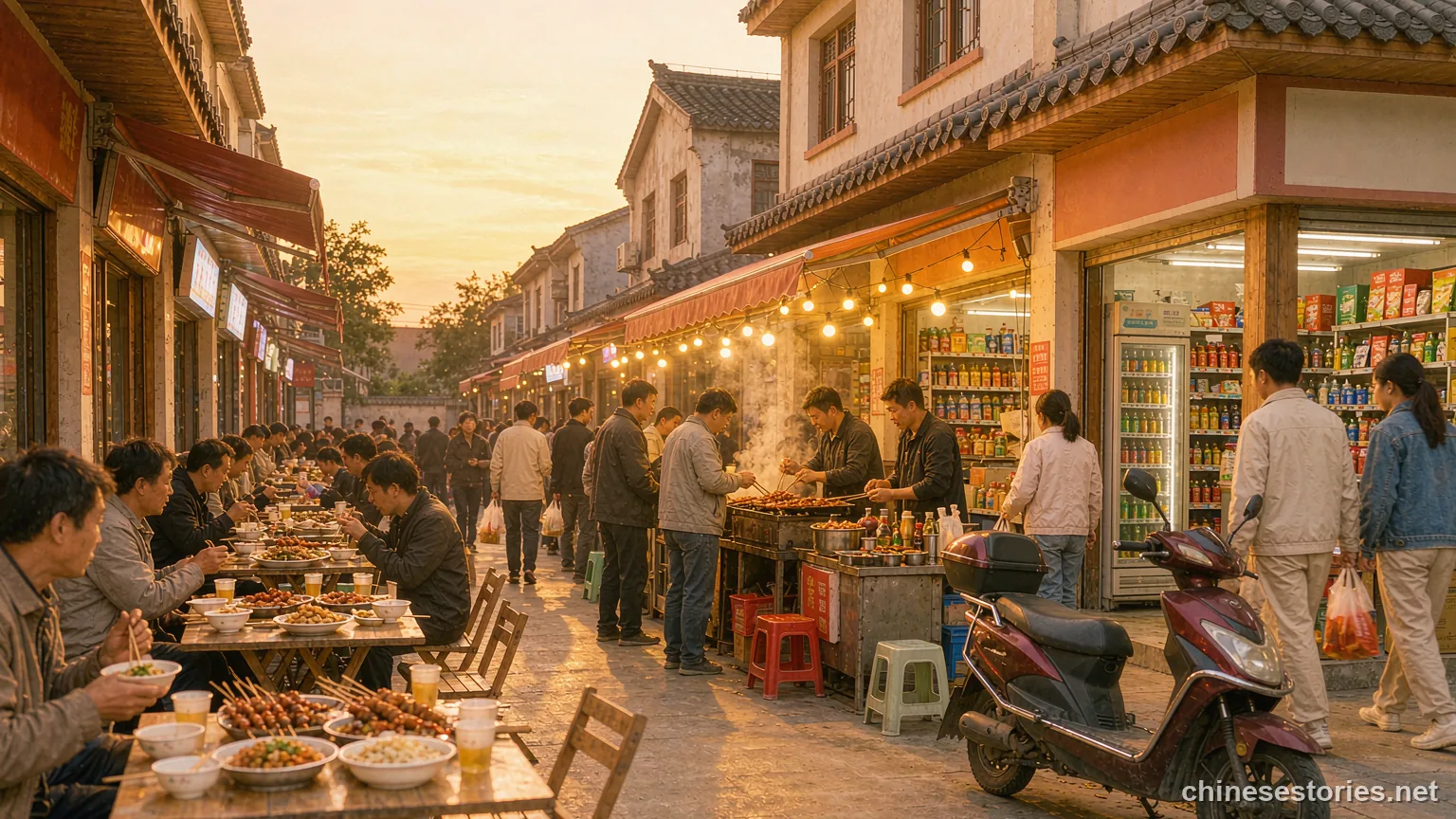
This is a city of several million people, on an ordinary Tuesday, long after the last metro train. Nothing about the scene is remarkable to the people in it. To a visitor from almost anywhere else, it is often the single most surprising thing about China.
Questions about safety at night are among the most common that foreigners ask before a first trip, and among the most common that they post about afterwards. The answer is not that the country is unusually virtuous. It is a set of ordinary physical and economic arrangements, most of them invisible, that together keep the streets awake and occupied after dark.
What Visitors Notice
The first thing travellers report is not the absence of crime but the presence of other people.
Foreign visitors describe walking home at midnight without planning the route, taking a phone out in the street without checking who is behind them, and letting a child run thirty metres ahead in a park. These are small things, and people who have lived in a city all their lives do not notice them at all. Visitors from places where the evening empties out notice them immediately.
What they also notice is that the streets are not empty. Shops are open. Food is being cooked outdoors. There are families, elderly couples walking slowly, students, and workers ending a late shift. A busy street is itself a form of protection, and most Chinese commercial streets are busy until well past midnight.
The third thing visitors notice is that the safety extends past the centre. It is not only the tourist districts that stay lit and populated. Ordinary neighbourhoods, the kind with a noodle shop and a pharmacy on the corner, keep the same rhythm, because the people who live above the shops are also the people who buy from them.
Why the Streets Stay Busy
The answer begins with food and with hours.
Dinner in many Chinese cities is later than in northern Europe or North America, and meeting friends at eight or nine in the evening is normal rather than unusual. A meal can stretch for two hours, and it is often followed by a walk, a drink, a dessert or a second stop at a tea shop. The evening therefore has a long tail, and businesses stay open to serve it.
Delivery extends the same tail into the home. A kitchen can take orders until two in the morning, and a rider will bring hot food to a flat on the twentieth floor for a small fee. The consequence is that an enormous number of people are awake, moving and working, which keeps the streets populated and lit.
Air conditioning and climate play a part too. In summer, especially in the humid south, the evening is the only comfortable time to be outdoors. In many southern cities the busiest hours of the day are after sunset, and the streets at eleven at night look like the streets at eleven in the morning.
Then there is the shape of the working week. Many young people in service jobs, technology firms and shops finish late. Their social life begins at nine. A city where a large share of the population is still out at midnight is a city where being out at midnight is normal.
The Shape of a Chinese Neighbourhood
The physical form of the city matters more than most visitors realise.
Most Chinese neighbourhoods mix homes and shops rather than separating them. A residential compound has a wall and a gate, and just outside it there is a row of small businesses: a convenience store, a fruit seller, a pharmacy, a hairdresser, a courier station, a noodle shop. People live above and behind this strip, and the strip stays open late because the customers are metres away.
A dense apartment compound also supports a surprising amount of business on its own. Several thousand people may live inside one gate, which is enough custom to keep a small shop open until midnight and a delivery rider busy all evening. Where a Western suburb disperses the same number of people across a wide area, a Chinese compound keeps them within a few minutes of a shop front.
Even the riding and walking patterns help. Scooters, bikes and pedestrians share the same streets in most of the country, and a street with a steady flow of people on it feels watched. Lighting is comprehensive and municipal: major roads, side streets and compound paths are lit all night, and few places are genuinely dark.
There is also a formal layer. Neighbourhood police stations sit inside the areas they serve, guards work the gates of compounds, and a network of cameras covers the main routes. Visitors mention this layer, and its effect is partly that crimes are harder to hide and partly that the presence of any official structure in a street changes how it feels to be in it.
Phones, Fewer Motives and the Small Hours
Two quieter changes have removed a great deal of the reason for street crime.
The first is payment. Cash has almost disappeared from ordinary life, and a wallet is no longer worth taking. A thief who steals a phone finds a locked device in a country where second-hand resale is traceable, and the money inside it cannot be spent without a password. A large share of the motive for pickpocketing and street robbery has quietly gone with the cash.
The second is that very few people are desperate in the way that produces street violence. Employment in cities is broad and low-skill work is available, rough sleeping is uncommon, and the state provides a basic safety net. This is not a claim that poverty has ended, and there are parts of every large city where a visitor should still be careful. It is an observation that the conditions that make a walk home dangerous in some other cities are less common here.
Drugs deserve a mention because their absence shapes the street. Their use is treated severely, and the market for them is small, which removes a category of chaotic, unpredictable crime that contributes a large share of night-time danger in cities elsewhere.
None of this makes a Chinese city crime-free. Theft, scams, fights and worse all exist. What has changed is the baseline. The ordinary walk home is no longer something a person has to plan.
Who Is Out at Midnight
The street at one in the morning belongs to a particular set of people, and knowing who they are explains the atmosphere.
Students are the largest group in many districts. Libraries and study rooms close late, and a group walking back from a campus takes the long way past a food street. Young office workers come next, released from a shift that ended at ten and unwilling to go straight home. Delivery riders move through both groups all night, and their scooters are the most common sound on an empty road.
Then there are the people whose day starts late. Night-shift guards, cleaners, convenience store staff and hospital workers all pass through the same streets, and the food stalls stay open precisely because they do. A dumpling stall that trades between eleven and three has a reliable list of customers, and most of them are working, not partying.
Older residents have their own hours. Many wake before dawn and walk in the park in the dark, and in summer the square dancing groups run until nine or ten. A neighbourhood street at night is therefore a sequence of different crowds, each handing the pavement to the next.
Women describe the freedom to walk alone at night as one of the clearest differences from cities elsewhere, and the market has responded to it. Some taxi and ride-hailing platforms offer female passengers priority for female drivers late at night in a large number of cities, and a woman travelling alone can choose the option from the app. It is a small feature built on a large assumption, that the trip itself is safe enough to plan calmly.
What Safety Is Worth
A quiet street after dark has an economic price tag, and Chinese cities have learned to read it.
Night spending now accounts for roughly a third of all consumer spending in the country, measured in 2025 at close to thirty-three percent. That figure is large enough that many local authorities now treat the night economy as a resource to be developed, and streets are now designed with the night in mind: lighting schemes, night markets, outdoor stages, late transport and food streets built for a crowd.
The returns show up in ordinary employment. A barbecue shop that serves until three employs more staff and buys more meat. A night market creates stalls, cleaners, security staff and riders. All of it depends on customers who are willing to be outside, and customers are only willing if they feel safe.
Safety also has a reputation value that is harder to measure. Foreign visitors talk about it constantly, and their account travels further than any advertising. Tourists describe the freedom to walk after dark as the thing they miss most when they go home, and the phrase they use for it is a feeling rather than a fact.
That feeling changes how public space gets used. Runners take the riverside path after ten at night. Children stay out on the compound square until their parents call them in. Elderly residents start their exercises before sunrise and are not the only people on the pavement. A city that is safe at night is a city whose public space is available for more hours of the day, and those extra hours are worth a great deal to the people who use them.
The same busy streets are also loud, and not everyone welcomes them. Residents above a food street deal with noise, cooking smells and traffic until the small hours, and complaints about night-time disturbance are a regular feature of life in the liveliest districts. The balance between a street that is safe because it is busy and a street that is livable because it is quiet is negotiated building by building, and rarely settled for long.
The other side of the same coin is that a busy night is not restful for everyone. The people who keep the barbecue shop open until three are working, not relaxing, and their own safe walk home happens at four in the morning.
Compared With the West
A reader from Europe or North America will find the principle familiar but the balance different.
Western cities are not uniformly dangerous after dark, and many are calm and pleasant at night. The difference is how much of the city is designed for life after dark, and how many people are expected to be there. Where a downtown closes at seven and becomes a set of dark office towers, a Chinese commercial street keeps trading, and the presence of trade is what keeps the pavement busy.
The layout explains part of it. Zoning that separates homes from businesses produces quiet residential districts and empty commercial districts in the evening. Mixed use produces the opposite: shops under homes, people on the street at all hours, and a natural audience for anyone else who is out.
Payment and cash explain another part. Western cities still run on cards, notes and coins, so a wallet or a handbag remains worth stealing. A society that has moved almost entirely to phone payments has removed the easiest target on any street.
There is a cultural gap as well. Westerners often treat an empty street as peaceful and a busy one as risky. In China the intuition tends to be reversed. The crowded street at midnight is the safe street, and the quiet one is the one to hurry through.
The Last Table
At two in the morning the barbecue shop is still open, though the tables are fewer now. A couple shares a plate of fried rice, a rider picks up one last bag, and the man at the grill wipes the counter and starts stacking bowls for the night.
The street will be quiet by four and busy again by seven, when the breakfast stalls open and the first riders collect their orders. Nothing about the rhythm is dramatic, and that is exactly the point. For the people who live here, a busy street at midnight is not evidence of anything unusual. It is simply what the street looks like at that hour.
This story is based on publicly documented practices and on reporting in the Chinese and international press. The families described are illustrative, and no individual is identified.