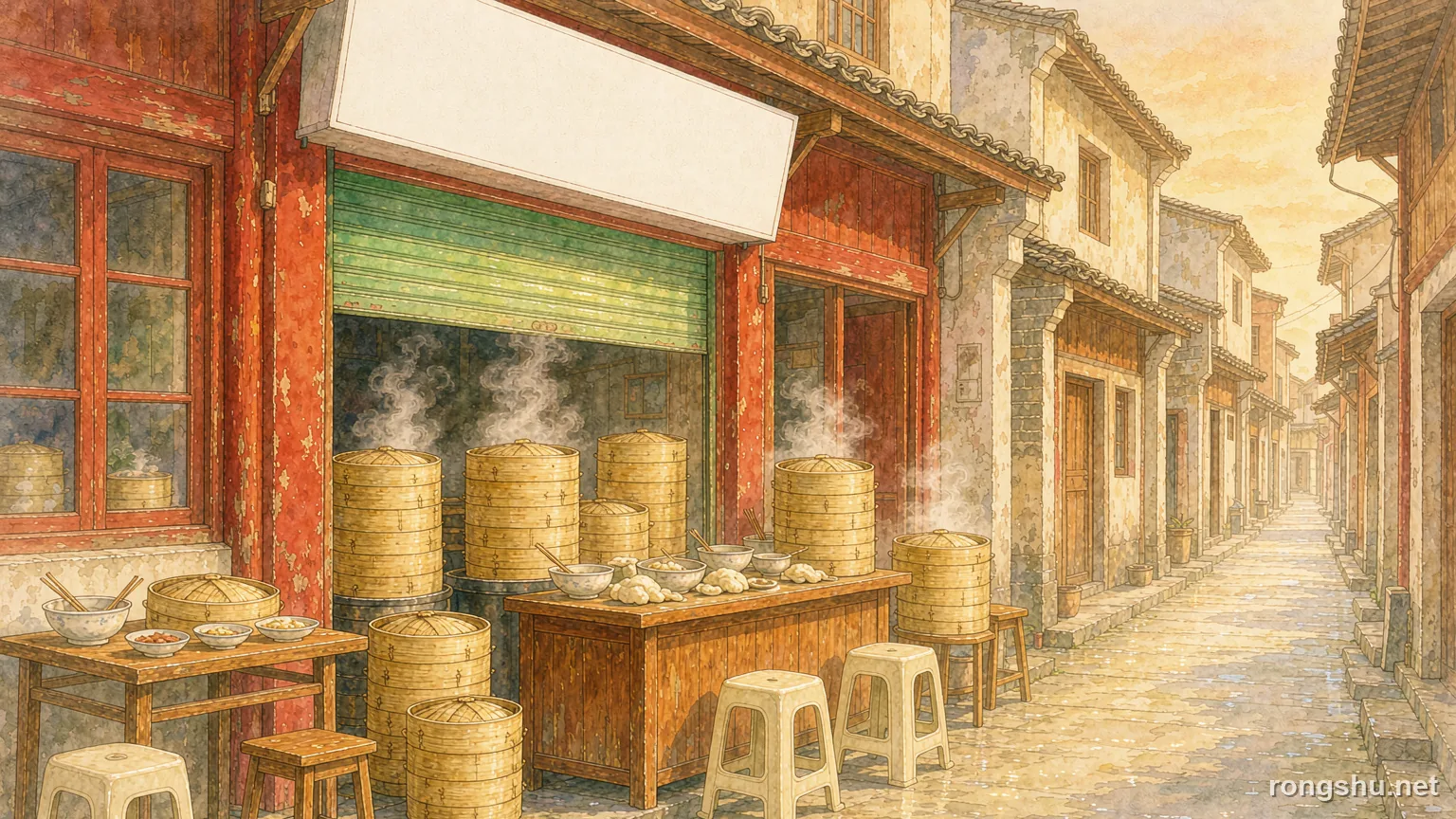
The shutter is green. Rust has eaten a few streaks into the metal, and it groans when you haul it up.
Seven years. Ma Changshun has counted. Twice a day, up in the morning and down at night, more than two thousand times.
On the last night he pulled it all the way down, locked it, and handed the key back to the landlord. He did not look back.
Seven Years of Mornings
Ma Changshun is forty-one. He Xiuying is thirty-nine.
For seven years they ran a breakfast stall in a migrant neighbourhood in a city in the south. Steamed buns, soy milk, fried dough sticks, rice porridge. The shop was under ten square metres, with two plastic tables set out at the door, one leg propped on a brick.
Up at half past three every morning. Mix the dough, let it rest, chop the filling, fold the buns. Into the steamer at half past four. Open at five.
They split the work. He mixed, she folded. She was fast, four buns a minute, pleats up, set in rings in the steamer basket. Her hands were dusted with flour all year. Her fingernails were white at the seams.
Summer was the worst of it. Once the steamers were going, the room was like a pot. Clothes soaked through, dried, soaked again. By evening there was salt on her back.
The first year was the hardest. They had taken the shop over from someone else, and the steamers were old, one cloth with a hole in it. In the first month they did not clear a hundred yuan a day.
The alleys of the neighbourhood were narrow, two people had to turn sideways to pass. Wires hung overhead in a tangle, and washing dripped from them. Across from the shop was an internet cafe, then a scrap yard.
Then it picked up. Most people in the neighbourhood were migrant workers, and the familiar faces grew. One man from a building site came every day for a bowl of porridge and two buns, and called out as he left, see you tomorrow, old Ma.
By the seventh year they were taking in twelve or thirteen hundred a day.
The money was made a coin at a time. The change went into a plastic basket under the counter.
At night they sat on their stools and counted it. The hundred notes, the fifties, the singles, sorted into stacks. Then into a cloth bag, and the bag to the bottom of the rice bin.
Over seven years they went through three of those bags.
Their son is called Shitou, Stone. He is eight, and he is in the village. They sent him back when he was four months old. His grandmother raised him.
This is ordinary in China. More than a hundred million people have left the countryside to work in the cities, and many of their children grow up in the village without them.
She keeps his photographs on her phone, lying down, sitting up, standing, with a schoolbag on his back. Under each one she has written the date.
When she talks about him she says he is sensible. Whatever you buy him, he says he does not need it.
Shitou is eight, not short for his age, and does not say much. On the video calls he answers one question at a time. She tells him to say hello to his father. He says it once, then looks down at his hands.
Once Ma Changshun said into the phone, Shitou, would you like to come to the city.
I do not want to, Shitou said.
Ma Changshun paused. All right, he said. If you do not want to.
He hung up and sat and smoked a cigarette, and after it was finished he still did not move.
Back to the County Town
Last winter the landlord said the rent was going up by a third.
The same month, the delivery platforms changed their rules and began taking a cut. A big character for demolish was painted on the wall of the neighbourhood.
The real wall was Shitou. He was due to start primary school in September, and without a local household registration he could not get a place. In China a school place is tied to the family registration, so a child belongs to the place his parents are registered, not the place they work. He Xiuying made two trips about it. On the way back from the second she stood the whole way on the subway and said nothing.
Her mother-in-law knees were finished too, past the point of squatting down and getting up again. Nobody swept the yard in the village any more, and the grass grew to knee height.
On her second visit back she bought the old woman a plastic stool with a back, to keep by the stove. Why spend money on that, her mother-in-law said.
The stool came home and the plastic wrap stayed on it, propped against the wall.
Three evenings they went over the figures. When they were done they had decided. They would go back.
The landlords of the shop tried to talk them out of it. Leave the boy in the village, they said. Two more years, then you will have the money.
Ma Changshun did not answer.
That evening He Xiuying said, Shitou starts school in September. We go back in September.
That was all she said. She was afraid that if she said more she would go soft first.
On the day they closed, a few regulars stood at the door and asked what had happened. Something at home, Ma Changshun said. Beside him He Xiuying packed, stacked the two plastic stools and tied them with string.
The bus home took sixteen hours. Outside the window the buildings turned into orchards, and the orchards into wheat.
Shitou asked three times how much further. Not far, He Xiuying said. It was still far.
They reached the county town at five in the morning. It was only getting light, and someone was sweeping the street. They stood in front of the station a while before they found a three-wheeler for the luggage.
They rented a shopfront on a street in the county town, and opened the same breakfast business. The sign was white with black characters, four of them: Old Ma Breakfast.
The frontage was smaller than the one in the city, but it faced the street. The landlord was a retired teacher, and he said small businesses had it hard.
On the day they moved, the steamers, the basins, the boards, the two plastic stools, all of it went on one three-wheeler.
Shitou came with his grandmother to see the shop. He walked twice around the counter, reached up and touched the characters on the sign, and asked, is this our shop.
Yes, He Xiuying said.
He did not say anything else. He ran outside.
It rained on the first day. The first batch of buns came out of the steamer, and nobody came in.
He Xiuying stood at the door watching the rain. No rush, she said.
Inside she was frightened. The rent in the city had been four times this, and so had the crowds. She knew what it would look like if the shop did not get off the ground.
The Names in the Credit Book
By summer the two of them could not make the numbers agree.
The takings looked decent, but little of it stayed in their hands. Rent, water, electricity, stock. Take it all off and a little over two thousand was left.
When she gave him that number he was scrubbing a steamer. He stopped for a moment, then went on scrubbing.
A shop in a county town is like this, he said.
Then why did we come back, she said.
He did not answer.
Then he started to go strange. At night he took his calls outside and laid his phone face down.
One day she caught half a line on his screen. You cover the fare, leave the rest to me.
The sender was saved as Old Liu.
She knew the name. He had run the shop beside theirs in the city. She did not scroll further. She was afraid that if she looked, it would become real.
Those days her cooking came out salty. At dinner Shitou drank three glasses of water.
She still did not ask. She told herself, wait a little longer. Waiting was the thing she did best in this world.
She had waited for the business to pick up, for the rent to come down, for Shitou to grow, for her mother-in-law legs to get better. What arrived was never the thing she had pictured.
In a county town, people do not take their food and go the way they do in the city. They sit down and eat and talk. One bun can last an hour.
And they run a tab.
Put it down. I will pay you later. The first was an acquaintance. The second was the brother of an acquaintance. The third was a friend of that brother.
He Xiuying kept a notebook under the counter and wrote down names and amounts. In half a year she had half the street in it.
She knew most of the names in that book. The woman with the little shop, the men on the building site, the young wife who came in with a baby on her arm.
She said nothing while she wrote, then closed the book and put it back under the counter.
Once a young wife came in, took out a handful of small change, counted it three times and was two yuan short. She went red and said she would bring it next time.
It is two yuan, He Xiuying said. Forget it.
The young wife did not forget it. The next morning she brought two eggs, set them on the board and left.
Shitou came home from school, dropped his bag under the counter and was gone, out to the river with the other children.
Sometimes she stood at the shop door and watched him run. He ran fast, and did not look back.
Her chest felt hollow for a moment. Then she thought, he is growing up, they are all like this.
The Drawing Under the Pillow
That night Shitou was asleep. He Xiuying went to collect his clothes, and a corner of paper showed at the edge of his pillow.
She pulled it out.
It was a sheet torn from an exercise book, fuzzy along the edge. In pencil he had drawn a bus, and behind the bus two small figures carrying bags. In front of the bus stood one more figure, shorter than the other two.
The drawing was crooked. One head was a circle and one was scribbled black.
On the back were two characters, in pencil, pressed so hard they showed through to the front. Do not go.
She knew those two characters. He did not know many yet, and had written the second one wrong, the upright stroke slanting off to the side.
She stood in the room holding the paper. Shitou turned over in bed and hugged the quilt, asleep, his mouth open.
She looked at the bus again. The wheels were a circle with two dots inside, like eyes.
She remembered the one time he had lived in the city, the summer he was five. They had put a narrow bed behind the shop. In the daytime he sat at the edge of the board and watched her fold buns. Once he put his hand into the basin of dough and she told him off. He did not cry. He wiped his hand on his trousers.
When he left she took him to the bus station. He sat by the window and watched her the whole time. The bus pulled out and he was still watching.
That time she cried, with her back to him.
She remembered how they had sent him back to the village at four months. She remembered going home each new year, the first two days with the boy hiding behind his grandmother, and from the third day following her, wherever she went.
When they left in the first month of the year, Shitou did not cry. Sensible boy, his grandmother said. He stood at the gate and watched the car drive off. He did not cry and he did not call out.
She had always thought it was because he did not care.
It was because he did not dare.
The Last Stroke on the Sign
The next morning she spread the drawing on the counter and showed it to Ma Changshun.
He looked at it a long time, until his eyes went red.
What is it, he said.
It is us, she said.
He folded the paper and pushed it back to her and said nothing. He turned away and put the lid on the steamer, and the steam rolled up.
At noon he sat down and sent a message to Old Liu. Three words. I am not coming.
Then he turned the phone off and set it on the board and went to chop filling. The knife came down hard.
That evening when they closed up, neither of them mentioned going back to the city.
He Xiuying carried a small stool over and set it beside the table by the window. If Shitou wants, she said, he can do his homework here after school, and when he is done he can help bring the stools in. One yuan a day.
That is too little, Ma Changshun said.
Two, then, she said.
That night Shitou was doing his homework in the shop, and halfway through he looked up. Mama, he said, are we going to leave again.
No, she said.
Next year, he said.
Not next year either, she said.
He said oh, and bent over his work. His pencil broke, and he sharpened it himself, crookedly.
The next morning Ma Changshun wiped down the sign. White ground, black characters, and a stroke of the second one had lost its paint and showed grey underneath.
He found a black paint pen, crouched at the door and went over it stroke by stroke. The door curtain lifted in the wind and dropped again.
Down at the end of the lane, Shitou came running with his schoolbag, shouting as he ran. Papa, I want a pork bun today.
This is a work of narrative writing based on real situations in Chinese family life. All names have been changed.