It is nine at night, and on a phone propped against a bottle of moisturiser, a woman in her thirties holds up a lipstick and turns it under the light. Behind her, a wall of shelves is packed from floor to ceiling. She reads out a comment from a viewer in a small city three provinces away and laughs. Then she does something a shop assistant almost never does. She takes the cap off, draws a line on her own wrist, and rubs it with her thumb to prove that it does not smudge.
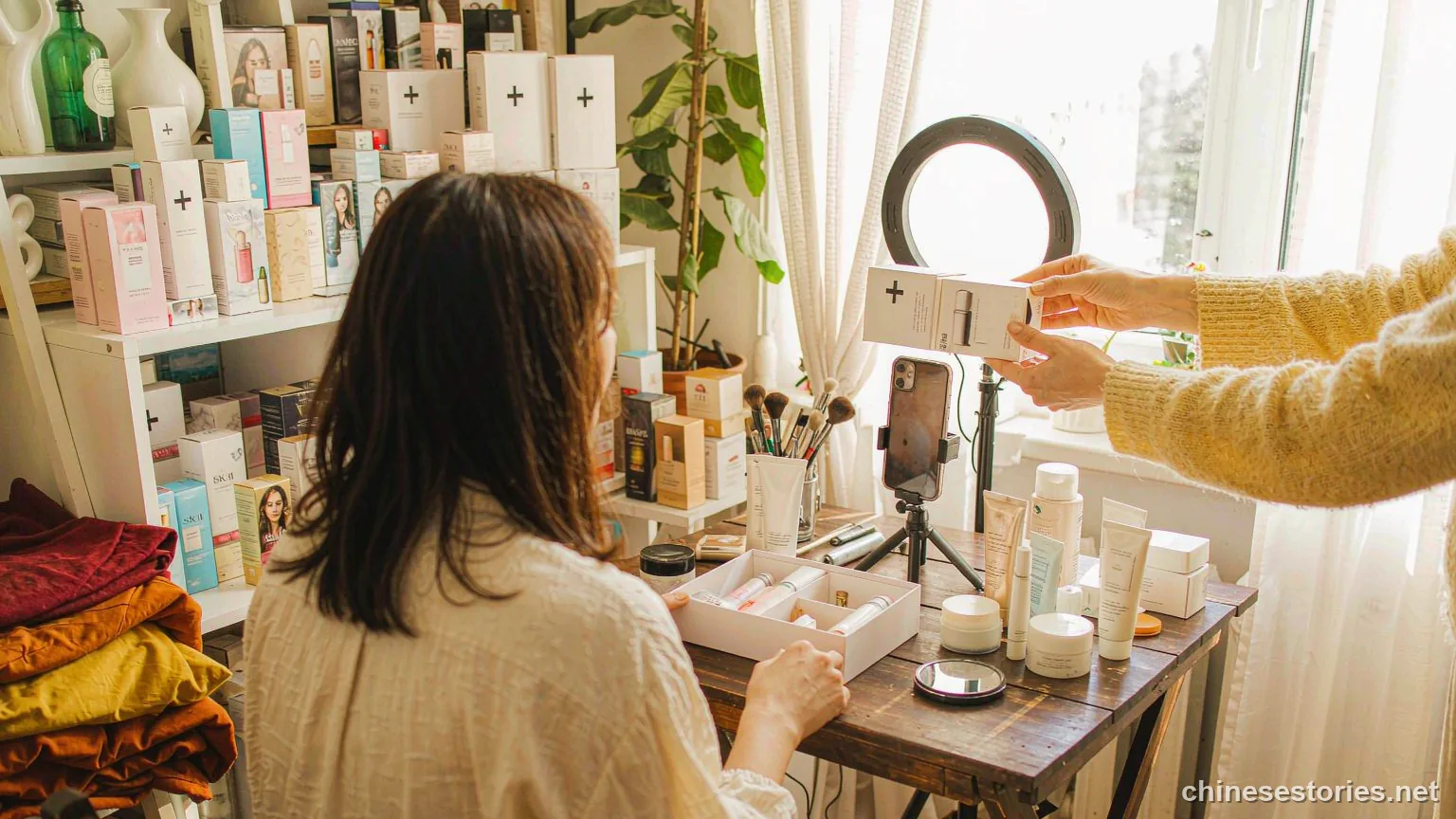
Within a minute, a counter on the screen climbs past four thousand orders. Nobody has left the room. Nobody has taken a bus.
This is how a very large share of China buys things now, and the numbers are hard for a visitor to believe at first. The format is called livestream commerce, and it has moved from a novelty to the ordinary plumbing of online retail in less than a decade.
A Shop That Never Closes
The scale is the first thing to understand.
Industry reports put live commerce in China at well over five trillion yuan in sales in 2025, with forecasts that it will pass six trillion. More than half a billion people have bought something from a livestream. In some measures, live selling now accounts for roughly a third of all online retail, and the share keeps growing while the growth of ordinary online shopping slows.
The number of people who host is just as striking. Tens of millions of Chinese host streams in some professional or semi-professional way, from a farmer selling apples for two hours after dinner to a full studio with a lighting rig, four cameras and a script.
The format is not confined to one platform. It lives inside the giant short-video apps, inside the shopping platforms, inside the messaging app almost everyone uses, and inside small dedicated apps built for nothing else. Wherever there is a screen and a payment button, someone is selling something on it.
Its rise was gradual and then sudden. Early versions appeared on shopping platforms around the middle of the last decade, when a few hosts discovered that talking through a product on camera sold better than a photograph of it. The short-video apps then made hosting easy for anyone with a phone, and the audience arrived in the hundreds of millions.
The turning point came in a period when many shops were shut and people were spending their days at home. Farmers who could not move a harvest and sellers who could not open a storefront went on camera instead, and the audience, stuck indoors, watched and bought. The habit that formed then never left, even after the streets reopened and the queues came back.
Since then the format has spread outward into ordinary commerce. A company that sells machine parts has a stream. A museum sells tickets on one. A university holds an admissions session on one. What began as a way to sell lipstick quietly became a general-purpose shop window for the whole economy.
What a Livestream Looks Like
A typical stream is a strange hybrid, part shopping channel, part talk show, part game.
The host stands or sits close to the camera, holding products up one at a time. Prices flash on screen, and a limited number of units goes on sale in a burst. A countdown appears, then the stock figure drops to zero in seconds, and the host promises more in half an hour. Viewers type questions in a scrolling column, and the host answers a handful of them by name.
Nothing about the room is accidental. The shelves behind are colour-matched. The lighting is warm and bright. A list of the evening’s products is taped at the edge of the table, in the order they will be shown, because the sequence matters as much as the products.
What makes the format work is that it is live. A product can be demonstrated, argued about and defended in real time, and viewers can see the demonstration rather than a photograph. When a host squeezes a sponge, empties a bag of oranges onto a table, or holds a jacket up against a heater to show the lining, the objection that a listing page cannot answer is answered on the spot.
The audience also becomes part of the show. Regular viewers are recognised by name, jokes repeat, and a small community forms around a seller the way it once formed around a market stall. People come back at the same hour to the same host, and the buying follows the relationship rather than the other way round.
Why It Works
There are practical reasons behind the format, and they are not only about entertainment.
The first is trust. Chinese online shopping developed fast, and shoppers learned to be careful about photographs that flatter a product and descriptions that overstate it. A live stream puts a face and a voice in front of the goods, and a host who misdescribes something is corrected by the crowd within seconds.
The second is price. Selling live removes a layer of retail cost, and hosts trade volume for margin. A product that sells a hundred thousand units in one evening does not need the same markup as one that sells thirty. Buyers have learned to wait for the stream before buying, because the stream price is usually the lowest the product will be.
The third is discovery. On an ordinary listing page, a shopper has to know what they want before they search for it. On a live stream, the product finds the shopper. This suits a market where enormous numbers of new goods appear each month and no one has time to search for them.
The fourth is the sense of a shared moment. A countdown, a limited stock and a visible crowd produce the same urgency that a queue outside a shop produces, and the psychology is familiar to anyone who has ever bought something because it was about to run out.
None of this would survive without the logistics underneath it. A stream can promise next-day delivery to a county town because the parcel system reaches there, and a buyer can return an item in two taps because the same system runs backwards. The format was not invented by the delivery industry, but it could not have grown anywhere the delivery industry had not already arrived.
Where the Streams Come From
Look past the slick studios and the picture changes.
A large and growing share of live selling now happens at the source. Fruit growers stand in orchards and hold the fruit they have just picked. Fishermen sell from the deck of a boat. Factory workers walk a camera down a production line and show the machine that made the thing on the table. Villages that once sold through middlemen now sell directly to consumers, and in some places the arrival of a reliable stream has reshaped what the village grows.
The warehouses reflect this. Many large sellers now run stream rooms inside their own storage, so a product shown on camera can be packed and dispatched while the orders are still coming in. Delivery reaches much of the country within a day or two, and same-day delivery is common in the biggest cities.
There is a sector that grew up around all of this. Training schools teach hosting, script writing and camera work. Agencies supply hosts to brands. Software firms sell tools that track comments, orders and returns in real time. For young people in smaller cities, hosting is one of the few careers that requires no degree, no licence and no capital, only a phone and the willingness to talk for four hours.
The economics are brutal in the same way that any performance work is brutal. A stream that attracts ten viewers earns almost nothing. A host who finds an audience can earn more in one evening than a shop assistant earns in a month. Between those two outcomes lies a great deal of unpaid practice.
The Hosts and the Hours
Behind the bright screen is a working day that most viewers never see.
A serious host prepares before the camera is switched on. Products are unboxed, tested and arranged. Scripts list the points to make and the objections to pre-empt. After the stream ends, the returns begin, and a host who oversold a product pays for it in refunds and complaints.
The hours are long and mostly late. Evening is when audiences gather, so the working day runs from late afternoon to midnight or beyond, six days a week in busy periods. Throats give out. Voices are trained like instruments, and some hosts keep honey and salt water within reach. Cameras add a strange pressure: every expression is a sales pitch, and fatigue shows.
The audience, meanwhile, treats the stream less as shopping than as company. Many viewers watch for an hour and buy nothing. They open the app the way an earlier generation turned on the television, to have a voice in the room while they eat or fold laundry. The order that arrives a day later is almost a side effect.
The Cost of Buying Fast
The same speed that makes live selling work also creates its own problems, and everyone in the chain knows them.
Impressions are easy to oversell on camera, and the distance between a product shown under studio lights and the same product at home is where most disappointment lives. Clothes that looked fitted arrive loose. A bag that looked like leather turns out to be a convincing imitation. Buyers have learned to defend themselves by checking reviews, comparing several hosts before choosing one, and keeping a generous returns habit.
Returns are heavy and expensive for sellers, and a stream that sells to a hundred thousand people will face a wave of parcels coming back. Large sellers now budget for it, plan for it, and treat the return rate as one of the numbers on the screen that matters as much as the sales counter.
There is a pressure that runs backwards along the supply chain as well. When a host promises a very low price to an audience of millions, someone upstream has to find the difference, and that someone is usually the factory. Manufacturers describe a contest in which the winner is often the one willing to shave a millimetre of material, and buyers who receive two versions of the same product a year apart sometimes notice the difference.
None of this has slowed the format down, because the audience has already accepted the trade. They know that the price is low partly because the process is imperfect, and they plan their buying around that bargain rather than against it.
Compared With the West
Western readers will recognise parts of this from home shopping channels and from influencer marketing, but the Chinese version combines them and pushes both further.
Television shopping has existed in Europe and North America for decades, with hosts, countdowns and phone lines. Social media influencers promote products to their followers. Live commerce fuses the two and adds the missing piece, an instant purchase button, so that attention converts to payment in the same second.
The scale differs. Western live shopping is a specialist channel used by some brands. In China it is a default sales channel used by almost everyone, from international cosmetics houses to a farmer in a mountain county. The infrastructure differs too. Payment, delivery and returns are fast and cheap enough that impulse buying carries little risk, which is exactly what an impulse format needs.
The cultural gap is perhaps the largest. Western shoppers tend to treat buying as a private transaction and distrust sales pressure. Chinese viewers have grown up with a marketplace culture in which haggling, recommendation and collective opinion are normal, and a host who crowdsources a decision with a live audience feels less like a salesperson and more like a person helping a group choose.
After the Stream Ends
At eleven, the host puts the last product down and reads the closing numbers. The room empties, the comments slow, and the phone is switched off. Somewhere far away, a warehouse printer begins working through the order list.
The stream will run again tomorrow, at the same hour, with a different row of goods on the table. By then the customers who bought tonight will have their parcels, or will be sending them back. Either way they will return to the app, because the habit is no longer about a product. It is about a voice, a countdown and a crowd, and the odd comfort of shopping together while sitting alone.
This story is based on publicly documented practices and on reporting in the Chinese and international press. The families described are illustrative, and no individual is identified.