History
-
Zheng Guo’s Canal: A Chinese History Story
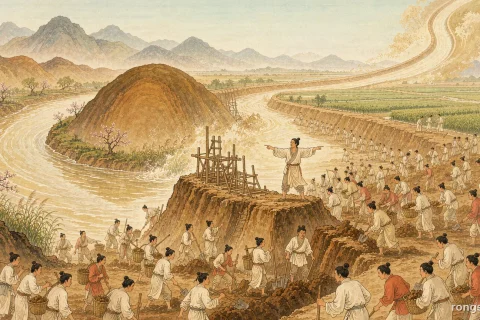
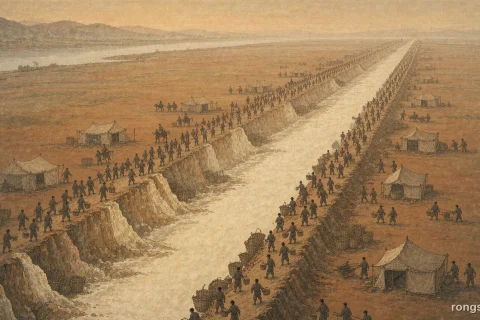
In 237 BCE a water engineer from the small state of Han stood bound in the Qin court, accused of being a spy sent to ruin the country with an enormous canal. He admitted it, and then pointed out that when the canal was finished it would belong to Qin. King Zheng let him go on digging. Ten years of earthworks turned forty thousand qing of salt flat between the Jing and the Luo into the granary that fed the conquest of the other six states.
-
The Sea at Yashan: A Chinese History Story
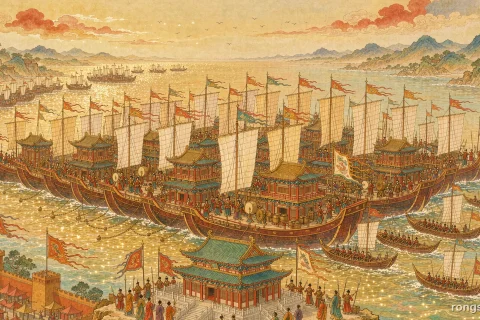
In February 1279 the last fleet of the Song dynasty lay chained together in a bay in Guangdong with the water cut off behind it. When the line broke, the chancellor went into the sea with an eight-year-old emperor on his back. Wen Tianxiang, first scholar of his year, watched from a Yuan ship and refused to write the letter that would have ended it earlier.
-
Three Ledgers and One Whip: A Chinese History Story
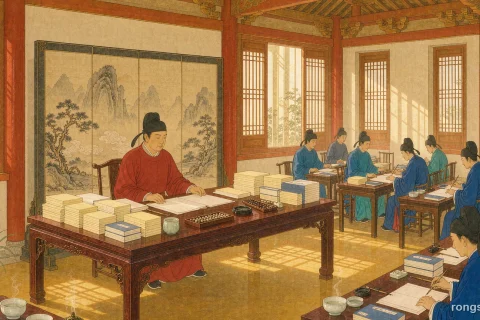
For ten years Zhang Juzheng ran the Ming empire for a boy emperor, auditing every office with three ledgers and rebuilding the tax on a single payment in silver. When he died in 1582 the granaries held ten years of grain. Two years later soldiers sealed his house and let the family starve inside.
-
The Battle of Feishui: A Chinese History Story
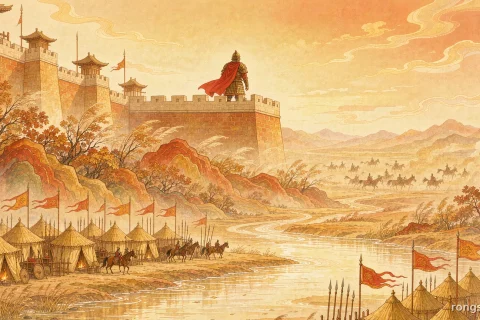
In 383 the ruler of Former Qin marched south with an army his own proclamations called a million. On the far side of the Feishui stood eighty thousand men of the Jin. One order to fall back, one shout from a captured officer standing in the rear, and the largest army in China came apart on the bank of a shallow river.
-
Dinner at Hongmen: A Chinese History Story
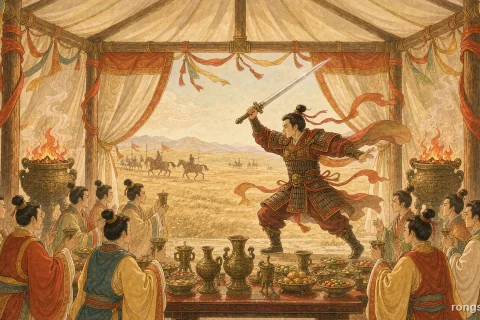
In 206 BC, with the Qin empire broken and forty thousand men camped behind the hills, Xiang Yu invited his rival to dinner. Through one long meal a sword dancer kept aiming at the guest, a bodyguard pushed past two halberds with a shield, and the host said almost nothing. This is what the historian Sima Qian recorded, down to where every man sat.
-
The Man Who Would Not Write: A Chinese History Story
On 13 June 1402 the Prince of Yan took Nanjing. The court record of the reign gives the fate of Fang Xiaoru one line. The story everyone knows gives him a brush thrown on the floor, a question he asked the new emperor, and ten degrees of kinship put to death. This is what the histories actually say, and how the legend grew around it.
-
The New Laws of Wang Anshi: A Chinese History Story
In 1069 Wang Anshi began the most ambitious reform in Chinese history: state loans for farmers, paid labour instead of conscripted labour, government trading to break the brokers, a militia instead of a million useless soldiers. He filled the treasury. He also broke the countryside and lost every friend he had. This is the story of the New Laws, and of the drawing of refugees that ended them.
-
The Gate at Xuanwu: A Chinese History Story
Before daylight on 4 June 626, ten men waited inside the northern gate of the palace at Chang-an with a bow. By the time the sun was up, the heir to the throne and his brother were dead in the road, and the empire had changed hands. This is the morning that made the Tang dynasty, and the emperor the world remembers as Taizong.
-
The Grand Canal: A Chinese History Story
In 605 AD Emperor Yang of the Sui ordered a canal that would join five rivers into one line and run two thousand seven hundred kilometres, from Beijing to Hangzhou. The first section took five months. Four or five men in every ten who dug it died. Here is how the longest artificial waterway on earth was built, who paid for it, and why it outlived the dynasty by thirteen centuries.
-
The Red Cliffs: A Chinese History Story
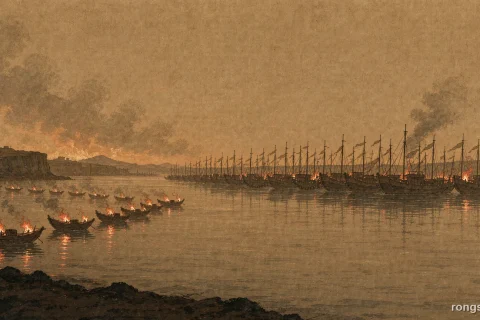
In the winter of 208 AD, Cao Cao lashed his captured fleet together so his northern soldiers could keep their footing. It worked. It also turned a navy into a single target. Ten fire ships, one southeast wind, and the battle that split the Yangtze between three powers for the next seventy years.