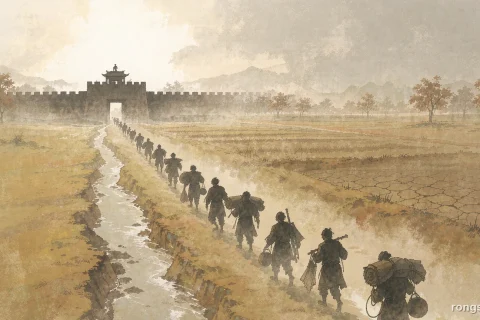
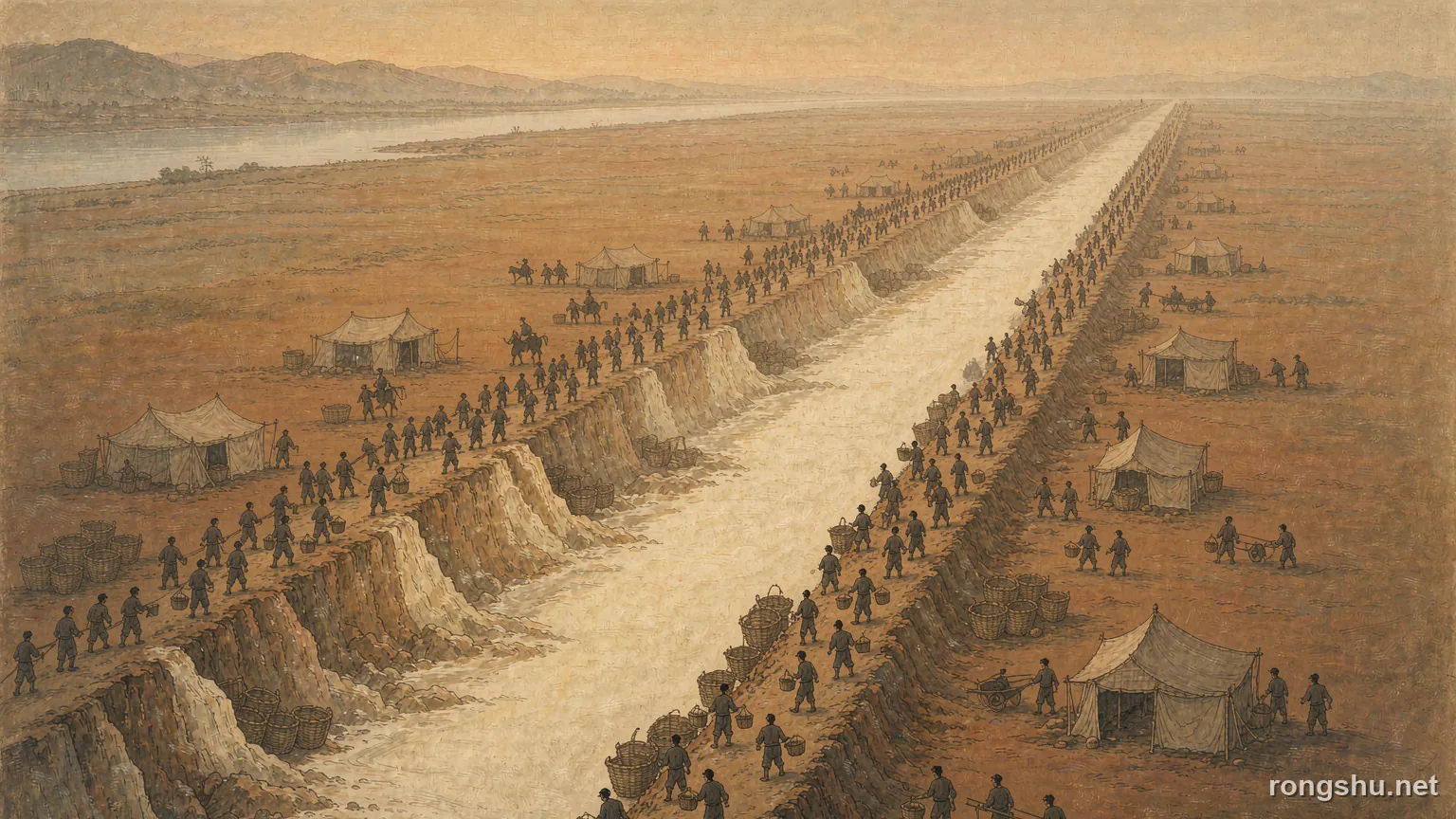
In the third month of 605 AD, several hundred thousand people stepped down into the mud west of Luoyang.
Their tools were the ordinary tools of the countryside. Wooden spades. Baskets woven out of willow. Poles over the shoulder. Some of them had no tools at all and used their hands and the folds of their coats.
The riverbed they had been told to cut ran from the imperial park outside the city all the way to the Huai River, hundreds of kilometres to the southeast.
The water was still cold. The Luo had only just gone clear of ice, and a man standing in it all day felt the cold climb past his ankles.
Nobody sang. A whip cracked somewhere up the line, and another basket of mud came up over the lip.
This was the third month of the first year of a new reign, and the order had come down from the palace a few days earlier.
The gangs in the mud had been gathered county by county, village by village, one adult male from each household. Every man taken was a farm with one less pair of hands on it.
Some ran on the road down and were beaten when they were brought back. Some, more deliberately, broke their own fingers with a stone so that the officials would send them home.
The overseers did not look at any of that.
They looked at how many feet of channel had been cut since dawn.
It was not one river that had been ordered. It was several, started one after another. The shortest of them would be finished in five months. The last of them would not be started for five more years.
Before any of it existed, China had been two countries for a very long time.
North and south of the great rivers had gone their own ways through four centuries of division. A boat carrying goods south had to unload at the Huai and hand the cargo to somebody else. A cart heading north had to stop at the Yellow River and change men and animals. The two halves traded, but every exchange cost a fortune in handling.
In 589 the Sui dynasty ended the division and brought both halves under one court. Winning that war had taken a generation of planning. Holding the two halves together turned out to be a different problem entirely.
The problem was food.
The capital region in the west had too many people for its fields. Grain came from the eastern plains, and it came overland, on carts and on the backs of animals, and the men and animals moving it ate a large part of it on the way. More was eaten on the road than was ever delivered.
Under the first Sui emperor a short canal had already been cut for that reason: from the capital at Daxing west to Tongguan, where it met the Yellow River. Three hundred li, and the histories note with satisfaction that the region lived off it for decades.
It was a start. It also solved nothing beyond the capital suburbs.
In 604 Yang Guang took the throne as Emperor Yang. In the third month of the following year he gave two orders in the same season.
The first was to build a new eastern capital at Luoyang. The labour force for that was set at two million men, working every month, and the city was largely standing within a year.
The second order was the canal.
Both orders had men behind them, and their names survive. The new city was laid out by Yuwen Kai, chief of the imperial works and a designer famous for devices; the first canal was supervised by Huangfu Yi, a senior officer of the secretariat.
What men like that calculated was where the water would go. Which river could be tapped for supply. Which slope would save the labour of lifting. Where a gate would be needed, and where a barge would need a sheltered bay to wait out a wind.
Where the Canal Would Run
What Emperor Yang wanted was not one river. He wanted a net.
He wanted the rice, the silk, the salt, the tea and the timber of the south to come to him by water, without ever being lifted onto a cart.
The first section was called the Tongji Canal, and it ran in two parts. The western part took water from the Gu and the Luo, ran through the new city at Luoyang and reached the Yellow River near Yanshi. The eastern part drew from the Yellow River at Banzhu and followed the old bed of the Bian southeast, past Kaifeng and Shangqiu, and Suxian, and Sixian, to enter the Huai at Xuyi.
Together the two parts came to nearly two thousand li.
And the canal was to be forty paces wide. The width was not vanity. Grain barges, and the great dragon boats of the court, had to fit through it side by side.
In the same year more than a hundred thousand men were taken from the counties around the Huai to widen and straighten the old Han Canal. That channel had been cut more than a thousand years earlier by a king of Wu who wanted to move troops north, and the Sui engineers kept its line, took out its bends, and ran it from Shanyang to the Yangtze.
In 608 the third section began. The Yongji Canal ran north from the Qin River across the plain to Zhuo Commandery, which is the ground modern Beijing stands on. The edict called for a million people, and it said men and women alike, which tells you what the labour market had come to.
Two thousand li, and it was done inside the year.
March to August
The Tongji Canal and the Han Canal were begun in the third month and open to traffic by the eighth.
Five months. A thousand kilometres. The scale of it sat strangely beside the means.
None of it was dug out of nothing. The men who planned the line were extremely good at their work. Where an old channel could be reused they reused it; where a natural river could be tapped they tapped it; where a lake could be borrowed they borrowed it. What was left over, the labourers did with their hands.
The number the histories keep for that work is this. The officials drove the gangs without mercy. Four or five men in every ten died. Carts were used to carry the dead away, east as far as Chenggao and north to Heyang, and the carts went out in an unbroken line.
Four or five in ten. Send out ten men, and five come back.
There were no machines on that site. There was earth, water, stone, and the days of an enormous number of people. The upper soil was silt that slid back in. The bottom was rock that had to be broken with iron wedges. The sides leaked, and one night of seepage could put water over a man to the knee.
The work itself was simple enough to explain to a child. Dig. Carry. Tip.
Carrying meant walking up and down a ramp from first light to dark. When a man could not lift any more, he changed shoulders. When he could not manage that either, he lay down on the earth for a moment. If the moment ran long, the whip arrived.
Later writers put the whole thing into a phrase: a canal bought with blood and sweat, and with lives.
The Dragon Boats
The canal was barely open before Emperor Yang went south on it.
He was going to Jiangdu, which is modern Yangzhou, the old heartland of the south.
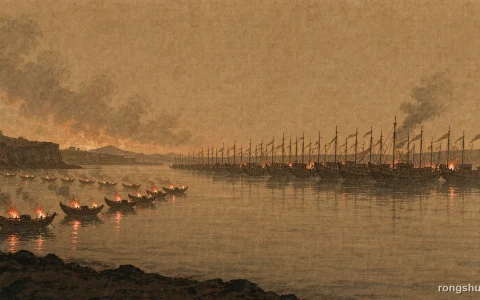
The boats had been building for months. There were thousands of them. Dragon boats, tower boats, sails of brocade, ropes of coloured silk. Ranged one behind another on the water with bow almost touching stern, the fleet stretched two hundred li.
A fleet two hundred li long does not move by itself. On both banks the Sui built an imperial road and planted willows along it in even rows. More than eighty thousand labourers, men and women taken off their fields, were harnessed to tow ropes. Two squadrons of cavalry rode the banks as escort. On the water, colour. On the land, colour.
Everyone on those boats had to be fed, and the emperor had a method for that. Counties along the route were ordered to present food. Local officials went into the villages and demanded banquets, some counties sending a hundred tables at a time. Whatever could not be eaten was buried in pits on the riverbank, because the next county would send its own tables at dawn.
The money for the tables came from the households that grew the grain.
For the result, the histories use four characters. Houses emptied.
That voyage was not the last one.
Cities on the Water
Where the canal went, towns grew.
The most famous was Jiangdu, which is Yangzhou. It sat where the Yangtze met the canal, so no boat going north or south could pass without stopping there, and in the Tang it was reckoned the richest city in the empire.
Further south was Hangzhou. Only after the Jiangnan Canal reached Yuhang did that city begin to occupy the place it holds in Chinese memory. Bai Juyi governed there, and Su Shi after him, and both of them moved earth around the canal and the lake beside it.
At the northern end stood Zhuo Commandery, on the ground Beijing now occupies. It became the capital of three later dynasties, and what made it viable was this water route.
In the best years of the Tang, several million bushels of grain came north along the canal annually. By the Northern Song, the million people inside Kaifeng were eating rice that had been poled up the Bian River.
When the Yuan moved the capital to Beijing they found the detour through Luoyang too long, and cut a new line to the east, saving nine hundred kilometres of travel.
Once that line was open, boats could reach the Jishuitan, a lake inside the walls of Beijing. The histories say that the boats on that water were too many to count to the far shore.
One river, and it strung together the rice of the south, the soldiers of the north, and the tax that moved between them.
Longer Than the Dynasty
In 610 the last section was ordered: the Jiangnan Canal, from Jingkou, which is modern Zhenjiang, south to Yuhang, which is Hangzhou. Eight hundred li, wide enough and deep enough that a dragon boat could pass.
Five rivers had now been joined into one line: the Qiantang, the Yangtze, the Huai, the Yellow River and the Hai.
From Zhuo in the north to Yuhang in the south, the system ran two thousand seven hundred kilometres. Nothing built by human hands had ever been longer, and nothing would be for centuries.
The canal was never only about grain.
In 612 the emperor raised an army of a million and invaded Goguryeo, in the north of the Korean peninsula. He went again in 613, and again in 614. All three campaigns failed. The men, the grain and the ships went north and did not come back.
The canal had been built in part to feed that war.
What broke first was not the army. It was the farmers.
In 611 a man named Wang Bo raised a rebellion in Shandong. A song travelled with it, and the first line asked why a man should march to Liaodong and die there for nothing. Once that line was being sung in the villages, other places began to answer it.
In 618 Emperor Yang was still at Jiangdu. He had no wish to go north again. His own guards mutinied and strangled him in a room, and a dynasty that had lasted thirty-seven years came to an end.
The canal had been finished eight years earlier.
And the river stayed.
The Tang took it over and lived on it. Contemporary records say that a thousand boats at a time were gathered on its waters, and that the grain fleets went up and down without a break, as far as the eye could follow.
The Song used it to feed a capital of a million people, and treated the stretch past Kaifeng as the artery that kept the state alive.
The Yuan moved their capital to Beijing and found the detour through Luoyang too long. They cut a new line further east and shortened the route by nine hundred kilometres. That is the Grand Canal as the name is used today, and it is worth setting beside the canals the West knows: sixteen times the length of Suez, thirty-three times the length of Panama.
The Ming and the Qing went on shipping grain along it. Only at the very end of the imperial age did steamships and railways take the trade away.
Seven or eight dynasties came and went. The water kept moving.
There is a comparison that may help here. Constantine moved the capital of Rome east to the Greek city of Byzantium, and the sea roads that fed Constantinople turned it into a city of half a million. Peter the Great built a new capital on marshland at the mouth of the Neva and called it a window on Europe, and the bones of the men who drove the piles are still under its streets.
A capital placed where the ruler wants it, and a waterway cut to feed it: the two go together. That is what happened at Luoyang in 605. It is also why the canal outlived the man who ordered it by thirteen centuries.
More than a thousand years after that first spring, a poet of the late Tang named Pi Rixiu stood on the bank of the Bian and wrote about Emperor Yang. Pi Rixiu was from Xiangyang, he lived through the last decades of the Tang as it came apart, and he ended his life among the rebels who finally pulled it down.
He had seen the barges on the river, and he had also seen the emptied villages along its banks. His last two lines are these. Had the man not built his river palaces and his dragon boats and gone cruising for pleasure, his work would be counted as no less than that of Yu the Great, who tamed the floods.
The poem is eleven centuries old.
In 2014 the Grand Canal of China was added to the World Heritage List. Its channels have been dredged and repaired and reopened, section by section, and cargo barges still move along them today.