In the winter of 208 AD, fog came up the Yangtze and swallowed the northern bank at a place called Wulin.
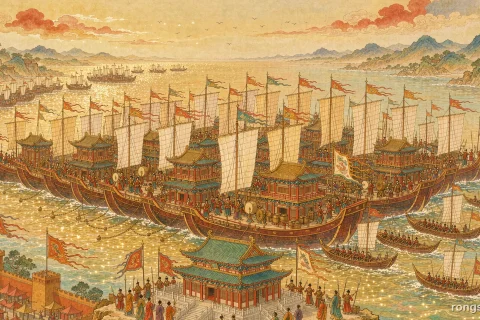
Beyond the mist lay a forest of masts. Ship after ship, lashed to the next with iron chain, bow to stern, until the whole fleet had become one long thing.
Northern soldiers stood on those decks. Most of them had never seen the Yangtze before that year.
The wind off the water was wet and cold. Men leaned over the railings and were sick. Men crouched on the planks and did not move.
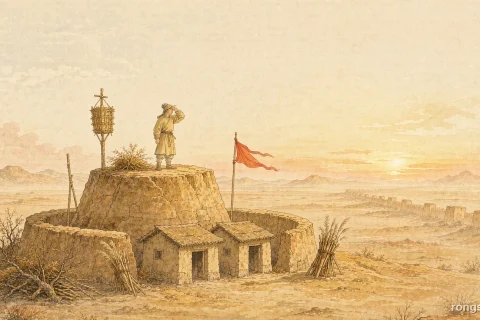
Across the river, on the southern shore, stood the Red Cliffs. Along the ridge above them, banners were set out in even rows.
That was not fear.
That was the army of Cao Cao, waiting for a piece of ground that would stop moving under its feet.
The trouble had begun in the seventh month of that year.
Cao Cao had just finished putting the north in order. He unrolled his maps and found two places that still worried him. One was Jing Province, the broad middle stretch of the Yangtze. The other was the land east of the river, where the Sun family had ruled for three generations.
In July he marched south to take Jing.
Its governor, Liu Biao, chose that moment to die. His younger son, Liu Cong, took the seal. Before the seal had grown warm in his hand, he sent men to surrender.
Even Cao Cao had not expected it to go this well. He walked into Jing Province almost unopposed. The grain stores at Xiangyang, the warships, the river fleet: all of it changed flags in a single night.
The fleet mattered most. Jing Province had a navy. Cao Cao had none, and the Yangtze is not a river that forgives amateurs. When he wrote to Sun Quan, he was writing from a position he had held for less than two months.
Liu Bei, meanwhile, was running south. He had been sheltering under Liu Biao at Fancheng. The moment he heard that Liu Cong had surrendered, he turned and left. More than a hundred thousand civilians went with him, and the column could cover only a few miles a day.
Cao Cao sent light cavalry after him. Three hundred li in a day and a night. They caught him at Changban, near Dangyang. Liu Bei escaped with a few dozen horsemen. His baggage, his two daughters and most of his people were taken.
He fell back to Xiakou and joined forces with Liu Qi, the elder son of Liu Biao. Between them they scraped together twenty thousand men.
East of that lay the territory of Sun Quan.
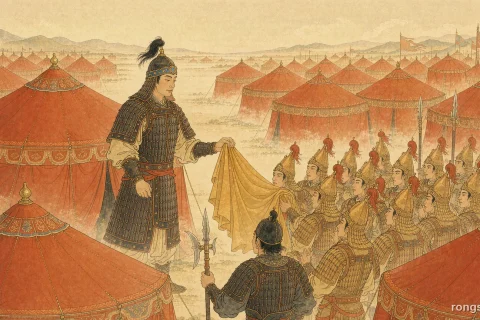
Cao Cao sent him a letter. It said that he had brought eight hundred thousand troops, and would like Sun Quan to come hunting with him in the east.
Sun Quan passed the letter around the hall.
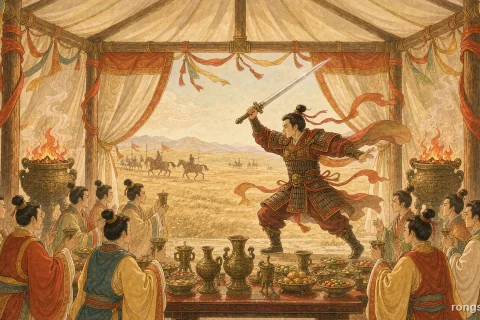
The hall filled with weeping. Several of his senior men told him to surrender. The argument was not cowardly. It was arithmetic. The north had the river, the fleet and the numbers. Surrender would keep the Sun family in its lands, its titles and its revenues. Resistance would cost everything.
One man did not weep. Lu Su, who had spent years watching the north grow, waited until the others had finished. Then he told Sun Quan the thing nobody else in the room could say out loud: everyone here can surrender and still be given a post. You cannot. Surrender is a future for a minister. For a lord, it is an ending.
The Man Who Crossed the River
Sun Quan gave no answer that day. He sent for Zhou Yu.
Around the same time, a visitor crossed the river. Liu Bei had sent Zhuge Liang to see him.
Zhuge Liang wasted no time on courtesies. He gave Sun Quan a piece of arithmetic.
The army of Cao Cao, he said, had marched a long way and was tired. Its northerners did not know how to fight on water. The river fleet that had just changed sides had no love for its new master. Three cracks in one wall.
Sun Quan listened with his hand on his sword. He drew it and cut off a corner of the desk in front of him. Anyone who spoke of surrender again, he said, would end like that desk.
Then he asked Zhou Yu what he thought.
Zhou Yu had done his own arithmetic, and his was the harder kind. Eight hundred thousand, he said, was a boast. What the north could actually put on the river that winter was nearer seventy or eighty thousand, and sickness was already in their camps. Give me thirty thousand men, and I will move up to Xiakou and finish it.
He was thirty-three years old. The man he proposed to fight was fifty-three. Zhuge Liang, the envoy, was twenty-seven. Nobody in the room was old except the enemy.
Sun Quan gave him thirty thousand. With the twenty thousand under Liu Bei and Liu Qi, the allies had fifty thousand in all.
Fifty thousand against seventy or eighty, on water, in winter, against the man who had spent twenty years beating everyone else. Nobody in that room called it a safe bet. It was simply the only bet that did not end with a rope.
There were still men arguing for peace. Zhou Yu put it plainly. Cao Cao had delivered himself into their hands, and an opening like that would not come twice.
The two allies were not friends. Sun Quan did not want Liu Bei growing strong on his soldiers. Liu Bei did not want Sun Quan to fight the battle and then sail home. Neither man put his whole back to the other, and both of them knew it.
Chained Together
The first clash came on the water.
The fleet of Cao Cao had been thrown together out of strangers. The men of Jing Province would not fight hard for a master who had arrived last month. The men of the north could not stand up on a deck. In the first exchange, the northerners came off worse, and Cao Cao pulled his ships back to the northern bank at Wulin and made camp along the shore.
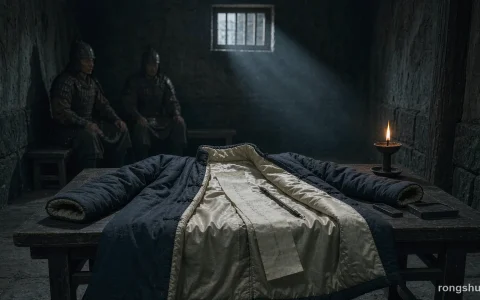
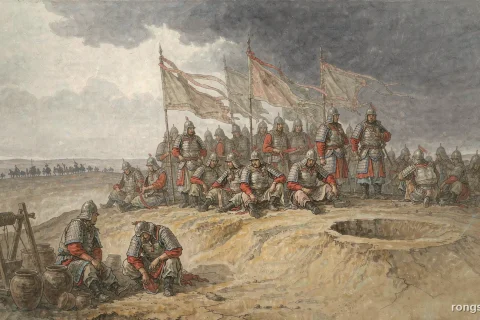
Sickness was worse than the fighting. The northerners did not tolerate the country. Dysentery and fever went through the camps, company by company, and the men who fell ill did not get up. The accounts left by later writers say that more of his soldiers died of illness that winter than died in battle.
So somebody made a suggestion. Lash the ships together, bow to stern, and lay planking across the seams. The decks would stop rolling. Men could walk and shoot as if on dry land.
Cao Cao took the advice.
Seen from the northern bank, it was a triumph of engineering over geography. A single joined platform, longer than any ship ever built, immune to the one thing the northern army could not do. The men stopped being sick. They could hold their positions and drill. In the camps, soldiers said it was a fine idea, and it was.
The one thing nobody on that bank could see was that they had just turned a fleet into a target.
On the far shore, Zhou Yu climbed to a high point above the water and watched for several days.
And watching, he noticed something.
A Letter of Surrender
One of the senior officers under Zhou Yu was an old soldier named Huang Gai. He had served three generations of the Sun family and had governed nine counties in his time.
Huang Gai said this. His enemy had more men, so there was no time to spare. But the enemy ships were tied head to tail. Set one on fire, and none of them could get away.
Zhou Yu understood him at once. So did the rest of the plan: to close the distance, they would have to be invited.
Huang Gai wrote a letter to Cao Cao. Its substance was this. He had laboured for the Sun family for decades and earned some credit. Now he was made to serve under a young man named Zhou Yu, and his heart had gone cold. He would bring his own troops over.
Cao Cao believed him.
Why? Because Huang Gai had once served under Sun Jian, the father, and his seniority reached back further than that of Zhou Yu. An older man with an older claim, made to answer to a young commander, nursing a grievance: Cao Cao had seen that story many times before, and it usually ended the way this letter promised.
Cao Cao wrote back. They agreed on the flags and the hour of the surrender.
The men of the south had done the harder part. They had made their enemy arrange his own defeat, and pay for the arrangements.
The Wind Off the River
The day came.
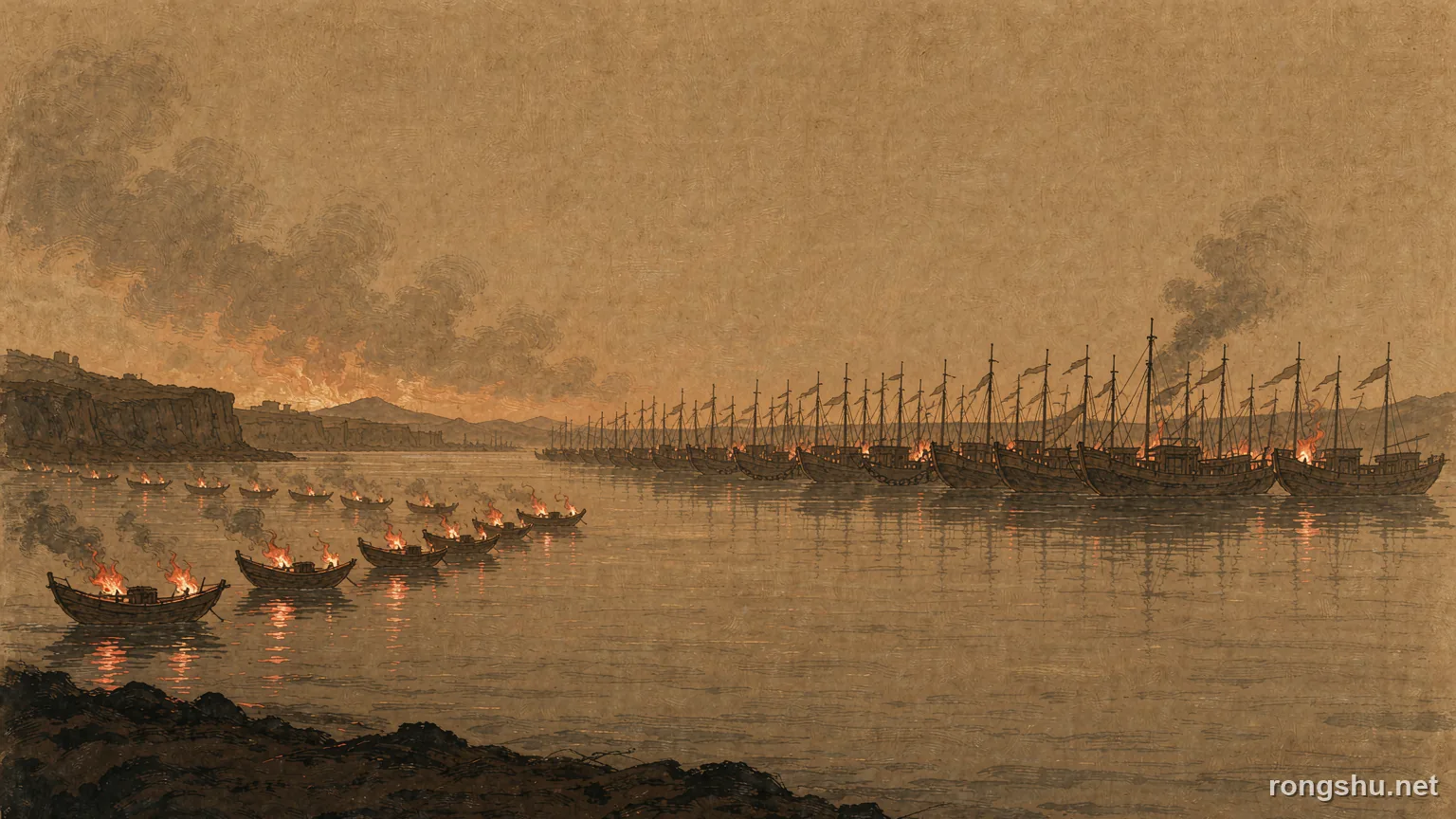
Huang Gai prepared ten large ships. They were packed with dry reeds and dead wood, soaked in oil, screened with cloth, and hung with the agreed flags. Behind each one trailed a fast boat, for the crews.
That night, a southeast wind began to blow.
In that stretch of the river, a southeast wind in winter is rare. It is not impossible, and the men who lived there knew both halves of that sentence. Zhou Yu and Huang Gai had counted on it. Cao Cao had not, and his advisers on the captured fleet had not thought to tell him, or had told him and were not heard.
The ten ships led, running north with the wind. Their crews stayed behind the screens.
In the camps of Cao Cao, soldiers came out to look. They pointed across the water and said that Huang Gai had come over. Nobody reached for a bow.
Two li short of the northern fleet, all ten ships were set alight, and the crews dropped into the trailing boats and rowed clear.
Wind fed fire, and fire fed wind. The ten burning hulls went in like arrows from a loose string.
The iron chains held the enemy ships in a single row. Once one of them was burning, there was no way left to separate them.
The fire ran from the river to the shore, through the tents and into the camps on land. The ships of Cao Cao were gone. So were the camps.
Zhou Yu and Liu Bei came on behind the flames, by water and by land.
Mud on the Huarong Road
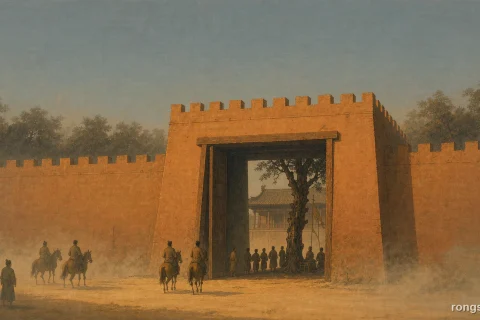
Cao Cao took what was left of his army west. The road he had to use is called Huarong.
It had rained. The track was deep mud, and nothing with wheels or hooves could get through it.
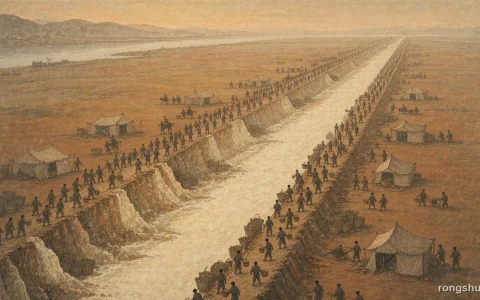
He gave an order. The weak and the sick were to carry grass and pack it into the mud, to make a surface the cavalry could cross.
The surface was made. The cavalry crossed. The men who made it were trampled into the mud by the horses behind them. The histories leave one line about it: those who sank into the mire died in great numbers.
He reached Jiangling. Of the army he had brought out of the north, the sick, the burned and the scattered accounted for more than half.
Cao Cao left Cao Ren to hold Jiangling and Xu Huang to hold Xiangyang, and took the rest home.
The next year, Zhou Yu took Jiangling. Liu Bei used the momentum to take four commanderies in the south, and for the first time in his life he had territory of his own. Sun Quan lent him part of Jing Province, because a weak ally holding the middle of the river was better than a strong enemy holding it.
From that winter on, the Yangtze was divided between three powers, and the division held for more than seventy years. Chinese history calls it the Three Kingdoms. The name is still used for the age.
Cao Cao told it differently. Years afterwards he wrote to Sun Quan and said that the winter had brought sickness, that he had burned his own ships and gone home, and that Zhou Yu had been handed a reputation he never earned. Losing sides keep their own accounts. This one has survived for eighteen centuries.
In the West, there is an older story that reads much the same. In 1588 the Spanish Armada lay anchored off Calais in a tight, disciplined crescent, waiting for its army to come across from Flanders. The English sent eight fireships in on the tide. The crescent broke. A fleet that had been unbeatable became a scatter of hulls driven north up the sea, and poor seamanship finished what the fire had started.
That was the same lesson taught a second time: a fleet packed too close together is a fleet that cannot save itself.
More than eight hundred and seventy years after Red Cliffs, a poet named Su Shi stood on a riverbank at Huangzhou and wrote about that night. He imagined the young commander, and the bride he had married that same year, and the enemy fleet going up in smoke and ash.
Su Shi stood in the wrong place. The real Red Cliffs are several hundred li upstream, near Puqi, and he knew it.
But the line he wrote about the ships was not wrong at all.
As for the other stories, the borrowed east wind, the arrows collected with straw boats, the beating that Zhou Yu is said to have given to Huang Gai for the sake of a trick, those came later. They belong to a novel written a thousand years afterwards, and readers have loved them ever since.
On the night that actually broke Cao Cao, no drums rolled, and nobody whistled up the wind for him.
The wind came by itself.