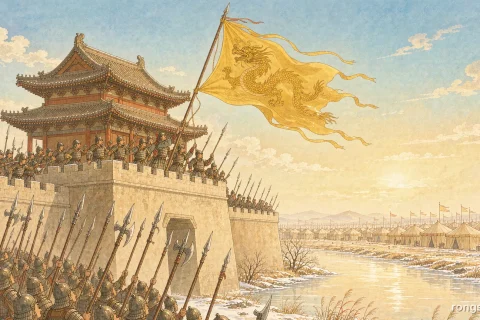
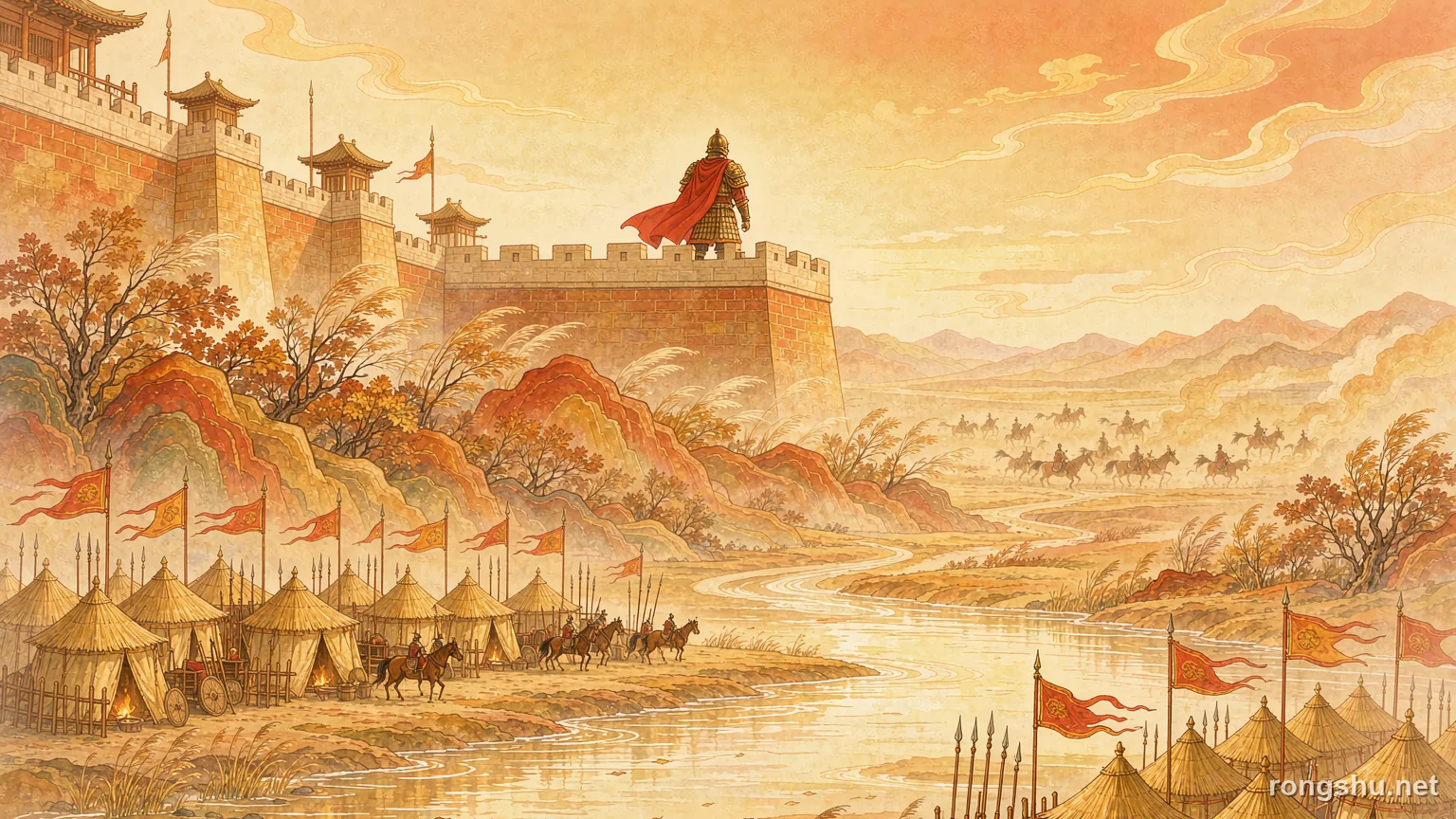
Fu Jian stood on the wall of Shouyang and looked south.
It was the winter of 383. Under his feet was a town he had just taken. Behind him was an army that his own proclamations called a million men.
Across the river, the whole slope of Mount Bagong was covered in trees. The wind moved through them and the shadows shook.
He turned to his younger brother and said: That is a real enemy. What did you mean, that they are too few to worry about.
His brother had nothing to say.
A few days earlier that brother had told him the opposite. The Jin are weak, he had said, but their ruler and their ministers are of one mind, and in this season they cannot be beaten.
Fu Jian had answered him with one sentence. With the men I have, he said, if every one of us threw his whip into the Yangtze, the river would stop flowing. What natural barrier has Jin got left.
That sentence is what Chinese remembers him for.
To see what it cost him, you have to know how he had built the state he was so sure of.
The fourth century in the north was a time when anyone with an army wanted a throne. Around Chang’an, a people called the Di had set up a kingdom called Former Qin. In 357 Fu Jian took the title from his own cousin.
He then made a choice no rival of his made. He put a Chinese scholar in charge.
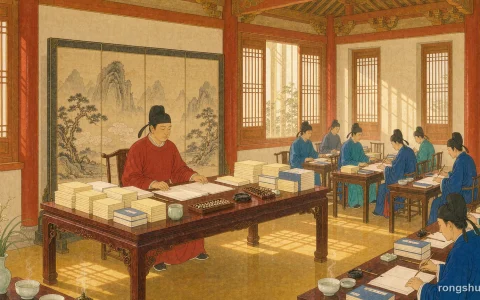
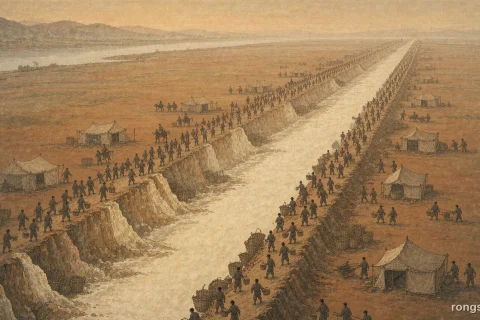
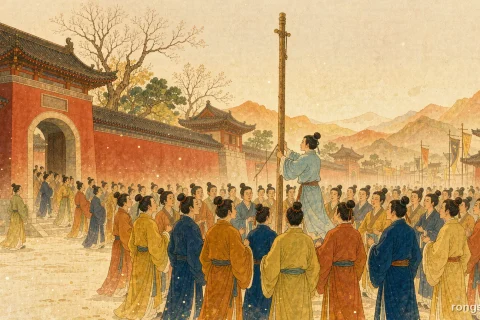
The man was Wang Meng. He had been poor, and had sold baskets in the market, and he was hard in a way that courts are not used to. In his first month in Chang’an he had more than twenty powerful men executed for abuse of office, and the capital stopped arguing with him. Over the next fifteen years Former Qin dug irrigation, opened schools, cut taxes, and rebuilt its army until it had more of all of it than anyone else in the north.
With that behind him, Fu Jian swallowed one kingdom after another, until by 376 the whole north was his. He pushed south too, taking the Liang and Yi regions, which today are southern Shaanxi and Sichuan, and breaking open Xiangyang on the Han River.
The Words He Left Behind
Wang Meng died in 375.
On his deathbed he called Fu Jian to him and left him two sentences. The first was this. Jin is entrenched in the south, its line of legitimacy runs unbroken, and its ruler and people are at peace with one another. After I am gone, do not go to war with it. The second was this. The Xianbei and the Qiang are the enemy inside your own house. Deal with them slowly, before they deal with you.
Fu Jian wept, and buried him.
Then he ignored both sentences.
Over the next few years he raised two men to high favour. One was Murong Chui, a prince of the Xianbei royal house, who had come to him after his own state was destroyed, and who was an excellent general with a great name. The other was Yao Chang, a Qiang leader who had followed him for years.
Fu Jian treated both of them well.
He had one famous weakness. He was generous to men who had surrendered to him. Murong Chui and Yao Chang were the first two of them, and later there was a third. What the three of them did with that generosity is written all over the end of Former Qin.
In the tenth month of 382 he put the question of the war to his court.
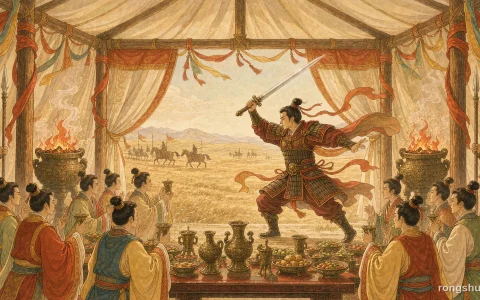
The four corners of the world are settled, he said. One small district in the southeast is left. I intend to take an army and wipe it out myself.
A few men agreed with him. Most did not.
One minister said: Xie An and Huan Chong are still alive. That court has no crack in it. This is not the year.
Another said: Jin has the Yangtze. Its people are behind it. Do not go.
Fu Jian overruled both, dismissed the court, and kept his brother behind.
His brother gave him three reasons against the war. The people do not want it. Jin has no weakness to exploit. And our own soldiers have been marching for years, and they are tired.
Fu Jian did not listen to that either.
Neither did he listen to his Buddhist adviser, or his favourite consort, or his youngest son, all of whom told him the same thing. He heard every objection anyone raised, and then he ordered the invasion.
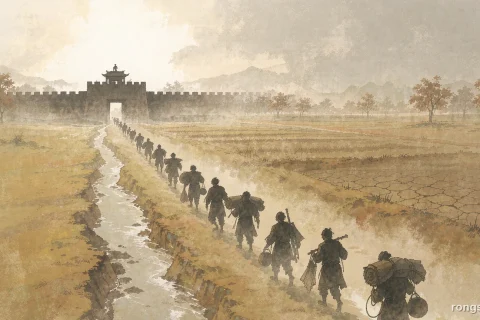
In the seventh month of 383 he issued the call-up. One man in ten from the farming households. The sons of rich families under twenty, if they were strong, were made officers in the guard.
At court he made a joke about it. When we win, he said, we will make the Jin emperor our minister of revenue, and give Xie An the ministry of personnel, and find something for Huan Chong. I will have their houses built in advance.
In the eighth month he marched south with six hundred thousand infantry, two hundred and seventy thousand cavalry and thirty thousand guards, calling the whole thing a million.
On the Jin side there were eighty thousand men.
They had a name. They were the Beifu troops, raised around Jingkou, which is modern Zhenjiang, from the flood of refugees who had come south when the north was lost. Such men had nothing left to go back to. They had been training for seven years. Their commander was Xie Xuan, and his hardest officer was Liu Laozhi.
The man running the Jin government was the chancellor, Xie An.
One Night at the Luo River
In the middle of the tenth month the Former Qin advance took Shouyang, in what is now Anhui. Five thousand Jin sailors had been sent to hold it. They were halfway there when they heard it had fallen, and they pulled back to a hill fort called Xiashi.
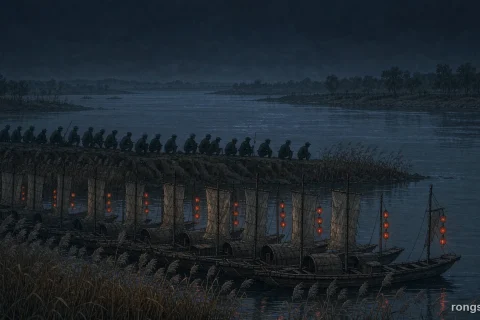
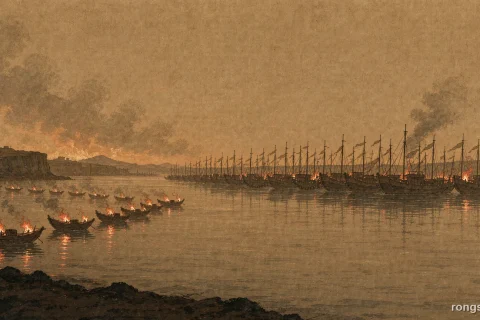
A Former Qin general named Liang Cheng brought fifty thousand men forward to the Luo River, a tributary of the Huai, and drove stakes and built a fence across the water to cut off anyone coming to relieve the garrison.
Inside Xiashi the Jin troops ran out of food. They wrote to the main camp asking for help.
The letter was intercepted.
Fu Jian’s brother read it and sent it straight on. The enemy is few and starving, he reported. Come up with everything you have before they slip away.
Fu Jian was delighted. He left the bulk of the army behind and rode to Shouyang with eight thousand cavalry.
Then he sent a man into the Jin camp to talk them into surrendering.
The man he chose was Zhu Xu.
Zhu Xu had been the Jin commander at Xiangyang. Five years before, his city had fallen and he had been captured, and Fu Jian had not killed him but had given him a post at court.
He reached the Jin camp, and instead of making his speech he laid out the truth of the enemy position, and then turned it into advice. The main body has not arrived yet, he told them. Fight now. Once several hundred thousand men are concentrated in one place you will not be able to move them. Break the advance guard first, take the edge off them, and the rest will be easier than you think.
Xie An’s brother, in command at the front, had been planning to sit still. After that conversation he changed his mind.
In the eleventh month Xie Xuan sent Liu Laozhi across the river by night with five thousand picked men, straight at Liang Cheng’s camp.
The fence on the water had been built to stop people. That night it did not stop men coming round behind it.
Liang Cheng was killed. His fifty thousand broke up. The ones who tried to swim for it drowned in numbers nobody bothered to count.
Five thousand men had done that.
The news reached the Jin main camp and the mood lifted off the ground. The whole army moved forward, on water and on land, and came up to the east bank of the Feishui.
The two sides looked at each other across the river.
Fu Jian climbed the wall of Shouyang. On the far bank the Jin camps were laid out clean and regular. He turned and looked back at Mount Bagong, where the trees and brush moved in the wind, and took them for soldiers.
That is a real enemy, he said.
The Line That Would Not Hold
The Former Qin army lined the west bank and settled in to wait.
Xie Xuan had no intention of waiting.
He sent an envoy across with a proposal that sounds absurd in any military manual. You have come deep into our country, the message ran, and then drawn up along a river. That is how a man fights a long war, not a short one. Pull back a little and give us room, let us cross, and we will settle it properly on open ground.
The Former Qin officers said it was a trick, and refused.
Fu Jian said to accept. Let them come, he said. Half across, that is the moment. Send the cavalry in when half of them are still in the water.
His brother passed the order down.
All along the line, the army was told to fall back.
That is where it came apart.
This force that the proclamations called a million was not one army. It was Di and Xianbei and Qiang and Jie, plus farmers and townsmen pulled in by the call-up, most of whom had never stood in a formation together. Men at the back saw the men in front moving and drew the only conclusion that made sense to them.
The line gave, and once it gave, nobody could stop it.
Then Zhu Xu, standing somewhere in the rear, began to shout.
The Qin army is beaten, he shouted. The Qin army is beaten.
That shout did more damage than any charge the Jin made that day.
Xie Xuan took eight thousand men across the Feishui and drove straight at the centre. Fu Jian’s brother galloped up and down the collapsing line trying to turn men around, and his horse went down under him, and the Jin troops who caught up with him killed him where he lay.
The banners went over. The army came apart.
Fu Jian took an arrow in the shoulder and rode north alone.
Somewhere short of the Huai River he heard the wind, and heard cranes calling, and thought both were Jin cavalry coming for him.
Chinese still uses those two images for panic. Soldiers that look like a forest. Wind and cranes taken for pursuit.
Eighty thousand men had broken an army that called itself a million.
The Man Playing Go
The dispatch reached the capital while Xie An was playing a board game with a guest.
He opened it, read it, said nothing, put it down, and went on with the game.
The guest could not help asking what the news was.
The young ones have beaten the enemy, said Xie An, and moved his piece.
When the game was over and the guest had gone, he went back into the inner rooms. He was so far off the ground that he did not notice his wooden sandal catching on the door sill and snapping its heel off.
He was sixty-four that year.
Former Qin did not die at once, but it never stood up again.
Luoyang was lost. Murong Chui took his men back to Hebei and the next year declared himself ruler of a new state, Later Yan. Yao Chang rose in the Chang’an region and shut Fu Jian inside the city.
In 385 Fu Jian got out of Chang’an, was caught by Yao Chang’s men, and was strangled in a Buddhist temple. He was forty-eight.
The man who had shouted in the rear at the Feishui went home. Jin took him back without a punishment, and he served it for the rest of his life.
The north he had spent fifteen years assembling broke into seven or eight pieces, and the pieces fought each other for the next two centuries.
On the Jin side the frontier moved north to the Yellow River. Xie An died the following year, and Xie Xuan handed back his command soon after.
The south was left in peace for another thirty-seven years.
Thirty-seven years later the last Jin general with an army, Liu Yu, had the two Jin emperors killed one after the other and took the throne himself. That was 420.
In the north, China was not put back together until the Sui armies came south in 589.
From the day Fu Jian stood on the wall at Shouyang and mistook the trees for soldiers, that is two hundred and six years.
Five years before the battle at the Feishui, something very like it had happened in Europe. In 378, at Adrianople, the eastern Roman emperor took the field against a Gothic force he expected to brush aside, and never came back. The frontier was never the same. Big empires are not usually killed by their enemies. They are killed by the weight they are already carrying when the fighting starts.
It remains one of the most argued-about battles in Chinese history, and the numbers are part of why. Sources for ancient China rarely agree on the size of an army, and the million here is the figure the court itself put out, not a count anyone made on the ground.
Whether that is what happened at the Feishui is still argued. One view holds that Former Qin was coming apart anyway, and the river only made it faster. The other holds that if Fu Jian had not given that one order to fall back, the north would have held together, and China would have looked different for the next two hundred years.
Fu Jian never got to find out.