On the afternoon of 13 November 1935, in a Buddhist prayer hall in the northern Chinese city of Tianjin, a man of about fifty sat cross legged on a cushion near the front, following the chanting of a sutra. The room smelled of incense. Around him the lay believers were quiet, ordinary people who had come to hear a monk read.
Three shots. The man fell where he sat and died almost at once. The pistol was in the hand of a woman of thirty.
She did not run. She stood, took out a bundle of printed leaflets she had carried in with her, and began handing them out. I have killed Sun Chuanfang to avenge my father, she said aloud. I will not harm anyone who is innocent. I acted alone, and I will answer for it alone.
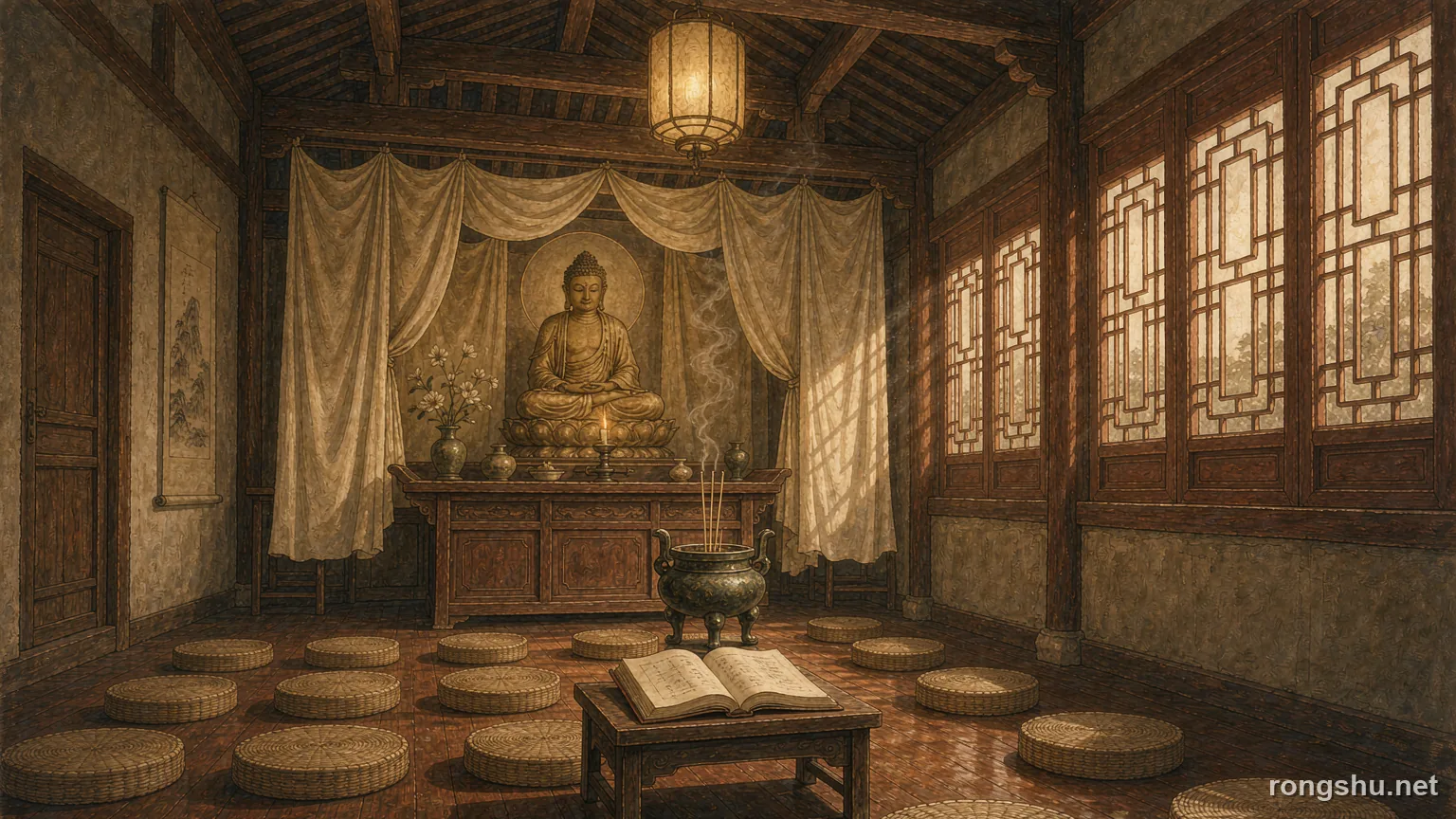
The dead man was Sun Chuanfang, once commander of the allied armies of five provinces and for a time among the most powerful soldiers in China. When his side lost the Northern Expedition in the late nineteen twenties he left the field, settled in Tianjin, and became a practising Buddhist.
The woman was Shi Jianqiao. Her birth name was Shi Gulan, and she came from Tongcheng in Anhui province. She had waited ten years for this afternoon.
Because a woman had shot a former general in front of a room of worshippers, the case was talked about everywhere. What reached the public first was a story of a daughter who avenged her father. What followed was a criminal trial, in the ordinary courts. The first court gave her ten years. The second reduced the term to seven. The highest court upheld that. Then, in October of the following year, the sentence was cancelled by an order of the head of state.
So two things are tied together here. One person took the law into her own hands, and then handed herself over to the law. To see why, it helps to start with the father, and with a railway station in the autumn of 1925.
One. The Station at Bengbu
In the autumn of 1925 the two great warlord camps of the north, the Zhili and the Fengtian, went to war over Anhui and Jiangsu.
Shi Jianqiao’s father, Shi Congbin, was an old soldier of the northern army. He was then deputy military commissioner of Shandong and commander of the Second Army of the Fengtian side, and Zhang Zongchang ordered him south to meet Sun Chuanfang, who was coming north.
Sun Chuanfang had sent him three telegrams before the fighting, inviting him to change sides. Shi Congbin ignored them. He pushed forward alone, and at Guzhen in northern Anhui his force was broken and he was taken prisoner, then brought to Bengbu.
The custom of the time was that a captured senior officer of the other side would be treated with courtesy. Sun Chuanfang did not do this. He had Shi Congbin put to death and the head hung at the front of the station, on a white cloth marked in red with the words, the head of the new military commissioner of Anhui, Shi Congbin. The body was left exposed for three days and nights.
The family learned of it many days later. Shi Gulan was not yet twenty.
She wrote a poem about that night. One line says that the vow to avenge her father would not spare even her own life.
On her parentage the sources do not agree. One account says she was Shi Congbin’s own eldest daughter. Another says she was a daughter of Shi Congyun, a leader of the Luanzhou rising of 1911, adopted by her uncle Shi Congbin. Either way, the father whose severed head had been shown at the station was the man she set out to avenge.
Two. Ten Years
A young woman without money or connections, setting out to kill a man who had once commanded five provinces, was not attempting something that willpower alone could finish.
First she looked for someone else to do it.
The first was her older cousin Shi Zhongcheng. He had lost his own father young and been raised by Shi Congbin, and at the funeral he swore before the family that he would one day bring back the killer’s head to offer at the grave. By the late nineteen twenties he commanded the garrison at Yantai. In 1928, when the Northern Expedition was driving Sun Chuanfang back, Shi Gulan wrote urging him to act. His reply refused, and for the first time he said plainly that he would not take revenge. After her angry answer the two did not speak for seven years.
The second was her husband, Shi Jinggong. A classmate of her cousin at the Baoding military academy, he was then a staff officer under Yan Xishan in Shanxi. In 1928 he was staying with the family, saw Shi Gulan weeping in the courtyard, and told her that he too had been helped in his career by her father, and would take the revenge for her. She believed him, married him, and went with him to Taiyuan.
For seven years of marriage the matter was never mentioned again. Whenever she raised it, he put her off. In June 1935 she took her two children and left for Tianjin. In a manuscript she wrote later she called it the second failure of her habit of relying on other people.
On the train back she wrote a short poem. Its closing line says that the wish for help must be given up, and that in the end she would have to do the thing herself.
In Tianjin the first thing she did was have her feet operated on. They had been bound in childhood, and she could not walk far, and a person who cannot walk far cannot hunt anyone. The surgery had to be done in stages, straightening the toes a little at a time, and it was painful. She came to every appointment and said nothing.
Then she began to look for Sun Chuanfang. She did not know what he looked like, so she searched the places that sold pictures of famous men. She found him on the stall of a fortune teller, where a pane of glass held down a row of small photographs of notables. One faded picture had three blurred characters on the back, and they read Sun Chuanfang. She told the man it was a picture of a relative and paid a high price for it.
She found where he lived through her elder son, who mentioned a classmate called Sun Jiamin. The teacher confirmed that the girl’s father was Sun Chuanfang. She traced the family to an old house in the French concession, but the gate carried a notice offering it for rent. Pretending to be a possible tenant, she was shown round and learned that the family had moved to the British concession. Sun Jiamin attended a school nearby, and at a ceremony there she memorised the number plate of the family car.
The pistol came to her by chance. Her eighth brother was a student in Nanjing, and in 1934 a classmate passing through Tianjin left at the house a Browning pistol, with two boxes of ammunition, that he had bought at the military ministry. She found it and kept it.
What remained was the routine of Sun Chuanfang. In 1935 he had turned to Buddhism and often went to the Lay Buddhists Society in Tianjin to hear sutras read. Shi Jianqiao, using the name Dong Hui, went there five times to listen, and mapped out where he sat and what he did. At first she sat some distance from him. Then she complained that the stove behind her was too hot, and moved forward.
Three. The Thirteenth of November
On the afternoon of the killing there were fewer believers than usual in the hall.
The monk Fuming was reading from the Shurangama Sutra. Sun Chuanfang sat cross legged on a front cushion with his eyes closed, chanting along with the rest. Shi Jianqiao took the Browning pistol from her handbag, aimed at his head, and fired three times.
According to the record in the later judgment of the Supreme Court of the National Government, the three bullets struck him on the right temple, the back of the head and the middle of the back, and he died on the spot.
She stood up and announced that she had killed for her father and would hurt no one else. She handed out the leaflets and a longer statement she had prepared. The leaflet set out four points. She had shot Sun Chuanfang that day to avenge her father. The details were in the statement. Her revenge being complete, she would go to the court and give herself up. And she was sorry for the alarm caused by blood in a place of worship.
When the leaflets were gone she telephoned her family to say what she had done, and asked a monk to call the police. When the officers arrived she handed over the pistol and the three remaining rounds, and went with them.
The case was transferred to the procurator of the Tianjin district court the next day. Under questioning she admitted everything and gave the reason. She offered no excuse.
Four. Two Voices in the Courtroom
The first judgment came from the Tianjin district court. It took as its measure an earlier case, that of Zheng Jicheng, who three years before had shot Zhang Zongchang to avenge an uncle. On the counts of carrying military arms and ammunition and of killing a man, the court sentenced her to ten years.
On appeal the Hebei higher court held that the lower court had been wrong to treat her surrender as grounds for reducing the sentence. It also found that her grief for a father who had died cruelly, and her willingness to risk herself for his sake, sprang from a dutiful heart and deserved compassion. It reduced the term to seven years. She appealed to the Supreme Court in Nanjing. On 1 August 1936 the procurator there wrote that in law there was no ground for mercy, and the appeal was dismissed.
Outside the courts, public opinion ran almost entirely her way. Telegrams and letters asking for a pardon poured into Nanjing, from party offices, teachers’ associations, chambers of commerce, farmers’ groups and women’s organisations in her home province of Anhui and far beyond it. They listed the killings for which Sun Chuanfang had been responsible, and called Shi Jianqiao loyal, brave, dutiful and wise.
On the other side, the family and former officers of Sun Chuanfang were working too. His eldest son, Sun Jiazhen, argued that the defendant had used revenge as a pretext for murder, and that there was nothing to forgive. He wanted a heavy sentence.
One thing is worth noticing about how the case was read at the time. It was not treated only as a story of a dutiful daughter. The killing happened while Japan was pushing its plan for autonomy in north China, and Sun Chuanfang had been on friendly terms with Japanese officers such as Doihara Kenji and Okamura Yasuji. In the same period several men known to be pro Japanese were assassinated, and some people suspected that this killing too had been arranged from Nanjing. The suggestion was never proved, but it was a rumour people exchanged that year.
Here it is worth pausing on the older question the case stirs up, because it is not only a Chinese one. A society with courts has to decide what to do with private revenge. In early modern Europe the blood feud, the right of a family to answer a killing with a killing, was slowly dismantled, and the state claimed a monopoly on punishment. China reached the same conclusion much earlier, and its magistrate manuals praise the dutiful son as a man of feeling while recording that the law still took his life. What is unusual here is that both verdicts survive in the same file.
Five. One Sheet of Paper
The last step in the case was taken outside the courtroom.
The man who worked hardest for it was Feng Yuxiang. In the revolution of 1911 he had served in the northern army with Shi Congyun, a brother of Shi Congbin and a leader of the Luanzhou rising. Shi Congyun’s son, Shi Zhongjie, worked for Feng Yuxiang as well. Feng Yuxiang joined with Li Liejun, Yu Youren and Zhang Ji, veteran leaders of the Nationalist Party, in a joint letter to Lin Sen, the chairman of the National Government, asking for a pardon. Papers at the time reported that he had also asked Chiang Kai-shek directly.
On 25 September 1936 the Judicial Yuan took up the question of whether a pardon should be granted, and resolved to ask the National Government for one. On 14 October the government issued the order over the name of Chairman Lin Sen. It said that Shi Jianqiao, whose father had been cruelly killed by Sun Chuanfang, had struck out of grief for him, and had then calmly given herself up and awaited punishment. Her act offended the criminal law, but it had been prompted by a daughter’s duty and a willingness to risk herself, and her case deserved leniency. Under article sixty eight of the provisional constitution, the sentence of seven years was set aside.
She had been in prison less than a year.
Readers who know the modern law of pardon may find the speed of this strange. In the United States a pardon is a political act, usually granted after years of petition, and the review of a death sentence through state appeals and federal habeas corpus can run for decades. Here the whole sequence took under twelve months, and the mercy came not from a jury but from a meeting of the judicial council and a signature at the top of the state.
Six. What Came After
Not long after she left prison the war with Japan began. She went south and raised money and comforts for the troops, and ran a primary school. After the founding of the People’s Republic she moved to Beijing in 1952 and lived as a lay Buddhist at the Biyun temple. In 1957 she was elected to the Beijing committee of the political consultative conference. She died in 1973.
The case has been retold so many times that the three shots have come to seem the whole of it.
The first half is a story of revenge. A daughter waited ten years, put her hope twice in other people, and was twice disappointed, and in the end did the thing herself. The second half is a story of courts. Ten years, then seven, then a final judgment, then a meeting of the Judicial Yuan and an order of the head of state. A killer handled that way is not the common run of the Nationalist judicial files, and the archive survives, including the judgment of the Supreme Court in the twenty fifth year of the republic, criminal appeal number four eight six.
Two things sit in the same file. One person answered an old wrong by her own rules, and then put herself in the hands of the state to be judged by its rules. What happened afterwards suggests she never meant to escape the second. She called the police on the day. In court she offered no defence of herself.
When Sun Chuanfang fell in the prayer hall, he was unarmed. Ten years earlier, so was Shi Congbin, hanging at the front of the station.