In the Northern Wei, in the city of Shouchun on the Huai river, two men came to the provincial office to argue over a child.
Each of them said the same sentence. This is my son. Each of them had neighbours willing to swear to it. The district court had tried the case and failed to settle it. So it travelled up, to the desk of the provincial governor, Li Chong.
Li Chong had the two men and the child separated and held apart. Some time later he sent word to each of the two fathers. Your son has fallen suddenly ill, the message said. He is dead. The detention is lifted. You may go out and arrange the funeral.
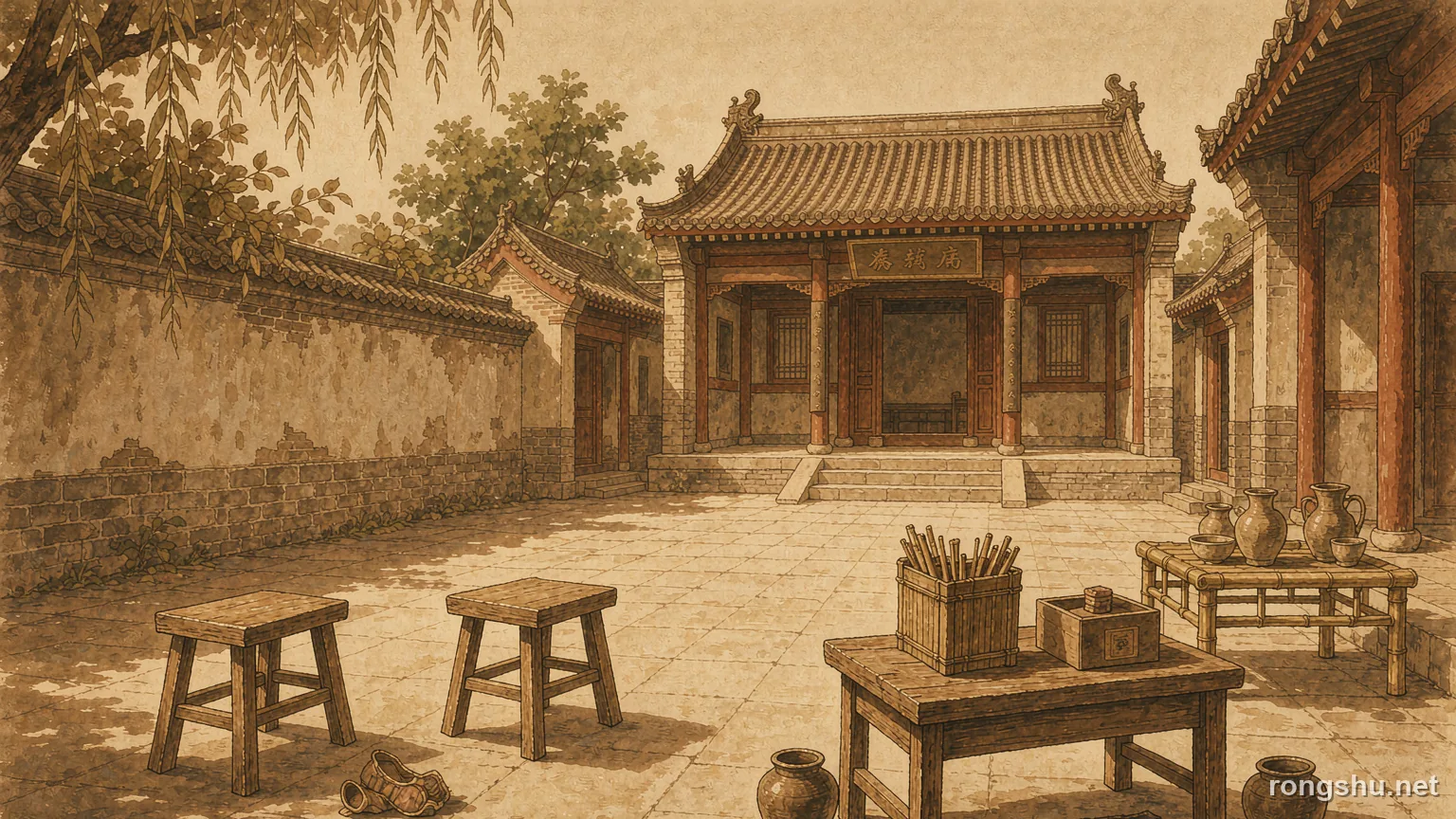
The case is recorded in the official history of the Northern Wei, in the biography of Li Chong. It was copied into the great Song encyclopaedia, and collected again in the Five Dynasties anthology of difficult cases and the Southern Song guide to the clearing of doubts, where it served as a model. It is short. Inside it is a question that is rarely put plainly: when two people tell opposite stories and neither can prove anything, what is a judge actually entitled to use?
The judge here is worth knowing first.
Li Chong, who lived from 455 to 525, was a nephew of an empress and therefore a member of the imperial in law family. He entered office at fourteen and served three emperors. He was governor of Jingzhou and of Yanzhou, and for ten years he held the frontier city of Shouchun, keeping several thousand picked troops there and beating off repeated attacks from the southern dynasties. The armies facing him nicknamed him the Crouching Tiger.
The official history says of him that he was generous in office and clear in judgement, and that when he heard a lawsuit he would not put brush to paper until the reasoning could be defended. The same biography also records the other side of the man. He was fond of money and of trade, and by buying and selling he accumulated a fortune so large that his contemporaries held him in contempt for it.
A man who could judge a case, and who also loved money. This was the official who was handed the dispute over the child.
One. A case no court could settle
The facts of the case are almost too simple to investigate.
A man of Shouchun named Gou Tai had a three year old son, and the boy was lost during a bandit raid. In a time of that kind, a child lost in a raid is usually lost for good. Gou Tai looked for several years and heard nothing.
Then, in the household of another man of the same district, Zhao Fengbo, he saw the boy.
He brought a complaint. That is my son, he said. Zhao Fengbo refused to give him up. The child is mine, he said. Both men had neighbours who came forward to testify. In the countryside of that period this was the ordinary form of proof: a village knows its own affairs better than any record does. This time both villages were willing to speak, and both said exactly the same thing.
The district court heard it and could not decide. The county court heard it and could not decide. The case went up.
The difficulty is that this is not a problem that reasoning can solve. The boy was three when he disappeared, and by the time he was found several years had passed. Small children change quickly, and after a few years their faces are not the faces anyone remembers. How the boy came to be in the Zhao household, and what had happened to him in between, nobody could say. Two men, two stories, and witnesses on both sides, and no way to close either account.
Faced with this kind of case, the usual practice of the period offered two exits. Apply torture until one man admitted something, and close the file. Or let the matter sit, and leave it to rot in the archive.
Li Chong used neither.
Two. The child is dead
The history gives the whole case in a few lines.
The boy had been lost at three. Years later he was found in another man’s household. Both men claimed him and both produced neighbours. The district and the county could not decide.
What Li Chong did first was not to interrogate anyone. It was to separate the three of them. He ordered the two fathers and the child to be held in different places, out of sight and out of contact.
That step looks small and is not. It cut every channel of information between the three people. Neither father could learn anything about the child. The child could see no adult he knew. In that condition, whatever a man was carrying inside him had nowhere left to hide.
After a stretch of time, Li Chong sent a messenger to each of the two fathers with the same sentence.
Your son has been taken with a sudden illness. He died a short while ago. The order of detention is lifted, and you may go out to mourn him and see to the funeral.
Three. What the two men did
The two reactions were not the same.
Gou Tai, the history says, wailed aloud and could not master his grief. Zhao Fengbo sighed a few times and showed no particular sorrow at all.
Li Chong read the difference, returned the child to Gou Tai, and then pressed Zhao Fengbo for the truth about his fraud. Zhao Fengbo confessed.
What he admitted was this. He had lost a son of his own, years before, and so when he saw this boy he had claimed him.
The truth of the case comes out there. He was not a kidnapper. He was a man who had also lost a child, and who wanted one badly enough to take another man. The motive is pitiable. But recognising another man’s son as your own is, for the real father, the second loss of that child.
The method in this case was quoted for centuries afterwards, and the reason is not the verdict. It is the procedure. Li Chong had no household register to consult, no birth record, no way of measuring anything. What he had was how a man behaves at the moment he is told that his child is dead.
And he was working from one assumption that turns out to be true. A man who has really lost a child, and a man who merely wants one, do not react to the same sentence in the same way.
Four. The other case
The same biography contains a second case from Li Chong’s time in Shouchun, worked in the same manner.
Two brothers from Dingzhou, Xie Qingbin and Xie Si an, had been sentenced to exile and sent to Shouchun for labour. The younger brother, Xie Si an, could not bear the work and ran away. Afraid that he would be held responsible later, Xie Qingbin decided to have the younger brother removed from the register. His method was to claim an unidentified corpse found outside the city, declare that it was his brother, killed by other men, and bring it home for burial. The corpse happened to resemble Xie Si an, and people who had seen him found it hard to tell the difference.
He went further. He accused two men from the same labour unit, Su Xianfu and Li Gai, of the murder. There was also a local spirit medium, a woman named Yang, who said she had seen the ghost of the dead man and described in detail how he had suffered, how thirsty he had been, how hungry. The case went to the provincial court. Su Xianfu and Li Gai, unable to endure the beating, each confessed.
The file was about to close when Li Chong found it doubtful and stayed it. He did two things.
First, he found two men from outside the province whom nobody in the city knew, and sent them to Xie Qingbin. They told him this story. We live three hundred li from here. Recently a man came to our house to stay the night. Talking with him in the dark, we thought something about him was wrong, and we questioned him about where he came from. He said he had been sent into exile, had run away from his labour, and that his name was Xie Si an. He said he had an elder brother named Xie Qingbin, living in the Xiangguo quarter of Shouchun, and that his brother’s wife was surnamed Xu. He begged us to go and tell his brother and speak for him, and he said his brother would reward us generously. So we have come to you. How much will you give us to get your brother back? If you do not believe us, you may come with us and see for yourself.
Xie Qingbin turned pale and asked them to wait a little while, so that he could raise the money.
Second, the two men reported back to Li Chong. Li Chong had Xie Qingbin brought in and asked him a single question. Your brother ran away. Why did you claim another man corpse as his?
Xie Qingbin confessed. Questioned again, Li Gai and the other man said that they had confessed under torture. A few days later Xie Si an was brought back in, tied up by someone who had caught him. As for the spirit medium who had seen the ghost, Li Chong had her brought in and given a hundred strokes of the cane.
That last detail is worth a moment. Li Chong did not argue with the ghost. He simply took the person who had been providing testimony on the ghost’s behalf and had her beaten.
Five. What he actually had
Put the two cases together and the method becomes visible.
He used almost no torture.
In the dispute over the child he laid hands on neither father, and he did not bring the boy out to be pointed at. He gave one piece of news to each man, separately, and watched what happened. And the standard he used was not a fine speech. It was the difference between two reactions: grief, and regret. Grief cannot be hidden. Regret can be performed, but it is performed badly.
In the other case he did the same thing, at a larger scale. The central witness was a woman who claimed to have seen a ghost, and the two confessions in the file had been beaten out of men. Li Chong did not waste a moment arguing about whether ghosts exist. He went around the ghost and asked a more concrete question. If Xie Si an were alive, what would he be most likely to do? The answer was that he would go to his brother for money. So Li Chong sent two strangers to offer exactly that, and watched Xie Qingbin’s face when he heard that his brother was alive, needed money, and could be seen.
The method rests on a premise. A man who knows the truth will carry it in his face before he carries it in his words.
The limits of that method need saying too. It is not evidence. It is a sieve. A sieve can show you who is lying, but it cannot reconstruct what happened; and a man who is naturally impassive, or whose feelings run differently from other men, will slip through it. This is why the anthologies of difficult cases were passed around as reference and never written up as law. They recorded experience, not rules.
Six. Solomon and Li Chong
Readers raised on the Bible will find the shape of this case familiar, and the resemblance is worth naming.
In the first book of Kings, two women come before King Solomon, each claiming the same living infant, each saying that the other woman’s dead child is not her own. Solomon asks for a sword and orders the living child cut in two, so that each woman may have half. One woman agrees. The other begs that the child be given to her rival rather than killed. Solomon gives the child to the woman who begged, because the real mother would rather lose her son than see him harmed.
Solomon used the offer of violence. Li Chong used the news of a death. Both were testing the same thing: not what a person says, but what a person cannot help doing when the thing they most want is placed in front of them, or taken away.
The Chinese tradition has other versions of the same device. In another recorded case, a governor ordered two women who claimed the same child to pull him out of a courtyard by force, one arm each. He gave the boy to the woman who let go. His reasoning was that only the real mother would release him rather than let him be torn.
What makes Li Chong’s case unusual is the speed of it and the cheapness. He did not need a sword, or a crowd, or a show. He needed two men in separate rooms and one untrue sentence.
Li Chong died in 525, in office, at about seventy, and was given a posthumous title and the rank of grand commandant. The history records the fortune he made from trade, and the contempt of his contemporaries, in the same paragraph as the praise. The two things are not in conflict. A man who can see through a lie is not thereby a good man, and Chinese court records are unusually willing to say so.
A century and a half later, in 1247, the official Song Ci would write the first systematic manual of forensic examination in the world, and officials would at last have procedures to work with. Before that there were men like Li Chong, who had no procedure at all, and nothing to work with except two fathers, one child, and a sentence that was not true.
Today the same dispute would take a laboratory a few days to settle, and no one would need to watch which man wept. Fifteen hundred years ago there was no laboratory, and the only instrument to hand was the moment after a man hears bad news.
Li Chong read that moment correctly. It is the reason this case is still in the books.