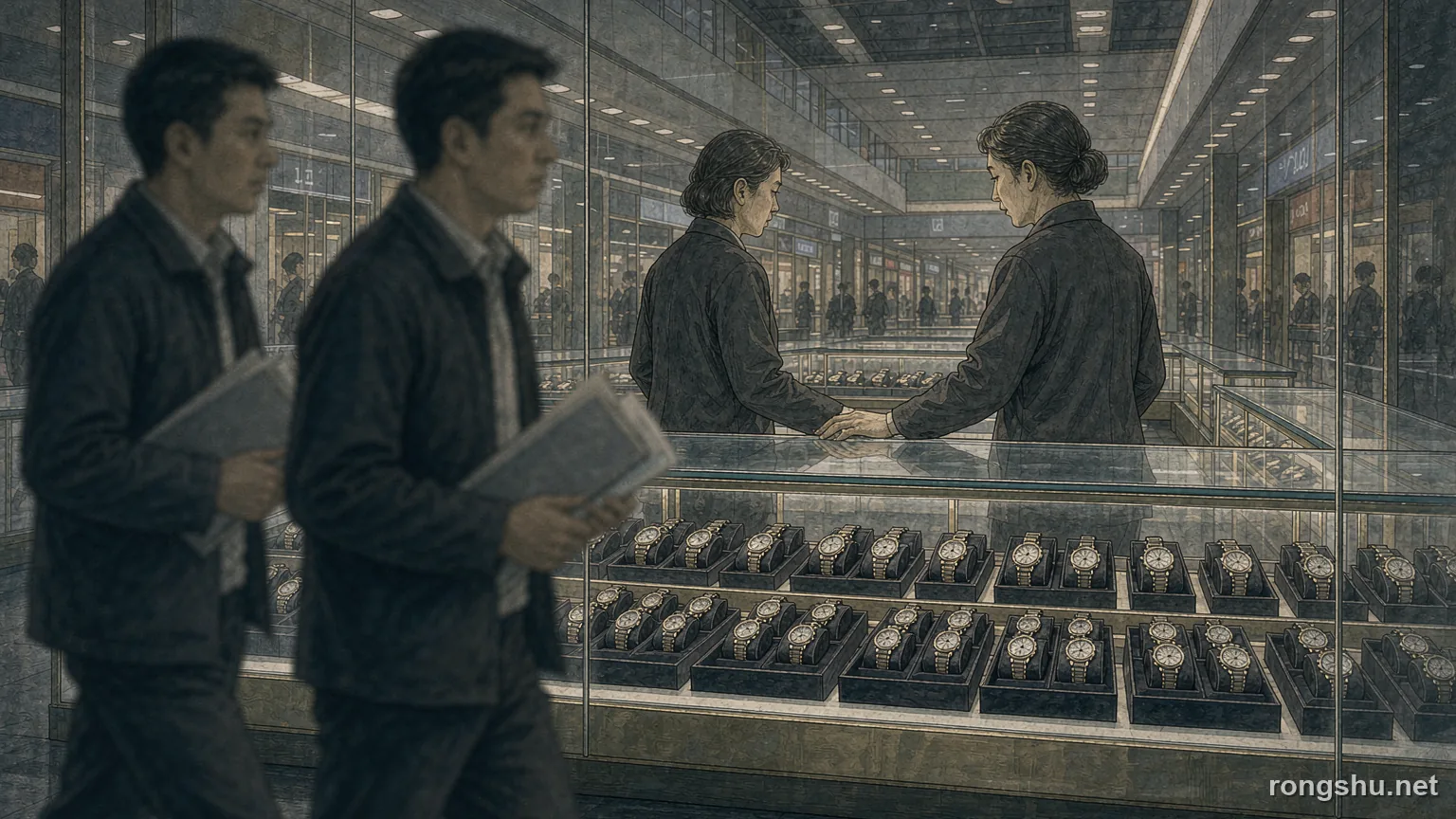
On the morning of 28 November 2019, in the city of Xiamen on the southeast coast of China, a few police officers walked up to a watch counter in a shopping mall.
They asked the woman behind the glass who she was. She was calm. She said her name was Hong Yejiao, and that she was from Nanjing.
The officers checked. In the Nanjing household register there was no such person.
A few hours later, a DNA comparison came back. The woman who had been selling watches behind that counter was Lao Rongzhi. She was wanted in connection with a string of crimes across four provinces and seven deaths, and she had been running for twenty years.
Most English-speaking readers know the shape of this story already, even if they have never heard her name. A man and a woman, working as a pair. He is the one with the record, the one with the knife. She is the one who gets close to the victims, who smiles, who is remembered by witnesses as pretty and quiet. When they are finally caught, she says he made her do it.
Bonnie Parker. Myra Hindley. Karla Homolka. The argument that follows is always the same: was she a victim who could not leave, or a partner who chose it?
In the crowded field of Chinese true crime, this is the case that refuses to fade. In China the argument reached its end on a December morning in 2023, and writing on Chinese true crime has been circling it ever since.
Lao Rongzhi was born in December 1974 in Jiujiang, Jiangxi province, in a family that worked for the state oil company. She did well at school, and in 1989 passed into the Jiujiang Normal School, which trained teachers. She graduated in 1992 and was assigned to the primary school attached to the Jiujiang petroleum company. She taught Chinese.
Had nothing else happened, she would have lived a different life. That is not a defence invented by a journalist. It is what she said in court herself.
In 1994, at twenty, she met a man ten years older at a friend’s wedding. His name was Fa Ziying. He had already been married, and he had already been to prison for robbery. She went with him anyway.
To follow what happened next you need one piece of 1990s China. In the nightclubs of that era there was a class of worker called a peishi xiaojie, a hostess: a young woman paid partly in tips to drink, talk and sing with male customers. Sitting in that chair, she could meet a great many men with money in a month, and learn quickly which of them had more.
That arrangement became the pair’s operating method, and it never changed.
In November 1995 Lao Rongzhi asked her school for unpaid leave, saying she wanted to go into business. In 1996 Fa Ziying fled Jiujiang after wounding a man. She went with him.
One. Nanchang, 1996
They reached Nanchang in June 1996. Lao Rongzhi used a stolen identity card to take work as a hostess in a nightclub, under the name Chen Jia.
She picked a man quickly. Xiong, in business, comfortably off.
At midday on 28 July she telephoned Xiong and invited him to her rented flat. The door closed. Fa Ziying, who had been hiding inside, came out with a knife. They tied Xiong’s hands and feet, took his gold chain, his watch and a bunch of house keys, and made him tell them where he lived.
Fa Ziying killed him, and cut up the body.
That evening the two of them walked to Xiong’s home and let themselves in with his own keys. Fa Ziying held his wife, Zhang, while Lao Rongzhi went through the rooms and collected jewellery, cash and bonds. Then Fa Ziying strangled Zhang and her two-year-old daughter.
A family of three.
One detail is worth keeping. Interrogated four times after her arrest, Lao Rongzhi said the same thing each time: worried about fingerprints, she had suggested to Fa Ziying that they burn the flat down. He refused. The prosecutor’s point was that she was not thinking about whether the mother and child would live, only about the traces she left.
Two. Wenzhou, 1997
The following autumn they moved east to Wenzhou, in Zhejiang. The method did not change. Lao Rongzhi took a hostess job in a KTV, and this time her target was one of the other women working there, a hostess named Liang.
On 10 October the pair went to Liang’s flat on the pretext of renting it. Fa Ziying threatened her with a knife; Lao Rongzhi tied her hands and feet with wire and cloth. They took her watch and phone, then forced her to call another woman, Liu, who managed the KTV and had money. Liu was tied up too, and made to give up her bankbook and password.
Then Lao Rongzhi went to the bank and withdrew more than 25,000 yuan. The teller asked why the account holder had not come herself. The answer was calm: she is busy. On the withdrawal slip, Lao Rongzhi wrote out the victim’s name in her own hand.
Once the money was in her hands she telephoned Fa Ziying. The call was a signal. The cash is out, you can finish up.
Fa Ziying killed Liang and Liu. The two of them left town together.
Three. Changzhou, 1998: the one who lived
In the summer of 1998 they were in Changzhou, Jiangsu. This time the victim was a businessman named Liu, again chosen by Lao Rongzhi in an entertainment venue.
The same method. Fa Ziying hid. Lao Rongzhi brought the man to the door. Liu was strapped to an armchair, and Fa Ziying stabbed him in the chest.
Then Fa Ziying went out to move Liu’s car, which was parked below. Only two people were left in the flat. Lao Rongzhi, and the man tied to the chair.
Liu later testified that she stood behind him and put a knife against the back of his neck. Do not move, she said. Move and I will kill you.
He also testified that he heard her say something to Fa Ziying.
I am going to get his wife. If I am not back in an hour, kill him and run.
The man with the knife said: all right.
Liu is the only person who walked out of those rented rooms alive. More than twenty years later he still had the scars on his shoulders where the wire had cut in.
He lived because his wife arrived with seventy thousand yuan and begged on her knees, and Fa Ziying put the knife down. By then Lao Rongzhi had already taken the money and gone.
Four. Hefei, 1999: the cage and the freezer
In June 1999 they arrived in Hefei, Anhui, better prepared than ever.
Fa Ziying ordered a steel cage a metre square from a welding shop, telling them it was for a dog. Lao Rongzhi, calling herself Shen Lingqiu, took a hostess job in a dance hall and selected a company owner named Yin Jianhua.
On the morning of 22 July she telephoned Yin and lured him to the flat. Fa Ziying held a knife on him, and together they tied his hands and feet and locked him inside the cage.
To convince Yin that they really would kill, Fa Ziying went out with a knife. At a roadside market he found a carpenter waiting for work, told him there was a carpentry job, and brought him back.
The carpenter was Lu Zhongming. He was in his early thirties and had three children. He was tied up, stabbed to death on the spot, and beheaded. The body was put in a freezer.
The freezer was bought by Lao Rongzhi. At trial she said she did not remember.
At about nine that evening Yin wrote two notes to his wife as instructed, telling her to raise the money. Then Lao Rongzhi added lines of her own.
Not one cent short, or I am dead.
His partner will certainly make me die faster than the man you just saw.
Those lines became key evidence against her. Years later prosecutors sent the notes for handwriting analysis; examiners from across Jiangxi, with specialists from the Criminal Investigation Police University of China, concluded that the added words were written by Lao Rongzhi.
At about ten in the morning on 23 July, Yin was strangled with wire.
Fa Ziying then took a homemade pistol and the notes to Yin’s home and asked for ten thousand yuan. Yin’s wife said she would go and raise it, and asked him to wait. She walked out and went to the police.
At five past twelve the police began firing tear gas into the flat. Five minutes later Fa Ziying ran out and shot at the officers. They returned fire. When the shooting stopped, the man with the gun still in his hand was on the ground with his right leg broken, under arrest.
Five days later the police found the bodies of Yin and Lu in the rented flat. Lao Rongzhi was long gone.
On 28 December 1999, Fa Ziying was executed by firing squad.
Five. Twenty years
From that day, Lao Rongzhi disappeared from the record.
She used many names: Chen Jia, Shen Lingqiu, Hong Yejiao. She moved between cities on false papers, took short jobs in bars and KTVs, and had cosmetic surgery.
She built a life that looked ordinary. In Xiamen she called herself Sherry and sold drinks in a bar on commission. She was good-looking and good with customers, and she soon became one of the fixtures of the place. At Christmas in 2016 the bar put up a seasonal poster outside: red and white dresses, and Sherry in the middle of the frame.
She was forty-two that year. In the photograph she is smiling, gently. Nobody looking at that poster thought anything at all.
Later she left the bar and sold cars, then watches, in shopping malls. She took up painting, learned an instrument, kept two dogs. She came across as a middle-aged woman doing comfortably.
Six. How she was found
On 27 November 2019, working a national campaign, Xiamen police ran their data and found a woman who might be Lao Rongzhi, moving around the Caitang commercial district. They did not approach at once. First they checked the file on the Jiangxi fugitive in the wanted database, then went shop to shop asking questions. A shopkeeper said the woman was covering a watch counter for a friend who was away on business.
The next morning, a little after eleven, they stopped her inside the mall.
She denied everything. She said she was Hong Yejiao, from Nanjing. The police checked the Nanjing records and found nothing that matched.
They did not wait for a confession. They took a blood sample and compared it with the DNA of Lao Rongzhi’s relatives. A few hours later the result came back.
On 5 December 2019 Xiamen police handed her over to Nanchang, and she was taken back to the city where it began.
Seven. The question in court
In December 2020 the Nanchang Intermediate People’s Court tried the case over two days, more than fifteen hours of hearings.
In court, Lao Rongzhi withdrew her earlier statements. She admitted robbery and kidnapping. She denied the killings. She said Fa Ziying had coerced her, that she was a victim too, that in her whole life she had never killed so much as a chicken or a duck.
Both the prosecutor and the victims’ lawyer asked her the same question.
Did you have the chance to leave?
Yes, she said.
That one syllable is the heaviest thing in the whole trial.
Three years, four cities, and she never once called the police and never once ran. After Fa Ziying was arrested she did not come forward to set the record straight. She changed her name and kept going.
The prosecutor set her explanations side by side. She had been tormented, she said, yet he walked her to work and did the laundry and cooking. She had known nothing, yet he sent her away first after each crime, to protect her. She was a victim who wanted him caught, yet in three years she never tried to stop him, and after he was caught she did not surrender.
The decisive evidence came from the man in Changzhou who lived. Liu’s testimony established that the pattern was not coercion but an agreed division of labour: she chose the targets, they chose the place together, and they acted together. It was this testimony that turned a twenty-year-old unsolved file into one of the most closely followed Chinese criminal cases of the decade.
The court found that Lao Rongzhi played a principal role in a joint crime.
One piece of legal machinery here is unfamiliar to most English readers. In China a death sentence from an intermediate court does not take effect at once; it must be reviewed and approved by the Supreme People’s Court in Beijing. That is why the timeline runs as it does.
On 9 September 2021 the first-instance court sentenced her to death for intentional homicide, robbery and kidnapping, the sentences to run together. On 30 November 2022 the provincial high court rejected her appeal and upheld the sentence, and sent the file for review. On the morning of 18 December 2023, following the order issued by the Supreme People’s Court, the Nanchang Intermediate People’s Court executed Lao Rongzhi.
From the night she first walked into that Nanchang nightclub, twenty-seven years had passed.
Behind the seven deaths were six families. In Nanchang, the mother of Xiong did not survive her son and his family. She fell ill that same year, 1996, and died. In Wenzhou, Liang and Liu never came home. In Hefei, Yin Jianhua died outside the cage he had been locked in. And there was the carpenter, Lu Zhongming, who had gone out that morning simply to look for work.
After Lu died his wife raised their three young children alone. She was a rural woman with no income of her own, and the only earner in the household was gone. When the case came to court she sat in the civil claimant’s seat and cried throughout.
The case is closed. What was never answered is both simpler and harder. How does a girl of twenty become a woman who can stand beside such things, and watch.