At dawn on June 15, 1920, a farmer on the western edge of Xujiahui, on the outskirts of Shanghai, followed a smell into a field of wheat.
A young woman was lying among the stalks, face up, her hair loose, stockings on and no shoes, dressed in a light striped silk jacket and trousers.
A rope was wound around her neck. She had no jewellery left on her at all.
One. Six days earlier
The farmer reported what he had found, and the local headman passed it up to the Shanghai district procuratorate, which sent an inspector and an examiner to the field.
The examination was unambiguous. The woman was in her twenties. There were no other injuries, inside or out. There was a single deep mark around the neck, made by a rope that had both wound and tightened: she had been strangled.
At almost the same hour, a different report reached the Laoza police station on the Great Road, which is now Nanjing East Road.
A man had come in to report a disappearance. Wang Lianying, who had been elected the first Prime Minister of the Flower Kingdom, had gone out the previous evening with a gentleman named Zhu in a car bearing the licence plate 1240. She had been wearing several thousand yuan worth of gold, silver and diamonds, and she had not come back.
By the end of that day the two reports were lying on the same desk.
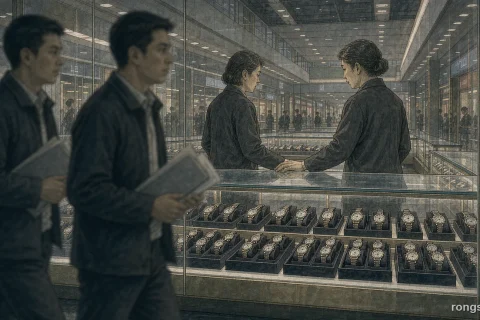
Shanghai in 1920 offered more ways for a clever man to make money, and more ways for a gambler to lose everything, than any other city in China. There were racecourses and lottery tickets inside the concessions, motor cars that had only recently arrived, and a film industry that was just beginning. The city supplied both the ambition and the means to be destroyed by it.
Two. A gambler
To understand the case, start with the man who caused it.
Yan Ruisheng was born in Shanghai in 1895, with family roots in Tangyin, Henan. He attended Aurora University, one of the best schools in the city, where he studied foreign languages and is said to have learned both English and French. He did not graduate. He was a gambler, and he gambled at school: drinking in restaurants, visiting brothels, and shutting himself in the dormitory with a few classmates to throw dice when classes were over. His dice were cut from dried tofu, so that they made no sound and could be eaten afterwards to destroy the evidence. Shortly before graduation the university expelled him.
Afterwards he studied at a communications school in Beijing and worked for the Huabei Bank, for the Liangji company, for the tramways of the French Concession, and as a comprador for foreign firms. His income was not small. All of it went to the tables.
Before the Dragon Boat Festival of 1920 he lost his job.
That year he did something that would later cost him his life. He borrowed a diamond ring from a woman he was keeping company with, a courtesan in Jiuan Lane known as Tihongguan, telling her he was short of cash and would return it in a few days. He pawned the ring for six hundred silver dollars, went straight to the racecourse at Jiangwan, and put the whole sum on the horses.
When the race was over, the six hundred dollars were gone.
Three. The Prime Minister of the Flower Kingdom
The woman he had marked out was called Wang Lianying.
Her father had been a bannerman from Hangzhou and died when she was small, and her mother remarried into a family named Wang. In 1916 she left a girls school and began working in Shanghai as a courtesan. In December 1917 the New World entertainment hall ran the first of its public beauty contests, and the poll elected one Grand President of the Flower Kingdom, two Vice-Presidents, and one Prime Minister. Wang Lianying received eighteen thousand votes, placed fourth, and became the Prime Minister.
The newspapers recorded the event. She went up onto the stage in men’s clothes, a pale grey gown and trousers under a gold waistcoat, and sang an aria from The Crossing of Xiaoyao Ford in the great hall, to a full house.
Her scale of living changed after that. According to the press of the day she wanted nothing but luxury in her clothes and ornaments, and wore a large diamond on her finger that glittered in the light. Domestic silks and satins she regarded as rags. She wore imported cloth and South African diamonds, and fixed on two new-style houses in Xiaohuayuan and moved in.
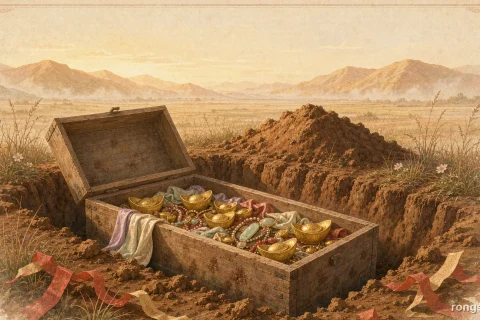
On the day of the killing she was wearing a pair of diamond-set bracelets, two diamond rings, a large diamond brooch, and a gold watch.
What a woman dressed like that, walking out in public, might attract was not difficult to guess.
Four. The car and the wheat field
Yan Ruisheng planned it.
The day before, on June 8, he spent the afternoon at Wang Lianying’s rooms playing mahjong with a group of people, and arranged to meet again the next day elsewhere for cards. That evening he went to borrow a private car. In Shanghai in 1920 a motor car was still a rarity and a private one more so. The car he obtained carried licence plate 1240.
On June 9 he began by buying a bottle of anaesthetic at a pharmacy, chloroform, sold under the name keluofang. He then went to a tea shop in Zhabei to find an old acquaintance, Wu Chunfang, and Wu brought in a shop assistant named Fang Rishan. Both agreed to help, and got hold of rope.
That evening Wang Lianying came out to play cards, wearing the bracelets, the two rings, the brooch and the watch. Yan Ruisheng told her that the other guests had not arrived yet, and suggested they take a drive first.
The four of them got into the car.
It went west along Bubbling Well Road, out past Jessfield Road and Beixinjing, and by the time it reached the wheat fields near Hongqiao it was fully dark. The three men said they needed to check the lamps, stepped out, and took the chloroform from the boot. Wu Chunfang pressed a cloth soaked in it over Wang Lianying’s mouth and nose. She struggled, and asked him, in substance, brother, if you want money I will give you money, do not take my life.
A farmer was passing. Yan Ruisheng walked over and offered to take him for a drive, and drew him away.
Then the three men strangled her, stripped the jewellery from her body, and left her deep in the wheat. They had meant to bury her, but it was late, and in the end they simply abandoned her there.
How much they actually took is not agreed. By one account the three men stripped a quantity of jewellery and precious stones from the body. By another, what reached Yan Ruisheng was a single diamond ring. The two versions are set side by side here for that reason. What is certain is that he went on the run with almost nothing, and that when he was searched the ring was in his mouth.
Five. 1240
The body lay in the field for six days before the farmer found it on June 15.
What broke the case was a lead nobody would have predicted: a licence plate number.
There were far fewer motor cars in Shanghai then, and very few Chinese owned one privately. The detectives of the police station took the number 1240 and looked up its owner. They reached him quickly. The car belonged to Zhu Zizhao, the fifth son of Zhu Baosan, one of the most prominent businessmen in the city.
Zhu Zizhao admitted that the car was his family’s. But on the evening Wang Lianying disappeared, he said, it had been lent out.
The man who borrowed it was named Yan Ruisheng.
From the complaint to the identification of a suspect took one licence plate. There were no witnesses and no confession. There was a car parked on a road, and a plate of metal on its tail.
Six. Where he went
Yan Ruisheng stayed in Shanghai for a while, until the Zhu family came looking for him. The Wang household had lost one of its own, and the Zhu family, anxious not to be dragged into it, was in a hurry to clear its name.
The group walked and talked together, and when they passed the door of an office on Nanjing Road, Yan Ruisheng said he had some business inside. He did not come out.
He went first to his father-in-law’s house in Qingpu, then further afield. The accounts put him in Songjiang, in Haizhou, and in Qingdao in Shandong. At one point he tried to take refuge in the church at Sheshan and was turned away by the priests.
The wanted notices travelled a long way. In July 1920, by the reckoning of one account in August, Yan Ruisheng was recognised at a railway station near Tongshan in Xuzhou, arrested, and brought back to Shanghai. The papers reported afterwards that he had been holding Wang Lianying’s ring, worth a thousand yuan, in his mouth when they took him.
Seven. The trial
The case was heard in two places.
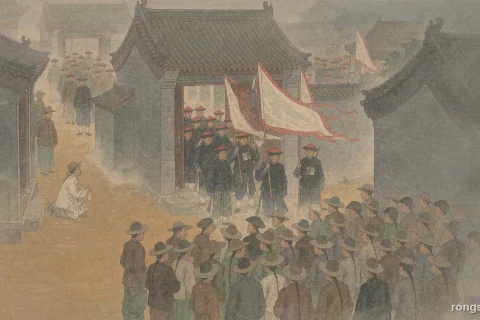
First in the Mixed Court of the French Concession. The Mixed Court was a peculiar institution of the treaty ports: nominally a Chinese tribunal, but in cases touching foreign interests a foreign consul sent an assessor to sit in, and the judgments were constrained accordingly. That court sentenced him to death. He was then extradited into Chinese jurisdiction and tried by the military court of the Songhu garrison commander, under the Beiyang government, which again sentenced him to death.
On November 23, 1920, Yan Ruisheng and Wu Chunfang were taken to Longhua and shot, by one account on the drill ground by the Western Battery near Longhua Temple. A very large crowd came out to watch. The papers put it at five thousand, others at more than ten thousand, many of them from the countryside and the concessions, and not a few of them women from the courtesan houses.
Fang Rishan, the third man, escaped and was never heard of again.
The Shenbao recorded one detail. In the crowd was a young woman of about eighteen or nineteen, who after the execution followed in a car to a bridge near Longhua and wept and could not stop. People said she was Tihongguan, the woman who had lent him the ring. Whether it was really her, the newspaper said, it could not establish.
Eight. After the case
The Yan Ruisheng case was the most sensational crime in Shanghai in the republican period. What it left behind, more than anything, was a pile of publications and a night at the theatre.
On July 2, 1920, the Shenbao carried an advertisement announcing a forthcoming book, The Tragic History of Lianying. There followed his own account, her story, and a volume sold as a sentimental novel called Shooting Yan Ruisheng. They appeared on the pavement bookstalls one after another.
The stage moved faster. In November 1920 the Great World and the Xiaowutai put up a Peking opera and a spoken drama on the case, and the Great Stage followed with its own version of the murder of Lianying. On New Year’s Day 1921 a fourth theatre opened a Peking opera called Shooting Yan Ruisheng. For a while four or five theatres in the city were performing the same killing at the same time.
Then came the film. In 1921 a group of young film enthusiasts worked with the Commercial Press’s motion picture department to make the case into a feature, and the result was Yan Ruisheng, the first full-length narrative film produced in China. The man who financed it volunteered to play the killer, partly because he looked like him and partly because he had once worked with him and could imitate his manner. The production paid a high fee to a former courtesan to play Wang Lianying.
At seven in the evening on July 1, 1921, the ten-reel picture opened at the Olympic Theatre in the French Concession. The first day took thirteen hundred silver dollars. It ran to full houses for seven days, with Chinese and foreign audiences in the city competing for seats; two shows a night were not enough, and added matinees also sold out. According to a film annual of 1927, it cleared four thousand dollars in its first week. It was re-released steadily from 1921, toured the country, ran until about 1924, and was finally banned by the authorities on the grounds that it was harmful to society.
The case has held its place for a century. In 2014 the director Jiang Wen took two of its elements, the beauty contest and the murder of the winner, and made them into a film of his own. He said in interviews that the story was adapted from the Yan Ruisheng case that had convulsed Shanghai, though the whole of it was rewoven into something stranger and more elaborate.
Two bridges are worth putting down here for a reader who knows the Western history of this kind of crime.
The first is legal. The Mixed Court that first sentenced Yan Ruisheng is a version of something the English-speaking world knows well from the treaty ports: extraterritoriality, under which foreign consuls sat in on Chinese proceedings and Chinese judgments could be constrained by foreign powers. He had to be extradited out of that system and into Chinese jurisdiction before he could be shot.
The second is cultural, and it is the more interesting one. The reason this Chinese criminal case is remembered at all, outside the historians, is that it became entertainment almost immediately and has never quite stopped. A killing that happened in June, a trial in the autumn, an execution in November, and by the following summer it was a feature film. That is the same appetite that produced the murder ballads and the penny dreadfuls of Victorian England, or the true crime industry of the present day, and it arrived in China in the same decade that the country acquired a film industry at all. It is also the reason the case survives as Chinese true crime rather than as a footnote in legal history.
The case that began in a wheat field ended as a first in the history of Chinese cinema.
From the killing on June 9 to the execution on November 23 is a little over five months. In that time a murder in a wheat field completed the whole journey, from newspaper report to street pamphlet, from stage to screen.
On the morning the body was claimed, the adoptive parents of Wang Lianying opened the coffin and wept. That was June 17, 1920. Within four days, theatres in Shanghai had begun to rehearse her name.