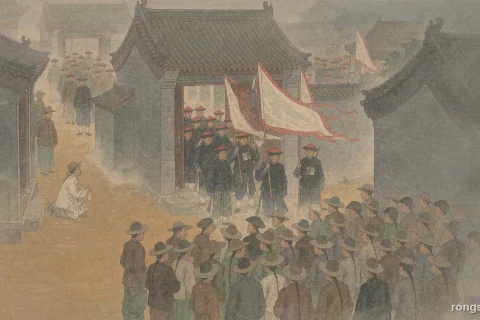
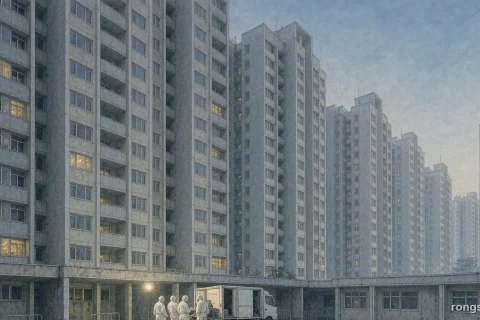
At five in the afternoon on July 10, 2015, in Fuzhou, a woman came home to the flat that the school had given her and bent down to change her shoes.
Her son, Wu Xieyu, was standing inside the door. Beside him was a dumbbell bar he had bought some days earlier. He lifted it and struck her on the head and the face, again and again, until the flat was quiet.
He was born in 1994. That summer he was not yet twenty-one. He was a student at the School of Economics at Peking University, a graduate of Fuzhou No. 1 High School, second in his city in the high school entrance examination, one of four students from his school admitted to Peking University early in 2012. His classmates called him the god of the exam hall. A teacher had once summed him up in a single line: his greatest flaw was that he appeared to have no flaws at all.
What followed is harder to explain than the killing itself. For the next six months, everyone who knew his mother believed that she was alive, and that she had gone to America.

One. A student with no faults
To make sense of this case you have to understand what kind of young man he was. Otherwise the rest of it will not add up.
His mother, Xie, taught history at a secondary school in Fuzhou. His father had been ill for as long as Wu could remember. In court Wu recalled a weekly routine of hospital visits and a daily routine of medicine, and a household held up by one woman. He said his parents had loved each other deeply, and compared them to a famous pair of lovers from a martial arts novel.
In 2010 his father died. Wu was sixteen.
His classmates saw a different person. In his first year of high school, when a Chinese class reached the famous speech about a dream, Wu stood up, explained the historical setting, and then delivered the whole thing in English, notes in hand, as if he were the man who wrote it. The text the class had been given was in Chinese.
In his final year he was admitted to Peking University. In his first year he was named an outstanding student. In his second he won a scholarship. He telephoned his mother almost every day and told her what he had studied, which teachers were interesting, what jokes his roommates had made. Friends remember that when he was unhappy he told her that too.
A close friend from high school later recalled a conversation in the summer of 2013. Wu told him that university felt oppressive, that he had no one there he could really talk to, and that he had thought about killing himself. The friend talked him down. Wu said he felt better.
Underneath that line there was another line, and nobody outside could see it. He had begun skipping classes. The forty minutes a week on the telephone with his mother were filled with small talk. Not one sentence in them was about what was going on inside him.
Two. He arranged a journey for his mother
On the night of the killing, Wu did not leave the building. He checked into a hotel nearby and came back the next morning to begin cleaning.
That went on for more than twenty days. He washed. He wiped. He cleaned the tool he had used. The prosecutor later told the court that this young man was not panicking at all. He came home every day to work on the flat, and he did not leave Fuzhou until July 31.
His mother’s body was covered in sheets and plastic film, laid on layer by layer, seventy-five layers in all, with packets of activated charcoal and a refrigerator deodoriser packed in between. That is one sentence in the review decision of the Supreme People’s Court. He also installed a camera and an alarm at the front door. In court he said he wanted to know when the flat would be discovered, so that he could then end his own life.
On July 31 he left Fuzhou.
In August a resignation letter arrived at his mother’s school. It was a photocopy, and the handwriting was hers. He had copied her hand and resigned from her job on her behalf. Her colleagues thought it slightly strange. The letter was not handwritten and not an ordinary printout either, but the font was hers. One or two of them noticed and did not follow it up.
Across those months her colleagues and neighbours received messages from her saying that she was going abroad. A colleague remembered that Xie had never shown much feeling in the office, but that at some point in that period she announced, happily, that her son was going abroad to study and would take her with him. After her husband died she had rarely smiled. The change was so unusual that they were pleased for her.
Nobody checked the flight.
Three. 1.44 million yuan and a phone that still worked
The money came in several rounds.
Wu told relatives and family friends that he had been selected for a study exchange at an American university and that his mother would go with him. He needed living expenses, tuition, and a sum in his account as proof of means. He asked them to transfer the money into his mother’s bank card.
He had never been told the password. In court he said he tried his own birthday, and it worked.
The payments ran from late July to early December of 2015. In the end he took 1.44 million yuan from relatives and family friends. That figure appears in the judgment of the first trial and in the review decision of the Supreme People’s Court.
One of the lenders was a friend of his father. He remembered a call in July or August, and a request for two hundred thousand yuan for the trip abroad. He hesitated. He talked with the boy for a long time, asking which university, which documents were needed, and the answers came back fluently. His greatest regret, he said later, was that he did not insist on speaking to Xie herself.
He did try. He called her number. It was cut off. Then a message came back, and the phrasing and the tone were exactly hers.
The person holding the phone was her son.
Four. 1380 days
On February 14, 2016, police in Fuzhou found a woman’s body in a school staff flat. Only then did her colleagues and neighbours learn that the person who was supposed to be in America had never left the country.
Investigators established that the killing had happened six months earlier, on July 10. Her son was the chief suspect. In March a reward notice went up.
From then on his name was on a wanted list. He moved between Fujian, Shanghai, Henan and Chongqing on identity cards that were not his. When he was finally arrested, officers searching his rented room in the Jiangbei district of Chongqing found twelve identity cards belonging to other people.
According to published reports, his time in Chongqing ran on two tracks. In the daytime he taught classes at a tutoring school. At night he worked in bars, and he had a nickname there. The reports differ on details. What is not in dispute is that he kept moving, and that he never left China.
On April 20, 2019, police stopped him at Chongqing Jiangbei Airport. Counting from the day he left Fuzhou, on July 31, 2015, he had been on the run for 1380 days.
Five. The same sentence from three levels of court
Once the case reached the courts, it moved more slowly than people expected.
The first trial opened at the Fuzhou Intermediate People’s Court on December 24, 2020. In the hearing Wu described his motive. Since his father’s death he had been depressed, he said, and had thought repeatedly about suicide. He read his mother’s diary and letters and concluded that she was living a tired life and wanted to die. He decided to kill her first and then himself. That afternoon he waited until she bent down to take off her shoes, and then he struck. Asked why he had not gone on to kill himself, he had little to say.
On August 26, 2021, the court delivered its verdict: intentional homicide, fraud, and the buying and selling of identity documents, punished together, with the death penalty as the overall sentence, deprivation of political rights for life, and a fine of 103,000 yuan.
Wu told his lawyer he would appeal, and he did.
The appeal turned on two questions. The defence asked for a psychiatric assessment, arguing depression and a family history, and the title of its written argument was a plea not to execute a mentally ill man. The Fujian High People’s Court gave six reasons for refusing. He had planned the killing in advance, bought the tool, chosen the method, and arranged and cleaned the scene. After arrest he gave a complete and coherent account that matched the physical evidence. In the courtroom he was lucid, his answers were responsive, and he showed no sign of disorder.
The second question was whether the victim had contributed to the offence. The defence argued that her state of mind was part of the story. The court cited neighbours, colleagues and relatives, and the diary and letters that investigators had taken from the flat. It found that mother and son had a good relationship, and that his conduct and his school record were her greatest comfort. After her husband died, the court noted, she had raised the boy alone and got him into a top university. Those materials, the court said, showed that Xie did not regard her own life as meaningless.
The Supreme People’s Court answered both points in its review decision. On the request for a lighter sentence on grounds of mental illness, it agreed with the lower courts and refused. On the suggestion that the victim had contributed to the offence, it found that the claim could not be sustained.
On May 30, 2023, the Fujian High People’s Court dismissed the appeal and upheld the original sentence. On January 31, 2024, the Fuzhou Intermediate People’s Court carried out the death sentence, acting on the order issued by the Supreme People’s Court.
There is no jury in a Chinese criminal trial. A panel of judges decides both the facts and the sentence, and a death sentence does not take effect until the Supreme People’s Court has approved it. That is why a ruling delivered in 2021 was carried out in 2024, and why the review stage turned into an argument of its own.
Six. Seventy-nine pages
After the appeal was decided, Wu began to write.
In November 2023 he wrote apology letters by hand in the Fuzhou No. 1 detention centre, addressed to his grandmother, his uncle, his aunt and the wider family. In one of them he said he would give the family every property he had inherited from his parents and keep nothing for himself. He told his lawyer that he wanted a chance to live and repay his debt.
On January 9, 2024, he sent seventy-nine pages of confession to the judge handling the review at the Supreme People’s Court. There were two subjects in it. One was remorse and apology. The other was thanks to the officers in the detention centre for what he described as their education and correction of him. He mentioned to his lawyer that he hoped his story could become a book.
Inside, he said that life in detention had been happier and more meaningful than his old life, that he had lost his freedom but gained a better state of mind, and that he had begun to understand certain things.
None of it changed the outcome. The wording of the review decision was that Wu had committed intentional homicide, fraud and the purchase and sale of identity documents in succession, that his subjective malice was deep, and that he showed no sincerity of remorse.
His lawyer said afterwards that he had played every card available to a defendant hoping to avoid execution, and that he had played them too late. She also mentioned a detail. Before the execution, the court told Wu that he could apply to see his relatives. He did not apply.
Seven. The question nobody asked
For years after the verdict, discussion of the case returned to the same thing: why. A boy with that record, in that family, after that bereavement. In the vocabulary of Chinese true crime he became a byword for something the courts could punish but not explain. There was never a question about who did it. The puzzle in this Chinese criminal case was the motive, and the motive was never settled to anyone’s satisfaction.
In court he offered an answer of his own. He said the root of everything he had done was that he always assumed he knew best. He had wanted, he said, to say to his mother that he found his own life pointless, and that if she felt the same they could go home together, to where his father was.
That sentence he never said out loud. And there the story runs into a wall. The court did not accept his inference about what his mother wanted. The Fujian High People’s Court found that the victim bore no fault in bringing the case about.
In that window between the ruling and the execution, a great deal can be said and written. Wu said and wrote a great deal. The court, in the end, read all of it the same way.
What the file does not contain is an answer to the question that sits under the whole case. A child who had made it his purpose, since the age of sixteen, not to disappoint his mother came to treat her life as something he was entitled to dispose of. Where exactly that turn happened, nobody in the courtroom asked, and nobody could have answered.