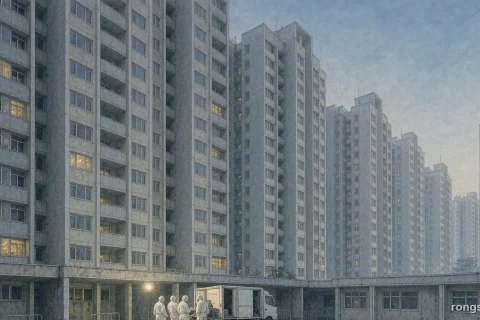
At 4:55 on the morning of 22 June 2017 the living room of an eighteenth floor apartment in Hangzhou began to burn.
The sofa caught first, and then the curtains. In the other rooms a mother and three children were still in their beds. The woman who had lit the fire was the family nanny. She walked out of the flat, took the lift down, and stood in the courtyard below.
She had not intended to kill anyone. In the account she gave the police and repeated in court, she had intended to stage a rescue. A small fire, and then she would put it out herself, and the family would be grateful to her, and in the morning she could ask to borrow money again.
The fire did not do what she had planned. Four people died.

One. The nanny
Hangzhou, in Zhejiang province on the eastern coast, is one of the wealthiest cities in China, and its wealthiest households employ live-in domestic workers. The Chinese word is bao mu, which means something between nanny, housekeeper and nurse. They sleep in the flat, they cook, they clean, and in families with small children they are often the adult who is present all day.
Mo Huanjing, the woman in this story, was thirty four years old. She came from Dongguan in Guangdong, and she arrived in that household in September 2016, placed by a domestic service agency in Shanghai.
The address was a large flat on the eighteenth floor of a riverside compound in the Shangcheng district. The compound was called Blue Coin River, and it stood on the north bank of the Qiantang, the river that runs through the city to the sea. The flat was more than 180 square metres, with windows towards the water. Her employer was Lin Shengbin, who ran a clothing business, and his wife Zhu Xiaozhen, who stayed at home with their three children, two boys and a girl. The youngest boy was four.
For a household like that, part of the point of a live-in worker is that she becomes almost invisible, and part of the point is that she is trusted completely. Zhu Xiaozhen told a neighbour that she was satisfied with her nanny, and that she had even raised her pay.
Her wage was six thousand five hundred yuan a month. For a live-in worker in Hangzhou in 2016, that was a good wage, and the family liked her. Court papers record that the couple had lent her money. They had no idea what she was doing with it.
Because before she came to that flat, she had already been dismissed three times.
In July 2015 she worked as a nanny for a family in Shaoxing, and stole two bottles of Moutai, the expensive sorghum liquor that Chinese households keep for guests and gifts. Between November and December of the same year she worked for a family in Pudong in Shanghai, repeatedly stole rings and necklaces and pawned them, then redeemed and returned them before anyone noticed. In February 2016, in another Shanghai household, she stole six thousand five hundred yuan in cash from the other nanny who shared the flat.
Each time she was found out she returned the goods or repaid the money, and each time she was dismissed. None of it stopped her from being hired again. By the time she reached the flat on the eighteenth floor she was already deep in debt.
Two. The gambling
The debts came from cards and screens.
According to the later reporting of The Paper, a mainland news outlet, it began in her home village in Guangdong with mahjong, moved on to the local numbers game known as liuhecai, and then went online. A phone was enough. When online betting stopped being enough for her she travelled to Macau, the gambling centre on the coast south of Guangdong, where mainland residents go to play.
She borrowed at an annual interest rate of seventy two per cent, which in China is the kind of lending that arrives with men at the door. By the time of the fire she was the defendant in seven civil enforcement cases at the courthouse in Dongguan, with claims totalling more than six hundred thousand yuan. She owned nothing in her own name and could not be found, so the court froze her share of the village collective dividend, about ten thousand yuan a year, and posted the enforcement notice on its website.
Inside the flat on the eighteenth floor, the gambling came much closer to hand.
From March 2017 until 21 June of that year she took gold jewellery and watches from the household, pawned and mortgaged them, and received more than one hundred and eighty thousand yuan. By the time of the fire, goods worth a further one hundred and ninety eight thousand yuan were still held by the pawnshops and unredeemed. So that the loss would not be noticed she bought replicas online and put them back where the originals had been. Zhu Xiaozhen rarely used the pieces, and never noticed.
She also invented a reason for a loan. There was a house, she said, that she wanted to buy in her home village. Over three months the household transferred to her one hundred and fourteen thousand yuan through the mobile payment app WeChat. Every yuan of it went to the betting accounts.
The judgment traced where the money went. Between March and 22 June 2017 a China Construction Bank card in her name transferred more than eight hundred thousand yuan to an Industrial and Commercial Bank card held by a man named Yan, in amounts that ranged from a few hundred yuan to a few thousand at a time. Every card in her own name held less than ten yuan on the day of the fire. The receiving card, it turned out, had been taken from its owner in September 2016 by someone who offered to arrange a loan for him, and he said he had not used it since. The site she played on called itself the Prestige Entertainment City and was registered in her own name. When the police logged into the account using the password she gave them, the available balance in it was eighty five fen, less than one yuan.
Three. The last night
On the evening of 21 June 2017 Mo Huanjing gambled online again, and lost.
The first instance judgment sets out the arithmetic. She lost more than sixty thousand yuan that night, and one part of it had been raised only hours earlier: a Jaeger-LeCoultre watch taken from the household that evening and pawned for thirty seven thousand five hundred yuan. When the police later examined it, every bank card in her name held less than ten yuan.
She still had the household jewellery in pawn, and no way to redeem it. The story about the house in her village had already been used once. To ask for money again she needed a new reason.
The reason she chose was fire.
The court found that she decided to set a fire in the flat and then put it out, so that Zhu Xiaozhen would be grateful and would lend her money again.
Between two and four in the morning she lay in the flat with her phone. The forensic examination of that phone produced a list of searches that later formed part of the evidence in the case. At 2:11 she searched whether household insurance pays out for fire. At 2:35, how the cause of a fire is investigated. At 3:32, whether arson leads to prison. At 3:57, whether fire burns slowly. At 3:59, how to make a fire burn more slowly. At 4:08, whether it is easy to find the point where a fire started.
At 4:55 she took a lighter and set fire to a book on the coffee table in the living room.
The book caught the sofa. The sofa caught the curtains and the padded wall panels behind them. The living room sat in the middle of the flat, so the fire started in the middle and the smoke went first into the corridor and the bedrooms. The judgment says simply that the fire spread rapidly.
She went into the children’s room and told them to get out. She did not wake Zhu Xiaozhen. Then she left by the door, took the lift down, and went out into the courtyard.
Four. Below, and above
The first person to hear anything was a neighbour. At about 4:55 a resident of the compound was woken by noise from the floor above, and a moment later someone heard a woman on the phone saying that her flat, number 1802, was on fire.
The fire brigade received the call at 4:56. The first engines arrived at 5:04. The fire was on the eighteenth floor, and the lifts had shut down, so the firefighters carried hose and equipment up the stairs. When they reached the door of the flat, it was locked.
They forced it at 5:07. Inside, Zhu Xiaozhen and the three children were found without vital signs. The forensic assessment gave the cause as carbon monoxide poisoning. Their ages were thirty four, ten, seven and four. The fire damaged the interior decoration of the flat, part of its structure, and the curtain walls of the two neighbouring flats. The assessed loss came to more than 2.57 million yuan.
Mo Huanjing made her emergency call only after she had reached the ground floor. She was taken into custody in the courtyard.
The locked door became the centre of a second case. In May 2018 Lin Shengbin sued nine parties, including the property management company and the developer, arguing that the maintenance of the fire systems, the emergency response and the management of the compound had all been deficient. In March 2019 he withdrew the claims against six of them and settled with the remaining two, and the civil side of the matter came to an end.
Whether the door had been locked from the inside by the nanny was fought over in the criminal court. The lawyer for the victims argued that after setting the fire she not only failed to help but closed the door, leaving the family trapped. Mo Huanjing told the court that she had only meant a small fire and would have put it out herself. She said she believed the book had not caught, and that she had dropped it on the sofa while she went to look for newspaper, since newspaper burns more easily. She said she had not run away.
Five. Two separate questions
The Hangzhou Intermediate People’s Court delivered its first instance judgment on 9 February 2018. In a Chinese criminal case of this kind the trial court establishes both the facts and the sentence, and there is no jury to persuade.
The first question was what she had done. The court found that she had deliberately set a fire in a residential building, endangering public safety, and that this constituted the crime of arson. It found that she had stolen property from her employers for the purpose of unlawful possession, in a large amount, and that this constituted theft. For the arson she was sentenced to death with deprivation of political rights for life. For the theft she was sentenced to five years and a fine of ten thousand yuan. The two punishments were combined, and the sentence to be carried out was death.
The second question was whether she should be spared.
In Chinese criminal law a defendant who truthfully confesses after arrest may receive a lighter punishment. Her defence argued that she had no intention of harming anyone, that she did act to help after the fire started, and that the building systems and the slow rescue were intervening causes that shared responsibility for the deaths. On the theft count the appeal court accepted that her confession of thefts the police had not yet discovered amounted to voluntary surrender, and that this could be treated leniently.
On the arson count, the courts answered the intention argument directly. Whether she wanted to kill anyone, they held, is one question. What she did after the fire was lit is another. The judgment found that after lighting the fire she did not warn Zhu Xiaozhen in time, did not call for help, and took no effective measures to rescue anyone.
The Zhejiang High People’s Court heard the appeal on 17 May 2018 and dismissed it on 4 June, upholding the death sentence and sending the case up for review.
That review is the part of the process that surprises readers outside China, so it is worth setting out. Since 2007, every death sentence with immediate execution in China must be reviewed and approved by the Supreme People’s Court in Beijing. No provincial court can carry out such a sentence on its own authority. In the United States a capital sentence typically travels through a state appellate court and then through years of federal habeas review, and the time between sentence and execution is usually measured in decades. In China the review is concentrated in one court and is normally finished within months, which is why the sentence in this case was handed down in February and carried out in September of the same year.
Executions in China are not public, and the courts announce them afterwards. The Supreme People’s Court approved the sentence, and on the morning of 21 September 2018 the Hangzhou Intermediate People’s Court carried it out.
Before the execution, the court notified her close relatives that they could come to see her. They stated clearly that they would not.
Six. The arithmetic she had done
The most uncomfortable thing about this Chinese true crime case is not the fire. It is that she did the sums.
She worked out how the fire would catch, how she would put it out, how she would be seen to be the one who ran towards it. She worked out how grateful her employer would be, and how easy it would then be to ask for money. She even checked, in advance, whether arson would put her in prison, and whether investigators could tell where a fire had started. What worried her was being found out. It was not the fire itself.
The one thing she never worked out was that once the book caught, the fire stopped being hers to control.
From 4:55, when she lit it, to 5:07, when the firefighters forced the door, twelve minutes passed. In those twelve minutes she rode the lift down eighteen floors, stood in the courtyard, and made a phone call to report a fire. In the half hour before that she had walked between the living room and the bedrooms with her phone in her hand, and left behind a trail of more than twenty searches, a record of a person who had not yet decided and was already preparing.
A mother and three children lived in that flat. The youngest of them was four years old.