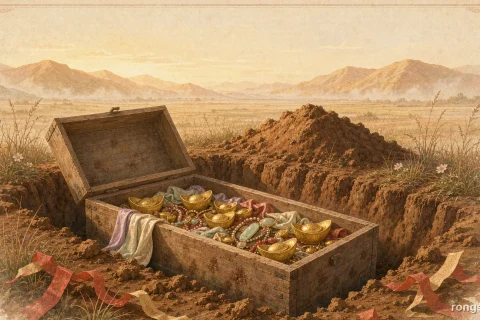
After the fire, they carried a blackened body out of the house. The wife said it had been an accident, and that her husband had not got out in time.
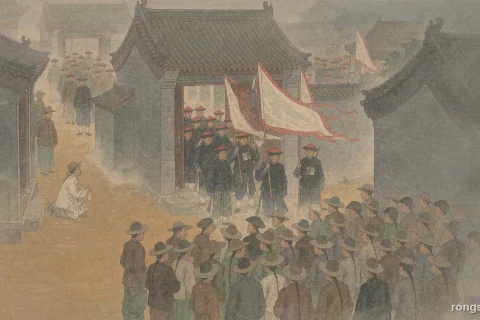
Her husband’s family did not believe her. They brought the case against her at the county office.
The case took place in the third century, in the kingdom of Wu, in a county called Juzhang on the coast of what is now Zhejiang province. The story is preserved in the Record of Wu by Zhang Bo, written in the Western Jin. A Song encyclopaedia of 983 quoted it. The case collection of the Five Dynasties period took it up, and so did the Southern Song collection of doubtful cases, which filed it under a chapter on exposing deceit.
The original text is a few dozen characters long. What it records is a controlled experiment carried out in an open courtroom.
The man who ran the experiment was the county magistrate, Zhang Ju.
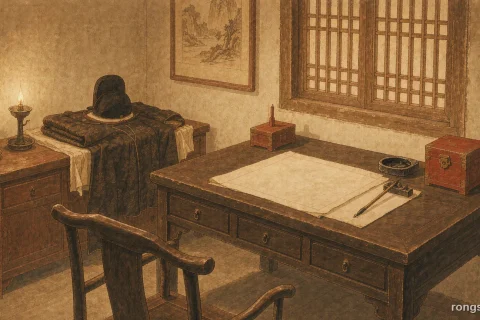
In that period a county magistrate was the entire justice system in miniature. He received the complaints, investigated, interrogated, decided, and saw to the punishment. There was no separate investigator, no prosecutor, no defence counsel and no jury. Whether a case came out right depended very largely on whether one man was clever.
What Zhang Ju did in this case was unusual for his time. He did not go looking for a confession. He went looking for evidence.
One. The house that burned
The part of the story that everyone agrees on is short.
A house in the county caught fire, and the husband died inside it. The wife said publicly that the fire had been an accident and that he had been burned to death. His family suspected otherwise. They accused her of killing her husband first and setting the house alight afterwards, and they took the accusation to the authorities.
In front of the magistrate, she denied everything.
At that point the case had reached the wall that most cases reach. There were no witnesses. A house that has burned yields very little. The neighbours had not seen the moment of the killing. Whatever the wife said was as good as anything else.
There was a further difficulty, and it was a technical one. In a burned building, it is often impossible to tell from the outside whether the dead person was alive while the fire burned, or was already dead when the flames reached the body. Charred remains are distorted and blackened, and the surface gives up almost nothing.
In other words, before the case could be decided at all, somebody had to answer a question of fact: how did this man die?
In the third century that question had no settled procedure behind it. There was no national rule for examining a body, and no trained examiner to call. The magistrate hearing the case had almost nothing to work with: one charred corpse, one suspect who would not speak, and a quantity of neighbourhood rumour. In the centuries before him, officials facing a hard case without corroboration had two customary ways out. They could apply torture until a confession appeared, and the file could then be closed. Or they could leave the matter unresolved and let it rot in the archive. Neither route required any skill. One required only power, and the other only patience.
Zhang Ju took a third route. He manufactured the evidence himself.
The records do not say why Zhang Ju suspected that the husband had been killed first and burned afterwards. They say only what he did next.
Two. Two pigs
This is the passage, as the case collection of the Five Dynasties records it.
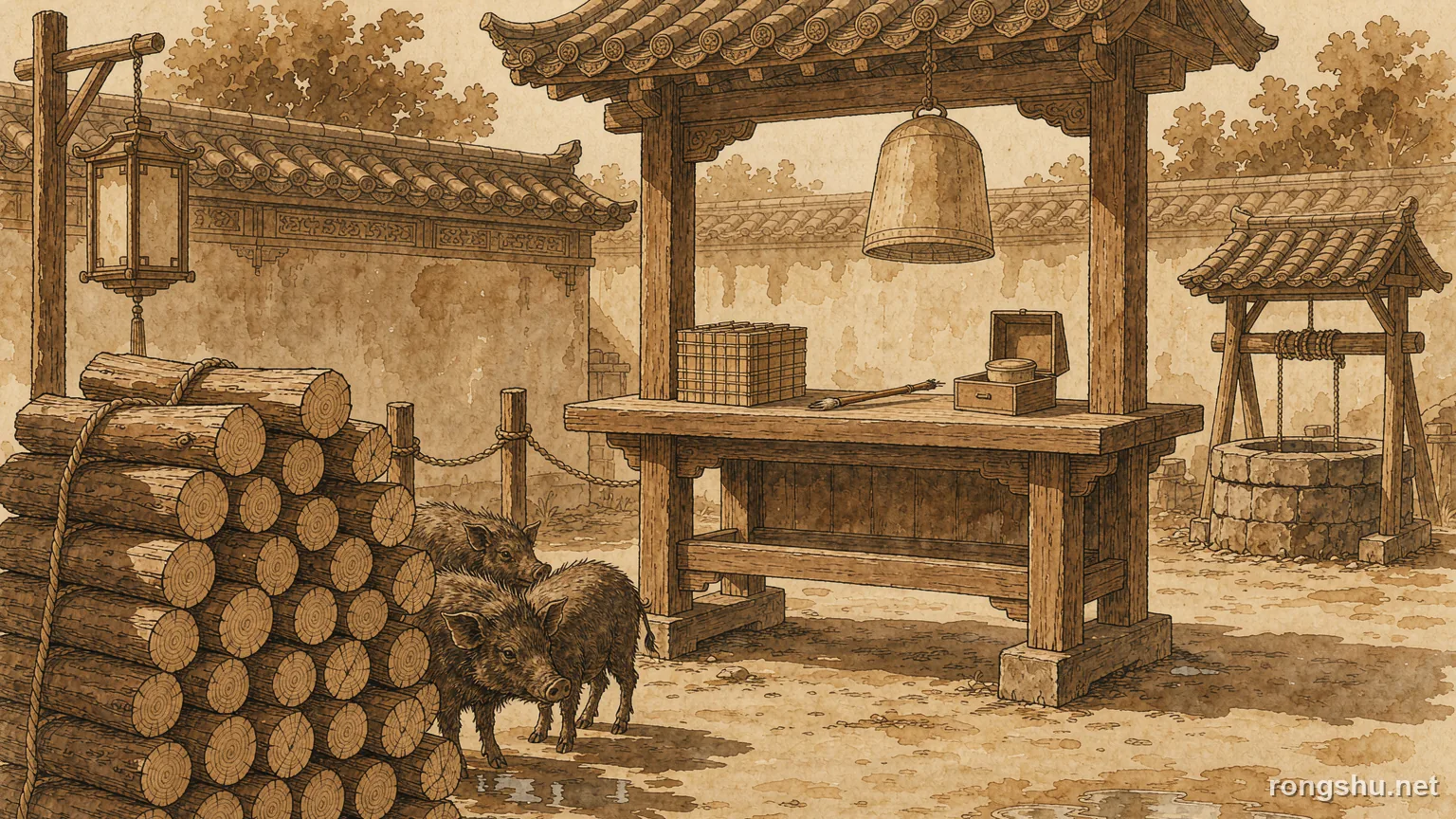
Zhang Ju took two pigs. One he had killed. The other he left alive. He piled up firewood and burned both of them on it. When the fire was out, he had the mouths of the two animals pried open, in front of witnesses. Inside the mouth of the pig that had been killed there was no ash. Inside the mouth of the pig that had been burned alive there was ash.
The reason is simple. A living animal in a fire struggles, gasps and opens its mouth to breathe, and smoke and ash go in with the air and stick to the soft tissue of the mouth and throat. An animal already dead does not breathe at all. Its mouth stays closed, and nothing gets in.
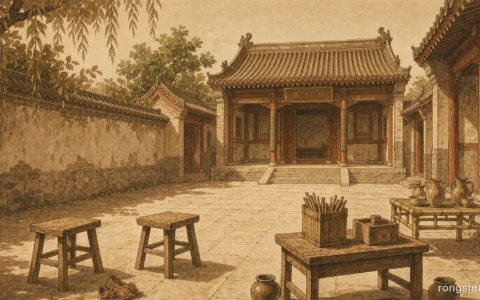
The demonstration was staged in front of a crowd. The firewood was stacked in the courtyard and the two animals were put on it together. One struggled in the flames, gasping and crying out; the other lay still. When the fire had burned down, Zhang Ju had the two mouths opened one after another, in full view of the onlookers, who looked first at the dead animal and then at the living one. One mouth was clean. The other was lined with ash.
Nobody in the third century described this in the language of physiology. But the doctors of the Han dynasty had already settled on the plain fact that a person is dead when the pulse and the breath have stopped, and that was all Zhang Ju needed.
With a working rule in hand, he went back to the body. He had the jaw of the dead man opened and looked inside the mouth. It was clean. There was no ash.
So the answer came out the other way round. The husband had been dead before the fire reached him.
The wife confessed on the spot.
Three. Why the pigs came first
The important move in this case is not the examination of the mouth. It is the order of operations.
The idea that a living victim breathes in ash, and a dead one does not, is a hypothesis. You cannot convict a person on a hypothesis. You have to show that the rule holds, and then apply it. Zhang Ju brought two pigs into a courtyard and demonstrated the rule in front of an audience. One animal served as a control and one as the sample. Conditions were as close to identical as he could make them. A single variable was changed, which was whether the creature was alive or dead when the fire reached it.
This is what would later be called a controlled experiment. In a period with no microscope, no chemical testing and no way of examining tissue, a county magistrate who thought of using live animals to reproduce the conditions of the crime was doing something rare.
And he did it in the right order. He did not open the dead man’s mouth first, announce a conclusion, and then go looking for support. He established the standard first and applied it afterwards. Had he done it the other way round, anyone in the room could have said that the whole demonstration was arranged to fit a verdict he had already reached.
There is one more thing worth noticing. He was working with a body that had already been badly damaged. In a burned corpse most of the usable information is gone, and only a few places retain any. He chose the mouth, because inside a burned building the mouth is one of the very few places where evidence survives.
Taken apart, the case shows three decisions, and the order of them decides everything.
The first was to seize on one plain fact about the world: a living thing in a fire breathes, and a dead thing does not. The second was to refuse to treat that fact as a verdict, and to turn it into a controlled comparison instead, with one pig killed and one left alive, the conditions matched as closely as possible, and one variable changed. The third was to put the confession last. Evidence first, admission afterwards.
That order is what settled the fate of the woman in the case.
Four. What the case became
The case was copied, reprinted and quoted for the next thousand years.
In the Five Dynasties period, a father and son named He Ning and He Meng compiled the earliest surviving anthology of difficult criminal cases in China. Their purpose was stated in the preface: to be a guide for officials, to let later readers understand by analogy. In the Southern Song, Zheng Ke took that book and enlarged it into the Guide to the Clearing of Doubts, arranging the cases by category and adding commentary. The two pigs went into the chapter on exposing deceit, as the standard example for telling death by fire from burning after death.
Then, in 1247, a judicial official named Song Ci wrote the Collected Writings on the Washing Away of Wrongs. It turned examination of the dead into a teaching discipline: what to inspect, where to look, what each finding means, and how to avoid being deceived by a false report. It is the oldest surviving systematic work of forensic medicine anywhere in the world, and it predates the comparable European treatises by several centuries. Zhang Ju and his two pigs stand near the beginning of that line.
Judged by modern forensic medicine, the method has limits. If a fire is hot enough and fast enough, a living victim may suffocate instantly, and the ash may not have time to settle in the airway. If the mouth and nose were blocked, or if the body was moved afterwards, the finding can mislead. Later examiners had to add those qualifications.
But in his own century Zhang Ju got something more fundamental right. He changed guessing into looking. And the books kept the method for a reason. The catalogue of the imperial library, describing the anthology of doubtful cases, noted that its contents were cases of wrongful charges overturned and deceit exposed, collected so that officials could reason by analogy from one instance to the next. The two pigs went into that tradition not as an anecdote but as something a later magistrate could copy.
Five. The old way and the new way
Set the case beside what came before it and the choice becomes clearer.
In the earliest Chinese legal practice, as in many ancient societies, guilt was often decided by ordeal. A suspect put a hand into boiling water, or carried a piece of hot iron. The wound was bound and examined days later. If the injury healed cleanly the person was innocent; if it festered, guilty. The verdict was handed to heaven.
Zhang Ju did the opposite. He handed the case to an action that any person in the courtyard could repeat: open the mouth and look for ash. He did not ask heaven, and he did not ask the gods. He asked a question about conditions. If she is innocent, what would a fire leave behind? If she is lying, what would a fire leave behind instead?
This is the pattern that readers of Chinese detective stories will recognise, though it took many centuries to become a genre. The phrase itself, a Chinese detective story, points most English speakers towards one name. The Dutch diplomat Robert van Gulik, who served in China and Japan in the middle of the twentieth century, wrote a long series of novels about Judge Dee, the Tang dynasty magistrate who investigates, interrogates and sentences in the same room. Van Gulik built his character on an official of the seventh century, and his books did more than anything else to give Western readers a picture of the Chinese magistrate at work. Judge Dee takes confessions, of course; the novels depend on them. But the pleasure of those books lies in watching the magistrate work out what the physical world is telling him, before anyone has to be asked a question at all.
The real Zhang Ju would have used the same courtroom that Judge Dee uses in the novels. He was the man who took the complaint, the man who questioned the widow, and the man who decided what to do about her. What he did not have was a police force, a laboratory or a manual. He had a courtyard, a pile of firewood and two animals.
Six. After seventeen hundred years
The record does not preserve the name of the wife. It does not preserve the couple’s history, or what passed between them, or what happened to the house.
What it preserves is the shape of a decision. A man was dead in a burned room. His wife told one story. His family told another. There was no witness, no weapon and no way to ask the dead man.
So the magistrate took two pigs, killed one, kept one alive, and burned them both.
Everyone watching learned, in the space of an afternoon, the rule that he was about to apply to a human being. When he opened the dead man’s mouth afterwards and found it clean, the conclusion did not depend on his authority, or on torture, or on the honesty of a witness. It rested on something the crowd had seen with its own eyes an hour earlier.
That is the reason this short passage has survived for seventeen hundred years in four separate books. It is not a story about cruelty or coincidence. It is a story about a man who refused to let a case turn on his own opinion, when he could make it turn on a fire, a pair of pigs and a demonstration that anyone present could check.
It is the earliest recorded experiment in Chinese forensic practice. All it needed was two pigs and a magistrate who thought the question of how a man died was worth answering properly.