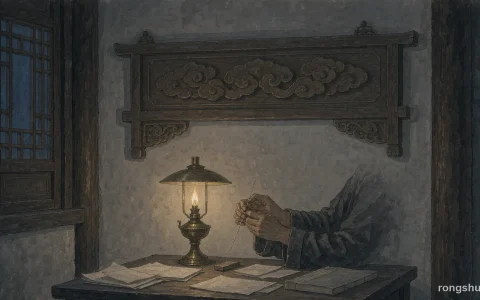
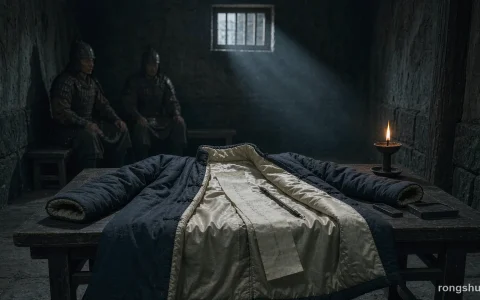
On the morning of 22 August 1870, in Nanjing, the governor-general of Liangjiang finished inspecting a parade of military candidates and walked back towards his yamen on foot. At the rear gate a man ran out of the crowd, calling that he had a grievance, and drove a dagger into his right side.
He was surrounded by more than ten bodyguards. Not one of them reached him in time.
The wounded man was Ma Xinyi, and he died the following afternoon. The assassin did not run. He was taken on the spot, and he stood there shouting a sentence that went into the case file and has been hanging over the case ever since. Feed a soldier for a thousand days, and you use him for one hour.
That sentence is the whole problem in seven words. It means an employer. It means somebody paid, and somebody waited, and somebody gave the order.
One. The three steps
Start with the ground, because everything in this case happens in the space of three or four steps.
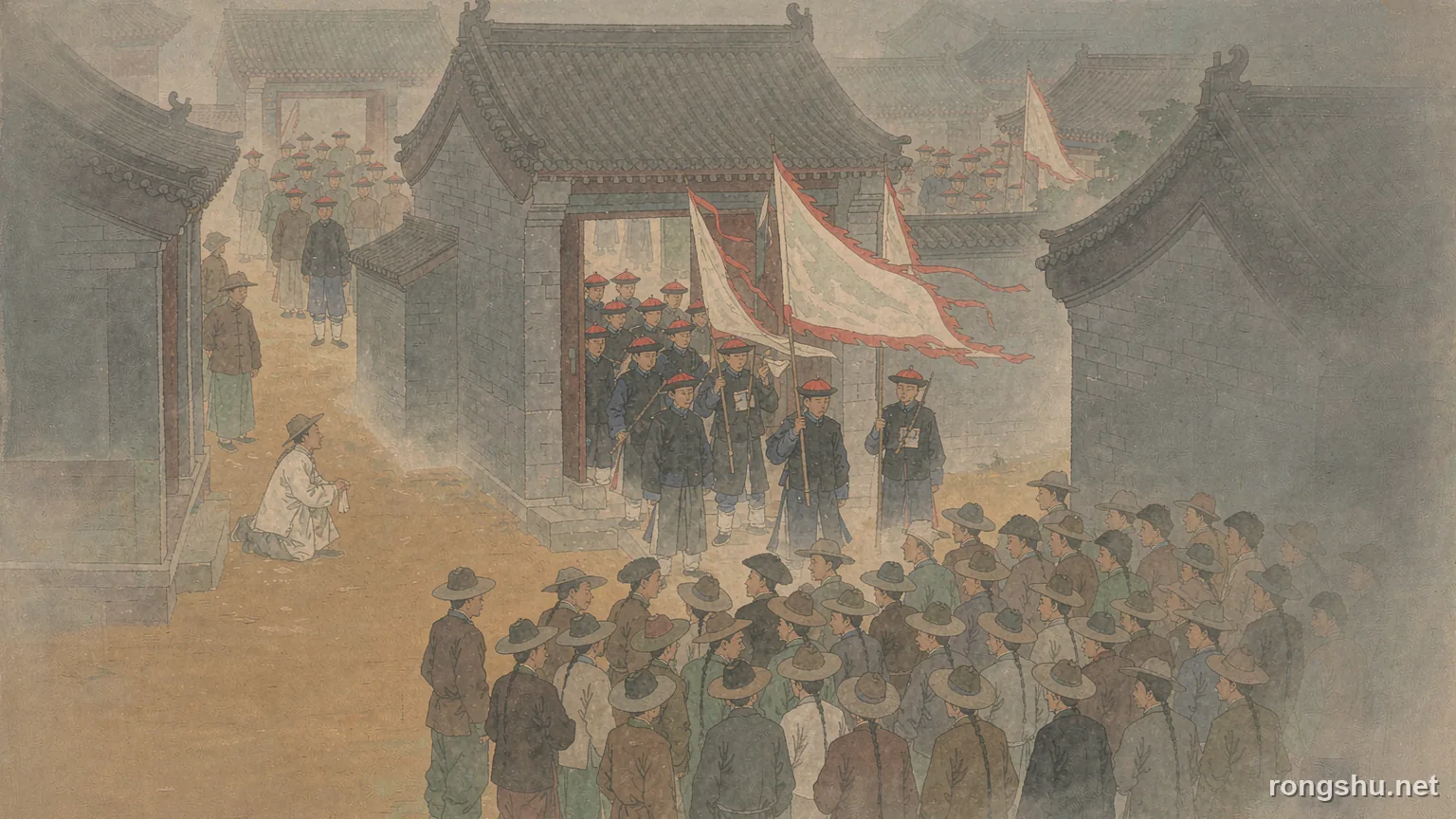
A Qing governor-general held a military examination once a month, on the twenty-fifth. In the seventh month of 1870 the examination was postponed a day by rain, and because so many candidates had turned up it was split into four groups. Ma Xinyi reviewed only the first group himself.
He finished around the middle of the morning and chose to walk back to his office instead of riding.
The procession went like this. First the banners and ceremonial men. Behind them four junior officers. Behind them two military constables to clear the way. Then Ma Xinyi. Then his household steward and five more officers.
Then the first man came out of the crowd and knelt in the road with a petition held up in both hands, shouting in the accent of Ma Xinyi’s home district in Shandong. One constable shoved him aside. The other stepped in to question him. Ma Xinyi kept walking.
That was the moment the second man came.
He shouted that he had a grievance and went straight at Ma Xinyi’s face. The space in front of the governor-general was, for perhaps two seconds, empty. The banners and the four officers had already passed through the gate. The two constables were occupied with the kneeling man. The rest of the escort was strung out along the street.
The dagger went in under the right ribs, deep enough that it could not be pulled free. An officer seized the assassin by his queue and took the knife. The steward ran up to catch Ma Xinyi. The crowd came apart.
The kneeling man was called Wang Xianzhen, from Yuncheng in Shandong, a martial licentiate who had come to Nanjing hoping that Ma Xinyi, a fellow townsman, might find him a post. The assassin was called Zhang Wenxiang, from Ruyang in Henan, forty-six years old.
Two men, one petition, one knife, and a plan that required both of them to be in exactly the right place at exactly the right second. Whether that was a coincidence is the first thing about this case that does not sit right.
Two. The man who would not talk
Ma Xinyi was carried inside. He died the next afternoon.
The general commanding the Nanjing garrison interrogated the assassin that night. Fifty-odd officials of the city, from the provincial treasurer down to county magistrates, took him in shifts afterwards. It was a technique the Qing called boiling: no beatings, just relays of questioners, no sleep, no end.
Under that, Zhang Wenxiang produced a story.
He said he had kept a pawnshop in Ningbo years earlier and joined the Taiping rebels when they came. When the rebellion collapsed he went back to Ningbo and found that a man named Wu Bingxie had taken his wife and cheated him out of his money. He had sued and got the wife back, but not the money.
In 1866 Ma Xinyi, then governor of Zhejiang, came to Ningbo to inspect the frontier. Zhang Wenxiang knelt in front of his sedan chair with a petition. Ma Xinyi thought the matter trivial and refused to hear it. Later Ma Xinyi also shut down the unlicensed pawnshop Zhang Wenxiang was running, which took away his living.
And then there were the pirates. Friends of his from the old days, a gang led by a man named Long Qiyun, had been hunted and killed by Ma Xinyi, and the survivors urged him to kill the governor and avenge them.
On that account Zhang Wenxiang spent the better part of two years following Ma Xinyi from Zhejiang to Fujian to Jiangsu, waiting for his chance.
The story does not hold. A governor who declines to hear a small lawsuit, and a governor who closes an illegal pawnshop, are not reasons to throw away your life and your children’s future. And the words he shouted in the street, the thousand days, the coming and the going, sound like a man speaking to somebody else. Six of the guards heard them.
Three. Three confessions, three motives
Later Zhang Wenxiang changed his account.
He said he had killed Ma Xinyi to save the country. Ma Xinyi, he said, was a Muslim who had secretly allied himself with a Muslim prince in the northwest and was preparing to rebel. He had learned this from a man named Xu Bian. He also said that while he was waiting for his opportunity a scholar of about thirty had twice pulled him back. The guards were too many, the scholar told him, and the distance too great; his moment had not come. The same man gave him money freely, and said that cost was no object as long as Ma Xinyi died.
This time even the interrogators did not believe him.
So a third motive appeared, and it did not fit either of the first two.
One file, one assassin, three confessions and three motives. The investigation ran nearly eight months, climbing from the garrison general to the commissioner of grain transport to the minister of punishments. The higher it climbed, the less clear it became.
It is worth saying that the paperwork exists. The interrogation record from the Grand Council, containing the testimony of thirty people, survives in the National Palace Museum in Taipei. It is the single most important official document in the case, and its problems are written into it.
Take the decoy. Wang Xianzhen was brought to the scene by the keeper of an opium den named Liu Xue, who had himself worked as a sedan-chair foreman at the governor-general’s yamen and knew its routines and Ma Xinyi’s habits. After the stabbing, Wang Xianzhen simply walked back to the opium den through the chaos. He got away cleanly. He was arrested later, along with Liu Xue, and testified that he had never met Zhang Wenxiang.
Now take the men who were supposed to solve it.
Zhang Zhiwan, the commissioner of grain transport, was ordered to Nanjing to join the hearings. He delayed his departure for weeks, and then travelled in terror, insisting on a guard of several hundred soldiers even to relieve himself. At the review stage Zeng Guofan, who had been sent back to govern Liangjiang, never once questioned the prisoner himself. When the case closed, two of the officials who had sat on it, Sun Yiyan and Yuan Baoqing, refused to sign the record. And Zheng Dunjin, the minister of punishments who had been appointed as imperial commissioner to supervise the whole thing, did not report back to the capital. He asked to be relieved on grounds of illness on the road home, and went back to Hunan. He did not die for another fourteen years.
Four. One sentence from Zeng Guofan
The first man the court sent was Zhang Zhiwan, and Zhang Zhiwan stalled until he could stall no longer. What he finally sent up to Beijing contradicted itself: in one version Zhang Wenxiang had been put up to it by the pirates; in another there had been nobody behind him at all.
The empress dowager Cixi is recorded as saying six words: is this not a very strange business of Ma Xinyi. Then she changed the appointments. At the end of 1870 Zeng Guofan was moved back from Zhili to be governor-general of Liangjiang again, and Zheng Dunjin was sent down from the Ministry of Punishments as imperial commissioner to review the case.
In February 1871 the two of them questioned Zhang Wenxiang together.
Afterwards, according to the record, Zeng Guofan, who had sat through months of hearings saying almost nothing, turned to Zheng Dunjin and told him to handle the case according to the original finding.
Zheng Dunjin understood him.
The conclusion sent to Beijing was that Zhang Wenxiang had acted on the instructions of pirates, out of private grudge, and that there was no other instigator and no accomplice.
Zhang Wenxiang was executed by slow slicing, and his heart was cut out and offered at Ma Xinyi’s coffin.
Eight months of interrogation, thirty depositions, and it all came down to the phrase: nobody sent him.
Five. The four theories
Nobody believed it, then or since.
The four accounts below all circulated from the year of the killing onwards, and none of them can be proved.
The first is the woman. Ma Xinyi, the story goes, was captured during the Taiping war and released by Zhang Wenxiang, and the two became sworn brothers along with a third man, Cao Erhu. When Ma Xinyi rose in rank he took a liking to Cao Erhu’s wife, had Cao Erhu killed, and was killed in turn by Zhang Wenxiang in revenge.
The second is the country. This is the version Zhang Wenxiang himself produced late: Ma Xinyi in league with a Muslim prince, about to turn traitor, and a patriot with a knife.
The third is the quarrel between officials. The son of Ding Richang, governor of Jiangsu, had committed a homicide, and the case fell to Ma Xinyi. Ding Richang asked him to go easy and was refused. A censor named Wang Jiabi memorialised this theory to the throne, and the men hearing the case threw it out.
The fourth is the army. This one has travelled furthest. Liangjiang was Xiang Army territory. The court had moved Zeng Guofan out and sent Ma Xinyi in precisely to cut the Xiang Army down to size, and, according to one claim that has never been documented, ordered him to find out what had happened to the Taiping treasury. He was threatening the people who had taken the south, and so he died.
Set the woman story against the record and it collapses at once. Cao Erhu does not appear anywhere in the interrogation file, and neither does any sworn brotherhood. The tale comes from Qing anecdote collections, which are literature, not case papers. That distinction matters in this case more than in most.
Zhang Wenxiang himself insisted there was nobody behind him. His words were: if there had been an instigator, I would have named him long ago; why would I take the whole weight of the crime on myself and drag my children into it.
That sounds reasonable. But go back to the file. In his three attempts on Ma Xinyi he made no arrangement for his children at all. On the second he left them two strings of cash and five pecks of rice. On the third, one and a half strings, and five pecks. He was not protecting them.
And why did the investigation stop where it stopped? The antiquarian Deng Zhicheng put it delicately: if Zeng Guofan did not want to dig, there must have been something that could not be dug up.
Six. A hundred and fifty years
Ma Xinyi was given a posthumous title and entered into the shrine of worthy officials, and Zeng Guofan took over his seat.
Yan Shizhang, a department director who assisted the imperial commissioner at the hearings, kept a diary of the whole thing. His descendants said later that in it he wrote that a great man had been behind the assassination.
The diary has never been published.
Even the assassin’s name is unstable. The official documents call him Zhang Wenxiang, with one particular character for the middle syllable. Researchers have argued that his name was originally written differently and that the character in the file was assigned to him after the killing.
Not even one character of his name is settled.
In the long list of famous Chinese criminal cases, this is the one that was never filed away. It has been the foundational mystery of Chinese true crime for a hundred and fifty years: an assassination that everybody agrees happened and nobody agrees about.
There is a Western shape to this story that most readers will recognise. A senior official is killed in public. A lone assassin is caught, tried and disposed of. The official finding is that he acted alone, and a large part of the public never accepts it, and the argument outlives everyone who was in the room.
What makes the Chinese case different is that the man with the knife was taken alive and questioned for eight months, and the interrogators still ended up writing that nobody sent him.
The films prefer the human story. In 1973 Chang Cheh made a film called The Assassin, and in 2007 Peter Chan made The Warlords; both take the blood-brother version and run with it.
The real case is smaller and colder. Three people knew the whole of it: Ma Xinyi, Zhang Wenxiang, and the man whose name was never written down.
The first two are dead. The third is still standing in the blank space in the file.