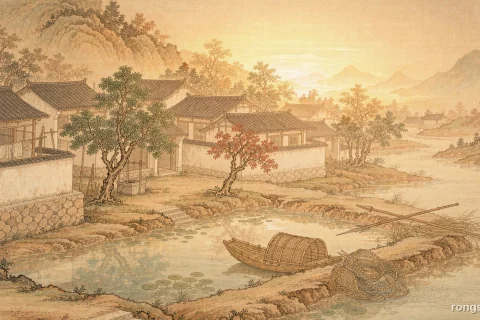
It was the season of Cold Food, and the road out of Luoyang ran north towards the Beimang hills.
Just after daybreak a funeral procession passed through the city gate. A dozen men in mourning white, hemp cloth wound round their heads, carrying a coffin northwards. They wailed loudly enough to be heard across several fields.
But a person who kept watching would have noticed two things.
The first was that although there was plenty of noise, not one of the mourners looked grieved. Their voices were loud. Their faces were dry. The second was the coffin. The men carrying it shifted the poles from shoulder to shoulder again and again, and their steps went uneven and heavy. It was far too heavy for a body.
One. A robbery nobody dared to take
The story is recorded in the Jiuen, a collection of notes and anecdotes by the Tang writer Niu Su, and was later included in the Taiping Guangji, a vast Song anthology.
The source should be labelled honestly at the start. This is a note, not a court file. It is a Tang book of things seen and heard, not the paperwork of a tribunal, and the names and the dialogue in it are not verifiable word for word. What it sets out clearly is the sequence of events and the reasoning behind them, and for more than a thousand years it has been used as a model case in Chinese writing about how crimes are solved.
The story belongs to the reign of Wu Zetian, before she took the throne. At court she was then called the Heavenly Empress, and the capital was Luoyang.
By the account in the Jiuen, her daughter Princess Taiping was one of the richest and most powerful people in the city. Of all her children Wu Zetian favoured this daughter most, giving her lands and gifts on a scale beyond the princes, and the princess kept a large household whose standard of living outdid her royal cousins. Her mother had once given her two food boxes of fine vessels and precious objects, worth a thousand yi of gold. The yi was a unit of weight, twenty liang to one yi, and a thousand of them was gold counted by the liang. She never wore any of the pieces. She put the whole gift away in her own storehouse.
It stayed there more than a year. When she finally went to look at it, she opened the storehouse and found nothing.
It had been stolen. Nobody knew who had done it, or when, and the room showed no trace at all.
The princess told her mother. Wu Zetian was furious. She summoned the chief administrator of Luoyang and gave him a deadline. In three days the thieves were to be caught. If they were not, he would answer for it with his position and possibly his life.
A word is needed here about the office. The chief administrator was the senior civil official of the prefecture, handling its day to day government, including law and order. Below him came the district police officers, and below them the runners and patrolmen who did the actual legwork. When a case was pushed down onto an office, it was pushed down again, and that is how this one travelled.
So this is the conversation that followed in Luoyang.
The chief administrator went back to his office and summoned the officers in charge of catching thieves from the two city districts. He gave them two days. If they had not caught the thieves in two days, he said plainly, they would die.
The two district officers went back and summoned the men beneath them. One day, they said, and made it just as plain. If the thieves were not taken within one day, they would die first.
And so it went down, layer by layer. In the end the ceiling fell on the lowest men in the chain, the runners and patrolmen who walked the streets and made arrests. They had less than a day, no idea where to begin, and nothing to do but tramp the streets of Luoyang.
Two. The man they met in the street
It was in the street that these men met somebody.
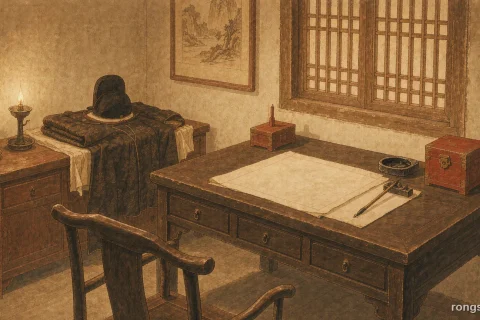
His name was Su Wuming. His post at the time was deputy governor of Huzhou. A deputy governorship was a substantial office, and he had come to Luoyang on the periodic duty of reporting his prefecture to the court and submitting himself for assessment.
One of the runners recognised him. His reputation as a man who could untangle a hard case was known among officials. A few of them put their heads together, surrounded him in the street, and virtually marched him to the district office.
At the hall, the senior patrolman reported to the district officer that the man who could catch the thieves had arrived.
Su Wuming smiled first, and said a word on behalf of the runners. Do not blame them, he said. There is a reason for this. In the places where I have held office I have a certain name for exposing what is hidden, and these men must have heard of it and brought me here to get themselves out of trouble.
That settled the room. The district officer immediately took him to the chief administrator.
The chief administrator came down the steps and took hold of his hand. Meeting you today, he said, has saved my life.
Su Wuming refused to explain himself in the office. He asked for one thing only. He would say what he had to say to the Heavenly Empress in person.
So Wu Zetian received him. Her question was direct. Can you catch the thieves.
Su Wuming answered that he could. But he asked her to grant three things. First, no deadline. Second, no pressure on the prefecture or the districts to make arrests in a hurry. Third, that every runner and patrolman in the two districts be placed under his command. Do those three things, he said, and it will not take many weeks.
Wu Zetian agreed.
And then Su Wuming did nothing at all.
Three. A month and a half
He gathered the men of the two districts and gave his first order. Do not be in a hurry. If anything moves, report it.
From that day the city of Luoyang went quiet. Officials in their brocade, shoppers at the market, life as usual. Nobody mentioned the princess and her lost treasure again.
The runners did not find the silence restful. They had been given their lives back and they knew on whose word they had been given. Every day that passed without an order was a day the treasure might be carried further away, and a day they might be called to account after all. Some of them, the story suggests, began to wonder whether the famous man who had saved them had simply put off the disaster for a few weeks.
A month and a half later, the Cold Food festival arrived.
Cold Food was a major festival of the period. For the days around it fires were put out and food was eaten cold, and families swept and tended the graves of their ancestors, going out of the city to make offerings. The Beimang hills held the densest burial ground outside Luoyang, and from morning to night that district was full of paper streamers, wailing and people on the road carrying offerings.
On that day Su Wuming called in every runner he had and sent them out.
The order was simple. In parties of ten, in groups of five, take post at the east gate and the north gate of Luoyang. If you see a dozen or so men of foreign appearance, all in mourning dress, going out of the city together towards Beimang, follow them and come back at once to report.
The runners took up their posts. Before long they had their group.
The report came back and Su Wuming went out himself. He did not move at once. He asked the man who had followed them a question. What are these foreigners doing.
The answer was this. They had gone to a new grave and laid out offerings, and made a great show of wailing. But there was no grief in the sound of it. Then they cleared the offerings away, walked once around the mound, looked at one another, and smiled.
Su Wuming heard him out and said three words. We have them.
He ordered the men arrested, and he ordered the grave opened and the coffin broken into.
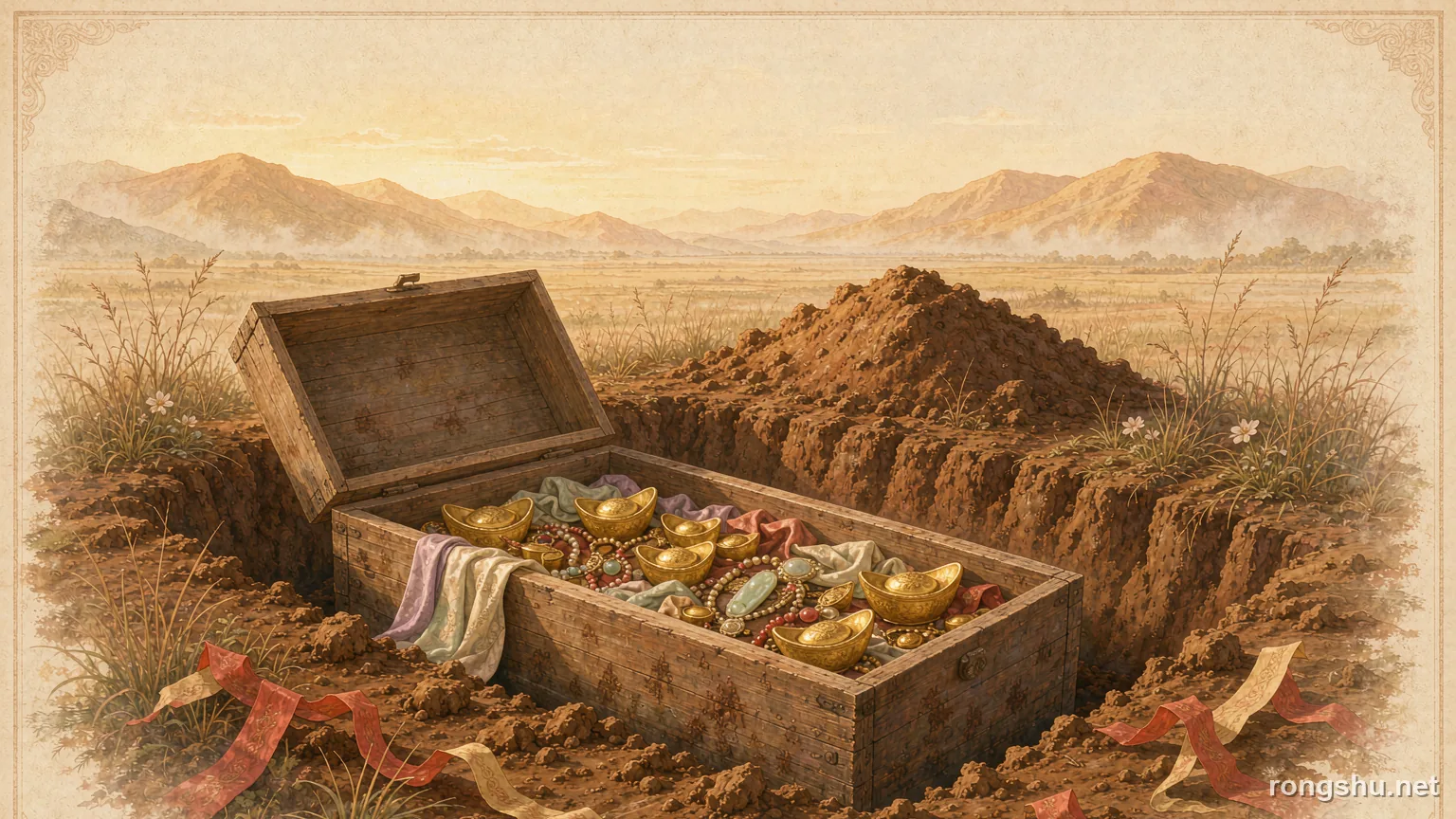
There was no body in the coffin. It was full of everything Princess Taiping had lost, not one piece missing.
Four. How he knew
The goods were recovered. Wu Zetian was delighted and also baffled, and sent for Su Wuming to ask him how on earth he had found the thieves.
His answer was flat. I have no exceptional talent, he said. I simply recognise a thief when I see one.
Then he explained.
On the day he arrived in Luoyang he had passed a funeral. He had looked at the procession once from the roadside and known that something was wrong. The mourners wailed loudly, but their faces held no grief. And the coffin they carried was strangely heavy. He understood at once that the box held not a corpse but goods. What he did not know was where the group had buried them.
Later, hearing that the princess had lost her treasure, he put the two facts together.
At Cold Food, when by custom everyone in the city goes out to tend graves, he knew the group would not be able to resist going to look at their grave. So he set men to follow them. And the two details they brought back closed it. To wail without grief means the thing buried there is not a person. To walk around the mound afterwards and smile at one another means the thing they care about is what is inside it.
But the most important question was the other one. Why had he done nothing for a month and a half.
He explained that too. If the throne had pressed the prefecture and the districts to hunt the thieves in a hurry, they would have panicked, taken the goods out of the ground and gone far away. Instead the government put out the word that it was no longer pursuing the matter. The thieves relaxed. The treasure stayed buried, waiting for somebody to come and dig it up.
What thieves fear is not a close pursuit. It is a loose one. Only when the hunt slackens do they dare to come back and look.
There is one more layer to it, and it is that he was gambling with himself. The three conditions he asked for, no deadline, no pressure, and men under his own command, put the whole weight of the matter onto his shoulders. The looser the hunt, the greater his risk. If his reading was wrong and the thieves took the goods and vanished, the first man to answer for it would be him. Doing nothing for a month and a half was not idleness. It was waiting for a day he could not do without.
Five. The reward, and what came after
Wu Zetian heard him out and said one word. Good.
She gave him gold and silk, and raised his rank by two grades.
That is where the story in the Jiuen ends.
Modern readers arrive at a case like this from two directions at once, through the long tradition of Chinese detective stories and through the modern appetite for Chinese true crime. Both habits of reading are older than they look.
It was copied afterwards into various collections of cases and stratagems, and quoted again and again. Song compilers of case books and Ming editors of the Wisdom of Feng Menglong both filed it under the wisdom of observation, meaning detection by looking and reasoning, without gods, ghosts or torture. Japanese writers of Chinese crime stories often begin with this one. In modern times somebody called him the Chinese Sherlock Holmes.
There is a small matter of timing worth mentioning there.
Arthur Conan Doyle wrote Holmes at the end of the nineteenth century. If Su Wuming was a real man, he lived in Luoyang at the end of the seventh. The two are about twelve hundred years apart.
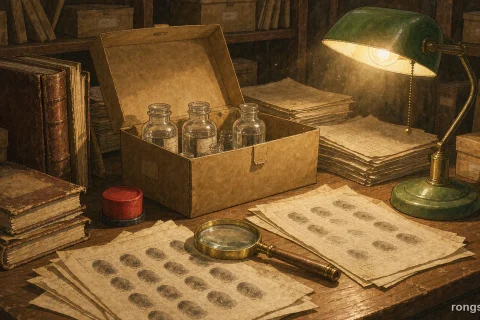
The point is not to award a prize for priority. The interesting thing is that across those twelve hundred years, Chinese writing about detection kept returning to the same idea. What an offender leaves behind is a trace, not a confession. The investigator works with eyes and mind, not with instruments of pain.
By the Southern Song, a man named Song Ci had written that whole approach down in a single book, the Collected Writings on the Washing Away of Wrongs. It dates from 1247, and it is the earliest systematic work on forensic medicine still extant anywhere in the world, three hundred years ahead of its European equivalents. Between it and Su Wuming lie five hundred years. It is the same road.
What happened to the coffin after it was opened, the book does not say.
When that patch of new earth below the Beimang hills was turned over, there was no dead man inside it. There was a pile of the things Princess Taiping had lost more than a year earlier, and very nearly paid for with other lives.