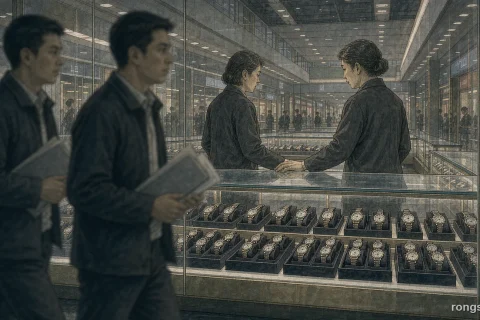
The grave had been opened, and the grave was empty.
The man who had reported the death stood at the edge of the pit and said that the family, afraid of what an examination would show, must have moved the body in the night.
The family stood nearby with nothing to say. There was no body, and therefore nothing to answer with.
One. A complaint signed at the risk of one life
The case belongs to the fifth year of the Yongzheng reign, which is 1727.
On the thirteenth day of the seventh month of that year, a man named Lan Dingyuan arrived to take up the post of magistrate of Puning county, in Guangdong. He was forty-seven, from Zhangpu in Fujian, and he had been in office less than a month when someone came to lay a complaint.
The complainant was Wang Shiyi, from neighbouring Chaoyang county. The man he accused was a Puning resident named Chen Tianwan, and the charge was poisoning.
The complaint set out the facts as the complainant told them. Wang Shiyi had a younger cousin called A Xiong. When A Xiong was a boy, his mother had remarried, into the household of Chen Tianwan, where she became a concubine. Chen Tianwan had a principal wife, Mrs Xu, who was jealous by nature, and who poisoned the boy with medicine. When he died, the paper said, his fingers were curled and his teeth and lips were blue.
Attached to the complaint was a document worth pausing over. Wang Shiyi had bound himself to the penalty for false accusation. If what he had written turned out to be a fabrication, he agreed to suffer whatever punishment would have fallen on the man he accused.
In a Qing county office, not many complainants were willing to sign such a thing. It made the document look credible.
Two. Start with the illness, then look at the woman
Custom, and the law, required that a reported death be examined.
The next morning Lan Dingyuan went out with his runners to the grave site. The earth was dug away. The tomb was empty. The body was gone.
Wang Shiyi adjusted his story immediately. Chen Tianwan, he said, must have been afraid that an examination would reveal the injury, and must have moved the body somewhere else in the night. It was an explanation that fit neatly with everything he had already said.
The Chen household stood by, frightened into silence. With no body, they had no way to answer.
Lan Dingyuan did not react in court. He went back to the beginning and worked forward.
The first question was how the boy had actually died. On inquiry, he learned that A Xiong had spent two months ill with dysentery, which is a death with a course, with witnesses, and with a doctor who can be questioned. He sent for the physician who had attended the boy and checked the account against him. It held.
The second question was who Mrs Xu was. If she had poisoned the boy, would an examination help her or hurt her? Lan Dingyuan looked at her closely. Her belly was swollen to the size of an ox, and it took three or four people to help her crouch down. It was dropsy, and she had had it for nine years. She did not look like a jealous poisoner.
The third question was where the body had gone. He examined the accused and the witnesses, more than ten of them, and went over the ground again and again. Nobody knew.
All three lines pointed the same way. The poisoning was probably invented. And the missing body had been removed on purpose.
Three. A boy of fifteen
Then Lan Dingyuan tried something else. Instead of questioning the adults, he questioned a child.
He sent for A Xiong and asked his mother, Mrs Lin, three questions.
First: on the day A Xiong died, had Wang Shiyi come to the house?
He had been invited, she said, and he had not come.
Second: and the next day?
He came, she said. He did not enter our house. He went to his elder female cousin, and then he left.
Third: did that cousin have a husband and a son?
She had a son, Mrs Lin said. His name is Liao Axi. He is fifteen or sixteen.
So Liao Axi was brought in.
Lan Dingyuan asked him: on the twenty-eighth, what did Wang Shiyi come to your house for?
He met me on the road, the boy said. He did not come into our house.
What did he say to you?
He asked me whether A Xiong had been buried yet, the boy said. I told him he had been buried. He asked where. I said behind the ridge. Then he left.
Lan Dingyuan struck the desk and called out: the man who stole the body is Wang Shiyi.
Wang Shiyi was put to the press. He confessed. He had hired a beggar, he said, and had opened the grave in the night and carried the body away.
That left the questions that mattered. Where was the body now, and which legal adviser had put him up to it? Wang Shiyi would not say. He hedged and changed the subject. Lan Dingyuan noticed something in his manner. He was not refusing to speak because he was stubborn. He was refusing because he was afraid that somebody was listening.
Four. Case closed, and a sedan chair that turned a corner
Lan Dingyuan made a decision.
In open court he sentenced Wang Shiyi to thirty strokes of the rod and announced that he would be taken back to the county town and put in the cangue for public display. The Chen household, and the neighbours who had been dragged into the case, were all released.
Several thousand people had gathered outside the office to watch. Every one of them took the case for finished. They cheered, and the courtyard knelt.
Lan Dingyuan got into his sedan chair and set off for the county town. Less than half a li along the road, he quietly called a runner named Lin Cai to the side.
His instruction was short. Take off your uniform and your cap. Go on ahead into the city, quickly, to the inn by the east gate. Ask how many days a man from Chaoyang named Wang Shiyi has been staying there, and in which room. If there is anyone in that room, tie him up and bring him to me.
Lin Cai went. In the inn he found a man, and brought him back. It was a legal adviser named Wang Jueting.
Five. Handwriting
Wang Jueting arrived in court entirely unruffled.
He said he did not know Wang Shiyi. Wang Shiyi did not look at him. The two of them were clipped and consistent, and for a moment there was no gap in the story to work with.
So Lan Dingyuan went around it. His reasoning was this. Wang Shiyi had come from Chaoyang. A complaint has to be written, copied by a professional scribe, and supported by a guarantor. A man from out of town cannot arrange all of that alone. So he sent for the scribe and the guarantor and questioned them separately. Both said the same thing: yes, this man came with him. They meant Wang Jueting.
Wang Jueting still denied it.
Lan Dingyuan gave him paper and a brush and told him to write out his statement. When it was done, he compared it with the original complaint. The hand matched stroke for stroke.
Only then did Wang Jueting confess. The whole scheme, he said, had been devised by an older legal adviser. The theft of the body, the carrying of it out of the county, the reburial outside the fort at Wushi, all of it had been done on that man’s instructions. Where the body was buried was known to that man alone. Wang Shiyi himself did not know.
The name he gave was Chen Weidu.
Six. The old legal adviser
Chen Weidu was brought in, and he was a far deeper article than Wang Jueting.
He began by protesting his innocence at length. Chen Tianwan, he said, was his junior kinsman, a member of his own clan. These two men have no conscience at all, and they wanted to destroy my kinsman with a false murder charge. Fortunately the magistrate sees as clearly as a god. Now that they have failed to destroy my kinsman, they are trying to turn the charge on me.
And then he added a line. If your honour were not a Judge Bao come back to earth, he said, my kinsman and I would die with our eyes open.
It was gracefully put. Lan Dingyuan was moved by it, and came close to letting him go. But he looked at the man once more, and Chen Weidu had a glitter in his eyes that did not belong to an innocent.
So he tested him. He said this. What a legal adviser you are. Your account is coherent and reasonable, and it is pleasant to listen to. Had you met anyone else, a hundred fine sentences would have won your release. Unluckily for you, you have met me. And since you have already decided that I am Judge Bao returned, there is no point in deceiving me any further. Tell the truth point by point, and I will be lenient.
Chen Weidu was thrown, and had nothing to say.
What actually broke the case open was Wang Jueting. He pointed at Chen Weidu in open court and said: the three of us planned this in the gate tower of the fort at Wushi. It was you who told us the story of Yang Ye and the stolen bones, and you who taught us to move the corpse out of the county. You said there were five advantages. An examination would never find an injury. Once the body was out of the jurisdiction, exposure was no longer a danger. The accused, terrified of being blamed for destroying evidence, would be convicted and the whole Chen household dragged through the courts after him. With the body outside the county, the magistrate could never close the case. And when the matter was settled privately, the money would begin. After the reburial the three of us drank to it, and you called it a plan that neither gods nor ghosts would detect, one that even Judge Bao could not see through if he came back to life.
Lan Dingyuan was still not satisfied. He tested Chen Weidu a second time.
He said: even if you had no part in the conspiracy, your movements were careless. Wang Jueting and Wang Shiyi were enemies of your kinsman. Why were you sitting and eating with them at the inn by the east gate?
Caught off balance, Chen Weidu answered: it happened once.
One meal is an accident, Lan Dingyuan said. Several days of meals together is also an accident?
There are not many eating houses in Puning, Chen Weidu said. There was nowhere else.
Then what of the nights you spent in the same lodging as those two?
Chen Weidu said he had not.
So Lan Dingyuan questioned Wang Jueting privately about where they had slept and how the bedding, the curtains and the furniture in the room had been arranged. He also sent to the house of a man named Lin Tai in the city and brought Lin Tai and his son in one at a time, and questioned them separately. The two accounts matched to the last detail: Chen Weidu and Wang Jueting had slept three nights in that house, all three in the same room.
The instigator was now certain.
Under the press, Chen Weidu gave way at last. And what he admitted went beyond this one offence, because he and Chen Tianwan had an old grievance over the sale of ancestral property. The body was buried by the stream at the foot of the fort at Wushi, three or four feet down, he said, with a tree half cut through above it as a marker.
Lan Dingyuan sent word to the magistrate of Chaoyang, and a dispatch to the garrison on the riverbank to bring troops. They went to the place he described, dug four feet, and raised the body.
Seven. The law in this case
The corpse of A Xiong had been stolen, carried across a county line, and hidden somewhere else so that a false charge would look true. With the body gone, the accused could not clear themselves. With no injury to examine, the accusation could never be disproved.
The case is recorded in Lan Dingyuan’s own collection of his judgments, written in the first person, and it belongs to the small class of Qing case files that are records of real hearings rather than stories invented by a novelist. For a reader of Chinese true crime, and for anyone who assumes that a Chinese criminal case was decided by confession alone, that makes it a useful document to have. He finished it in 1729, while he was out of office and in prison after being impeached, working from memory through the twenty-four cases he had handled in fourteen months at Puning and Chaoyang.
What it shows is a working magistrate using working magistrate methods, and they are not pretty. He used torture to get confessions. He tricked suspects. He dangled a false promise of mercy and watched the man’s face. Lan Dingyuan made no secret of it. He called such things technique, and set them down as part of the job.
The case, though, was broken not by the confession but by ordinary things. Correct the cause of death. Test the complainant’s motive. Catch the memory of a fifteen-year-old boy before it drifts. Then ask who composed the complaint. The sharpest move came last, when he closed the case in public. Had he gone on hearing it that morning, the man in the inn would have been gone by noon.
The preface, by a scholar named Kuang Minben, said that Lan Dingyuan heard cases as if by a kind of sight, and had the manner of Judge Bao himself.
For English-speaking readers, the Chinese investigating magistrate needs no introduction, though the version they know is not this one. Chinese detective stories in the West begin from Judge Dee, the character the Dutch diplomat Robert van Gulik built into a long series of novels after finding a forgotten Qing novel in wartime Chongqing. The real magistrates are harder to like and easier to believe, and they belonged to a system that in the same decades was being argued out of existence elsewhere. Lan Dingyuan was putting a man to the press in Puning in 1727, in a county office with no jury, no defence counsel and no appeal worth the name.
In the winter of 1728 Lan Dingyuan exempted fishing boats from a fee, and the men who wanted him gone used it against him. He was impeached, stripped of office and imprisoned. In fourteen months as a magistrate he had broken up rings of legal advisers and corrupt clerks, cleared a backlog of cases, and left a reputation for fairness in two counties of eastern Guangdong. The case book was the product of the cell.
The decisive moment in this case was not the slap on the desk.
It came half a li outside the office gate, when he finally called the runner over and told him to take off his uniform.