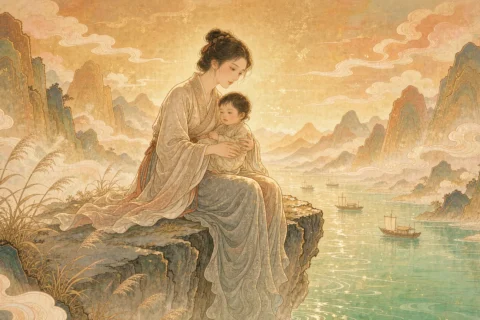
At the foot of Mount Hua, you live for me, and now that you are dead, for whom shall I keep living? If you truly pity me, then let the coffin open for me.
Those lines are a song. More than fifteen hundred years ago, a young woman stood in front of a coffin and sang them. When she finished, the coffin opened by itself.
The song is preserved in the great collection called the Book of Music Bureau Poetry, and its title is Huashan Ji. The word ji means the edge or the border of a place, so the title means the country around Mount Hua. Some say this is the Hua Shan near the town of Zhenjiang today. Others place it elsewhere. The song was first written down in the reign of the young emperor of the Liu Song dynasty, in the Southern Dynasties period. There was a tune in those days called the vexation tune, and this song was made for it.
People in the West sometimes call this story the Chinese Romeo and Juliet. Look closer and it is not the same at all. There, somebody drinks poison and somebody takes a dagger, and it is a loud and bloody disaster. Here, nobody harms anybody. There is no weapon in it anywhere. A young man looks at a young woman once, and then he dies.
Among Chinese ghost stories this is one of the oldest that is not really about a ghost at all, and that is likely the reason it has lasted.
In the south there was a young man of the district of Nanxu.
That spring he was travelling from Huashan Ji toward a place called Yunyang, and on the road he stopped at an inn to rest his feet.
In the doorway of the inn stood a young woman of about eighteen or nineteen, busy at some work.
He looked at her once.
That was all. He did not step forward to speak. He did not ask her name. In those days a man passing on the road had no business speaking to another man’s daughter.
He rested, then went on his way, and carried the thing quietly in his chest, and left.
On the way back he passed the door of the inn again. That time he did not even dare to raise his head.
But he could not remember the rest of that journey at all. What business he had in Yunyang, whom he met there, what the weather was on the way home, he could not say afterward. All he remembered was a certain doorway, and a certain figure standing within it. Some things are like that. You look at them one time, and they move in behind your ribs and will not be driven out.
When he reached home, he was not himself.
At first he could not eat or drink. His mother asked whether he was ill and he said that he was not. Then he grew thin, day by day, and could not sleep at night, and sat staring in the daytime at one direction out of the window.
A physician was called, and found nothing wrong with him. Medicine was brewed and he would not drink it.
His mother grew frightened and sat by the bed and asked him again and again. He held out as long as he could, and then gave in and told the truth. There was a woman in the doorway of an inn at Huashan, he said, and he had looked at her once, and could not let her go.
His mother was silent for a long while.
The next morning she went alone to Mount Hua.
She found the inn and saw the girl.
She told the girl everything. How her son had passed on the road, how he had looked once, how he had gone home and taken ill, and how he now had only a breath of life left.
The girl stood listening. At first she looked down. Then her eyes went red.
She went into the inner room and came out with something. It was her bixi, a small piece of cloth that a woman wore at the waist, against the body. She folded it and put it into the mother’s hand and told her to go home and slip it under her son’s mat, so that he would sleep on it. In time, she said, he would mend.
The mother thanked her and carried the cloth home. She waited until her son was asleep and put it under the mat, as the girl had said.
And it was a strange thing.
From that time on, the young man grew lighter day by day.
He could eat again. Color came back into his face, and he began to walk about. His mother was glad and thought some god had been kind to them, and did not dare to ask more.
In those days the young man himself felt something odd. He slept deeply, and in his dreams there was a faint warmth that he could not name, as if someone were keeping watch beside him. He did not know what was under his mat. He only felt that the days were becoming more like days again, and he almost began to believe that the whole trip to Mount Hua had been a thing he invented.
Then one day the weather was fine, and his mother carried the bedding out to the sun.
The young man was alone in the room, and for no reason he lifted the mat.
Under it lay a piece of cloth.
He knew it at once. It was the thing from the girl at the inn. He picked it up and held it close and looked at the stitching and breathed the last of its scent, and looked at it a long time.
Then he ate it.
When his mother came back and saw a thread on his lip, she knew that something was wrong. The young man said that he had known there was such a thing near him, and that now he had eaten it, he and she were of one body. He asked whether he might see her once.
His mother was so grieved by this that she could not answer. She wiped her face, and went to Mount Hua again.
This time the girl looked different.
She sat there and listened to the whole of it, and tears fell, and she said that he had come too late.
She had already been promised to another man. The wedding day was close at hand. It was her parents’ wish, and she had no power over it.
She said that she could not repay what his son had given her. Since she could not repay it, she said, she would repay it with her life.
The mother went home and told her son exactly what the girl had said.
The young man listened, closed his eyes, and said nothing.
A few days later, he was gone.
The day of the burial came.
Before he died he had left one request. The cart that carried the coffin should take the long way, by Mount Hua, and should pass the gate of the inn where he had seen her, just once.
His family agreed.
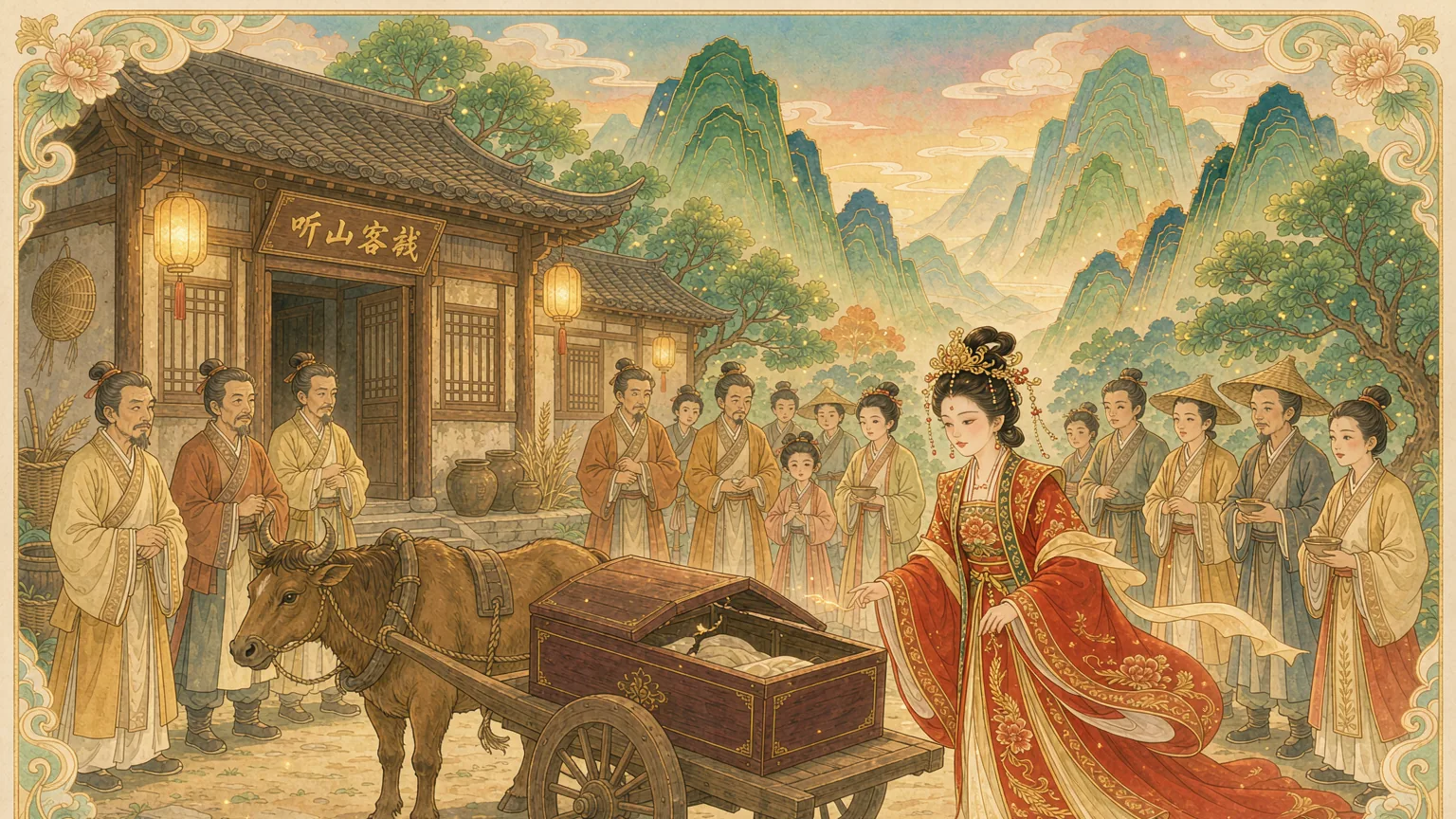
That day the cart went slowly along the road toward Mount Hua. When it reached the gate of the inn, the ox that drew it stopped and would not move.
It was a grey, sunless day, and the wind came down off the mountain in gusts. The driver first shouted, then took up the whip, and after two strokes he stopped of his own accord. The hair stood up all over the ox, and its eyes were fixed on the door of the inn, as if it saw something that no one else could see.
Upstairs, the girl heard the noise.
She opened the window and looked down. The coffin stood at her own gate. The ox that drew the cart stood as still as if it had been nailed to the ground.
She understood everything at once.
She said that they should wait a moment.
She shut the window and turned back into the room. She fetched water and washed. She combed her hair again and put on the new clothes meant for a wedding, and set in her hair the ornaments one by one, working very slowly, and very steadily.
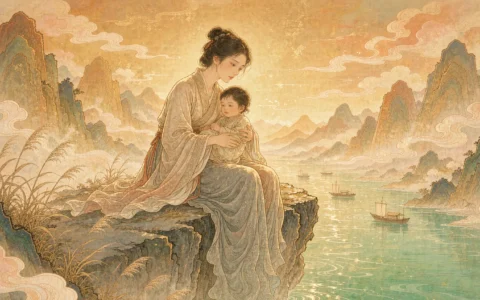
Then she came down the stairs and out the door, and walked as far as the coffin, and stood.
Everyone around her went quiet.
She stood there, looked at the coffin, and began to sing.
At the foot of Mount Hua, you live for me, and now that you are dead, for whom shall I keep living? If you truly pity me, then let the coffin open for me.
The last line fell.
The coffin gave a crack, and opened by itself.
The girl stepped in and lay down beside the young man.
The lid closed slowly, and never opened again.
The ox lowered its head then and began to move. What the cart carried was still a coffin, but there was more than one person inside it. The trees along the road rustled in the wind, and no one made another sound.
Both families watched and neither one stopped her.
What was there to stop? She had come this far, and she had made her own choice.
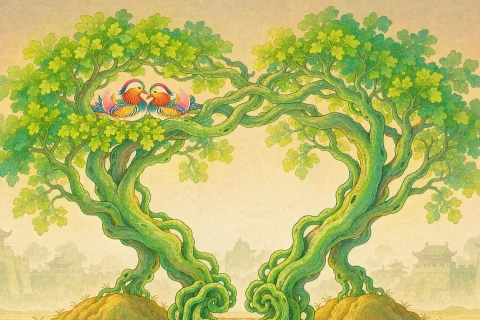
They buried the two of them together. In time people gave the grave a name. They called it the grave of the goddess.
Those lines were later gathered into the Book of Music Bureau Poetry, with the title Huashan Ji.
Some say the girl sang them herself, that day. Others do not believe it, and say that someone wrote them later, for the two of them, because such words are hard for the living to say out loud. Which version is true can no longer be sorted out.
There are twenty-five songs in the Huashan Ji set. They are all short. They are sung in a thin, plain way, the way a tune comes off the water or up from the river bank. There is only one thing that happens at the end of every one of them. The last line is sung over again.
Once, and then once more.
Like a person standing outside a door, who will not go away, and goes on knocking, and knocking.