On the evening of 6 July 2020 a young woman walked into a police station in Hangzhou with two relatives behind her. Her mother, she said, had not been seen since the morning before.
Her name was Lai Huili. She was fifty-one, she cleaned offices for a living, and she lived in a high-rise estate called Sanbao Beiyuan on the eastern side of the city. The estate keeps cameras in the lifts and at the gates. They showed her coming home at dusk on 4 July with her eleven-year-old daughter. They never showed her walking out again.
That is the shape of the whole thing. A woman walks into a tower block that houses thousands of people, and she does not come out. For nineteen days the Hangzhou police turned that disappearance into one of the most closely followed Chinese criminal cases of the decade. Yet the man who first pushed it under the noses of the entire country was the last person on earth who wanted the police to keep looking.
One. The husband on television
English-speaking readers have met this story before, in a different postcode. In 2018, in Colorado, Chris Watts stood on his lawn and told television reporters that his pregnant wife and two small daughters had vanished, and asked the public to bring them home. In 2002, in California, Scott Peterson did something similar. Both men had already killed the people they were pleading for. That is why this case travelled so far beyond China. It belongs to a small and grim family of cases in which the person asking the public for help is the person who did it.
The report on 6 July was made by Lai Huili and her first husband’s daughter. She had rung her mother at work, been told that nobody had seen her that day, and gone to the police with relatives.
Within days, Lai Huili had a second face: her husband, Xu Guoli, was on television.
He was fifty-five, from Zhuji in Zhejiang province, and he drove for a company in Hangzhou. On camera he wore a dark short-sleeved shirt and looked exhausted. He said the same sentence over and over.
When is my wife coming back.
He asked the public: what am I supposed to do about my daughter, what am I supposed to do about my own life, is she even alive. He offered a reward of one hundred thousand yuan. Neighbours pinned missing-person notices around the estate on their own initiative. A reporter asked whether he and his wife had ever fallen out. At the most it was half a year ago, he said, and it was not a matter of life and death, so there was nothing to settle. Then his voice rose and he snapped: do not call any of this unusual. There is nothing unusual going on.
At the time, the police were looking somewhere else. Sanbao Beiyuan is a resettlement estate, tower pressed against tower, people coming and going all day. The task force opened up the concrete floor of the underground car park to look underneath it. Officers crawled the lift shafts and the fire tanks by hand. They drained the ornamental river beside the estate and went through the junk piled in the stairwells. They pulled roughly six thousand hours of camera footage from the estate and the surrounding streets and watched it frame by frame. They interviewed more than fifteen thousand people.
And they found nothing.
All that time Xu Guoli came and went as usual. He gave his interviews. He cooperated. Neighbours later remembered that he joined the searches himself.
Then two very small facts surfaced.
Two. Two tons of water
The first was the water meter.
Staff at the estate confirmed that during the days around the killing, the flat where Lai Huili lived used two tons of tap water. A household of three normally gets through a few hundred litres in a day. Two tons means that somebody spent dozens of hours flushing and scrubbing.
The second fact was the video. After working through roughly six thousand hours of footage from the estate and the streets around it, the police could confirm that Lai Huili had not left the compound after coming home on the evening of 4 July.
She had not gone out. So where was she.
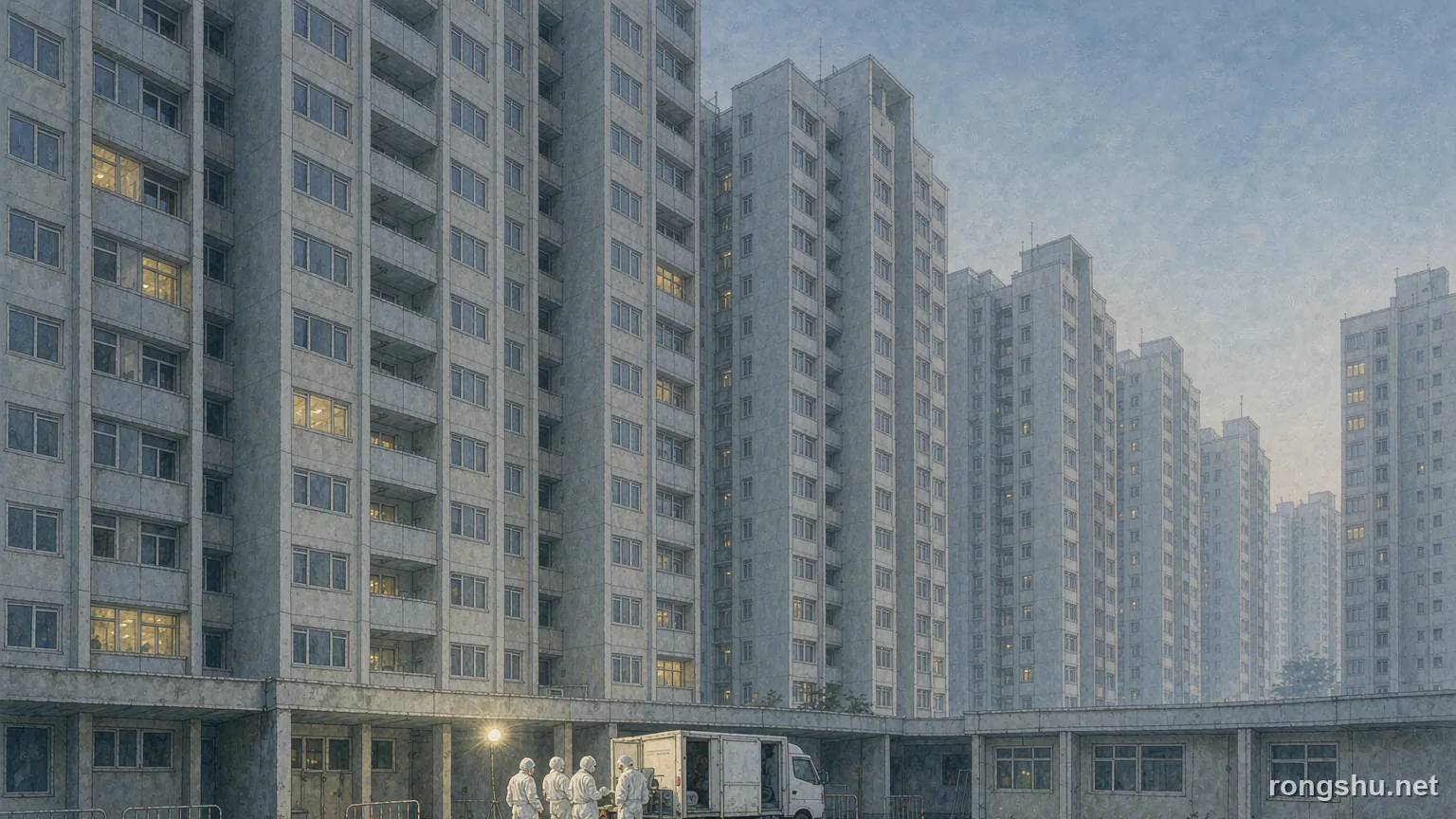
On the afternoon of 22 July the weather finally cleared and the ground was dry enough to work. The task force moved its attention to the end of the building drain, to the place every pipe in a Chinese tower block runs into: the septic tank.
At three in the afternoon the officers put on full-body protective suits and went to work. The tank was pumped out, truckload by truckload, and each load was washed and sifted. It was close to forty degrees outside. They kept at it for twenty-five hours and filled thirty-eight trucks.
Out of those thirty-eight loads the searchers recovered fifty-three pieces of suspected human tissue, and two more were taken from the bathroom of the flat. Thirty-eight of them matched the DNA of Lai Huili.
For two of those days a pumping truck stood inside the estate. Reports later noted that Xu Guoli walked past it twice, and that both times he turned his head and looked at it.
At one in the morning on 23 July the task force summoned him for questioning on suspicion of intentional homicide. By ten in the morning they had broken through his account. That evening the Hangzhou public security bureau announced that Lai Huili was dead, that her husband was the principal suspect, and that he was in custody.
On the same day the footage of his arrest was released. In it he is wearing a grey polo shirt, signing the detention order and pressing his thumb to it, before being led away in handcuffs and leg irons. Fewer than twenty days had passed since he first asked the cameras when his wife was coming back.
On 25 July the bureau held a press conference and walked reporters through its nineteen days of work: eighteen days and nights since the daughter first asked for help, six thousand hours of video, more than fifteen thousand people spoken to, thirty-eight truckloads of sewage. The deputy director closed with the sentence that fixed the case in the public mind. This was a premeditated killing.
Three. The request for a psychiatric test
The first-instance trial opened at nine in the morning on 14 May 2021 at the Hangzhou Intermediate People’s Court. The court sat as a panel of seven judges. The prosecutors sent four lawyers to present the case. Xu Guoli wore a white protective suit and a face mask.
Before the hearing he made two requests, and both were refused. He asked for the trial to be closed, on the grounds that publicity would hurt his family. He also asked for a psychiatric assessment.
The court gave a concrete reason for refusing the second one. His planning had been meticulous. After the killing he lied and staged a cover story. There was no mental illness in his family.
In court the prosecution and the defendant told two versions of the same night, and they did not agree on whether the killing had been planned.
The prosecutors said that from early 2020 Xu Guoli had been buying the tools he would need, a hobby knife and a cutting machine among them, and had decided to kill his wife. On the evening of 4 July, they said, he put sleeping pills into the milk she drank before bed, and when she was unconscious he sealed her mouth with tape and smothered her with towels and a pillow. He then carried the body into the bathroom and dismembered it, flushing part of it down the toilet and scattering the rest.
Xu Guoli admitted the killing and denied the planning. The tools, he said, were ordinary household things. The sleeping pills had been bought through a friend because they both had trouble sleeping. What pushed him to it, he said, was family conflict.
By his own account in court, the marriage had soured after 2018. They argued about money, about a flat, about their daughter’s schooling, and all the while they had to keep up appearances in front of the neighbours. At the end of 2019 the family was allocated a resettlement flat. The decoration loan needed his wife’s signature and she refused to give it, telling him to sort it out alone. He wanted a hand in their daughter’s studies and she would not allow it. He said his state of mind had gone wrong, that at the start of July he had gone up to the roof of the building thinking about jumping, and that he had not had the courage. I felt that getting rid of her was the only road left.
On 4 July they quarrelled again. They went to a hospital in the morning and made meatballs together in the afternoon. Lai Huili was cleaning the cutting machine in the bathroom; the blade was sharp, it cut her finger, and she swore at him. The child was in the flat, he said, so he held it in until nightfall.
Then the presiding judge asked the question that mattered most. While he was smothering her, did she wake up.
Yes, Xu Guoli said. She woke once, and she called his name. He paused. Then he went on pressing.
His own lawyer asked him why he had done anything with the body at all. He said he had sat staring at it for a long time, and then he thought about his daughter, and told himself that somebody in the household had to stay alive to look after her.
There was one more detail in that courtroom. The daughter Xu Guoli and Lai Huili had together, who was eleven that year, had written a letter asking the court for leniency toward her father. When the defence read it aloud, Xu Guoli wept.
In his final statement he told the court that the police and the prosecutors had been fair, that he would accept any sentence without complaint, and that he hoped people would not think of him as a monster. He said the person he had wronged most was his daughter. Daddy is sorry, he said. Grow up quickly.
The criminal case was followed immediately by the civil claims attached to it. Two sets of relatives were asking for money. One was the eleven-year-old daughter, claiming funeral costs, compensation for the death and support, more than 1.5 million yuan in all. The other was Lai Huili’s older daughter from her first marriage, claiming a little over 1.1 million. Xu Guoli told the court he accepted both in full, and then added that the older daughter should be paid first and in full. To his own daughter’s claim, oddly, he objected, on the grounds that it might not really be what she wanted.
At half past two on the afternoon of 26 July 2021 the court sentenced him to death for intentional homicide, with deprivation of political rights for life, and ordered him to pay two hundred thousand yuan in civil damages to the relatives who had joined the case.
At the sentencing he had said that he would not appeal, whatever the outcome. Ten days later he appealed.
Four. The appeal
The second-instance hearing opened on 25 January 2022 at the Zhejiang Higher People’s Court and ran from nine in the morning until a quarter to four in the afternoon.
This time Xu Guoli changed his story. He and his lawyer argued that the first-instance findings were unclear and the evidence insufficient, and that he should be acquitted. The defence also argued that the confession he had given during the investigation, the prosecution and the first trial could not be trusted.
The court rejected all of it, and said so in specific terms. At every stage, it noted, he had faced a different set of officials. At every stage, investigators, prosecutors and judges had explained his rights and the consequences of what he said. He had still chosen to confess, freely and consistently, and that confession stood. What he had said was corroborated by physical evidence, point by point, with no contradiction left unresolved.
He had also passed information about other people to the authorities, hoping it would count as a contribution. Investigators looked into it and found that it did not.
On 8 April 2022 the higher court dismissed the appeal, upheld the death sentence, and sent the file to the Supreme People’s Court for approval.
Here is the machinery that puzzles readers outside China. Why was he sentenced in July 2021 and executed only in March 2023.
In China a death sentence handed down by an intermediate court does not take effect when it is pronounced. It must be reviewed and approved by the Supreme People’s Court in Beijing, which then issues the order to carry it out. In a capital case that review is not a formality, and it takes time. That single rule explains the twenty months between the two dates.
On 21 March 2023, following that order, the Hangzhou Intermediate People’s Court executed Xu Guoli. Prosecutors attended to observe. He was allowed to see close relatives beforehand.
He was fifty-seven years old. It was two years and eight months since the night he pressed a pillow over his wife’s face.
The case is closed. What stays with you is not the dismemberment, and not the thirty-eight trucks. It is the ten days when he was on television.
A man can be getting rid of his wife and crying on camera in the same week. He can accept the help of neighbours pinning up missing-person notices. He can walk the estate with the search parties while the twenty-five hours in the heat, and the thirty-eight trucks, are still ahead of him, and wait them out one day at a time.
Lai Huili was his first love. They met in 1988 and went together for three years. When it came to marriage, their families pulled them apart, and each married somebody else. In 2008, when he was forty-three and she was thirty-nine, they found each other again, married, and had a daughter.
That story went round in a circle for twenty years, and at the end he summed it up himself in court: I loved her, and I hated her too.
One detail is rarely mentioned. Lai Huili cleaned offices. She went to work every morning and came home to look after her child. The last trace of her that the cameras kept is a woman stepping into a lift at dusk on 4 July, with her eleven-year-old daughter beside her, going home.
The doors closed. They did not open again.