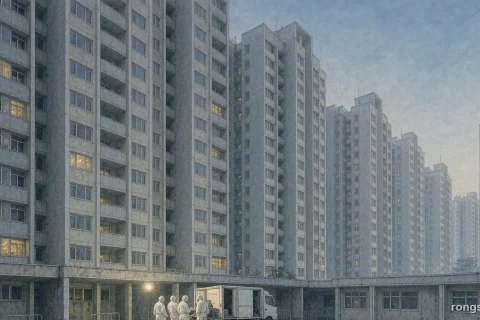
At half past three on the afternoon of November 2, 2020, in the Jinjiang Huafu compound in Nanan district, Chongqing, two children fell from the fifteenth floor.
The first down was a girl of two. The boy of one followed her. A crowd gathered quickly on the grass below.
The father, Zhang Bo, came running down from the apartment, sat on the ground and wept, striking his head against the wall. People who saw him said afterwards that it was unbearable to watch.
That afternoon, the first thought of everyone present was accident.
One. A man with two faces
Zhang Bo came from Changshou district in Chongqing. His family had little money when he was small, and he left school after the sixth grade. Later he came into the city to work, met a woman we will call Chen, and in time they married.
Neighbours in his home village described him as sharp enough, but not talkative. After the marriage he bought an apartment in the city and settled down with his wife. When their daughter was born, they were getting by well enough.
They registered the marriage in August 2017. Their daughter was born that year, and their son at the beginning of 2019.
The change came around 2019. Zhang Bo told his wife that they were not suited, and asked for a divorce. At the same time, without telling the woman he was pursuing that he was married or that he had children, he began courting an online acquaintance named Ye Chengchen. By August 2019 the two were in a relationship.
According to reporting, Chen knelt down and begged him to keep the family together for the sake of the children. Zhang Bo told her to stop talking about it.
On February 26, 2020, they divorced by agreement. The daughter would live with Chen. The son would stay with Zhang Bo until he turned six, and then go to Chen as well. Zhang Bo would pay eight hundred thousand yuan in maintenance, in instalments.
At that point it was still an ordinary divorce.
Two. The obstacle
Ye Chengchen was also from Changshou. Her family had at one time run a food factory. When she met Zhang Bo, she learned that he had children only after the relationship had begun.
From February 2020, the nature of the thing changed.
Over the months that followed, the two of them discussed, again and again, what to do about the children. What they settled on was that the children should die, as if by accident. The method they chose was to make it look like a fall.
The prosecution case and the judgments set out what happened. Ye Chengchen knew the terms of the divorce agreement. Of the two children, one was an obstacle and one was a burden. She saw both of them as standing between herself and marriage to Zhang Bo, and between herself and any shared life afterwards. She did not withdraw, and she did not walk away.
Over more than half a year, the two of them talked about it on WeChat.
On June 3, 2020, Ye Chengchen wrote that she would not meet Zhang Bo again before the children were dealt with, and that a man with children was simply not acceptable. She said it was impossible, and told him to think of a way. Zhang Bo said that it was not possible to do both. Her answer was to take the girl out to play, to drive her somewhere, to buy the extra car insurance, to say they were going to take photographs.
One proposed, one pushed. One considered, one urged. The exchange came back again and again over those months, each time with more detail.
Pressure was coming from her side of the family as well. The evidence in the file shows that her parents could not accept that Zhang Bo had children, and that with children the two of them could not be together. That sentence became a second rope around his neck.
Ye Chengchen also did one more thing. She set him a deadline. She applied pressure with the end of the relationship, with refusal to meet, with her family being against it. When Zhang Bo hesitated about doing both children at once, she insisted that both had to go, on the reasoning that if only one was dealt with, the other would still be a problem later.
Zhang Bo had chances to stop during those months. He put it off more than once, finding reasons not to bring the girl into the apartment.
He put it off many times. The last time, he did not.
Three. Two accidents that did not happen
In the last days of October 2020, Ye Chengchen pressed harder.
On October 25, Zhang Bo asked his mother to contact Chen and say that he wanted to buy the girl some clothes, so that she would send the child over. The girl went, and came safely back that day. That time, Zhang Bo did not act.
A few days later came November 1. Zhang Bo drove to Chen and picked up the girl again, and took her to his mother. That evening, because his mother was at home, he found no opportunity.
Ye Chengchen was angry when she heard. That same day, Zhang Bo drove from the city out to Changshou to calm her down, and transferred forty thousand yuan to her.
The next morning, he drove home.
At half past three on November 2, while his mother was out, he took the two children, who were playing on the window seat of the second bedroom, by both legs and lifted them over the sill.
One child died at the scene. The other died in hospital.
The first thing Zhang Bo and Ye Chengchen did afterwards was delete their WeChat history, and then get their stories straight. They needed to complete the paperwork on the accident.
Four. It was not an accident
The police found the problems quickly.
How had two children gone over the same window sill at the same time. The height of the sill, the place they landed, the state of the room, none of it fitted the story of two children falling in play. The case changed from an accidental fall into a criminal investigation, and the father and his girlfriend became the suspects.
The WeChat history they had deleted was later recovered by the public security authorities, lawfully, from the phones.
What came back out of the two phones was a line of messages running from June 3 to November 2, 2020. Investigators matched the times, the contents and the locations of each of them, and were able to reconstruct the change in Zhang Bo month by month. At first he put things off. Then he went along with it vaguely. Later he began asking for actual methods. A phone does not take anyone side. It simply lays out what happened in the order it happened.
That history became the hardest piece of evidence in the case. The judgment states it plainly. The phone records objectively document the two of them planning the killing together. Ye Chengchen made repeated confessions during the investigation, and the facts she admitted matched Zhang Bo’s account, the chat records, and the other evidence in the file.
Some evidence does not live in what people say. It lives in the memory of a phone, and deleting it leaves a mark of its own.
Five. The reversal in court
On December 28, 2021, the No. 5 Intermediate People’s Court of Chongqing delivered its first instance judgment in open court.
The court convicted both Zhang Bo and Ye Chengchen of intentional homicide and sentenced each of them to death, with deprivation of political rights for life.
Both appealed.
On April 6, 2023, the Higher People’s Court of Chongqing heard the appeal. In court, both of them changed their testimony.
Ye Chengchen said the messages on WeChat had been a discussion made in a moment of impulse, and that they had never intended to carry it out. She said she had a mental illness, and that she had sent those messages while her mind was disordered. Zhang Bo said the children had fallen by accident after all.
At the end of the hearing, Zhang Bo apologised to the two dead children, and to their mother and her parents. He said he would not be able to care for his own mother in her old age, and was sorry. He said he had made a will, and that if he were executed he wished to donate his organs.
On the question of who first proposed the killing, each blamed the other. Zhang Bo’s lawyer said the idea had come from Ye Chengchen, that Zhang Bo had opposed it at first and then gone along passively, and that on the day of the killing she had threatened him by cutting her own wrist. Ye Chengchen’s lawyer said she had merely encouraged him, that her culpability was plainly less than his, and asked the court for a psychiatric assessment of her.
The court answered each of these in turn.
On May 11, 2023, the Higher People’s Court of Chongqing announced its decision in open court. The appeal was dismissed and the original judgment upheld. The appeal court held that the facts found at first instance were clear, the evidence solid and sufficient, the conviction correct, the sentence appropriate, and the procedure lawful.
At the announcement, the court safeguarded the procedural rights of the two defendants and their counsel, who attended in person. Relatives of the victims, relatives of the defendants, reporters, deputies to the people congress, members of the political consultative conference and members of the public sat in the gallery to hear it.
Six. The one who did not lay a hand
At the review stage, the biggest question in this case was not who had done the killing. That was Zhang Bo, and it was not in dispute.
The question was whether Ye Chengchen, who had never laid a hand on either child, should die as well.
English-language readers will find the shape of that argument familiar. It is the same question that was asked about Myra Hindley in England and about Karla Homolka in Canada, in two cases where a woman stood beside a man who killed children and where the country spent years arguing over how much of it was hers. In those cases the argument usually turned on fear, or on the claim that the woman was herself under the man’s thumb. Here the court had the messages, and the messages did not read like fear.
The Supreme People’s Court set out its reasoning in the review ruling. Zhang Bo and Ye Chengchen stood at broadly the same level in the joint offence, both playing a principal role, and both were principals. Zhang Bo was the one who carried out the killing, with an especially prominent position and role, and the most serious responsibility. Ye Chengchen, by shaping, reinforcing and hardening his intent to kill, and by her part in starting, driving and carrying out the act, had played a role of the highest importance, and bore responsibility just as serious.
The ruling answered the defence arguments one by one. On the claim that Zhang Bo was under psychological control, and had been forced to act by her threatened suicide, the court was careful. Ye Chengchen did have two old horizontal scars on her left wrist. But the time they were made could not be established. The evidence did not show she had threatened him that way on the day. Zhang Bo was an adult who killed his own children in order to marry her, and the evidence did not show that his judgement or self-control was impaired. On the claim that she was less culpable and should be assessed by psychiatrists, the court found that she had a real motive, a definite target, a careful plan, strong instincts for self-protection and for avoiding detection, and no hallucinations or delusions at the relevant time. She had full criminal responsibility.
The defence also argued that the police had seized the two phones unlawfully, and that the electronic evidence should be excluded. The court found that the seizure had indeed been procedurally flawed, but that the officers had made records of extraction and sealing, filmed the whole process, and obtained signatures, and that on video the two defendants agreed to the seizure. The explanation given at the appeal was reasonable. It was not evidence that must be excluded. On the further complaints about procedure, including that the earlier stages had not heard from defence counsel and that a pre-trial conference had not been notified, the court held that while the procedure had certain flaws, they did not affect the finding of fact or a fair trial.
During the review, Ye Chengchen reported other people for crimes. The reports were checked and found untrue, and did not count as meritorious service.
On January 18, 2024, the Supreme People’s Court issued its review ruling, approving the death sentences of Zhang Bo and Ye Chengchen.
On the morning of January 31, 2024, the No. 5 Intermediate People’s Court of Chongqing carried out the executions, in accordance with the order issued by the Supreme People’s Court. The Fifth Branch of the Chongqing Municipal People’s Procuratorate sent officers to observe. Before the executions, the court arranged for the two to see their close relatives.
Seven. The birthday
November 2, 2020, was the fifty-eighth birthday of the children’s maternal grandfather.
The old man told reporters afterwards that the family had planned to go out that evening to celebrate, and that he and his wife were at home getting ready when the call came from their daughter.
Since that day he has kept one rule. Every year on that date, he tells his old army comrades in advance not to wish him a happy birthday.
Between them, the two children were less than four years old.