In the bamboo groves of Hunan there is one kind of bamboo that is not like the rest.
The stems are covered with small marks, purple and brown, some dark and some faint, as though somebody had pressed an inked fingertip against them again and again. The marks are not on the skin. Cut the stem open and they are still there, running all the way through the wood.
People in Hunan call it spotted bamboo. They also call it the bamboo of the Xiang ladies.
For this bamboo there is an explanation that takes six characters. Two wives wept, and the bamboo took the marks.
The two wives were sisters, both daughters of the emperor Yao. The elder was named Ehuang and the younger Nüying. Yao married them both to the same man, the future emperor Shun.
The old books keep this in the Book of Documents, and also in the Biographies of Exemplary Women compiled by Liu Xiang in the Han dynasty. That book places the two sisters in the very first chapter, and says of them that they never became proud or careless just because they were daughters of an emperor.
The two poems called the Lord of the Xiang and the Lady of the Xiang, in the great southern anthology known as the Songs of Chu, are also about them. Readers have argued for a thousand years over who is who. One reading says that the Lord of the Xiang is Shun and the Lady is the two wives. Another says that Ehuang is the Lord and Nüying is the Lady. The readings do not agree. The waiting in the poems does not change.
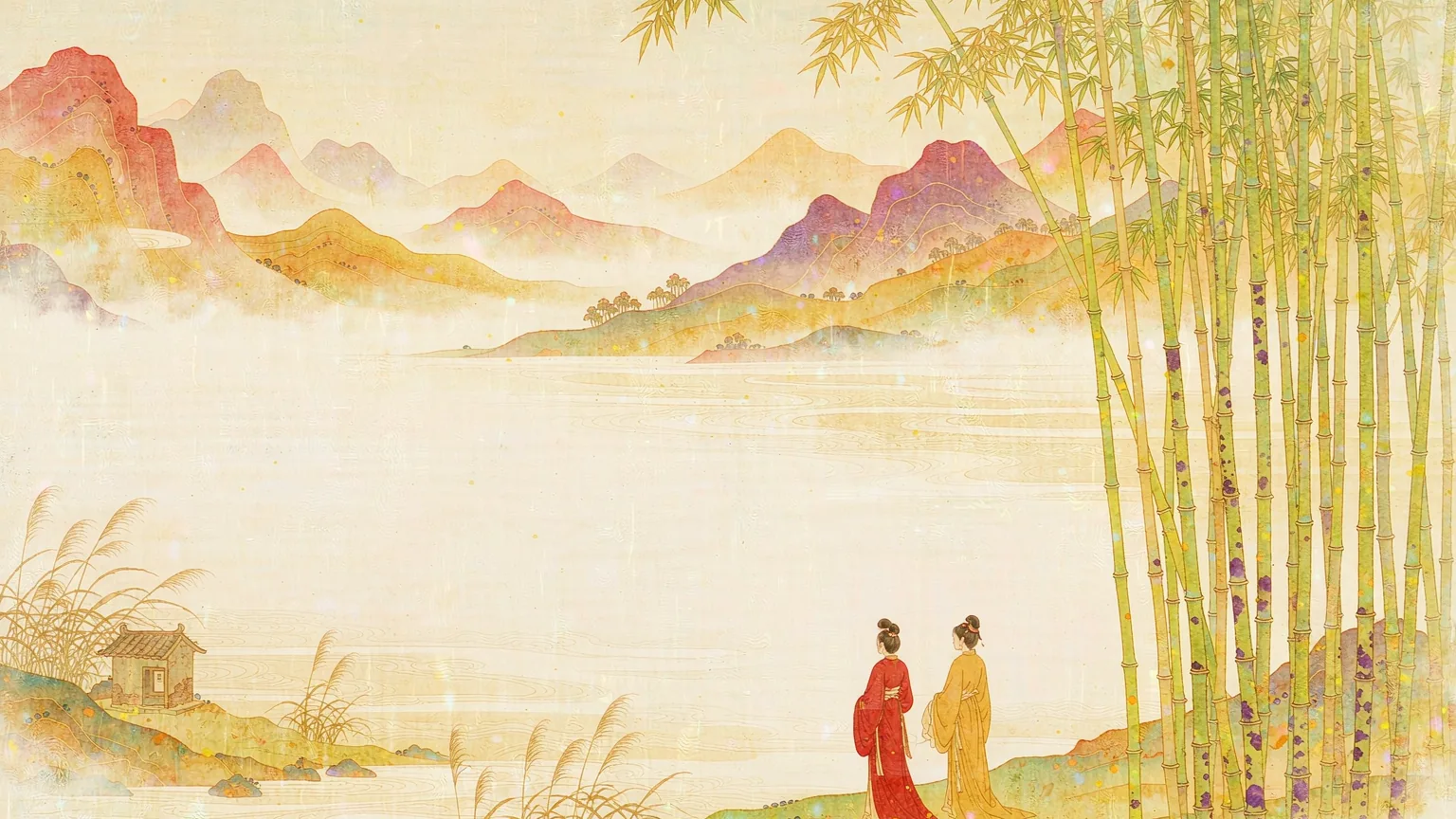
To understand the two of them, you have to start with Shun, because Shun had the worst family in Chinese legend.
The Book of Documents sums up that household in three phrases. The father was foolish. The stepmother was sly. The younger brother, Xiang, was arrogant. Those three wanted one thing above all others, and it was the death of Shun.
They told him to climb onto the roof of the granary and repair it. When he was up there, they took the ladder away and set the granary on fire. Shun used two wide straw hats as wings and jumped from the roof, and did not die.
They told him to go down into the well and clear the mud. When he was at the bottom, they began to fill the well with earth. Shun had already cut a side tunnel into the wall of the well, and he crawled out through the mouth of a neighboring well.
Both attempts end with the same sentence. Shun came back. He behaved as though nothing had happened. He went on being good to his father, and good to his brother.
A man out of that house became famous enough that the emperor Yao heard of him.
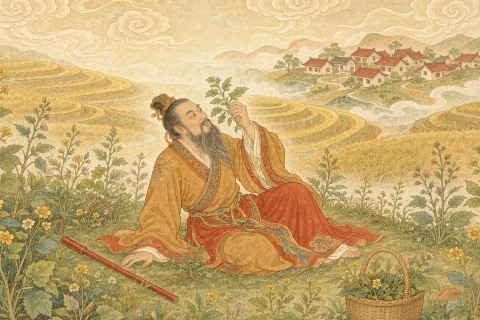
The fame did not come from the house. It came from outside it. Shun worked as a farmer at the foot of Mount Li, where the neighbors had been quarreling for years over the boundaries between their fields, and after he had farmed there a few seasons the quarreling stopped. He fished on the shore of Lake Lei, where the fishermen fought over the best spots in the water, and after he had fished there the fighting stopped. He made pottery on the riverbank, and his pots did not crack, so the pots of the other makers stopped selling.
All of it points at one thing. Wherever this man went, that place had a little less trouble in it.
Yao needed an heir, so he did two things at once. He married his two daughters to Shun, and he treated the marriage as an examination. How a man treats a wife, the ancient Chinese reasoned, shows how he will treat an empire.
The two sisters moved into that house. They were daughters of an emperor, and in their new home they had to serve a mother in law who wanted their husband dead, and manage a brother in law who was always looking for an opening.
When the two escapes happened, the sisters helped. That detail is in the old text, and it is the reason they are remembered at all.
Yao grew old and handed the throne to Shun, and Shun became emperor.
As emperor, Shun went home once. He visited his father, the blind man Gusou, and behaved with the same respect as before. He also gave his brother Xiang a piece of land and made him a lord.
Depending on how you read it, this is either the highest filial piety or the deepest foolishness. The old books simply record it, and let the word filial stand there and be heavy.
Shun ruled for thirty-nine years. In his last year he set out on one great journey. He would tour the south.
A southern tour in that age was not a sightseeing trip. It meant crossing mountains and rivers, months of travel, and a ruler who had to show his face in places that had barely heard of him. The south was still half wilderness then, full of fever and bad water, and a man who went down there might not come back.
Shun went south. His destination was a region called Cangwu, in what is now southern Hunan.
The two sisters did not go with him. They stayed behind. In some versions they followed as far as the shore of Lake Dongting and waited there, because the road beyond was too hard.
The news came in autumn, or perhaps winter. The histories are not precise about it.
Shun died in the wild land of Cangwu.
He did not come home. What happened afterward was that his companions buried him on Mount Jiuyi, the Mountain of the Nine Doubts.
There is a quiet detail attached to that grave. The men dug in haste, and the mound was shallow. Then, the story says, elephants came down from the surrounding hills, many of them, and carried earth with their trunks and raised the mound higher over him.
The mountain is called Jiuyi, and the name is itself a doubt. Jiuyi means the Nine Doubts. Nine peaks stand there, all of them so alike that from the foot you cannot tell one from another, and a man who walks in may not be able to find his way back out. The grave is somewhere on that mountain. Under which peak, nobody can say.
By the time Ehuang and Nüying reached the Xiang River, there was only mist over the water. That mist later became the first of the Eight Views of Xiaoxiang, and it has a name of its own. Night rain on the Xiao and the Xiang.
The two women stood by the river. They could not find the grave, and they could not find the man.
They walked south along the water, and they wept as they walked. They walked to Dongting, and up the Xiang, and to the foot of the mountains. Beyond that lay Jiuyi, and Jiuyi was too large for two people on foot to search.
After that, the people around the lake began to see two women standing at the water.
They were not doing anything. They were standing. The wind came and their robes filled with it. The water rose and the sand around their feet went dark. They looked south, toward the direction the river came from.
The days went by, and they never walked north again.
Their tears fell on the bamboo.
From that day, the story says, the bamboo in that grove carried marks. The marks could not be wiped off, and they could not be cut away, and they went all the way through the stem. People named the plant spotted bamboo, and also the bamboo of the Xiang ladies, and also the tear bamboo.
After that the record has no more detail to give.
Some books say the two women wept until they walked into the Xiang River and drowned. Some say they fell ill and died somewhere along the river between the Xiang and the Yangtze. Other books put it more lightly. They finished their weeping, and they came apart like a breath of wind.
All three versions end in the same place. They died at the water.
So the Xiang River has two goddesses.
Ehuang became the Lord of the Xiang, and Nüying became the Lady of the Xiang, or the other way around. Shrines were built to them. In Yueyang, and on Junshan Island in Lake Dongting, there are temples to the two ladies that still stand today.
There is a second half to this that is easy to miss.
Shun died, and he is remembered as a sage king, a devoted son, and the man who handed the empire to the worthiest successor. He is in the Book of Documents. That is a large thing to be remembered for. The two women died, and what they are remembered for is a few dark marks in the wood of a bamboo stem.
A whole reign goes into the history books. A few tears go into the bamboo.
The Greeks told a story very like this one, about the same kind of transformation, from grief into a plant. When Phaethon, the son of the sun, fell out of the sky, his sisters sat beside the river where he fell and wept without stopping. The gods turned them into poplar trees, and their tears went on falling, and hardened into amber on the bank. The Chinese story has no sun chariot and no falling boy. It has two wives by a river, and marks inside the wood.
There is a second Greek parallel worth holding beside this one. Orpheus, the singer, went down into the land of the dead to bring back the woman he had married. He was told not to look at her until they reached the light, and at the last moment he looked, and she was taken from him again. In both traditions, love walks all the way to the edge of the world. The shape of the walk is what differs. Orpheus goes down to fetch. Ehuang and Nüying go south on foot, and cannot find the way.
The people along the river found a plain use for the plant.
Spotted bamboo grows straight, with even joints, and it makes a good fishing pole and a good punt pole. The men on the water cut it without asking whose tears had colored it. When it is dried in the sun, the marks are still there.
A fisherman pushes off with it in the morning, works all day, and comes back in the evening. Somebody at the door takes the pole from him and leans it against the wall.
By then it has nothing to do with destiny or with kingship. It is a pole.
Only once in a while somebody splits one open, and finds that the marks are not on the skin. They are inside.
Boats still run on the Xiang River.
When they pass Junshan, there is a temple on the shore. Inside are two figures of women, dressed as queens, sitting upright and composed.
Outside, the bamboo groves move in the wind, and the whole slope makes a sound.
It is not weeping. It is only wind in bamboo. But every year one or two people stand there listening for a long while, and find that their eyes sting, and cannot say why.
Tears falling on bamboo leave no trace at all.
The old saying is that only the tears of those two women could leave a mark.
Which means that when anyone else weeps, they weep, and nothing stays behind.