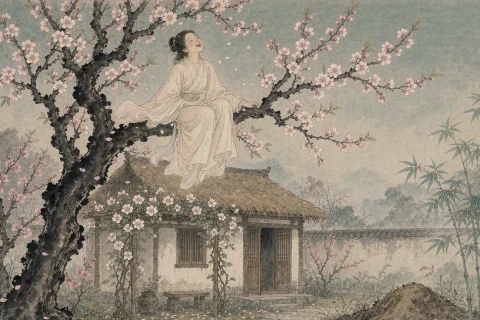
In Lingyang county there was a hall that nobody entered after dark.
It was the Hall of the Ten Kings, where the dead are brought to be judged. Along both side galleries stood rows of guards carved from wood and painted in gold. Wind came in through the cracks of the door and stirred the paper banners. When a child would not stop crying, the mother had only to say, we will send you to the Hall of the Ten Kings, and the child went quiet.
This story is recorded by Pu Songling, in a collection called Strange Tales from a Chinese Studio. Pu Songling was a schoolteacher in Shandong who set out a tea stall beside the road and invited travellers to tell him their stories, and wrote down the new ones at night.
He is the same kind of writer as the Brothers Grimm, who also went out and collected what other people told them. The difference is in the harvest. The Brothers Grimm gathered fairy tales. Pu Songling gathered ghosts.
The word in the title is pan, a judge of the underworld. When a person dies, the old belief went, the soul is brought before the Ten Kings of Hell and tried. The judge sits below the bench with the ledger of life and death open on his knee. Whatever name he writes in that ledger has to come.
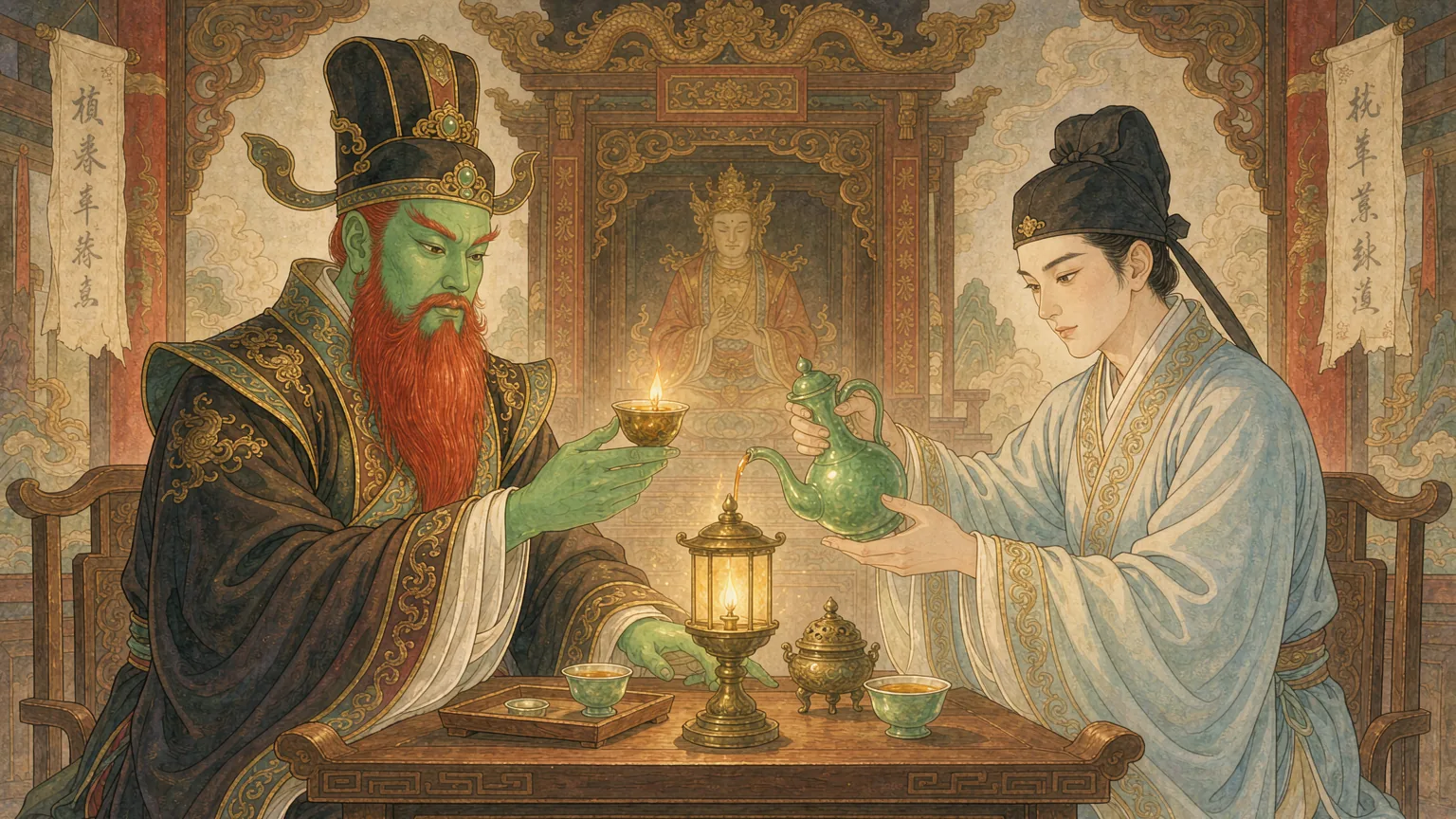
In Lingyang the judge in the western gallery was the worst of the row, green-faced and red-bearded, more terrible than all the others.
Zhu Erdan was a scholar of Lingyang, a man of loud courage and poor luck. He studied hard, his writing never came to anything, and he failed every examination he sat.
One day the literary club of the town was drinking together, and somebody had a mean idea. Brother Zhu, he said, had a famous name for daring. Let him go to the Hall of the Ten Kings in the dead of night and carry back the judge from the western gallery. If he did it, they would all pay for the wine.
Every man at the table knew what that statue looked like, and what the hall was like after dark.
Zhu Erdan put down his cup and walked out without saying anything.
A little while later a shout came from the street. He had brought the bearded master.
The drinkers started to their feet. Zhu Erdan came in backwards, bent under a wooden figure as tall as a man, and set it down on the table in front of them. Every man in the room shrank back into his seat.
Zhu Erdan was not troubled. He poured three cups of wine, tipped them out onto the floor as an offering, and bowed. Then he spoke to the statue as to a living man, saying that he had been rude and reckless, and that if the master ever had a free evening he should come and drink a cup.
Then he carried the statue back and went home.
The next night he came home half drunk with his spirits still up, lit a lamp, and poured one more cup. The door curtain moved. Someone came in.
He looked up. It was the judge. The wooden statue had come alive.
Zhu Erdan got to his feet, his face unchanged, and said that he supposed he was going to die. He had been rude to the master a few nights ago, and now the master had come to take his life.
The judge stroked his thick beard and smiled. He said that this was not so. Zhu Erdan had invited him, and he happened to be free, so he had come to keep the appointment.
Zhu Erdan hurried to give him the seat of honour and to bring out more wine. The two of them drank from dark until nearly dawn. The judge said his family name was Lu. He drank like a man who had been thirsty for a century, and he talked about things no scholar of Lingyang had ever heard named. From that night on, Lu came every few days, and Zhu Erdan kept the lamp lit and the wine warm and waited for the door.
This is the part a reader from the West has to slow down for. In European stories a ghost usually wants something settled. It has a wrong to right, a body to be found, a debt to be collected, and once that is done it goes quiet and the house is safe. The Chinese ghost in these tales is often just a person with business still unfinished among the living, and the danger is never that they are dead. The danger is that you cannot tell. The man drinking your wine may have been in the ground for two hundred years, and he will be better company than anyone you know.
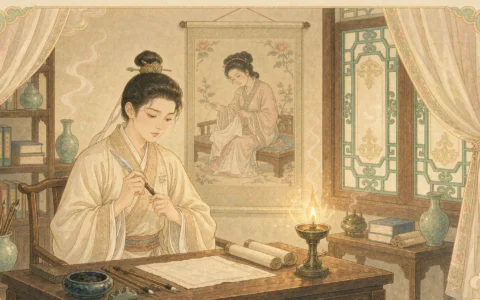
When the two of them had grown used to each other, Zhu Erdan began to show Lu his essays.
Lu read two pages, closed the manuscript, and frowned. The writing did not work. The problem, he said, was not effort but the heart. The passages of the heart were blocked, and another ten years of reading would not open them.
A few nights later Zhu Erdan woke to a coldness across his belly and a strange tugging, as if somebody were rummaging in a drawer. He opened his eyes. Lu was sitting on the edge of the bed and had already opened his clothes. His stomach was open, and his entrails had been lifted out one length at a time and were being sorted in the lamplight.
Zhu Erdan shouted in terror.
Lu did not stop. He said that he would take out what was blocked and put in something better. He reached into his robe and brought out a heart, still warm, one chosen out of many thousands of hearts in the courts below. He set it in place and returned everything he had lifted out to where it belonged. Then he closed the belly and pressed the seam flat with his hand.
The smell stayed in that room for several days, the smell of an animal opened up mixed with wet earth after rain.
Zhu Erdan picked up a book again, and it was as if a window had been opened in his head. Lines he had read ten times and could not hold now went in at a glance and stayed. That autumn he took first place in the provincial examination, and the literary club could not believe it.
Once a heart can be replaced, a face must be a small matter.
Some time later Zhu Erdan asked Lu to do something about his wife, who was plain. Lu said he would have to look around.
A few nights later there was a knock at the door after midnight. Zhu Erdan got up and opened it. Lu stood outside with something bundled in the front of his robe. He said that he had found what Zhu Erdan asked for, and opened the robe.
Inside the cloth was a human head, still wet. Zhu Erdan looked, and his knees went weak.
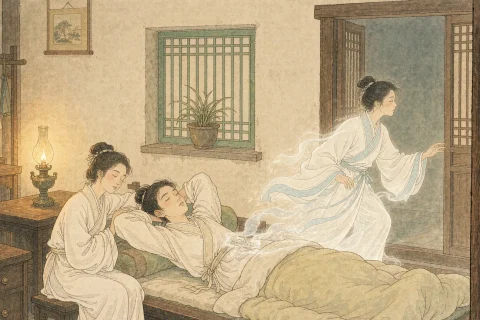
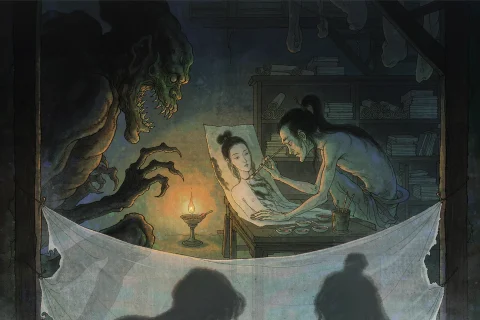
They went into the inner room. The wife of Zhu Erdan was sleeping deeply. Lu drew a small knife from his boot, bright as ice. He held the neck with one hand and cut with the other, and the cut was as easy as slicing bean curd. The head rolled onto the pillow. He took the beautiful head, lined it up with the neck, pressed it on, and smoothed the join with his fingers.
Bury the old one somewhere quiet, he said, and then he was gone.
Morning came. The wife woke with a numbness in her neck. She rubbed it, and her fingers came away smeared with blood. She called for water and washed, and the basin turned red. When she lifted her face, the serving girl stepped back with a cry.
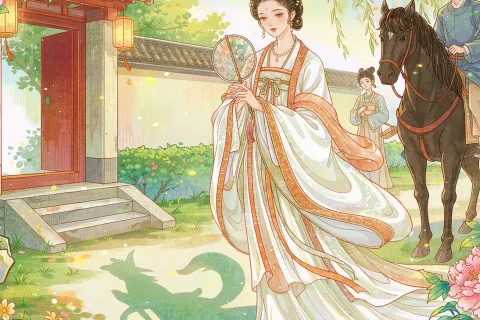
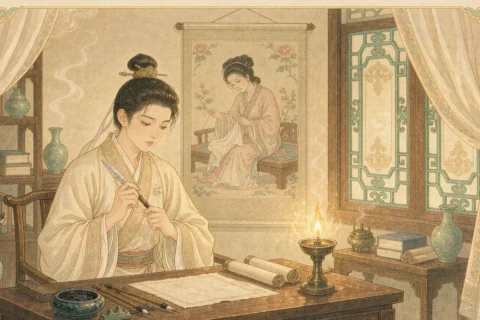
The face was not hers. The eyebrows were long and fine, there were two dimples in the cheeks, and she was as beautiful as a woman in a painting. Around her neck ran a thin red line, as if she were wearing a collar that could not be seen.
Only then did Zhu Erdan tell her what had happened in the night. She touched her face, and then her neck, and said nothing.
That face already belonged to somebody.
The censor Wu, an official of the town, had a daughter famous for her beauty. Three months before, the girl had been violated and killed, and her body had been laid out in the front hall. In the middle of the night her head went missing, and the family searched the whole city for it.
Word reached the censor, and he brought the case to the magistrate, on the theory that Zhu Erdan must have used black art. The runners came and took the whole household in for questioning. Zhu Erdan told the truth: his wife had had her head changed in a dream, he said, and he did not know how it was done, and it was a great injustice to call him a murderer. The magistrate heard him out and felt his scalp crawl. There was no way to pass judgment on a case like that, and in the end he let Zhu Erdan go.
Zhu Erdan went to Lu, who said it was not difficult. He would let the daughter of the Wu family speak for herself.
That night the censor dreamed that his daughter had come back. She told him that the man who had killed her was Yang Danian, of Suxi, and that the scholar Zhu was innocent. Yang Danian had long been unhappy with the plainness of his own wife, she said, and the judge Lu had taken her head and given it to the wife of Zhu Erdan. This was the one mercy in the whole affair, that her body was dead but her face still lived. She asked her father not to make an enemy of the Zhu family.
The censor woke in a cold sweat and told the dream to his wife, who had dreamed the very same thing. He took it to the magistrate. Enquiries were made, and there really was a man named Yang Danian in Suxi, and he was arrested and tried, and he confessed, and he was punished.
The censor called at the house of Zhu Erdan and asked to see the wife. He looked at her for a long time, and said nothing at all. He only asked her to be his adopted daughter. From then on the two families were kin, and the head of the wife of Zhu Erdan and the body of the daughter of Wu were buried together.
A heart can be changed, and a face can be changed. There was one thing about Zhu Erdan that nobody could change.
He sat the metropolitan examination three times, and three times he was turned out for breaking the rules of the examination yard. He gave up on office after that, and thirty years passed.
One night Lu came and said that his span of life was running out. Zhu Erdan asked how long he had. Five days, Lu said.
Can you save me, Zhu Erdan asked.
Lu said that life and death are fixed by heaven, and that no man may bend them for a friend. To a man who sees clearly, he said, living and dying are one thing, and there is no reason to call life a joy and death a sorrow.
Zhu Erdan thought about it and said that Lu was right. He prepared his burial clothes and his coffin, set everything in order, and five days later dressed himself properly and went, sitting straight.
The next day his wife was holding the coffin and weeping when a man walked slowly in from outside. It was Zhu Erdan, in the same clothes as before.
He told her that he was indeed a ghost, and no different from when he had been alive, and that the only reason he had come back was that he could not bear to leave a widow and an orphan on their own. She asked why he could not simply live again. He shook his head. The number of days, he said, cannot be argued with.
She asked what work he did among the dead. He said that Lu had recommended him to oversee documents, and had given him rank and title, and that it was not hard work. He added that Lu had come back with him and that she should set out wine. Soon there was laughter in the room, bright and loud, exactly as it had been when he was alive. Somebody looked in at midnight, and the room was empty.
After that he came back every two or three days, and took care of whatever needed doing about the house. His son Zhu Wei was five years old that year. Whenever the father came he took the boy onto his knee, and when the boy was seven or eight he taught him to read by lamplight. The child was quick, and at fifteen he was admitted to the county school. He grew up never once feeling that he was a boy without a father.
Later the visits grew rarer, and in the end the father came only once in a month or two.
In the old house at Lingyang there is a lamp that often burns until the small hours.
Under the lamp sits a boy, reciting from a book. When he makes a mistake, a finger comes down on the page and puts him back to the beginning of the line.
Sometimes the boy looks up, and there is nobody at the table.
Only the page, still open at the place where he went wrong.