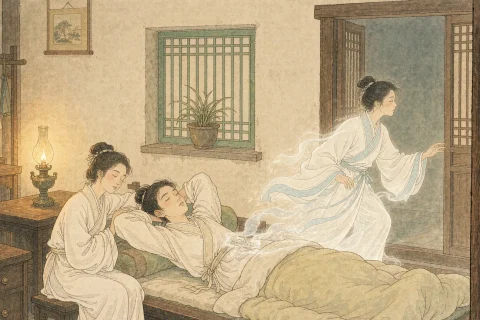
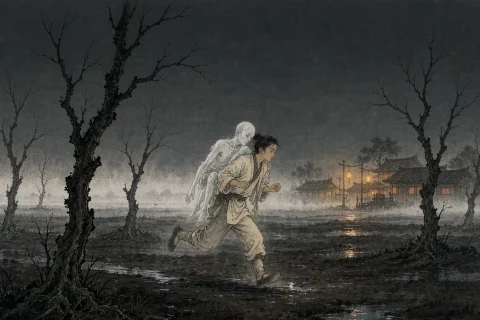
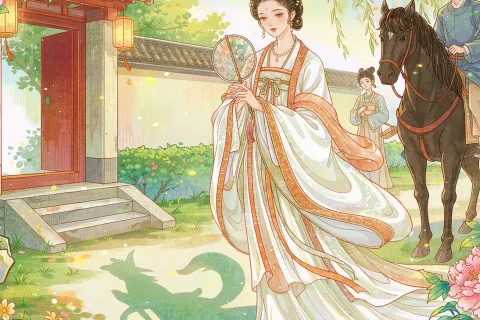
The darkest hour in Taiyuan is the one just before dawn. That is when Wang walked out of his house, and that is when he saw her: a young woman alone on the road, carrying a bundle, walking fast.
She walked like someone who did not want to be caught.
Before the story, a word about where it comes from.
It is from a book called Liaozhai Zhiyi, usually translated as Strange Tales from a Chinese Studio. Its author, Pu Songling, lived from 1640 to 1715 and spent most of his adult life failing the imperial examinations. He never held a real official post. What he did instead was collect stories — from travellers, from neighbours, from anyone who would sit down and talk.
The comparison English readers usually find useful is the Brothers Grimm. Two German scholars in the 1800s went out and wrote down the tales people told them, and today we remember the tales and not the scholars. Pu Songling did the same work in China two hundred years earlier, and he did it with ghosts.
There is a folk story about how he worked. He is said to have set up a tea stall by the road outside his village and let travellers drink for free on one condition: that they tell him a story. Some scholars doubt he ever did this. The point survives either way. The material was not invented in a study. It came off the road.
Chinese ghost stories are their own thing, and they do not work like the European ones. In the Western tradition a ghost is usually a problem to be solved: find the bones, say the right words, and the haunting stops. In the Chinese tradition the ghost is often a person with unfinished business, and the danger is not that it is dead. The danger is that you cannot tell.
That is what makes The Painted Skin the most famous piece of Chinese folklore horror in the language. The title gives the trick away and people still read it. A face can be painted. Paint it well enough, put it on the way you put on a coat, and you are somebody else.
The horror here is not that a demon exists.
The horror is that you would not have known.
On the morning he met her, Wang got close enough to see her face.
Young. Pale. Clean. The bundle in her arms was not large.
Wang was a scholar — a xiucai, which meant he had passed the lowest level of the imperial examinations and had earned the right to keep studying for the next one. He was not a cruel man. He had one weakness, and it was this: when he saw a beautiful woman, his thinking stopped for a moment.
He asked if she was travelling alone so early.
She did not answer. She kept her eyes on the road ahead.
He asked whether something had happened to her.
That did it. Her eyes filled. Her name was Mei, she said. She had been bought as a concubine into a wealthy household, and the man’s principal wife could not stand the sight of her. Before daylight they had put her out of the gate. Her own family lived far away. She had nowhere to go.
Wang felt the blood come up in him. “My house is just ahead,” he said. “If you are willing, come and rest.”
She lifted her head and looked at him.
That look bent the rest of his life.
He took her home and did not tell his wife. When Chen asked, he said he had found a serving girl on the road, a runaway from a rich house, and that she would stay in the back study for a few days until he could give her travelling money.
Chen did not believe him. She also did not dare push it. She said one thing.
“Be careful. You do not know where she came from.”
Wang waved it off.
For the next few days he studied by day and went out to the back study at night. The woman kept the rooms spotless and spoke softly. When he asked about her family, she said only that she had escaped, and nothing more.
The strangeness began on the third day.
Every night when he came out of the study, Wang smelled something he could not name. Not perfume. Not rot. Something like an object that had been soaked and then shut up in a closed room far too long. It went around the room once and then it was gone.
On the fourth morning he went into the street and met a Daoist priest.
The priest had a cloth bag over his shoulder and walked with his head down, looking at no one. When he came level with Wang he stopped short, looked him up and down, and his face changed.
“There is evil on you.”
Wang blinked. “I am a scholar. What evil would I have?”
“Have you been keeping company with something you should not, these past days?”
Wang went red and got stubborn. “You want money.”
The priest looked at him for a while. He did not get angry. He said one sentence and turned to go.
“You are at the door of death and you still will not wake up.”
Wang stood there and decided the man was a fraud.
He walked on about a dozen steps, then glanced back.
The priest had already turned into an alley. There was not even a back to look at.
That evening Wang came home and found the gate of the study courtyard bolted from the inside.
He had never bolted it.
He called out twice. Nothing answered.
He went around to the back, climbed the wall, and dropped down into the yard. A lamp was lit in the study and the window was shut. The paper over the frame was old. He stood on his toes, made a small hole with his fingernail, and looked in.
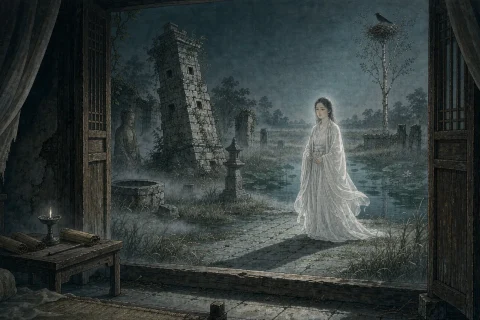
The thing sitting under the lamp was not the woman called Mei.
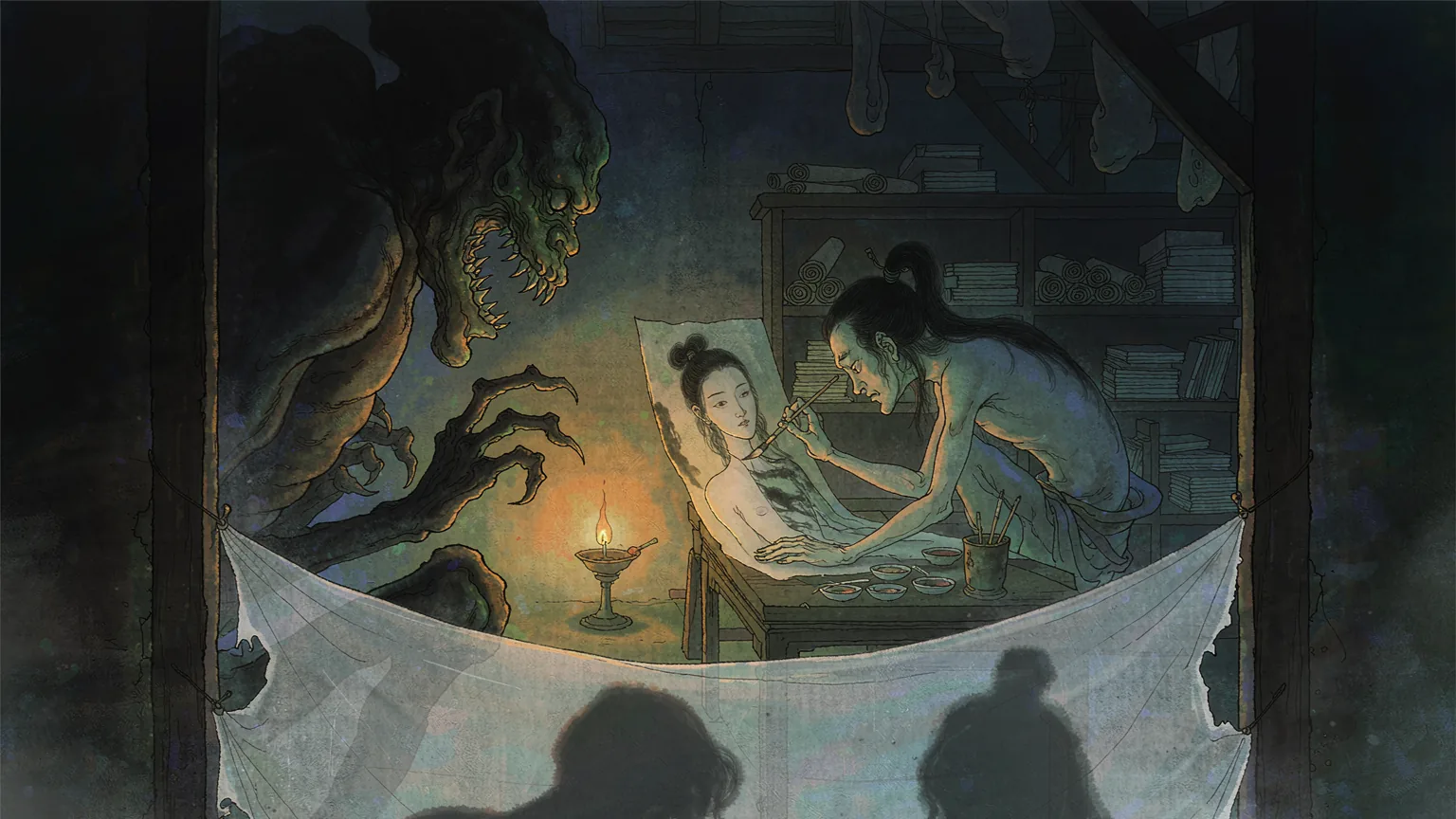
It crouched in the light with a face the colour of green copper, and its teeth pushed out past its lips in a row, like a saw. Spread out in front of it was a thing: a human skin, laid flat like a garment, with a head and hands.
It held a brush. It dipped the brush in colour and worked along the skin, stroke by stroke.
An eyebrow. An eye. The small lift at one corner of the mouth.
When it was finished it set the brush down, took the skin by the collar, and pulled it on the way a person pulls on a coat.
The lamp flame swayed.
Standing under the lamp was the pale, gentle woman with the bundle in her arms.
She turned to the wall, straightened the pin in her hair, and let out one small breath.
Outside the window, Wang’s legs had gone. He sat down on the ground, got up again, and scrambled back over the wall.
He ran until he found the priest at the edge of the city. He went down on his knees and knocked his head against the paving stones until it bled.
The priest pulled him up. “I told you.”
“Save me,” Wang said. That was all he could say.
The priest said, “This thing did not find it easy to take human form. It has not hurt anyone. I am not willing to simply kill it.”
What he gave Wang was a fly whisk, the kind of object a Daoist priest carries and a householder uses to brush away mosquitoes.
“Go home and hang it above your bedroom door. When it sees this, it will not come in.”
Wang did as he was told.
That night he hung the whisk over the door and kept the lamp burning. Husband and wife sat together and neither of them spoke.
Some time after midnight there was a sound outside.
Very light. Once. Then again. Like a fingernail drawn across the door.
Then the eyes. With the whisk hanging across the doorway, the thing stood out in the dark and did not move. It stood there a long time, long enough that Wang began to think it had gone.
Then it spoke from the other side of the door.
“The priest is trying to frighten me.”
A pause.
“What is already in my mouth, do you think I will spit it out?”
Something cracked outside. It had torn the whisk down, frame and all, snapped it in two, and thrown it on the ground.
The door came in.
Wang had just enough time to stand up.
The thing said nothing at all. It came at him, tore his chest open with both hands, took out a heart that was still beating, and left.
The blood ran from the edge of the bed all the way to the threshold. Chen held her husband and wept until morning.
At daylight Chen left his body in the room and went to find the priest.
He listened, and then he sighed and said something she could not make sense of. “I helped him as far as I could help him.”
Chen knelt on the ground and would not get up.
The priest had no answer for that. “There is one man in the street who can save him,” he said. “Go and beg him. If he agrees, your husband lives. If he refuses, there is nothing I can do.”
“Who?”
“The mad beggar in the market.”
The market was full of people. Chen searched the crowd for a long time before she found him, a beggar crouched against the foot of a wall with a bowl. He stank. His hair was one solid mat. The filth on his clothes lay in layers. People walking past gave him a wide berth.
Chen knelt down in the mud and told him what had happened to her husband.
He looked at her, spat into his palm, and held it out.
“Pretty lady. You want to save your husband?”
She nodded.
“Then swallow this.”
He held his palm up in front of her face.
Chen went white.
She was the wife of a scholar. She had spent her whole life being respectable. And here, in the middle of the market, with all these people watching.
She opened her mouth.
Someone laughed. Someone told her not to. Someone shook his head.
She swallowed it.
The thing was rank and thick and it stuck in her throat. She could not get it down and she could not bring it up.
The beggar laughed out loud, clapped his hands, stood up and walked off. Over his shoulder he threw one line back at her.
“Good. Good. So somebody loves him. I was interfering.”
The crowd broke up. Chen stayed on her knees in the mud for a long time and could not stand.
She went home and went into the room. Her husband was still on the bed. The hole in his chest was black.
She held the body and wept, and the weeping turned into wailing.
Halfway through, something turned over inside her chest. She doubled up and vomited.
What came out was not food.
It was a heart.
It fell into the hole in her husband’s chest, and it was beating.
Chen’s hands shook. She pressed both palms over the wound and held it shut.
She held it for a long time. She did not dare let go.
Close to dawn, something moved under her hands.
Then she heard the man on the bed take one small breath.
Wang woke up.
He opened his eyes and saw his wife sitting at the edge of the bed with her face wet. He was weak, but he could speak. The first thing he asked her was:
“What happened to me?”
The book spends two characters on what came next. Guo huo. He really lived.
The priest went away afterwards with something sealed in a bottle. The skin, they say.
It was folded neatly and laid at the bottom of the bottle, and the mouth of the bottle was stopped tight. He did not destroy it. He could not, or he could not bring himself to, and nobody knows which.
And Chen. The thing that the mad beggar made her swallow in the market that day, she never once said what it was.
Wang never asked.