There is a tree on the moon.
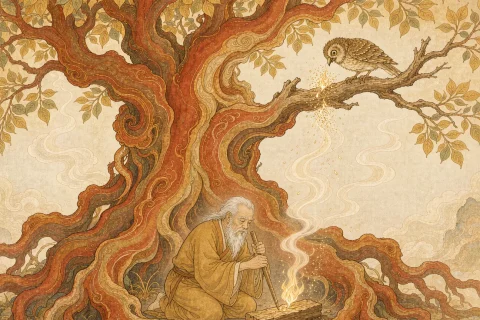
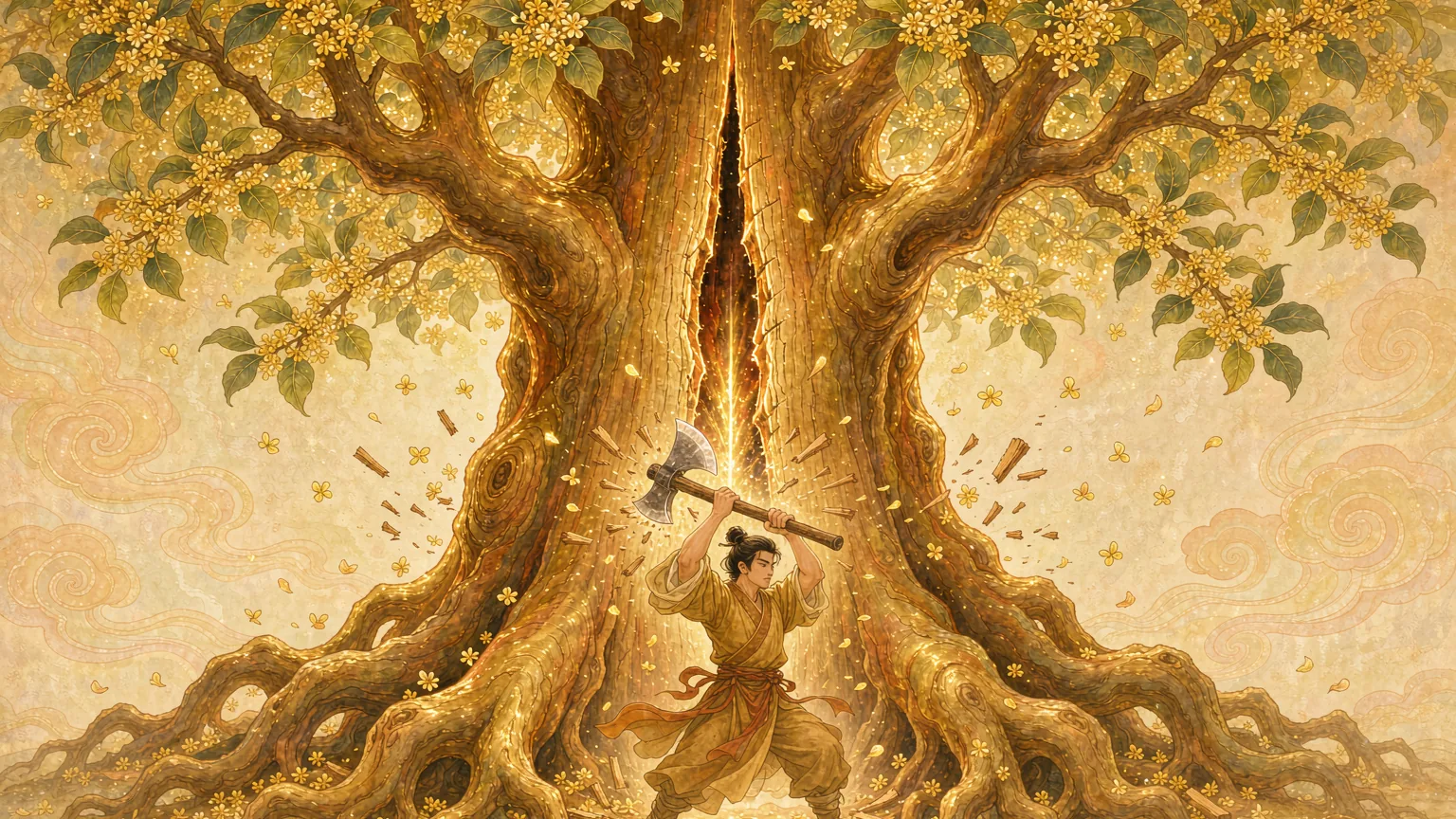
Under the tree stands a man holding an axe.
He swings. The blade bites into the trunk and opens a split in the wood. By the time he pulls the axe back out, the split has closed, and the grain of the bark is exactly as it was before.
He swings again.
He has been doing this for a very long time.
The fullest old account of him is in a book of notes written in the Tang dynasty, about twelve hundred years ago. It is short, and it is worth reading slowly.
It says: the old stories tell us that in the moon there is a cassia tree, and a toad. Another book says the moon cassia is five hundred zhang tall, and that beneath it one man is always chopping at it, and that the wound in the tree closes up again. The man is named Wu Gang, and he is from the town of Xihe, and while he was studying to become an immortal he committed a fault, and he was sent down and ordered to cut the tree.
The most important part of that passage is six characters long.
He studied to become an immortal and committed a fault.
Studied. Committed a fault. Which fault, the text does not say.
The old books left the one thing that mattered most completely blank, and left it blank for more than a thousand years.
It should be said at once that the Greeks told a version of this story, and almost everybody has heard theirs.
Sisyphus was a king who cheated death twice, and for that he was sentenced to push a boulder up a hill forever. Every time he neared the top, the stone rolled back down, and he walked down after it and started again.
Greece also had Tantalus, who stands in water he cannot drink with fruit he cannot reach. It had the daughters of Danaus, who were set to fill a jar with holes in the bottom. It had Prometheus, whose liver grew back every night.
The north of Europe had its own version. Loki was bound to a rock, and a serpent hung above him, and his wife stood beside him catching the venom in a bowl, and every time she turned away to empty the bowl, the poison fell on him.
So the endless task is not a Chinese invention. Chinese mythology and Chinese legends simply gave it a different shape, and the shape is the interesting part.
Think about Sisyphus. He does the work. He gets the stone almost to the top. He fails at the last step, and the failure is dramatic, and it is visible, and it happens once every climb.
Wu Gang never gets near an ending. There is no last step, and there is no moment where the stone turns around. He fails at every single stroke. His punishment has no scene in it at all.
One is a story about a man who almost wins. The other is a story about a man who was never given anything to almost win.
Before anything else, deal with the size.
A zhang in the Tang dynasty was about three meters. Five hundred zhang is about a kilometer and a half. That is a tree one thousand five hundred meters tall. If you stood at the base and looked up, you would not see the top of it. The crown would be above the clouds.
One man, one axe, one tree that size.
How long would it take?
The answer is that it does not matter, and the reason is not the size of the tree. The reason is in four characters that follow: the wound closes up again.
The cut he makes is gone before he can lift the axe for the next one.
He is not too weak to cut the tree down. He is in a situation where cutting can never add up to anything.
It is worth asking why this punishment works so well.
Because it removes the one thing that makes labor bearable. What keeps a person going at a hard job? The knowledge that the job is getting smaller. Cut a foot off the tree and the tree is a foot shorter. Move a basket of earth and the hill is a basket lower. Slow does not matter, as long as the direction is right, because at the end of the day something has changed.
In this case, nothing changes.
Ten thousand strokes from now, the tree will be exactly what it is at this moment.
So the text does not describe his pain and it does not describe his tears. It says only this: he is always chopping. Always. Three words, and that is the whole of the punishment.
It would be reasonable to ask what he actually did.
As was said, the oldest account gives six characters and stops. Later centuries were not willing to leave it there, and they supplied several answers. Here are two of them.
The first is simple. He was a bad student.
The story goes that Wu Gang wanted to become an immortal, and that he studied for three years without his heart ever being in the work. The immortal path requires a quiet and single mind. His mind was full of other things. Whoever was teaching him tried for a while, decided that this student would never arrive, and sent him away.
Sent him away to where? To the tree.
The second version has names in it, and dates, and other people.
In the Classic of Mountains and Seas there is a very short entry. It says that Bo Ling, a grandson of the Flame Emperor, had an affair with a woman named A Nü Yuan Fu, who was the wife of a man named Wu Quan. She carried the pregnancy for three years and gave birth to three boys, named Gu, Yan and Shu.
Wu Quan, most commentators agree, is Wu Gang.
So that version of the story runs like this. Wu Gang was away, studying to become an immortal. While he was away, his household came apart. He came home, learned what had happened, and in a single fit of rage he killed Bo Ling.
And Bo Ling was the grandson of the Flame Emperor.
The Flame Emperor did not have him executed. He gave him something worse. He sent him to the moon and ordered him to cut a tree that cannot be cut down.
So a man who set out to become an immortal ended up as an axe.
Put the two versions side by side, and they are doing different kinds of work. The first is a story about the gods. The second is a story about people.
What is interesting is that both of them explain the same punishment.
The first one says: you were a man who never finished anything, so you have been given something that can never be finished, and your half done work will now last forever.
The second says: you were a man who lost his temper and used his hands, so you have been given work that needs no thought at all, only hands, and you can spend that temper until the sky wears out.
Which of the two is a harsher punishment is left for the reader.
Now go back to the tree itself.
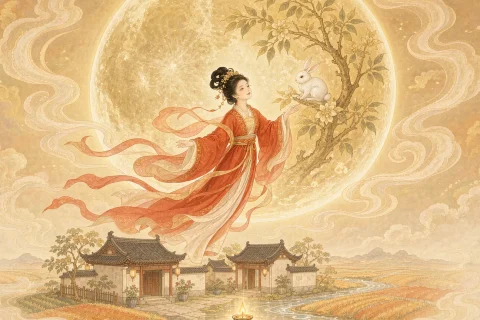
It is a cassia tree. In China the cassia is not just a tree. It flowers in the eighth month, and the flowers are small and pale and yellow, and when it blooms the whole courtyard fills with a fragrance that comes and goes. Cassia has a strange quality. You can smell it from far away. When you walk up close to the tree, the smell becomes faint.
That quality is exactly why the Chinese hung the cassia in the moon. The fragrance is somewhere between there and not there, like something arriving from very far off with no visible source.
And that is where the Mid-Autumn association comes from. Every year on the fifteenth night of the eighth month, families set out cassia wine and cassia cakes and look up, and the smell of the season is in the air at the same time.
So there is a folk saying that the cassia fragrance on a Mid-Autumn night comes down from the moon.
A harsher way of putting it goes like this: the fragrance comes out of the wound the axe just opened.
That last line is not in any old book. It is what people are willing to believe. A tree that has been cut for ten million years still puts out flowers, and those flowers have perfumed every autumn on the earth.
The same tree carries a second meaning on the ground.
The moon palace in the old books is also called the toad palace, because of the toad that lives there. And the cassia became the tree of the imperial examinations. When a scholar passed the highest examination and won a place in the government, people said that he had plucked a cassia branch in the toad palace. He had reached the moon, taken one flowering sprig, and come home with it.
So the same tree grew two meanings.
For Wu Gang it is the thing that cannot be cut, and the work that can never be finished. For the scholar it is one flowering branch, small enough to carry home, big enough to lift a whole family.
One man is condemned to stand under it with an axe. A crowd of other men stand outside the gate and look up at it. The only thing between them is whether a person is allowed.
There is one more thread in this story, and it is the one most tellings leave out.
The wife of Wu Gang, as was said, had three sons: Gu, Yan and Shu.
Those three grew up and did things. According to the same old text, Gu and Yan were the first to make bells, and they gave shape to the music of the people. In other words, the oldest instruments in China had their hands in them.
Now set the family in one picture.
The father is on the moon, with a tree that cannot be cut down, an axe, and a motion that repeats forever. The sons are on the earth, making bells, building instruments, adding sound to the world.
One of them turns repetition into nothing. The others turn nothing into something.
In the original text these two entries sit in separate places, and it was later readers who decided that these people were one family. It is a good join. It is hard to think of a better one.
So come back to the tree one last time.
He does not need to cut it down, and nobody has asked him to cut it down. The rule has only one word in it. Chop.
The old book says he is always chopping. Always. Chop.
So when you look up tonight, you will not see a man, and you will not see a tree. The markings on the moon, the ones the Chinese called a toad, a rabbit and a cassia, are just markings.
And he is still at it.
The blade goes in. The tree closes. The blade goes in again. The tree closes again. One stroke. One stroke. One stroke.
It has been a very long time.
The tree has not lost so much as a piece of its bark.