English has a plain word for it: a comeback. Chinese makes it a landscape. There is a mountain in the phrase, and a man who lived on that mountain for twenty years before he came down.
The Chinese idiom is 东山再起, in pinyin *dong shan zai qi*. Word for word, it means rising again from the Eastern Mountain. It is used for anyone who steps back, disappears for a long while, and then returns to a higher place than he left.
The story behind it belongs to the Eastern Jin dynasty, and it comes from the *Book of Jin*, the official history of that age. The man was Xie An, and for most of his life he was famous for one thing. He refused to take a job.
In Eastern Jin, Xie An had been known since he was a child.
He came from the Xie clan of Chenjun. At the age of four, an elder looked at him and said his spirit was clear and fine. As a young man he spoke slowly, thought carefully, and kept company with the most celebrated people of the day. Wang Xizhi, the greatest calligrapher in Chinese history, was one of his friends.
By any normal standard, a man like this should have entered the government early.
He did not go.
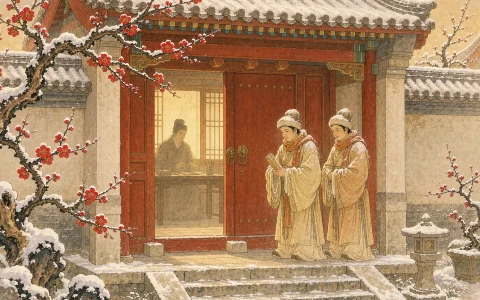
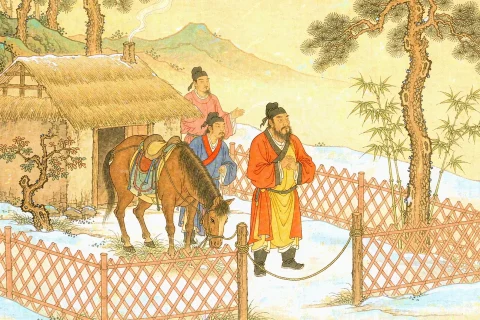
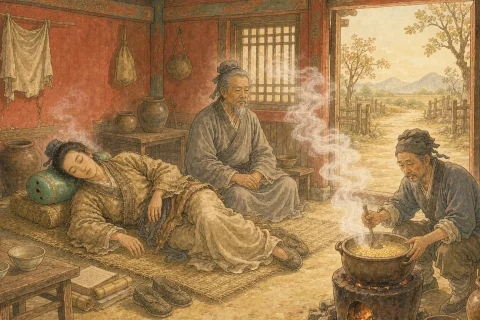
The court invited him again and again. He refused each time. In the end he moved to the Eastern Mountain near Kuaiji, and lived there with Wang Xizhi and the others, sailing, fishing, walking in the hills, writing poems.
This was not a pose. He genuinely believed that the court of his time was a swamp of factional fighting, where even one honest sentence was hard to speak. He preferred to keep his distance in the hills and stay clean.
The *Book of Jin* records how he spent those years. He would go out to fish and hunt among the hills and rivers, and come home to recite poems and write prose. Orders from the court arrived one after another. He read them, folded them, and set them aside. He told people he was not refusing office forever. He was waiting for a moment he could accept.
Once, he and his friends went out to sea and ran into a storm. Everyone on the boat turned pale and shouted to go back. Xie An sat in the bow, unhurried, and went on reciting poetry. The waves were heavy, and his voice never wavered. Watching him, the others calmed down. Only then did the boatman dare to turn for shore.
Back at court, people were anxious about him.
A saying went around at the time. If Anshi will not come out, what is to become of the common people? Anshi was Xie An’s courtesy name. The meaning was simple. A man of your ability, staying in the hills, while the country needs him. What about the rest of us?
The words reached him. He still did not move.
He spent a long time on the Eastern Mountain. Long enough for his younger brother Xie Wan to lead a northern campaign and rise to high office. Long enough for the court to change faces several times over.
Some people assumed he would spend his whole life like this. It is possible that he sometimes thought so himself.
Then the turn came, and it came fast.
Xie Wan went north, underestimated his enemy, lost the battle, was stripped of his post, and reduced to a commoner.
The footing of the Xie clan at court suddenly shook.
At this point, Xie An, now past forty, had no choice but to come out.
He did it for more than himself. The position his branch of the family had built over generations was about to collapse, and the Xie clan did not have many men left who could hold a place at court. With Xie Wan down, if Xie An stayed in the hills, another clan would take the spot. In the world of the great families, you advanced or you slid. One step back could drag a whole house down. If he stayed in the mountains, no one would be left standing in front of the family.
His first post was as aide to Huan Wen.
It was a middling position, given on purpose to test him. Xie An took it without complaint.
He was already past forty. He came down from the Eastern Mountain, and few at court knew him, though he was older than most of the men around him. They looked at him and saw the famous Anshi who would not take office, suddenly standing next to them, and did not know quite what to call him.
Huan Wen was the most powerful man of the age. He held the armies, he read people well, and he carried his authority heavily. Under him, Xie An neither bowed nor bristled. Once, Huan Wen held a banquet with armed men hidden behind the screen. The mood in the room went cold. Xie An did not change expression. He sat down and recited a poem, and the line about the vast rushing river came out calm and steady. The whole room was quiet. Huan Wen never gave the order, and the ambush was quietly withdrawn.
Later, when Emperor Jianwen died, Huan Wen wanted to use the moment to seize the throne. He summoned Xie An and Wang Tanzhi. Wang Tanzhi was so frightened that his sweat soaked through his clothes, and he walked in holding his court tablet upside down. Xie An walked into the tent, sat down, and asked one question. I have heard that the rule among the lords is that each keeps to his own territory. General, what is the purpose of the soldiers you have placed behind the tent?
Huan Wen had no answer. He did not dare move.
In time, Xie An became prime minister.
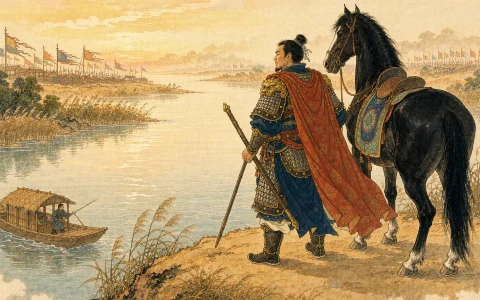
Then the Former Qin state, under Fu Jian, came south with a great army. The court panicked. Xie An was named commander-in-chief, and stayed in the capital, Jiankang, to direct the war.
He gave the fighting to his nephew Xie Xuan.
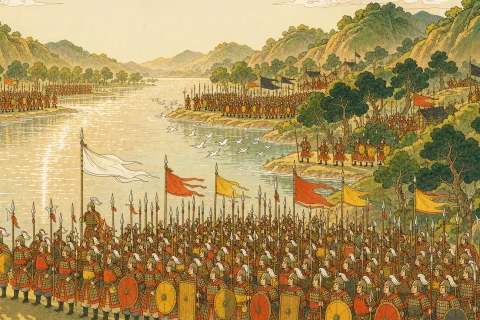
Xie Xuan had eighty thousand men of the Beifu army. Across the field, Fu Jian’s force was said to number a million. Their banners covered the sky.
Any other man would have lain awake night after night.
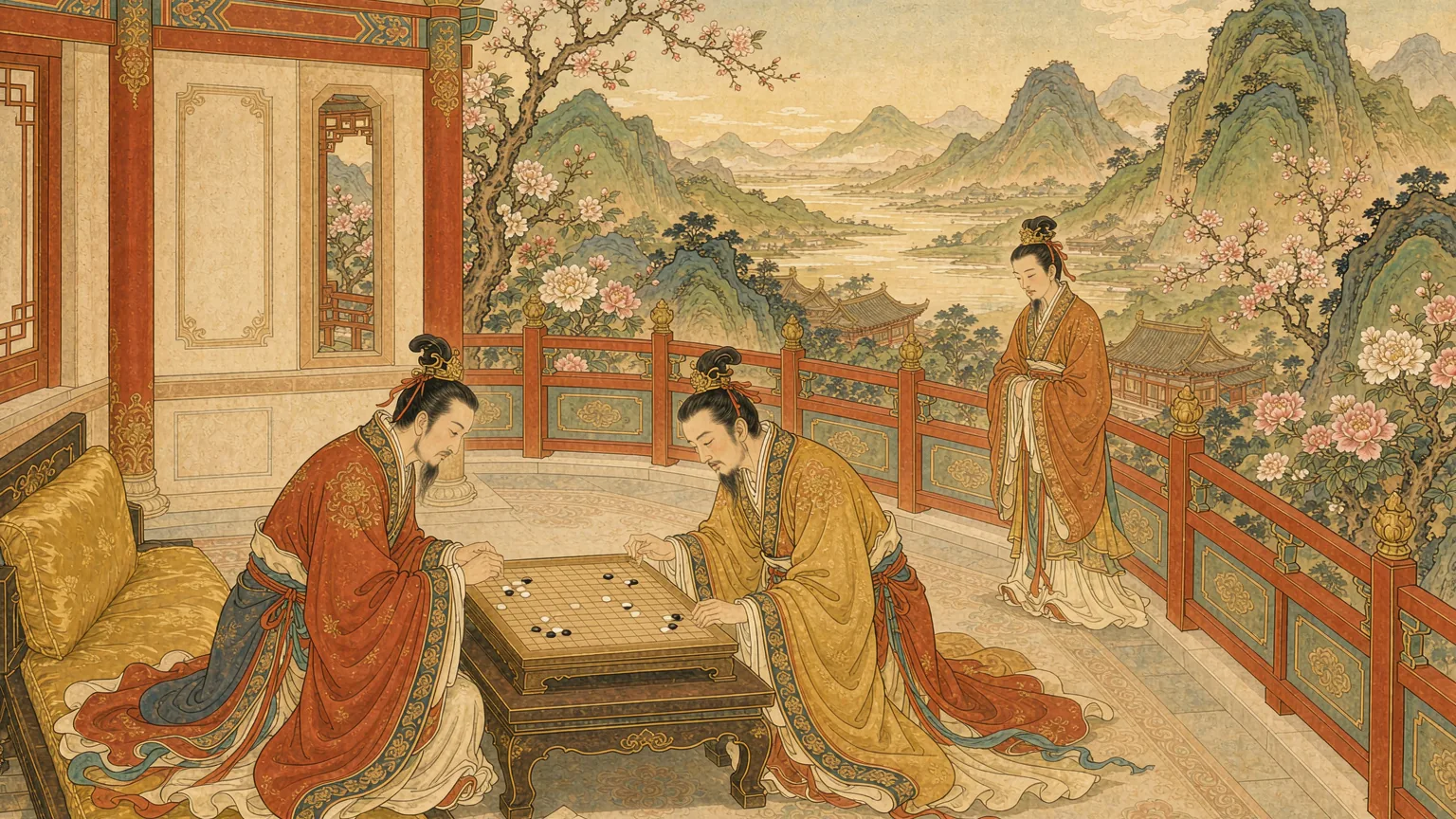
Xie An did not. He went on with his routine. Before the battle, he invited friends out to a country villa to play a game of Go.
The game was against his nephew Xie Xuan. Xie An wagered the villa itself. Xie Xuan was normally the stronger player by far, but his mind was full of the enemy across the river, and his moves went wild. He lost. Xie An took the villa, and gave it away on the spot to a nephew named Yang Tan. He was telling Xie Xuan one thing with an afternoon of chess. Do your job. Being afraid changes nothing.
That day, the battle was being fought. He was playing.
Halfway through the game, a messenger from the front arrived and handed him a letter.
Xie An read it, put it down on the couch beside him, and without the least change on his face went on playing.
The guest could not hold back. How is it at the front, he asked.
Xie An answered quietly. The boys have beaten the enemy, he said.
That was all. Then he placed another stone.
The guest could not sit still any longer. He left before the game was finished.
Xie An saw him out, then turned and went back inside. Only then did he notice that the wooden clog on his foot had lost a tooth against the doorsill.
He had walked all the way in without feeling it. He was that happy.
The game was not finished before the war was decided. He held the greatest news of his life under one sheet of paper, and did not let it show until the whole board was done.
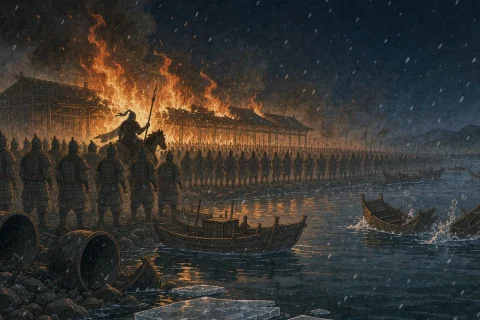
At Feishui, eighty thousand men of Eastern Jin broke Fu Jian’s army, and the lands south of the Yangzi were safe.
The xie in 东山再起 has been used ever since for promotions, careers, and men who fall and climb back up.
But its real weight is not there.
Xie An hid on the Eastern Mountain for close to twenty years. He was not idle. He was building the floor a man stands on. When he finally came down, he was over forty, later than everyone else, and steadier than anyone else.
A comeback is not the sentence “I am back.”
It is a man who stepped away for a long time and still stood upright, who stayed hidden and still dared to return, and who could set the most important stone of his life down without his hand shaking. Chinese proverbs like this one are sometimes mistaken for Chinese fables about luck. This one is about neither.