In English we say a person is licking his wounds. It means he has been beaten, and he is nursing what is left of his pride.
Chinese says something harder. Chinese says the man did not lick his wounds. He tasted something far more bitter, on purpose, every single day.
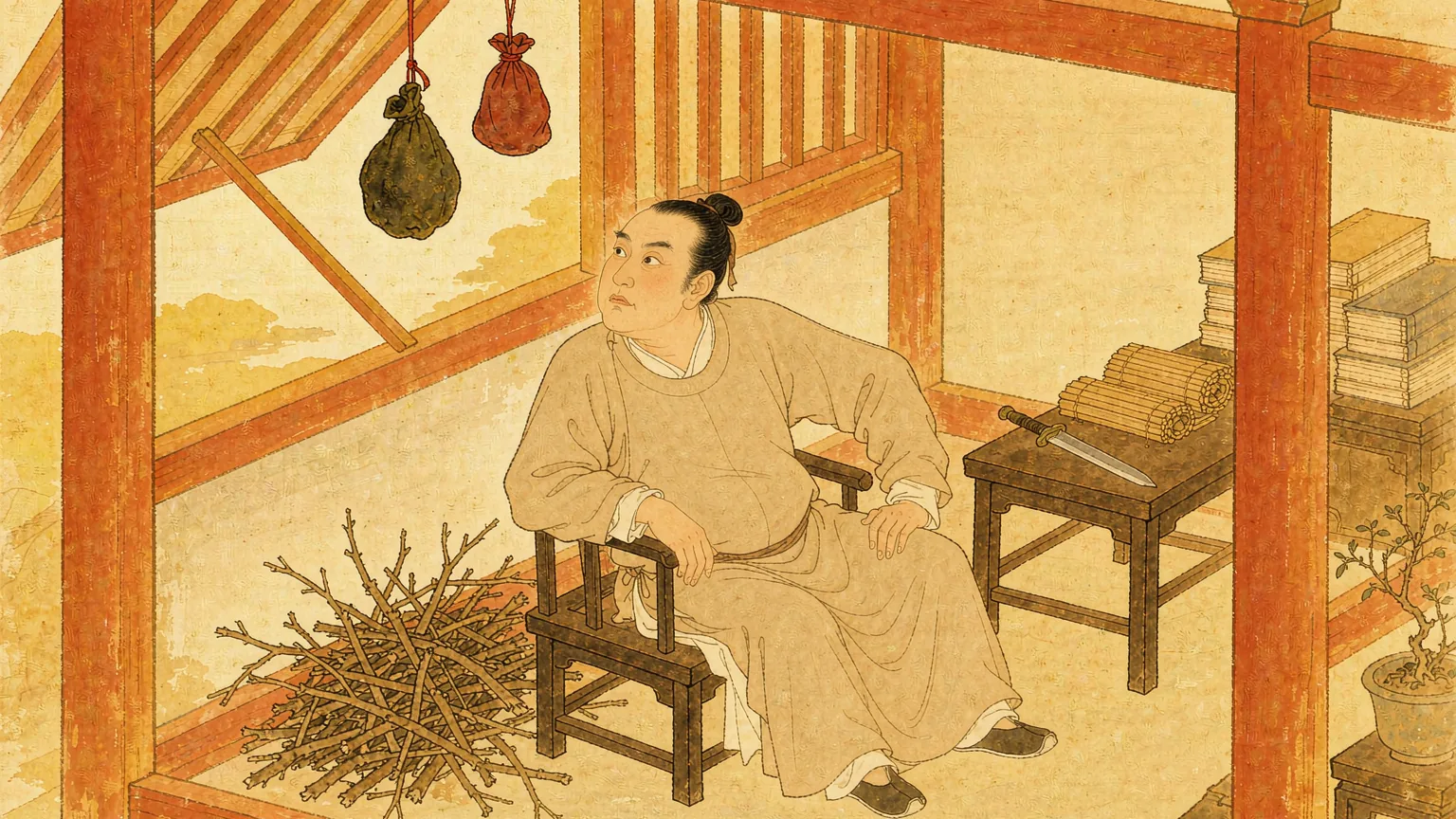
The Chinese idiom is 卧薪尝胆, in pinyin *wò xīn cháng dǎn*. It means, word for word, sleep on brushwood and taste gall. Gall is the bitter green liquid found in an animal’s liver, and it is the most bitter thing in a Chinese kitchen. Brushwood is a pile of dry branches, the kind of thing nobody would ever call a bed.
Put together, the four characters describe a man who refuses to be comfortable, because he refuses to forget.
Like many Chinese fables, this one has real people in it. The man’s name is Goujian, the king of a small southern state called Yue. He lived about two and a half thousand years ago. And for three years he was not a king at all. He was a servant, feeding horses in the courtyard of the man who had beaten him.
That is where the story begins.
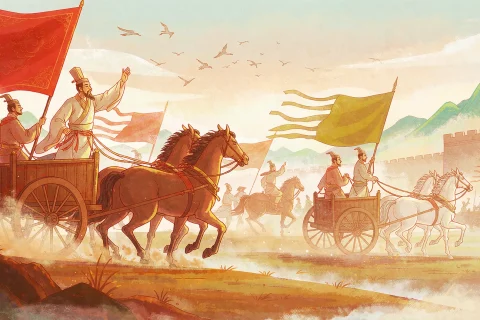
The battle happened at the foot of Mount Kuaiji, in the wet green south of China.
Yue struck first. King Goujian heard that the ruler of Wu had just lost his father, and he decided that grief would make Wu weak. So he attacked.
He was wrong.
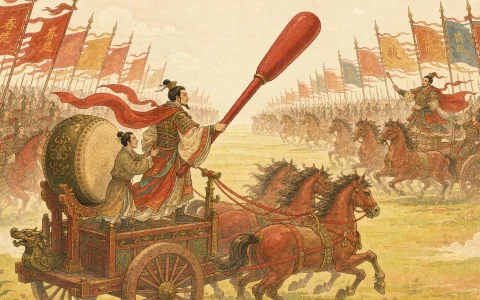
Wu had a new king, named Fuchai, and Fuchai was not weak. He drove the Yue army back through the hills and trapped what was left of it on Mount Kuaiji. Five thousand men. No food. No way out.
Goujian stood on the hill and looked down at the campfires of the enemy. His chief advisor, Wen Zhong, came to stand beside him.
There is only one way, Wen Zhong said. We must beg for peace.
Beg? How do you beg from a man you just tried to kill?
There is a minister in Wu, Wen Zhong said. His name is Bo Pi, and he is greedy. Send him gold. Send him treasure. Send him beautiful women. Let him speak for us.
A messenger went down the hill that night.
In the Wu camp, King Fuchai was ready to say yes. Then an old general named Wu Zixu stepped forward and stopped him.
If you do not destroy Yue today, Wu Zixu said, you will regret it for the rest of your life.
So the deal stalled. Then Wen Zhong offered something bigger. Yue would not simply surrender. Yue would become a servant state. And Goujian himself would come to Wu and serve Fuchai in person, as a slave.
That offer Fuchai liked.
Goujian bit down on his pride and said yes.
He took off the robes of a king and put on coarse cloth. He walked with his wife through the gates of the Wu palace, and no one bowed.
Fuchai did not kill him. He gave him a job. Goujian was told to keep the horses.
So every morning before sunrise, a king swept out a stable. He cut grass and filled buckets of water. The people of Wu walked past and pointed. Some of them called him the king who lost his country. He kept his head down and said nothing.
Three years went by.
Then Fuchai fell ill.
He was sick for a long time, and the court began to whisper that he might die. Goujian asked to see him. What he did next shocked everyone in the room. He asked to taste the king’s waste, to tell from it what the illness was.
The whole hall went silent. Fuchai stared at him.
Goujian tasted it. Then he raised his head, and his face was bright with joy.
Your sickness is not serious, he said. In a few days you will be well.
How can you know that, Fuchai asked.
Goujian said he knew a little medicine. He said the taste of the waste, bitter with a hint of sweet, was the sign of a body about to heal.
This scene is not in the *Records of the Grand Historian*, the great history written by Sima Qian. It comes from an older and looser book called the *Spring and Autumn Annals of Wu and Yue*. But no one who tells this story ever leaves it out.
Fuchai got better. From that day on, he trusted Goujian completely. A man who would taste your waste, he thought, is a man who has truly given in.
Wu Zixu was frantic. He went to the king again. He said that this man could endure anything, and that this was the most dangerous kind of enemy. Kill him now.
Fuchai no longer listened. Soon Bo Pi, the greedy minister, whispered enough poison about Wu Zixu that the king handed the old general a sword and ordered him to die.
Wu Zixu had one last thing to say. Take out my eyes, he said, and hang them on the east gate of the capital. I want to watch the armies of Yue march in.
Nobody paid attention.
Not long after, Fuchai decided that keeping Goujian around was pointless. He sent him home.
Goujian walked back into his own palace. Everyone expected him to rest. He did not.
He had a pile of brushwood laid down beside his seat. He hung a gall bladder from the beam in the middle of the room. Every time he sat down, he looked up and tasted it. It was so bitter that it made his face twist.
The people around him did not understand. So he asked himself a question, out loud, every day.
Have you forgotten Mount Kuaiji?
Then he went back to work.
He slept on the hard brushwood. He ate plain food. He worked in the fields himself, and his wife wove cloth with her own hands. He cut taxes again and again, so that the farmers could get back on their feet.
Sima Qian wrote that he spent ten years helping his people grow, and ten more years training his army.
Ten years is more than three thousand days. On every one of them, before the first meal, there was that taste of gall.
Meanwhile, Wu grew magnificent.
Fuchai dug canals. He built great ships. He took his army north to compete with the lords of the Central Plains, and at a place called Huangchi he forced even the state of Jin to give way.
Behind him, Yue said nothing.
The year Fuchai went north, he took his best soldiers with him. The Wu capital was left with the old and the young.
That was the moment Goujian had been waiting for.
The Yue army marched out of Kuaiji and struck straight at the Wu capital.
Wu’s army broke. Fuchai’s son, the crown prince, was killed. When the news reached Huangchi, Fuchai was in the middle of a ceremony to claim leadership of the lords. He told no one. He slipped away and hurried home.
By the time he got back, it was too late.
Fuchai sent men to ask for peace. Goujian weighed it. Wu was hurt, but not finished, and he could not destroy it yet. So he said yes, and let a few more years go by.
Then Yue attacked again. This time the Yue army surrounded the Wu capital and stayed for three years.
When the city fell, Fuchai fled to a hill called Gusu and sent a letter down.
Once, at Kuaiji, I did not kill you, the letter said. Will you let me live now?
Goujian’s heart wavered.
Fan Li, his other great advisor, spoke up. Do not let him go, he said. Fuchai apologizes faster than any man alive. But give him time to heal, and he will be exactly what he was before.
Goujian thought about it. Then he offered Fuchai a way out. He could go to a place called Yongdong, he said. He would be given a hundred families there, and could live out his days.
Fuchai heard the offer and laughed once, out loud.
I am too old, he said, to face Wu Zixu again.
He killed himself.
With Wu destroyed, Goujian led his army north, met the other lords, and became the last great overlord of the Spring and Autumn period.
From five thousand beaten men on a hill to overlord of the plains. In between lay three years in a stable, a single gall bladder, and twenty years of grinding work.
Later, Fan Li left. He had seen what kind of man Goujian was. He could share hardship with you, but not comfort. He sent Wen Zhong a letter. When the birds are all shot, he wrote, the good bow is put away. When the rabbits are gone, the hunting dog goes in the pot.
Wen Zhong stayed. In the end, Goujian ordered him to die.
But people rarely remember that part.
What they remember is the gall bladder hanging in the room, and the pile of dry branches on the floor.
This Chinese proverb has outlived the kingdom it came from. Two thousand years later, English speakers still talk about grit. Chinese speakers still say the four characters, and they mean the same stubborn thing. The wound is not healed. The work is not done. And sleep can wait.
The gall is bitter. The brushwood is hard. He touched them both every day, not so that anyone would see.
So that he would not forget.