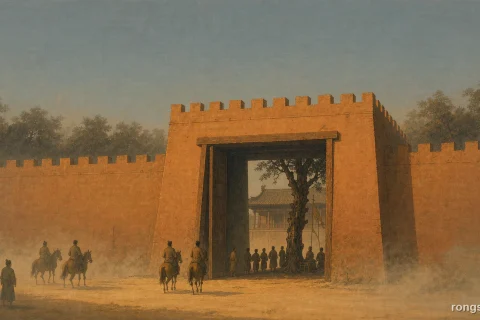
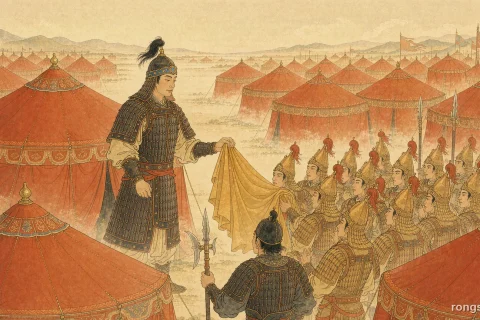
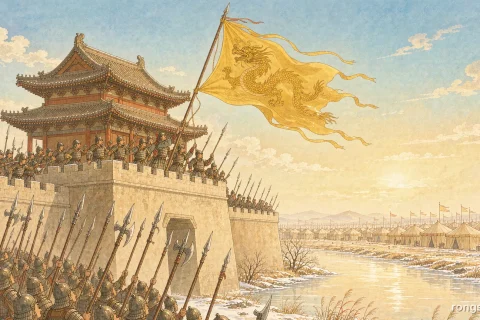
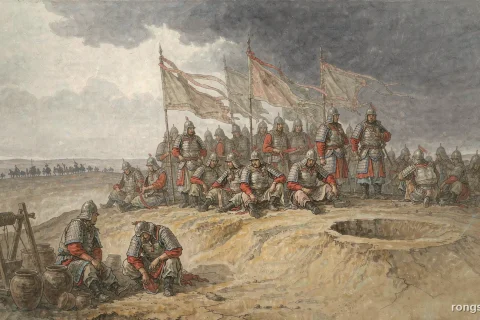
On the night of 20 April 1949, nine thousand wooden boats lay hidden in the reeds on the north bank of the Yangtze River.
They were not warships.
The largest could carry a platoon. The smallest held seven or eight men and no more. They were fishing boats, cargo boats and ferries, borrowed one at a time from the families who lived along the river.
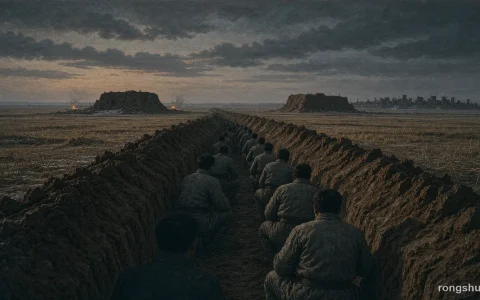
Soldiers crouched in the holds. More soldiers crouched behind the dikes on shore.
Across the water lay the Yangtze defence line, which the Nationalist government had spent three and a half months building. Pillboxes. Gun emplacements. Searchlights. Warships working up and down the channel.
Nobody spoke.
The sky was overcast. There was no moon.
Then three red signal flares went up and lit half the sky.
Several thousand boats started south at once.
This battle did not have to happen.
Between the autumn of 1948 and January 1949, in less than six months, the People’s Liberation Army fought three enormous campaigns: Liaoshen in the northeast, Huaihai in the centre, Pingjin in the north.
When they were over, the Nationalists had lost most of what they had. Their armies had shrunk from more than four million men to about two million, and fewer than one and a half million of those could still be put in a line.
On the other side, the PLA had grown from 1.2 million at the start of the civil war to 3.58 million.
North of the Yangtze, there was nobody left to fight.
So Chiang Kai-shek withdrew to the south, and put his last card on the table. The card was the river.
The Yangtze runs more than 1,800 kilometres from the gorges down to the sea. Along that line Chiang placed 115 divisions, about 700,000 men. Tang Enbo, commanding the Nanjing-Shanghai-Hangzhou sector, held the stretch from Hukou to Shanghai with another 450,000. The navy patrolled the channel day and night. The air force could be up in minutes.
Seven hundred thousand men. More than a hundred warships. Aircraft.
What Chiang wanted was one thing only. He wanted to divide China at the river.
North of the water, the Communists. South of it, his own government. Two Chinas, side by side.
For English readers this needs a word of explanation, because the Yangtze is not just a river in Chinese history. It is the line that splits north from south: different food, different speech, different weather. In the year 208, a northern army far larger than its enemy was destroyed on this water at Red Cliff, and China stayed divided for centuries afterwards. Everybody in 1949 knew that story.
On 1 April 1949, talks opened in Beiping between the two sides.
The PLA was in fact already ready. To give the talks a chance, the date of the crossing was pushed back again and again.
On 15 April the two delegations agreed a final draft of the peace terms and fixed 20 April for the signing.
On 20 April, the government in Nanjing refused to sign.
After that there was no other way.
To cross a river, you need boats.
The PLA had no navy. It did not own a single proper ship.
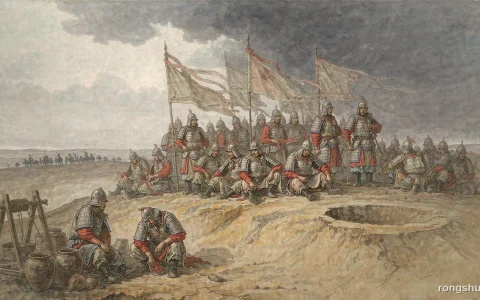
That spring, almost every boat on the north bank had been towed to the south by the Nationalists, or scuttled where it lay. When the PLA reached the water, its hands were empty.
So they went looking, one boat at a time.
People pulled their boats out of the reeds, up from the riverbed, out of the mud at the bottom of the ponds. Some brought the boat they had used for half a lifetime and said, take it.
By the time the crossing began, they had gathered more than 9,400 wooden boats.
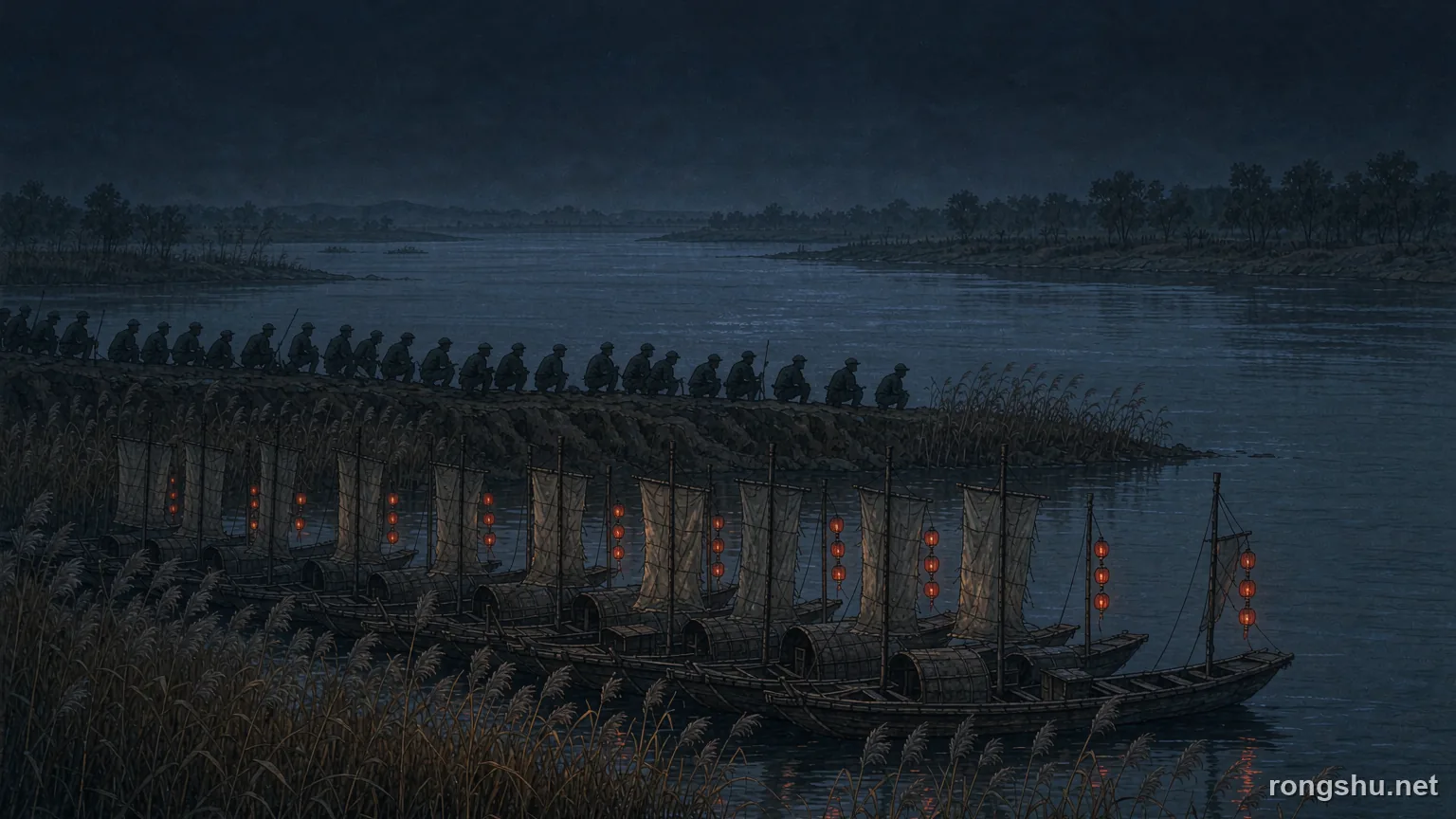
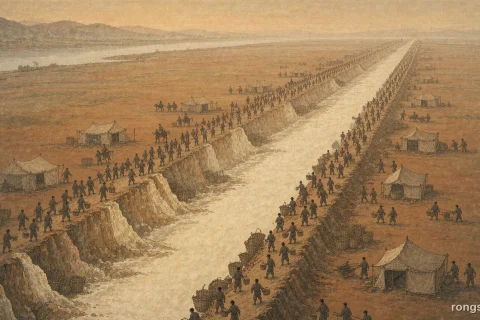
For months beforehand, the marshes on the north bank were full of men practising. They dug ponds to stand in for the river, and practised climbing in and out of boats, rushing the far bank, and plugging shot holes with padded quilts when the planks started taking water.
Boats were one thing. Somebody had to row them.
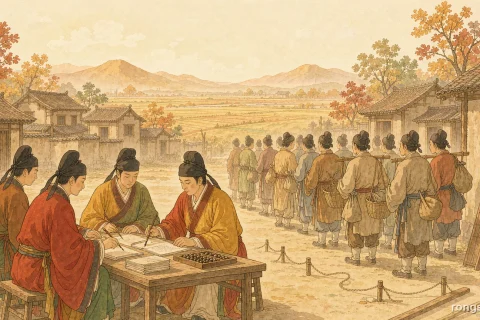
A few thousand soldiers were taught to handle an oar. But the people who really knew this water were the boatmen who lived beside it. More than ten thousand of them went across with the army. Add the labourers who built roads, carried grain and hauled stretchers, and the number reaches three million.
Those three million propped up the second half of this war with handcarts, shoulder poles and their own backs.
There is one small detail I like very much.
A scout named Qi Jinhu took a handful of men onto Heishazhou, an island in the middle of the river. When it was time to leave, their boat was gone. They hid on the island for more than ten days. In the end they crossed the Yangtze in a wooden washtub.
One man. One washtub.
When the story reached the troops, everyone understood the same thing. The river looked terrifying, but it could be crossed.
On the morning of 20 April, a warship came up the river.
It was not a Nationalist ship. It was British: HMS Amethyst.
She was steaming upstream towards Nanjing. The British said she was going to collect civilians.
But Xinhua had already announced that every foreign warship had to be out of the Yangtze before 20 April.
She did not leave. She came in.
For a hundred years, foreign gunboats had gone up and down Chinese rivers whenever they liked, protecting trade, enforcing treaties, and reminding everybody who was in charge. British warships had been on the Yangtze since the 1850s. In London this was ordinary business. In China, by 1949, it was not.
At half past eight in the morning Amethyst reached the water off Sanjiangying, in Jiangdu, Jiangsu. On the bank ahead of her was the ground the PLA had chosen for its crossing.
The gunners on shore fired a warning shot.
She did not turn round. She kept coming, and her turrets swung towards the bank.
The PLA opened fire. Amethyst fired back.
Within minutes her bridge took a direct hit. Her captain and first officer were both badly wounded. Her forward turret was knocked out and her rudder jammed. She swung out of control, ran onto a shoal and stuck fast.
Then she ran up a white flag. The flag was a bedsheet.
When word got out, the Royal Navy could not sit still.
At half past one that afternoon HMS Consort, lying at Nanjing, came charging upstream to tow her off. By three o’clock Consort had lost both her forward turrets, her bridge had been hit and her captain was wounded. She turned and ran east.
The next morning Vice-Admiral Alexander Madden, deputy commander of the China Station, came up from Shanghai himself with the heavy cruiser HMS London and the frigate HMS Black Swan.
That fight was worse. A shell hit London’s command tower. Her captain was badly wounded. Madden was thrown across the deck by the blast, his dress uniform torn open by shrapnel.
Both ships ran as well.
In three exchanges of fire, four British warships were damaged. The British later counted their own losses: forty-five dead, one missing, ninety-three wounded.
On the Chinese side, 252 men were killed or wounded. A regimental commander of the 23rd Army, Deng Ruobo, died under that shelling.
Britain was in an uproar. Winston Churchill, out of office but still in Parliament, got up and demanded that aircraft carriers be sent to the Far East for revenge.
Mao Zedong issued a statement in the name of the PLA headquarters. One sentence mattered most. China’s territory and sovereignty, it said, would be defended by the Chinese people, and no foreign government would be allowed to violate them.
Amethyst stayed where she was while the talks went nowhere. On the night of 30 July she took advantage of a rising river, put a passenger steamer between herself and the shore, and slipped out of the Yangtze.
After that, the foreign gunboats that had moved up and down this river for a hundred years were never seen on it again.
On the night of 20 April, the centre group moved first.
Three hundred thousand men, more than a thousand boats, along more than a hundred kilometres of water, from Yuxikou near Wuhu to Zongyang. All at once.
There is one detail the men who were there kept telling afterwards.
At the stern of every boat, a small red lamp was lit.
The lamp was shielded at the front, on the left and on the right. It could only be seen from behind.
So if you stood on the south bank and looked north, the river was black. You saw nothing at all.
If you stood on the north bank and looked south, you saw numberless small red lamps drifting on the water, all the way out to the horizon.
Zhang Xiaohua had pulled an oar on this river for more than twenty years. He volunteered, and was put in the first boat of the first assault group of the 27th Army.
Half an hour out, his boat was in the lead.
The machine guns on the south bank opened up. Shells threw columns of water up among the boats. Planks were punched through and the river poured in. Men were hit and went into the water without time to call out.
The boats kept going.
A boat was blown apart and the one behind it simply went round. Nobody stopped to pull anyone out. Nobody turned back.
That night, three hundred thousand men of the centre group crossed the Yangtze.
The PLA headquarters had a rule. When a battalion was across, the division commander went across. When a regiment was across, the army commander went across.
Nie Fengzhi, commanding the 27th Army, was among the first senior officers onto the south bank. The moment his boots hit the mud he sent a telegram back to the front committee. It was one line: we have set foot on the soil south of the river.
On 21 April, Mao Zedong and Zhu De issued the order to advance, and the order went out over radio, newspapers and leaflets to every position along the river.
That same day, two things happened on the water.
The first was at Jiangyin.
Jiangyin Fortress guarded the narrowest stretch of the lower Yangtze. At that point the river is only about fifteen hundred metres wide, and people called the place the gateway to the river defences. Tang Enbo put seven thousand of his best troops in it, with more than ninety guns. Their job was simple. Seal the river. Any boat that wanted past had to ask those guns first.
On the evening of 21 April, the fortress commander, Dai Rongguang, gave the order to fire.
The shells did not fly north.
Underground Party members inside the fortress, led by Tang Binglin, burst into the command post. Battery by battery, the guns swung round and pointed at the water to the south.
Seven thousand officers and men came over.
Just like that, the batteries that were meant to seal the crossing became the batteries that covered it. Nationalist warships were shut out of that stretch of river by their own guns.
Soldiers of the nearby Nationalist 21st Army shouted across the water, furious. Why are you firing on your own people?
The second thing happened on the river off Badoushan, east of Nanjing.
Lin Zun, commanding the Nationalist Second Fleet, brought twenty-five ships over. Another twenty-three surrendered at Zhenjiang, further upstream.
That same afternoon, the eastern group prepared to cross.
At three in the afternoon the wind on the river was still from the south-east. At four it dropped. Then it turned north-east.
A following wind. Full sails.
The assault boats went south like arrows and were on the far bank in fifteen or sixteen minutes.
The first wave was the 23rd, the 28th and the 29th Armies. East of Jiangyin they tore the line open, fought for a day and a night, threw back one counterattack after another, and dug in along a line running through Xiangshan, Qinhuangshan, Nanzha and Baizhangzhen.
Then they pushed south. Changzhou. Wuxi. Suzhou. One after another.
On 23 April, Nanjing.
That day the city was barely fought for.
The government officials had already gone. Underground Party members were keeping order in the streets, waiting for the PLA to arrive.
The unit that entered was the 35th Army. Part of it had been formed from Nationalist troops that came over during the battle of Jinan.
At midnight, the 35th Army walked into the Presidential Palace.
The flag that had hung on the roof for years was pulled down.
From the first boat leaving the north bank on the night of 20 April to the red flag over the Presidential Palace at midnight on 23 April, three days had passed.
Once Nanjing fell, the river line meant nothing. The PLA went south after them, and a little over a month later, on 27 May, Shanghai was taken.
There is one thing about Shanghai that people still talk about.
Shanghai was then the biggest city in China, with millions of people in it. Factories, docks and power stations were packed in shoulder to shoulder. With heavy artillery it could have been taken in a day, and what would have been taken would have been rubble.
So the order went out. Fight inside the city with light weapons. No heavy guns.
The battle was awkward, and it was slow.
On 27 May Shanghai was liberated. The water and the power never went off, and the factories barely stopped.
That night, not one soldier knocked on a civilian door. They sat down with their rifles on the pavements along both sides of the street and slept there.
The next morning people opened their windows and saw rows and rows of sleeping soldiers.
A hundred and fifty-odd days later, on 1 October 1949, in Beijing.
On the rostrum at Tiananmen, one man spoke to the crowd below. The People’s Republic of China, and its central people’s government, had been founded.
Zhang Xiaohua’s boat was taken to the Military Museum in Beijing.
The holes punched in her planks by machine-gun fire were never patched.
Of the more than 9,400 wooden boats, almost none survived. They went back to the Yangtze, to fishing and ferrying and carrying passengers, and rotted away, one day at a time.
Only this one was kept, wiped clean, and put behind glass.
She sits there. Anyone who walks past can see her.