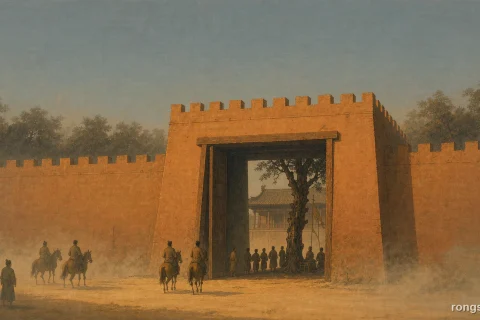
In the winter of 1004, on the wall of a river town, a soldier turned a heavy crossbow and looked at a man in a yellow robe.
It was cold. The Yellow River was beginning to freeze. North of the wall the enemy camp stretched from the foot of the rampart to the horizon.
That day a few officers rode out. One wore yellow. He was pointing at the ground, reading the land.
He was inside the range of the great crossbows.
The soldier served one of those. It had to be spanned with the foot by several men together, and it threw not an arrow but a heavy bolt.
He aimed at the man in yellow and released.
The man went down off his horse. That night he died.
The camp wept. The dead man was their field commander, Xiao Talin, one of the authors of this invasion.
That bolt took the war onto a different road.
Two Men Who Wanted to Run
To see why, go back to the autumn.
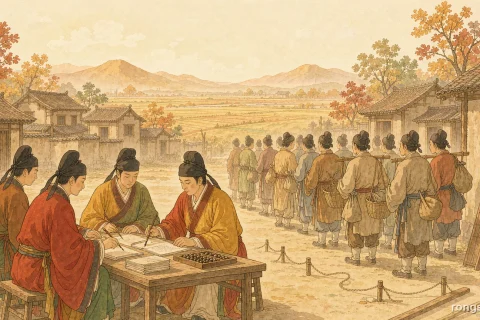
The year 1004 had not been a quiet one. Earthquakes had shaken the capital in the spring. Then, in the ninth month, the Liao empire moved.
Its emperor was thirty-two. The real power was his mother, the Dowager Empress Xiao, who had run the empire for more than twenty years and understood both war and arithmetic. She led the Liao cavalry south into Hebei.
The army was said to number two hundred thousand.
They did not sit down in front of fortresses. They went around them and drove south. The walled towns of the frontier shut their gates and watched the cavalry stream past and vanish deeper into the country. In under two months the Liao vanguard reached the north bank of the Yellow River.
South of the river lay the Song capital, Kaifeng. Between the two there was one river and one town: Chanzhou.
The news reached the court, and the emperor asked his ministers what to do.
The first to speak was a deputy chief councillor from the south, Wang Qinruo. Go to Jinling, he said. Get out of the way.
The second was an official from Sichuan, Chen Yaosou. Go to Chengdu. The mountains will hide you.
Both plans came to the same thing. Jinling sat on the far side of the Yangtze; Chengdu sat behind a wall of mountains.
One man in the room disagreed.
The new chief councillor was named Kou Zhun.
Whoever gave your majesty those two ideas, he said, deserves death for it.
Then he went on. The army is still here, he said, and the generals have not turned on each other. If your majesty goes north in person, the enemy will fall back. And even if they do not, we can raid their flanks and hold our walls and wear them out. How can we abandon the ancestral temples and run off to Chu or Shu?
The emperor did not run. He decided to go north himself.
But he went reluctantly, and he went slowly.
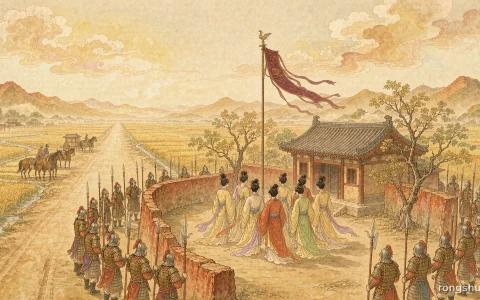
The column left Kaifeng and moved north. At a town called Weicheng the emperor wavered. Someone had been whispering to him: turn around, go south, keep out of the way of the Liao cavalry.
He sent for Kou Zhun.
Kou Zhun did not soften it. The men telling your majesty to run south, he said, are no wiser than old women in a village. The enemy horse are already at our throat. Your majesty can advance a foot but not retreat an inch. The soldiers in Hebei look every day for the imperial standard. Take a few steps back and the whole army comes apart.
The emperor still hesitated.
Kou Zhun walked out and found the commander of the palace guard, Gao Qiong. What will you give the state in return for all it has given you? he asked.
The old soldier answered plainly. I am a soldier, he said. I will die for it if I must.
Kou Zhun went back in, with Gao Qiong following into the courtyard. If your majesty doubts my word, he said, ask Gao Qiong.
Gao Qiong put it in a way the emperor could not argue with. The men who marched out with your majesty left their parents and wives and children in the capital, he said. They will not leave them and run south; they would desert on the road. Go on to Chanzhou, and we will fight to the death.
Only then did the emperor settle, and the column went on north.
The Emperor Crosses the River
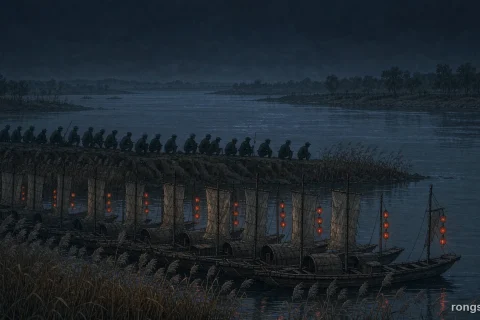
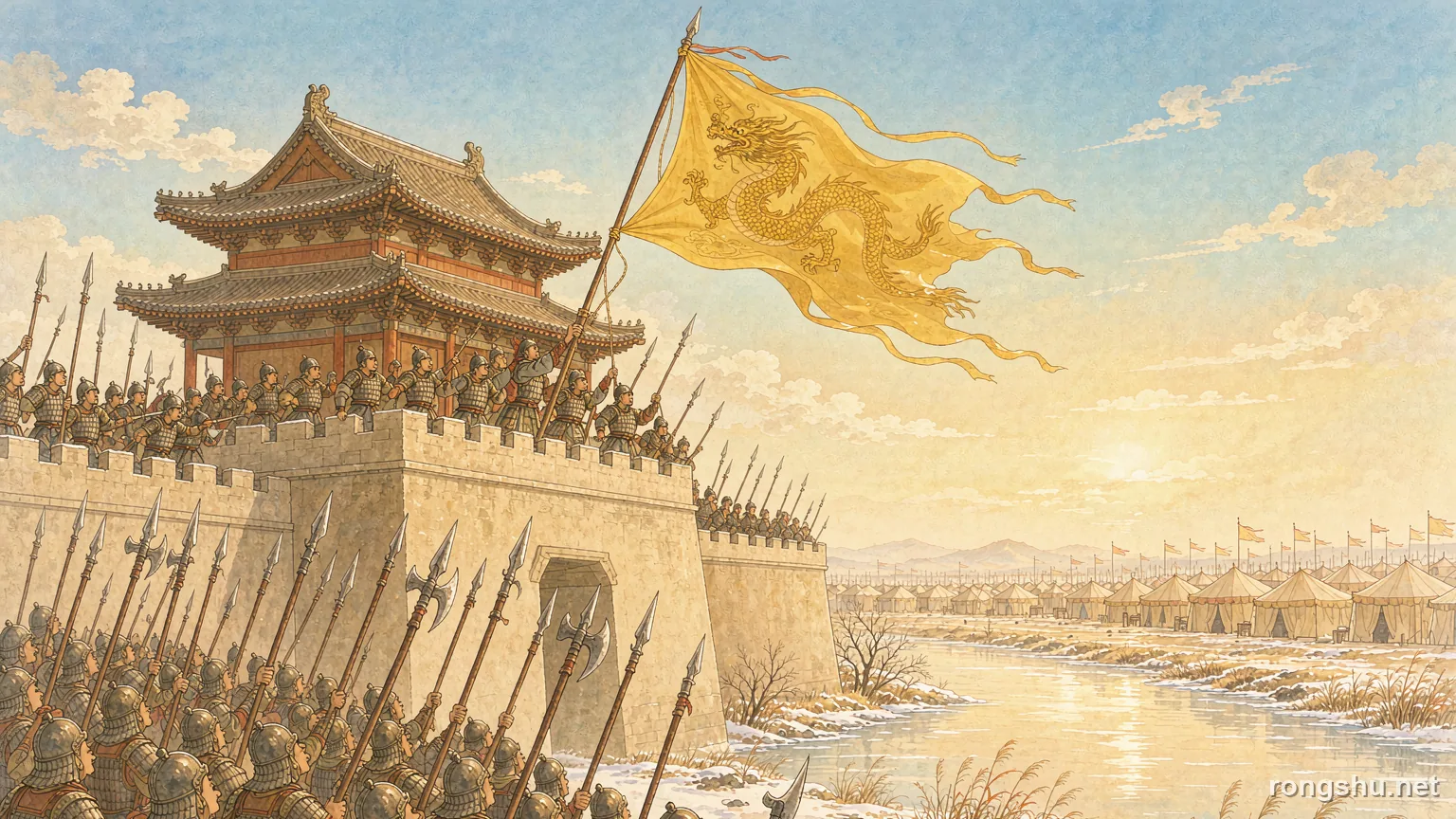
Chanzhou was split in two by the river, each half with its own walls and a pontoon bridge between them. The north half stood directly under the enemy camp.
The carriage reached the south half first, where the sight of the Liao tents lining the far bank was enough to frighten the emperor. He decided to stay where he was.
Kou Zhun would not have it. If your majesty does not cross, he said, the army will be even more unsettled and the enemy will not be overawed. This is no way to win.
The emperor did not move.
Kou Zhun caught the eye of Gao Qiong. The general understood. He put his left hand on the imperial carriage, felt for his sword with his right, and gave one order. Up.
The bearers lifted the carriage and carried it out onto the pontoon bridge.
At the bridge they stopped again. Gao Qiong tapped the bearers on the back with his baton. Go on, he said. We have come this far. What is there to hesitate about?
The carriage went across, up into the north town, and climbed to the gate tower above the north gate.
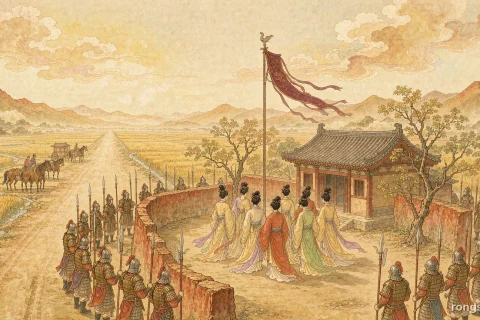
Then the yellow dragon banner went up.
The soldiers below looked up and saw the imperial canopy, and a roar went up that carried for li in every direction. Across the river the Liao army saw it too, and was taken aback.
The emperor stood on the tower, thanked the garrison officers one by one, and sent food and wine and money out to the ranks.
That was how the spirit of the army was lifted.
The Bolt from the Wall
The sources differ a little on exactly how the bolt was loosed.
By one account, the Liao army had thrown a line around three sides of Chanzhou, and the Song general Li Jilong had hidden teams of crossbowmen at the key points. The Liao field commander, Xiao Talin, trusting in his own courage, rode out with light cavalry to read the ground. A Song officer named Zhang Gui was serving one of the heavy crossbows. He saw him and loosed quietly, and the bolt struck Xiao Talin in the forehead. His men dragged him back to camp, and he died that night.
The Dowager Empress went to his wagon and wept over him, and the court stood silent for five days.
There was one more thing. That same week there was an eclipse of the sun. Under the astronomy of the day, an eclipse meant that two sides would make peace. The emperor took some comfort from it.
The death of Xiao Talin cost the Liao more than a general. Their army was already hanging in the air.
They had come south around the fortresses, which meant every walled town behind them was a nail in their back. If Chanzhou would not fall, the road home grew longer and more dangerous. The weather was turning, the river was about to freeze, and the men and horses were worn out.
And the Dowager Empress had never meant to swallow the Song empire whole. What she wanted was to use the weight she had on the battlefield to sit down and name a price.
Naming the Price
By the Song account, the first word of talks came from a man named Wang Jizhong, a Song officer taken prisoner a year before who had stayed on in Liao service. He sent a letter across the river saying the Liao side would talk. The emperor half believed it, but one thing was clear to him: what they wanted was goods, not land. So he answered.
The man chosen to go and negotiate was named Cao Liyong. It was a thankless errand.
Before he left, the emperor gave him his instructions. So long as the talk is not about land, he said, then silver and silk, up to a million a year, may be granted.
Kou Zhun heard this, had Cao Liyong brought to his tent, and told him something much harder. The emperor may have said a million, he said. You will not offer more than three hundred thousand. Offer more, and do not come back to see me. I will have your head.
Cao Liyong rode into the Liao camp.
The Liao opened high. The Dowager Empress said that the territory south of the pass had belonged to them since the Later Jin, that the Later Zhou had taken it by force, and that it should now be returned. That territory was the country around Yingzhou and Mozhou, today in Hebei, close to the border and worth having.
Cao Liyong did not touch it. The Later Jin may have given you land, he said, and the Later Zhou may have taken it back, but our dynasty knows nothing about any of that. A yearly gift of silver and silk, to help with the cost of your army, might be something our emperor would consider. As for handing over land, I would not dare carry such a request to him.
An official of the Liao court could not sit still. We brought an army here, he said, to recover our old territory. If we go home with a little money, how do we face our own people?
Cao Liyong gave him an answer of his own. You would do better, he said, to think of your own country’s interests. Do it your way, and the fighting goes on and on.
What they finally settled on was this. Each year the Song would send two hundred thousand bolts of silk and a hundred thousand ounces of silver.
Three hundred thousand in all, exactly on the line Kou Zhun had drawn.
Cao Liyong went back to Chanzhou to report. The emperor was at his meal and sent an attendant out to ask the figure. Cao Liyong would not say; it was a state secret, he would report it in person. The attendant came out a second time: still nothing. He laid three fingers against his cheek.
The attendant went back and offered a guess. Three fingers against the cheek, he said. Does that mean three million?
The emperor was startled. Too much, he said.
A little later Cao Liyong came in and gave the figure: three hundred thousand. The emperor was delighted, and rewarded him richly.
After the Oath
In the twelfth month, at Chanzhou, the Song and the Liao swore a treaty.
Each side would keep to its own borders, and neither side’s people were to cross them. Neither would shelter the other’s fugitives. Neither would build new walls or ditches or forts along the frontier. The two states became brother nations: the Song emperor the elder, the Liao emperor the younger, and the Song emperor addressed the Dowager Empress as his aunt. Each year the Song would send two hundred thousand bolts of silk and a hundred thousand ounces of silver, handed over at the border town of Xiongzhou.
One detail is usually missed. This money was not called tribute. It was not carried to the other court by an envoy who knelt. It was handed over at the frontier, face to face between officials, and the term used for it was a contribution to the cost of an army. In the text of the oath the two states called each other Great Song and Great Khitan, each addressed the other’s ruler as emperor, and the Song referred to the Liao as the Northern Court. No Chinese dynasty since the Han had offered a neighbour that kind of language.
This was not a document between a master and a servant. It was a treaty between two states that were, on paper, equals.
For an English reader there is a rough comparison. The English paid the Danegeld for years, buying off Viking raiders who came back for more. The Chinese paid as well, but the raids stopped, and the two courts went on exchanging birthday greetings and New Year letters for more than a century.
Chinese writers have argued about the treaty ever since. Some have called it weakness with a seal on it. Others point out that the yearly payment cost less than a single middling campaign. Wang Dan, a chief councillor of the day, said it came to less than one per cent of what the fighting had cost.
One thing is beyond argument. From that year to the day the two states finally fell out, more than a hundred and twenty years passed.
In those years the envoys went back and forth, and markets opened along the border: tea and silk and porcelain going north, horses and sheep and hides coming south. The old frontier place names, coined as insults in the days of war, were quietly changed. Fortress of the Cowed Barbarians became Broad Trust. Barbarian Breaker became Secure Peace.
At Chanzhou, Kou Zhun drank late every night, singing and joking until dawn. Word of it came back to the emperor, who said: if Kou Zhun can carry on like that, what have I to worry about?
That credit, in the end, became Kou Zhun’s trouble.
Back at court, the other chief councillor, Wang Qinruo, raised the matter of Chanzhou with the emperor. He called the treaty a bargain struck under the wall, and called it a deep disgrace. Then he added the sentence that did the damage. Your majesty has heard of gambling, he said. When a gambler stakes everything he owns on a single throw, they call it one stake, one throw. At Chanzhou, your majesty was Kou Zhun’s one throw.
The emperor went cold.
Two years later Kou Zhun was dismissed. In time he was exiled to the far south, to Leizhou, and died there.
The man who had won the war did not last in the court. The treaty he had negotiated outlasted him, and was kept to the letter until both dynasties had ended.
Nobody on that wall knew what the bolt would change.
A soldier was serving a crossbow. He saw a man who looked important. He tripped the release.
A hundred and twenty years later the Jurchen cavalry came down from the north, and the Song discovered that the neighbour who had collected three hundred thousand a year could no longer keep out a new enemy.
The walls of Chanzhou are gone. The river has moved.
Today the place is a stretch of flat wheat fields in Henan, and under the wheat there is nothing left at all.