The afternoon was hot, and the plain north of the city was white with dust. Two armies stood facing each other, and neither moved first.
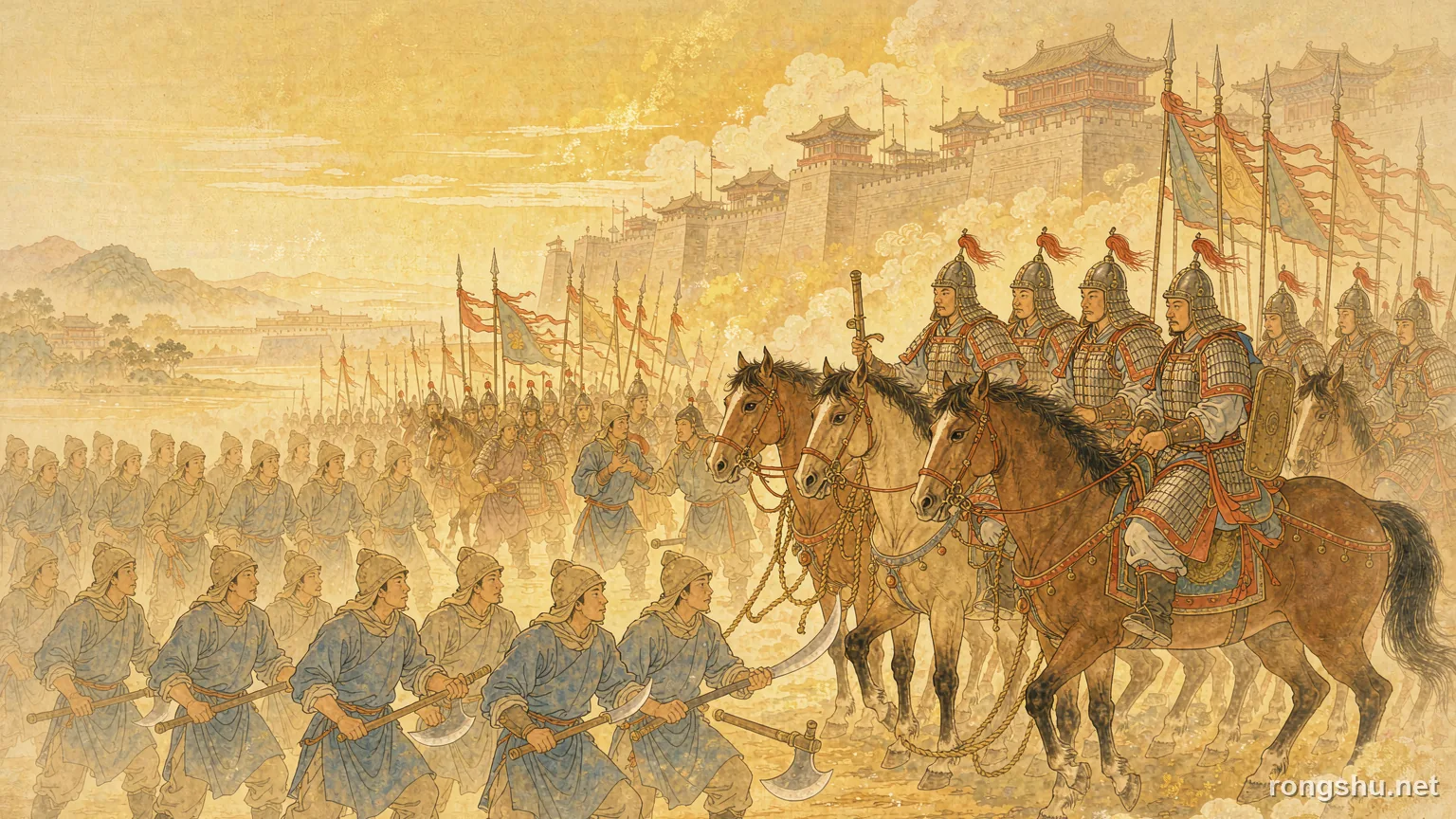
On one side were the horsemen of the Jin. Men and horses alike were wrapped in iron. Three horses were tied side by side with leather ropes, so that they advanced like a wall of iron that walked. The Jin called them iron pagodas, after the towers of a temple. Along the flanks rode lighter cavalry, waiting for the worst of the fighting before they came slanting in from the side.
On the other side stood the men of the Song.
Few of them had horses. Not one man in ten was mounted. The rest were infantry, on their own two legs.
When the wall of iron came on, Yue Fei did not pull his infantry back. He told them to wait, and to move only when the hooves were close. They carried no long spears. They carried broad blades and heavy axes, and they did not aim at the riders. They aimed at the legs of the horses. With three horses tied together, one cut leg brought all three down. So the iron wall fell in one stretch, and then in another.
The fighting went on from early afternoon until dark. Then the Jin pulled back.
Their commander was Wanyan Zongbi, a Jurchen, known in Chinese writing as Wuzhu and remembered by later generations as Jin Wuzhu.
He had not expected that the two things his army trusted most would be broken on the same day by men on foot.
Iron Towers and Axes
First, where this army came from.
Yue Fei was born to a farming family in Tangyin, in the north of China. He grew up at the end of the Northern Song. In 1127 the Jin took the capital, Kaifeng, and carried off two emperors, the imperial clan, and some three thousand craftsmen to the north. History remembers it as the Jingkang disaster. The court set up afterward in the south belonged to Zhao Gou, the ninth son of one of those captured emperors. It is called the Southern Song.
Yue Fei began as an ordinary soldier.
He served under several commanders. One was Zong Ze, a veteran close to seventy, who once handed him a diagram of battle formations. Yue Fei answered that drawing up a formation before a fight was ordinary practice, and that the real skill lay elsewhere, in the mind, where it could not be seen. Zong Ze agreed. In his last year, already ill in bed, Zong Ze kept calling out three words: cross the river, cross the river, cross the river.
The name Yue family army was given by other people.
The troops had one rule, later summed up in a line that is still quoted today. Freeze to death rather than pull down a house. Starve rather than plunder. A soldier who took a single strand of hemp from a villager to tie up fodder was to be executed under military law. On night marches, when villagers opened their doors and offered shelter, no one dared to go in. Even the Jin left a line about them that people still repeat. It is easier to shake a mountain than to shake the Yue family army.
Yue Fei did not keep money for himself. The emperor once offered to build him a mansion, and he declined, saying the enemy was not yet destroyed and there was no point in talking of a home. Asked when the world would be at peace, he said it would be when civil officials did not love money and military men did not fear death.
There were four characters cut into his back.
According to the History of Song, they read loyal and devoted to the country, and by tradition his mother cut them there with her own hand. A different version, better known today, was changed by storytellers and stage plays.
The army had a human side too. When a soldier fell ill, Yue Fei prepared his medicine himself, and every reward from the court he divided evenly among his troops, keeping nothing for himself.
His own son, Yue Yun, went to war at twelve. Once in training the boy rode downhill, his horse stumbled, and threw him. Yue Fei had him punished under military law. Before the battle at Yancheng he put the boy in the front rank and said that he could come back only if he won, and that if he lost, his own father would have him killed first.
Twelve Tablets of Gold
Back to the campaign of 1140.
In May of that year the Jin tore up a treaty that had lasted barely a year, and sent their armies south. Only then did the Song court order its commanders to fight. Yue Fei marched north from Ezhou, on the middle Yangtze, and took back one town after another. By July his army had beaten the Jin main force at Yancheng and again at Yingchang. Not long after, a line came out of the Jin camp: it is easier to shake a mountain than to shake the Yue family army.
At Yingchang, Yue Yun took more than a hundred wounds, and the cloth under his armor was soaked through with blood.
One of the officers, Yang Zaixing, ran into a Jin force at a small river north of Yancheng. He rode alone into the enemy ranks and cut his way through, until his horse sank in the mud and he was shot down by a volley of arrows. Of the three hundred men he led out, not one came back.
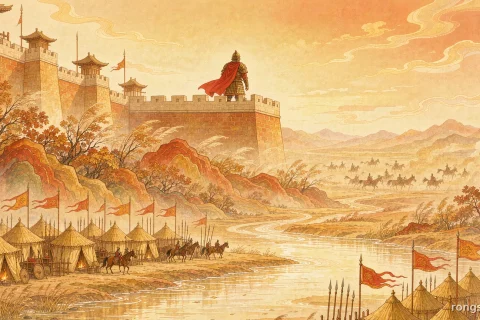
The Jin commander Wuzhu began to pack up, ready to give up Kaifeng and withdraw north. The front of the Yue family army had already reached a town called Zhuxian, only fifteen miles from the city wall.
That was when the order arrived from Linan.
The emperor wanted Yue Fei to pull back.
One tablet came the first day. Another came the second. In the end no one counted how many. For the most urgent orders the Song used a long wooden tablet painted red, with characters in gold, carried by riders from the palace. People later told the story as twelve tablets of gold in a single day, and told it with every detail in place.
How many tablets there really were, and how large the fight near Kaifeng really was, is still argued. Yue Fei’s grandson later wrote a biography of him, full of stirring scenes. The modern historian Deng Guangming held that the tale of five hundred horsemen beating a hundred thousand, and the tale of twelve tablets in one day, were most likely added later, by the grandson and the storytellers after him. What can be trusted is that the court did send a run of orders that July, and did call Yue Fei back.
As he turned around, Yue Fei said one thing. He said that the work of ten years had been thrown away in a single morning.
To a reader in the West, it may seem impossible that an army winning its war would be halted by its own court. Yet this is not only a Chinese story. Belisarius won back Italy for the emperor Justinian, and then spent his last years watched and set aside by the very emperor he had served. A general who wins can become a problem to the man above him.
Promoted and Set Aside
In 1141, the year after, events moved on.
In April the court called three commanders to Linan: Han Shizhong, Zhang Jun, and Yue Fei. On paper it was all promotion. Han Shizhong and Zhang Jun were made ministers of the Bureau of Military Affairs, and Yue Fei a vice minister of the same bureau, the highest office for military matters in the state. Everyone could see what it meant. From that day, none of the three could lead his own troops directly again.
Of the three, Zhang Jun changed sides.
He had once been a famous commander against the Jin, counted with Yue Fei and Han Shizhong among the four generals of the revival. This time he stood with those who wanted peace, and later helped build the case against Yue Fei.
In August a censor named Moqi Xie filed a charge, saying Yue Fei boasted of his own merits and neglected his duties. Yue Fei was stripped of his posts and went home to Jiangzhou, on the Yangtze. A number of officials who had served under him fell with him. Some were demoted. Some were sent into exile.
After that came the investigation.
First a man named Wang Jun, one of Yue Fei’s own soldiers, came forward with a report. He said that Yue Yun, the general’s son, had written to an officer named Zhang Xian, and that the two were plotting. Then Zhang Jun had Zhang Xian arrested. On the thirteenth day of the tenth month, Yue Fei and his son were taken to the prison of the supreme court in Linan.
The first man to question them was the censor He Zhu.
As the questioning went on, Yue Fei took off his upper garment and turned his back. There were the four characters, loyal and devoted to the country, cut deep, down to the flesh. He Zhu looked and was silent for a long while. Later he reported to Qin Hui, the chancellor, that he could find nothing in the case.
So the man in charge was changed. He was replaced by Moqi Xie.
The Three Words
Three words from this case weigh more than anything else in it.
Han Shizhong would not let it rest. He went to Qin Hui and asked what crime Yue Fei had actually committed. Qin Hui gave him an answer. In the speech of the time, it came to this: the letter from Yue Yun to Zhang Xian may not be clear, but such a thing perhaps existed.
The phrase he used was a piece of everyday talk, close in meaning to maybe there was, or there may well have been.
Han Shizhong heard him out. Then he answered. With these three words, how would anyone ever convince the world?
To tell this as a simple tale of a wicked minister destroying a loyal one is the easy way. Look a layer deeper, and several forces are twisted together.
The first was a fear in the emperor’s mind. Zhao Gou had come to the throne only after his father and his elder brother were carried off. If Yue Fei won back the north and brought the captured emperor home, what would become of the man now on the throne? The histories do not say this plainly. Later readers have seen it clearly enough.
The second was a road that avoided war. In its early years the Southern Song fought every year, and the money and grain were a pit that could never be filled. Qin Hui argued for peace with the Jin, judging that a long war could not be sustained. In November 1141 the two sides agreed on terms. The Song would be a subject state to the Jin. The border would run along the Huai River in the east and the Dasan Pass in the west. Every year the Song would send two hundred and fifty thousand taels of silver and the same number of bolts of silk.
The third force came from the other side. Among the terms the Jin set down, the History of Song records one. Yue Fei must be killed before there could be peace. Without his death, there would be no agreement.
Twist the three together, and the end of Yue Fei was settled on the day he was called back to Linan.
He probably knew it himself.
He had spent more than ten years in the army and fought more battles than he could count, and he had never lost. In the end he was beaten by something other than an enemy army.
The Night Before New Year
The twenty ninth day of the twelfth month of 1141 was the last day of that year, the eve of the new year. On the Western calendar it falls in late January 1142.
In the prison at Linan, a guard brought Yue Fei a cup of wine. According to the record, he wrote eight characters on his confession. Heaven and sun are bright, heaven and sun are bright. Then he drank, and died. He was thirty nine years old.
The same day, his son Yue Yun and the officer Zhang Xian were taken to the market and executed.
In later years people gave the place of his death a name of its own, a pavilion in the wind and the waves. The official history keeps only a plainer line, that he died in the prison. Whether that pavilion was a real structure inside the walls, or a name later generations gave to the whole affair, no one can now say. Either way the name survived, and it has become the deepest mark of the story in people’s minds.
After he died, it is said that a low ranking guard carried his body out of the city in secret and buried it in the waste ground outside the wall, marking the spot. Twenty years later, when the court cleared his name, the reburial found the place by that mark.
The guard was called Wei Shun.
This episode comes down to us in later notebooks, not in the official histories.
Yue Fei was cleared only after the throne changed hands.
Qin Hui died of illness in 1155. In 1161 the Jin ruler tore up the peace and invaded again, and was beaten by Song forces at a river crossing. In 1162 a new emperor restored the rank of Yue Fei and ordered a proper reburial on the slopes by West Lake. In 1179 he was given the posthumous name Wumu. In 1204 he was made a prince. In time his name was changed again, to one that means loyal and martial.
Today the tomb and the temple of Yue Fei still stand by West Lake in Hangzhou. In front of the tomb kneel four figures cast in iron, two of them Qin Hui and his wife. Beside the grave hangs a couplet. The green hills are lucky, it says, to hold these loyal bones, while the innocent white iron has been cast into the shape of traitors.
Twenty years passed between the day he was put to death and the day the court cleared his name. In those twenty years, no one in the Southern Song ever again reached the walls of Kaifeng. The line drawn between the Huai River and the Dasan Pass in 1141 held, in its broad shape, for more than a century.